World Heritage Identification Number: 724
World Heritage since: 2004
Category: Cultural Heritage
WHE Type: Buildings & Architectural Ensembles
Transboundary Heritage: No
Endangered Heritage: Yes
Country: 🇷🇸 Serbia
Continent: Europe
UNESCO World Region: Europe and North America
Map
Medieval Monuments in Kosovo: A Fusion of Byzantine and Romanesque Architecture
The Medieval Monuments in Kosovo, inscribed as a UNESCO World Heritage Site in 2004, stand as a testament to the rich cultural history of the region. These four edifices, each with its unique charm and historical significance, reflect the high points of the Byzantine-Romanesque ecclesiastical culture that developed in the Balkans between the 13th and 17th centuries.
More to come…UNESCO Description of the World Heritage Site
The four edifices of the site reflect the high points of the Byzantine-Romanesque ecclesiastical culture, with its distinct style of wall painting, which developed in the Balkans between the 13th and 17th centuries. The Dečani Monastery was built in the mid-14th century for the Serbian king Stefan Dečanski and is also his mausoleum. The Patriarchate of Peć Monastery is a group of four domed churches featuring series of wall paintings. The 13th-century frescoes of the Church of Holy Apostles are painted in a unique, monumental style. Early 14th-century frescoes in the church of the Holy Virgin of Ljevisa represent the appearance of the new so-called Palaiologian Renaissance style, combining the influences of the eastern Orthodox Byzantine and the Western Romanesque traditions. The style played a decisive role in subsequent Balkan art.
Encyclopedia Record: Medieval Monuments in Kosovo
The Medieval Monuments in Kosovo are a World Heritage Site consisting of four Serbian Orthodox Christian churches and monasteries which represent the fusion of the eastern Orthodox Byzantine and the western Romanesque ecclesiastical architecture to form the Palaiologian Renaissance style. The construction was founded by members of Nemanjić dynasty, the most important dynasty of Serbia in the Middle Ages. The sites are located in Kosovo.Additional Site Details
Area: 2.8802 hectares
Number of Components: 4
(iii) — Unique or exceptional testimony to a cultural tradition
(iv) — Outstanding example of a type of building or landscape
Coordinates: 42.6611111111 , 20.2655555555
Image
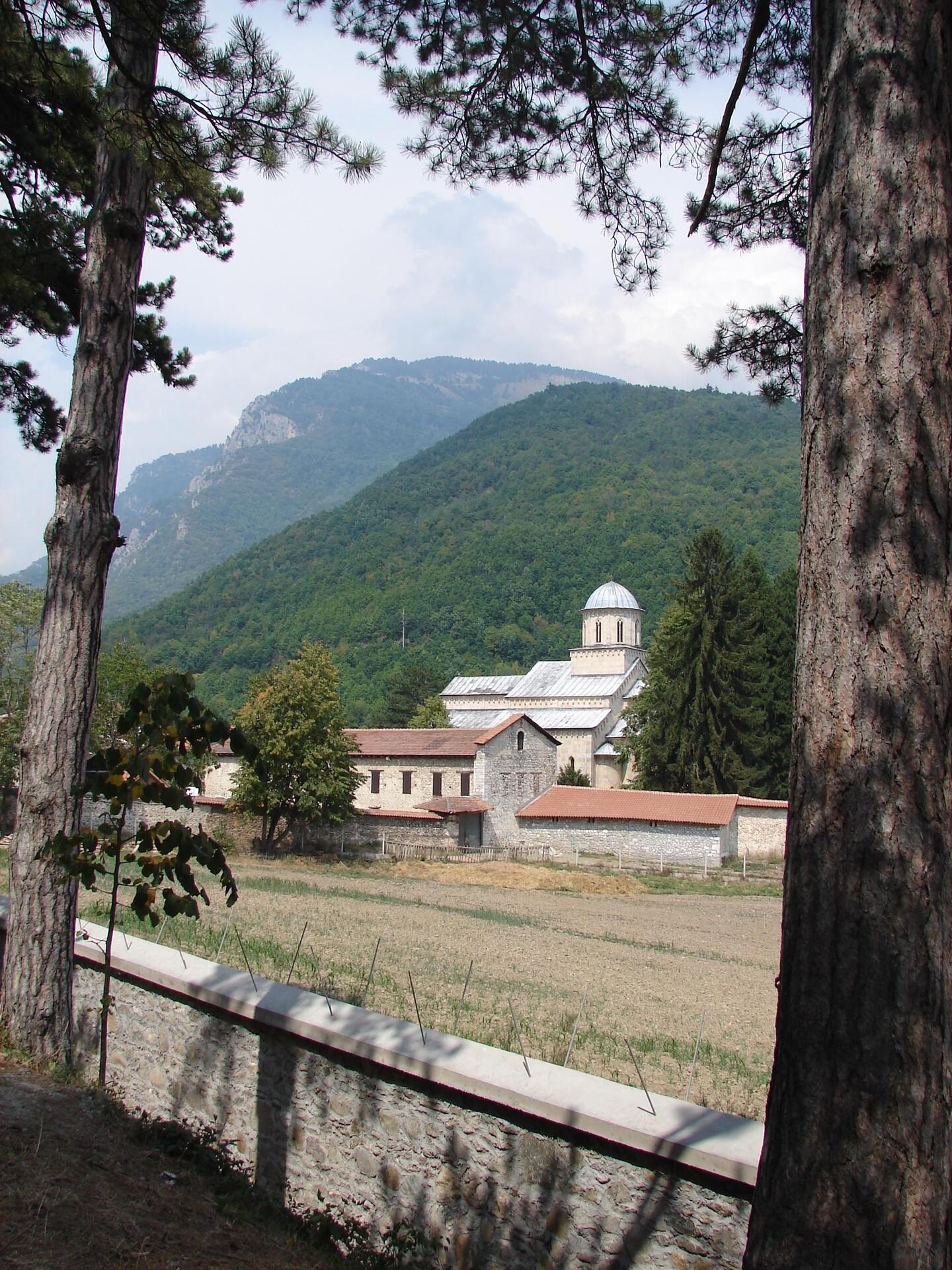
© a.dombrowski, CC BY-SA 2.0 Resized from original. (This derivative is under the same CC BY-SA license.)
World Heritage Research
Discover scientific research and academic studies that deepen our understanding of Medieval Monuments in Kosovo from its history and significance to its conservation, management, and contemporary challenges.
-
A contribution to the study of the history of the church of St. George in Rečani
The Church of St. George in Rečani, Kosovo, was definitively established as a 14th-century Serbian cultural monument through the discovery of a tombstone inscription dating to December 23, 1370, suggesting its founder (ktitor) may have been a duke buried there. While earlier mentions in Dušan’s charter around 1348 remain uncertain, this inscription provides the earliest reliable evidence of the church's existence. The study also documents the church's decline from the 19th century onward, marked by neglect, vandalism, and a suspected fire, followed by partial restorations in the mid-20th century. Tragically, it was destroyed in 1999 despite international protection, raising concerns about historical erasure in Kosovo. The research combines epigraphic analysis with historical documentation to reconstruct the church's fate.
Stevanović, B. (2026). A contribution to the study of the history of the church of St. George in Rečani. Zbornik Radova Filozofskog Fakulteta U Pristini, 56(1), 199–215. https://doi.org/10.5937/zrffp56-63041
View Publication Record | Read Publication -
Visitors’ Book of the Vysoki Dečani Monastery: Russian Names
A unique insight into Russian-Serbian ecclesiastical and cultural ties emerges from the analysis of the Visitors' Book of the Vysoki Dečani Monastery, revealing a rich tapestry of names, signatures, entries, and commemorative notes left by Russian visitors. This study highlights the significance of this lesser-studied historical document in understanding pilgrimage history and Russian emigration patterns in the Balkans. The research employs a meticulous examination of the Visitors' Book, contributing valuable data to the broader discourse on transnational religious and cultural connections during the medieval period.
Antanasevich, I. (2025). Visitors’ Book of the Vysoki Dečani Monastery: Russian Names. Issues of Migration, 1(2), 20. https://doi.org/10.65324/im008
View Publication Record | Read Publication -
The Challenge of Kosovo
Medieval Monuments in Kosovo face persistent armed protection due to ongoing conflicts, yet this phenomenon receives little attention despite its significance. The study highlights the complex fate of Serbian royal foundations in the region, revealing that their historical narratives are often polarized along sectarian lines, which poses challenges for traditional art history methodologies. Notably, some of these sites, nominally Christian, were historically venerated by Muslims, a practice largely overlooked in academic discourse. This essay argues that integrating such diverse religious experiences into the study of these monuments is crucial, as it not only enriches our understanding but also reflects on the limitations and scope of art history's analytical tools.
Maniura, R. (2024). The Challenge of Kosovo. Art History, 47(3), 462–491. https://doi.org/10.1093/arthis/ulae031
View Publication Record | Read Publication -
World Cultural Heritage in Times of Crisis and Conflict: Close-up View
World Cultural Heritage sites, including Medieval Monuments in Kosovo, face significant threats during crises and conflicts, such as violent repurposing, deconstruction of meaning, and negation of historical significance. The study highlights the vulnerability of these sites despite international legal protections under the 1972 Convention on the Protection of World Cultural and Natural Heritage. It examines contemporary examples—such as the destruction of monuments in Afghanistan and Syria, and the reinterpretation of Hagia Sophia—in demonstrating how social factors exacerbate risks to heritage integrity. The research underscores the need for stronger maturity and enforcement of protection services to safeguard sites critical to global cultural identity.
Pavličić Šarić, J. Z. (2023). World Cultural Heritage in Times of Crisis and Conflict: Close-up View. Thematic Proceedings of the International Scientific Conference Educational Programs — the Future of World Cultural and Natural Heritage, 340–361. https://doi.org/10.18485/arh_whc50.2023.ch17
View Publication Record | Read Publication -
Mitrovica İlçesindeki Dini Anıtların Lehinde ve Tahrifatında Kültürel Miras ve Siyasi Etkiler
The Sokolica Monastery, historically tied to the Boletini family's mine accountants and later repurposed as an Orthodox church, lacks documented medieval origins (XIII-XIV centuries) and was never associated with a local population or monastic properties. Instead, its land was seized by the Serbian regime during Kosovo's occupation, with post-war Kosovo institutions further enabling this dispossession for political gain. This study reveals how Sokolica Monastery's cultural heritage has been manipulated through political narratives, contrasting its actual historical context with claims of medieval significance.
HAJZERİ, P. (2022). Mitrovica İlçesindeki Dini Anıtların Lehinde ve Tahrifatında Kültürel Miras ve Siyasi Etkiler. Journal of History and Future, 8(2), 490–498. https://doi.org/10.21551/jhf.1115199
View Publication Record | Read Publication -
Destruction of Serbian churches and monasteries in Kosovo and Metohija from 1999 to 2022: Cultural-geographical determinants
From 1999 to 2022, Serbian churches and monasteries in Kosovo and Metohija faced systematic destruction, primarily at the hands of Albanian extremists. This study documents and analyzes these incidents using cultural-geographic research methods, revealing a pattern of devastation that traces back centuries but intensified during NATO intervention and subsequent decades. The research confirms 130 cases of destruction, highlighting the ongoing persecution of Serbian heritage in the region. Kosovo and Metohija's historical significance as a medieval Serbian state further underscores the cultural and spiritual impact of these losses.
Medojević, J., & Milosavljević, S. (2022). Destruction of Serbian churches and monasteries in Kosovo and Metohija from 1999 to 2022: Cultural-geographical determinants. Zbornik Radova Filozofskog Fakulteta U Pristini, 52(4), 237–256. https://doi.org/10.5937/zrffp52-40045
View Publication Record | Read Publication -
The cycle of St. Demetrius in the Patriarchate of Peć - III
The cycle of St. Demetrius in the Patriarchate of Peć, Kosovo, presents a unique and partially preserved hagiographic fresco cycle from the 14th century. The study reveals that the cycle includes scenes inspired by the Passion of Saint Demetrius and miracles, with two key surviving compositions: 'The Dormition of Saint Demetrius' and 'Saint Demetrius Saves Thessaloniki from the Enemy.' These scenes, though partially damaged due to 17th-century restorations, offer insights into medieval iconography and cult practices. The research explores the source and meaning of these scenes, particularly the Dormition, which was previously misunderstood but linked to liturgical ceremonies over Saint Demetrius' relics. The study also examines the cycle's context within broader Byzantine, Serbian, and Bulgarian art traditions, highlighting its uniqueness and contributions to understanding medieval religious art.
Pajić, S. (2022). The cycle of St. Demetrius in the Patriarchate of Peć - III. Zbornik Radova Filozofskog Fakulteta U Pristini, 52(4), 305–327. https://doi.org/10.5937/zrffp52-40564
View Publication Record | Read Publication