World Heritage Identification Number: 493
World Heritage since: 1988
Category: Cultural Heritage
WHE Type: Historic Cities & Urban Areas
Transboundary Heritage: No
Endangered Heritage: No
Country: 🇬🇷 Greece
Continent: Europe
UNESCO World Region: Europe and North America
Map
The Medieval City of Rhodes: A Gothic Masterpiece in the Heart of the Eastern Mediterranean
The Medieval City of Rhodes, located on the island of Rhodes in Greece, stands as a testament to the rich history and architectural prowess of the Middle Ages. This fortified city, built between 1309 and 1523, is a remarkable blend of Gothic, Byzantine, and Islamic architectural styles, reflecting its diverse cultural heritage. The city's inclusion on the UNESCO World Heritage List in 1988 recognizes its exceptional historical and architectural significance.
The heart of the Medieval City of Rhodes lies in the Upper Town, where the Order of St. John of Jerusalem established their headquarters after taking control of the island. The Order, also known as the Knights Hospitaller, transformed the city into a formidable stronghold, complete with defensive walls, towers, and moats. The Palace of the Grand Masters, the highest-ranking official of the Order, serves as a prime example of Gothic architecture within the city. Its intricate stone carvings, vaulted ceilings, and grand courtyard offer a glimpse into the opulence and power of the Order during this period.
Another significant structure in the Upper Town is the Great Hospital, which served as both a hospital and a guest house for pilgrims and travelers. The hospital complex included a church, a pharmacy, a kitchen, and living quarters for the knights and patients. Today, the Great Hospital remains a well-preserved landmark, housing the Archaeological Museum of Rhodes, and stands as a reminder of the Order's commitment to caring for the sick and injured.
The Street of the Knights, running through the Upper Town, is lined with inns known as "Langues," each representing one of the seven linguistic nations within the Order. These inns housed the knights who hailed from these nations, fostering a sense of camaraderie and unity among them.
In contrast to the Upper Town, the Lower Town presents a more eclectic mix of architectural styles. Here, Gothic structures such as the Church of Our Lady of the Castle coexist with mosques, public baths, and other buildings dating from the Ottoman period. The Mosque of Suleiman the Magnificent, built in the 16th century, is particularly noteworthy for its elegant Ottoman design, featuring a large dome, minaret, and intricate calligrapy.
The Medieval City of Rhodes offers visitors a unique opportunity to explore the rich tapestry of history that has shaped the Eastern Mediterranean. From the imposing fortifications of the Upper Town to the vibrant multiculturalism of the Lower Town, every corner of this ancient city tells a story of conquest, trade, and religious diversity. As a UNESCO World Heritage Site, the Medieval City of Rhodes stands as a symbol of human creativity, resilience, and the enduring power of culture to unite us across time and space.
UNESCO Description of the World Heritage Site
The Order of St John of Jerusalem occupied Rhodes from 1309 to 1523 and set about transforming the city into a stronghold. It subsequently came under Turkish and Italian rule. With the Palace of the Grand Masters, the Great Hospital and the Street of the Knights, the Upper Town is one of the most beautiful urban ensembles of the Gothic period. In the Lower Town, Gothic architecture coexists with mosques, public baths and other buildings dating from the Ottoman period.
UNESCO Justification of the World Heritage Site
Criterion (ii): The fortifications of Rhodes, a “Frankish” town long considered to be impregnable, exerted an influence throughout the eastern Mediterranean basin at the end of the Middle Ages.
Criterion (iv): This cultural property is an outstanding example of an architectural ensemble which illustrates the significant period of history in which a military/hospital order founded during the Crusades survived in the eastern Mediterranean area in a context characterised by an obsessive fear of siege. Rhodes is one of the most beautiful urban ensembles of the Gothic period. The fact that this medieval city is located on an island in the Aegean Sea, that it was on the site of an ancient Greek city, and that it commands a port formerly embellished by the Colossus erected by Chares of Lindos, one of the Seven Wonders of the ancient world, only adds to its interest. Finally, it must be noted that the chain of history was not broken in 1523 but rather continued up to 1912 with the additions of valuable Islamic monuments, such as mosques, baths and houses.
Criterion (v): With its Frankish and Ottoman buildings the old town of Rhodes is an important ensemble of traditional human settlement, characterized by successive and complex phenomena of acculturation. Contact with the traditions of the Dodecanese changed the forms of Gothic architecture and building after 1523 combined vernacular forms resulting from the meeting of two worlds with decorative elements of Ottoman origin. All the built-up elements dating before 1912 have become vulnerable because of the evolution in living conditions and they must be protected as much as the great religious, civil and military monuments, the churches, monasteries, mosques, baths, palaces, forts, gates and ramparts.
Encyclopedia Record: Medieval City of Rhodes
The Medieval City of Rhodes was constructed around 1309 to 1523 and is part of the modern capital city of Rhodes on the Island of Rhodes in Greece. The site was added to the UNESCO World Heritage list in 1988.Additional Site Details
Area: 65.85 hectares
Number of Components: 1
(iv) — Outstanding example of a type of building or landscape
(v) — Outstanding example of traditional human settlement
Coordinates: 36.44722 , 28.22778
Image
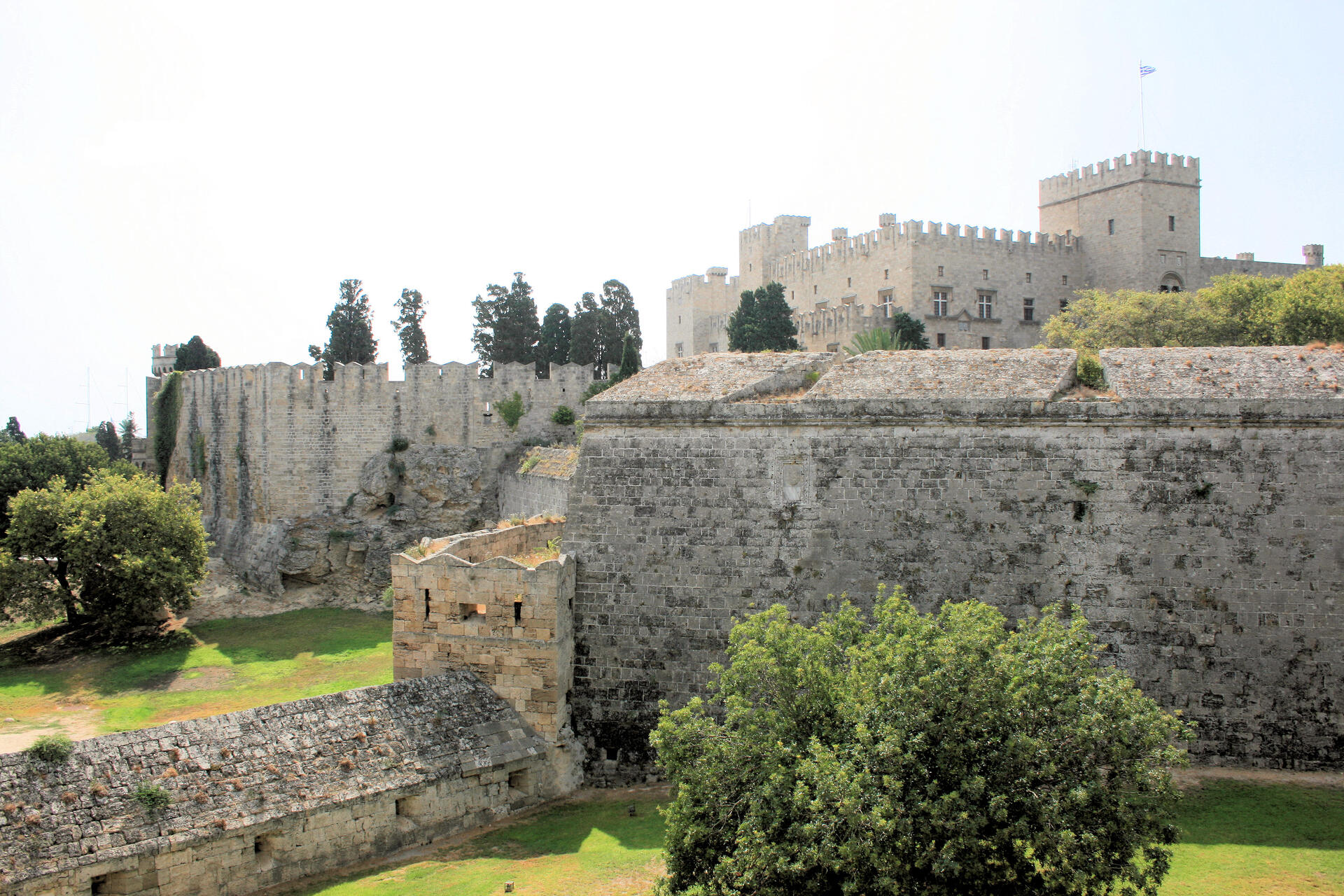
© Olbertz 23:14, 21. Dez. 2010 (CET), CC BY-SA 3.0 Resized from original. (This derivative is under the same CC BY-SA license.)
World Heritage Research
Discover scientific research and academic studies that deepen our understanding of Medieval City of Rhodes from its history and significance to its conservation, management, and contemporary challenges.
-
The Marquis of Tarifa’s Journey to the Holy Land (1518–1520): Mediterranean Impressions and Sevillian Reflections
A detailed analysis of the pilgrimage diary of Fadrique Enriquez de Ribera, Marquis of Tarifa, reveals his unique aesthetic preferences and political interests during his journey to Jerusalem between 1518 and 1520. The study highlights that despite being a man of the Renaissance, Don Fadrique's aesthetic tastes remained rooted in medieval values, with minimal reference to classical antiquities or Renaissance innovations. His focus on city fortifications, hospitals, and political structures in urban republics, such as those observed during his travels through Italy and the Eastern Mediterranean, underscores his aristocratic background and knightly status. The diary also sheds light on his interactions with significant religious orders like the Hospitallers of Rhodes and Carthusian monasteries. Post-journey, his reconstruction of the Casa de Pilatos in Seville and the creation of a funerary chapel for his ancestors demonstrate a clear influence of northern Italian Renaissance architecture, marking these as the first such structures in Seville and playing a pivotal role in the development of Spanish Renaissance architecture.
Vedyushkin, V. A. (2026). The Marquis of Tarifa’s Journey to the Holy Land (1518–1520): Mediterranean Impressions and Sevillian Reflections. Cuadernos Iberoamericanos, 14(2), 62–89. https://doi.org/10.46272/2409-3416-2026-14-2-62-89
View Publication Record | Read Publication -
Operational Modal Analysis and Finite Element Model Updating of the Naillac Tower in Rhodes, Greece
A study on the Naillac Tower, part of Rhodes' medieval cityrevealed significant discrepancies between assumed and actual material properties of its stone masonry. By combining 3D documentation (using digital cameras, laser scanners, drones, and total stations) with operational modal analysis (OMA), researchers developed a calibrated finite element model that accurately reflects the tower's dynamic behavior. This approach, which integrates ambient vibration testing data, underscores the necessity of OMA-based calibration for vulnerability assessments in historical structures, offering insights critical for sustainable restoration practices.
Shabani, A., & Karimi, A. H. (2025). Operational Modal Analysis and Finite Element Model Updating of the Naillac Tower in Rhodes, Greece. The 1st International Conference on Net-Zero Built Environment, 1335–1345. https://doi.org/10.1007/978-3-031-69626-8_112
View Publication Record | Read Publication -
Dodecanese, One Hundred Years Later: Rhodes
The book 'DODECANESE, ONE HUNDRED YEARS LATER: RHODES' reveals that the architectural and urbanistic achievements of Rhodes during Mario Lago's governorship (1923-1936) represent a significant yet overlooked chapter in Italian history. It argues that Governor Lago was the central figure behind the eclectic style, blending Deco, oriental, medieval, and rationalist motifs, which transformed Rhodes into a 'park city' with low-density green spaces. The research revisits the 1926 master plan by Florestano di Fausto, debunking claims of racial segregation and highlighting Lago's inclusive policies. It catalogues over 50 buildings and developments commissioned during his tenure, including public infrastructure, residential projects, and tourist facilities, while also documenting the stylistic purges under Governor Cesare Maria De Vecchi post-1936. The study is based on archival sources, contemporary press, and cartographic documents, offering a comprehensive analysis of this period's urban planning innovations.
Bruno, S. A. (2025). DODECANESE, ONE HUNDRED YEARS LATER: RHODES. Zenodo. https://doi.org/10.5281/ZENODO.22860015
View Publication Record | Read Publication -
Dodecanese, One Hundred Years Later: Rhodes Vol. 1 a Short Photographic Guide
Rhodes stands as a testament to the enduring impact of Governor Mario Lago's innovative urban planning during his tenure (1923-1936). This study reveals that Lago, often overlooked in colonial urban planning debates, was the driving force behind Rhodes' transformation into a 'park city,' characterized by low-density architecture interspersed with green spaces. Contrary to previous interpretations, Lago's policies promoted integration rather than segregation among the island's multi-ethnic population. The research employs archival sources and contemporary documents to catalog over 100 architectural projects, including administrative buildings, residential complexes, and tourist developments. It also highlights the subsequent stylistic shift under Governor Cesare Maria De Vecchi, which sought to replace Lago's eclectic style with an abstract crusader architecture, further illustrating Rhodes' dynamic architectural evolution.
Bruno, S. A. (2025). DODECANESE, ONE HUNDRED YEARS LATER: RHODES Vol. 1 A SHORT PHOTOGRAPHIC GUIDE. Zenodo. https://doi.org/10.5281/ZENODO.22878211
View Publication Record | Read Publication -
Evacuation modelling for rapid multi-hazard tabletop exercise deployment
A novel evacuation simulation model enhances tabletop exercises (TTXs) by providing real-time feedback on the impact of hazards, decisions, and injects during multi-hazard scenarios. This approach offers qualitative and quantitative insights into route choices, assembly performance, and incident management, surpassing traditional scripted TTXs that lack dynamic adaptability. The methodology was successfully deployed in a TTX for Rhodes' Medieval City, demonstrating its potential to improve understanding of evacuation complexities and response strategies under real-world conditions.
Filippidis, L., Lawrence, P. J., Veeraswamy, A., Blackshields, D., Cooney, D., Galea, E. R., & Argyris, I. (2024). Evacuation modelling for rapid multi-hazard tabletop exercise deployment. Safety Science, 173, 106438. https://doi.org/10.1016/j.ssci.2024.106438
View Publication Record | Read Publication -
Leveraging Digital Tools for Immersive Gamified Learning in the Old City of Rhodes
A gamified learning approach, integrating GPS, Google Maps, and geolocation, transforms outdoor education into an immersive, interactive experience. Using Rhodes' Old Town as a case study, the research demonstrates how adventure and technology can enhance multidisciplinary learning, blending history, science, technology, engineering, mathematics, language, and arts. This method creates dynamic, engaging educational environments that captivate students while fostering deep understanding through location-based gaming.
Sarlis, I., Antonopoulou, S., Antoniou, M., Kotsifakos, D., & Douligeris, C. (2024). Leveraging Digital Tools for Immersive Gamified Learning in the Old City of Rhodes. 2024 IEEE Global Engineering Education Conference (EDUCON), 1–10. https://doi.org/10.1109/educon60312.2024.10578598
View Publication Record | Read Publication -
The Location of the Colossus
The Colossus of Rhodes, long believed to straddle the harbor, was likely positioned on a hilltop near the Palace of the Grand Master of the Order of Saint John. This conclusion challenges the medieval myth and aligns with an epigram on its base, which described it as 'crowning' the city. The study evaluates all existing hypotheses, emphasizing that the Colossus's location would have been visible from the Asian mainland, reinforcing its symbolic significance. Historical evidence suggests this hill also hosted the sanctuary of Helios, further supporting its plausibility.
Badoud, N. (2024). The Location of the Colossus. The Colossus of Rhodes, 121–162. https://doi.org/10.1093/oso/9780198903734.003.0007
View Publication Record | Read Publication