World Heritage Identification Number: 595
World Heritage since: 1992
Category: Cultural Heritage
WHE Type: Archaeological Sites
Transboundary Heritage: No
Endangered Heritage: No
Country: 🇬🇷 Greece
Continent: Europe
UNESCO World Region: Europe and North America
Map
The Pythagoreion and Heraion of Samos: Ancient Testimonies to the Cultural Significance of Samos
The Pythagoreion and Heraion of Samos, located on the small Aegean island of Samos off the coast of Asia Minor, stand as significant remnants of the rich history and cultural significance that has marked this region since the third millennium B.C. Inscribed as a UNESCO World Heritage Site in 1992, these two sites offer a unique glimpse into the cultural, military, and economic importance of Samos during the Archaic and early Classical periods of Greece.
More to come…UNESCO Description of the World Heritage Site
Many civilizations have inhabited this small Aegean island, near Asia Minor, since the 3rd millennium B.C. The remains of Pythagoreion, an ancient fortified port with Greek and Roman monuments and a spectacular tunnel-aqueduct, as well as the Heraion, temple of the Samian Hera, can still be seen.
UNESCO Justification of the World Heritage Site
Criterion (ii): The temple of Hera at Samos is fundamental to an understanding of classical architecture. The stylistic and structural innovations in each of its successive phases strongly influenced the design of temples and public buildings throughout the Greek world. The technological mastery of the Eupalineio similarly served as a model for engineering and public works.
Criterion (iii): Samos was the leading maritime and mercantile power in the Greek world in the 6th century BC, and this importance is reflected in the extent and richness of the archaeological remains, which are largely untouched by subsequent development.
Encyclopedia Record: Pythagoreion
The Pythagoreion is the archaeological site of the ancient town of Samos in Samos, Greece. It is located in the area of the modern town of Pythagoreio, from which it got its modern name. The archaeological site contains ancient Greek and Roman monuments and a famous ancient tunnel, the Tunnel of Eupalinos or Eupalinian aqueduct. Along with the Heraion of Samos, the Pythagoreion was registered as a UNESCO World Heritage Site in 1992 because of its testimony to the cultural, military, and economic importance of Samos during Archaic and early Classical Greece.Additional Site Details
Area: 668.35 hectares
Number of Components: 2
(iii) — Unique or exceptional testimony to a cultural tradition
Coordinates: 37.69083 , 26.94333
Image
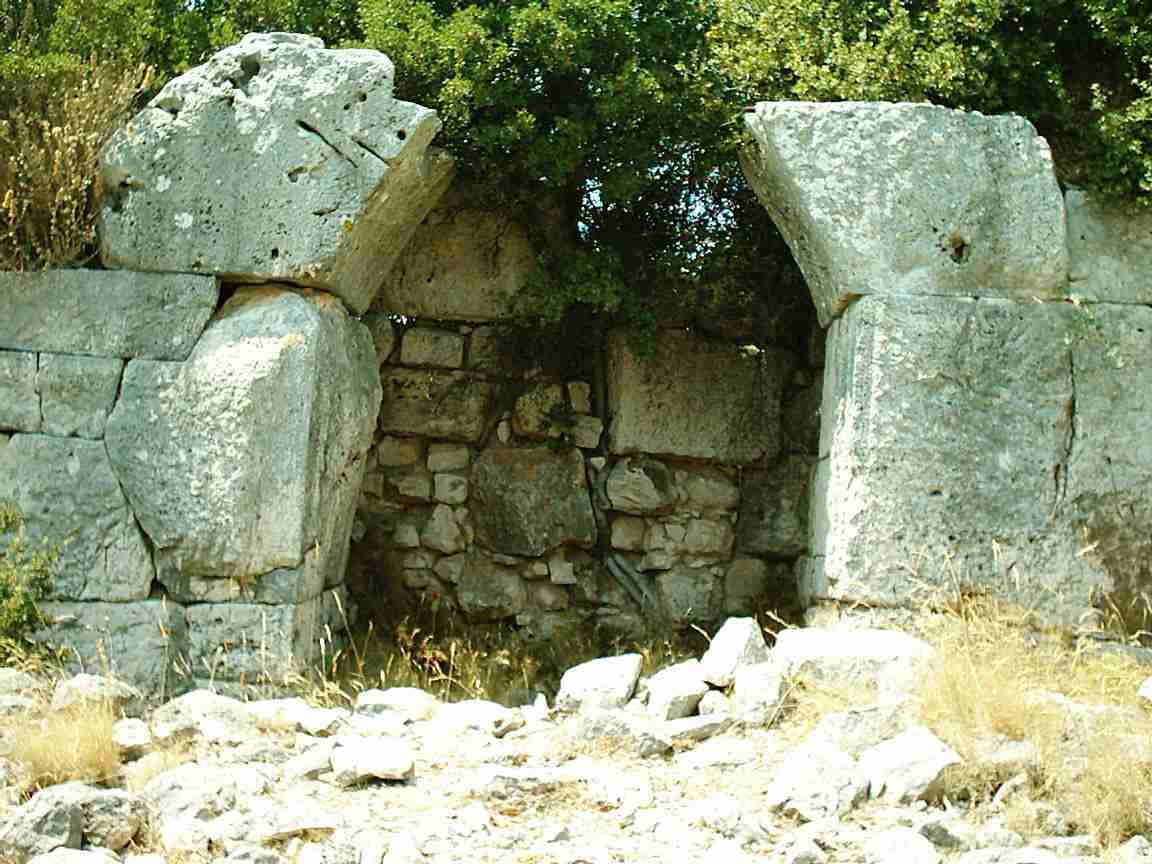
© Christopher Eckert (de:User:Wikipedia ce), CC BY-SA 3.0 Resized from original. (This derivative is under the same CC BY-SA license.)
World Heritage Research
Discover scientific research and academic studies that deepen our understanding of Pythagoreion and Heraion of Samos from its history and significance to its conservation, management, and contemporary challenges.
-
ΝΥΜΦΑΙ ΟΡΕΣΚΩΟΙ ΒΑΘΥΚΟΛΠΟΙ
A distinct Nymph type, characterized by intricate draping with broad hollow hems and long fringes, has been identified through multiple replicas from the Pythagoreion of Samos. This type, likely originating around the mid-2nd century BCE, represents a significant artifact of Samos' Nymph cult. The study connects this type to earlier references in the Heraion's 346/345 BCE inscription and draws parallels with the fringed mantle of the Knidian Aphrodite, providing insight into the cultural and artistic practices of the region during the Hellenistic period.
Freyer-Schauenburg, B. (2025). ΝΥΜΦΑΙ ΟΡΕΣΚΩΟΙ ΒΑΘΥΚΟΛΠΟΙ. Athenische Mitteilungen, 135(Athenische Mitteilungen, Bd. 135 (2020), 257–280. https://doi.org/10.34780/NNDPEF57
View Publication Record | Read Publication -
Tracing Interaction on Samos Island: Pottery Traditions and Connectivity at Kastro-Tigani and the Heraion During the Aegean Late–Final Neolithic/Western Anatolian Middle–Late Chalcolithic
A new analysis of Neolithic and Chalcolithic pottery from Kastro-Tigani, Samos, reveals distinct production strategies and raw material sources, suggesting multiple local production units. This study, using thin-section petrography and X-ray fluorescence spectroscopy, provides the first compositional characterization of early Samian ceramics, offering insights into regional connectivity during a poorly studied period (c. 5500–3200/3000 BC). Isolated imported vessels and exotic artifacts indicate broader Aegean maritime interactions, while comparisons with nearby Heraion pottery hint at potential relations between these sites.
Menelaou, S., & Kouka, O. (2022). TRACING INTERACTION ON SAMOS ISLAND: POTTERY TRADITIONS AND CONNECTIVITY AT KASTRO-TIGANI AND THE HERAION DURING THE AEGEAN LATE–FINAL NEOLITHIC/WESTERN ANATOLIAN MIDDLE–LATE CHALCOLITHIC. The Annual of the British School at Athens, 117, 1–52. https://doi.org/10.1017/s0068245422000041
View Publication Record | Read Publication