World Heritage Identification Number: 530
World Heritage since: 1990
Category: Cultural Heritage
WHE Type: Archaeological Sites
Transboundary Heritage: No
Endangered Heritage: No
Country: 🇬🇷 Greece
Continent: Europe
UNESCO World Region: Europe and North America
Map
Delos: An Ancient Cosmopolitan Port in the Heart of the Cyclades
Delos, officially known as Dilos, is a minuscule yet historically significant island nestled within the Cyclades archipelago, situated just off the coast of Mykonos. With a mere surface area of 3.43 square kilometers (1.32 square miles), Delos stands as one of the most crucial mythological, historical, and archaeological sites in Greece. This ancient island has been the subject of extensive archaeological excavations, making it one of the most extensive digs in the Mediterranean region. Many of the artifacts unearthed during these excavations can be found at the Archaeological Museum of Delos and the National Archaeological Museum of Athens.
More to come…UNESCO Description of the World Heritage Site
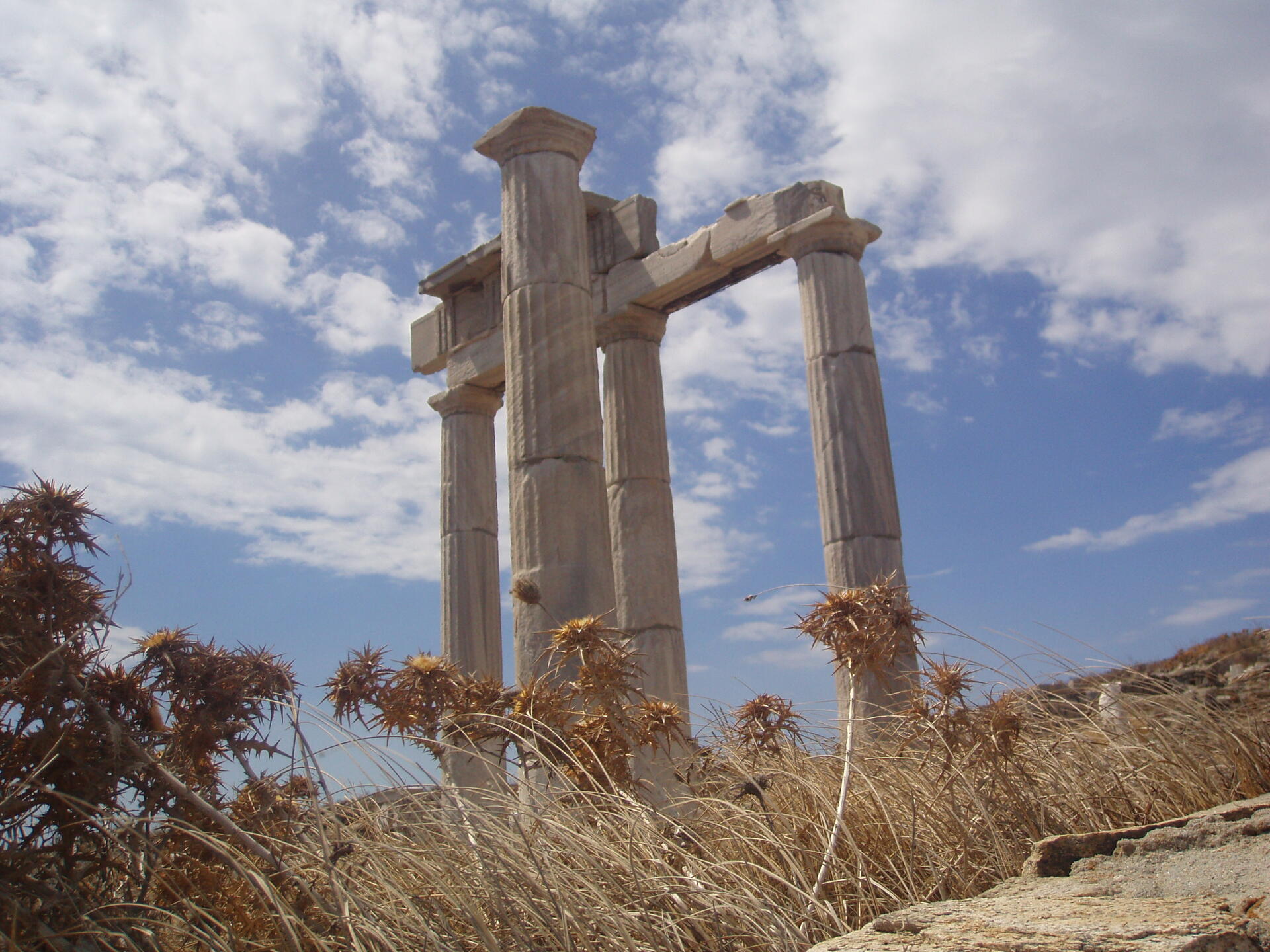
According to Greek mythology, Apollo was born on this tiny island in the Cyclades archipelago. Apollo's sanctuary attracted pilgrims from all over Greece and Delos was a prosperous trading port. The island bears traces of the succeeding civilizations in the Aegean world, from the 3rd millennium B.C. to the palaeochristian era. The archaeological site is exceptionally extensive and rich and conveys the image of a great cosmopolitan Mediterranean port.
UNESCO Justification of the World Heritage Site
Criterion (ii): Delos had considerable influence on the development of architecture and monumental arts during the Greco-Roman period, as seen in the immense Hellenistic sanctuary. A great part of its treasure of masterpieces was found during the excavations and is exhibited today in Delos’ Museum. This influence was matched later by the important role it has played since the 15th century in furthering our knowledge of ancient Greek art from a widely renowned site, which is among the first sites in Greece that captured the attention of archaeologists and travellers.
Criterion (iii): The island of Delos bears unique witness to the civilizations of the Aegean world since the 3rd millennium BC. During the Palaeo-Christian era, it was the seat of the bishopric of the Cyclades. From the 7th century BC to the pillage by Athenodoros in 69 BC, the island of Delos was one of the principal Pan-Hellenic sanctuaries. The feast of the Delians, which was celebrated every four years in the month of May until 316 BC, included gymnastic, equestrian and musical competitions, Archaic Age dances, theatrical productions and banquets. Like the Olympic and the Pythic Games, it was one of the major events in the Greek world.
Criterion (iv): The archaeological site of Delos provides an outstanding example of an architectural ensemble that restores the image of an extremely important cosmopolitan Mediterranean port that began to prosper since 314 BC, reaching outstanding levels during the 2nd and 1st centuries BC. Warehouses and trading companies abounded, large residential areas were established, public buildings were founded by associations of bankers, traders and ship-owners. Moreover, there were an unprecedented number of sanctuaries dedicated to foreign religions: temples of Sarapis, Isis and Anubis, temples to the Syrian gods Haadad and Atargatis, and even a synagogue in the stadium district.
Criterion (vi): Delos is directly and tangibly associated with one of the principal myths of Hellenic civilisation. It was on this arid islet that Leto, made pregnant by Zeus and fleeing the vengeance of Hera, gave birth to Apollo and Artemis after a difficult labour. According to a Homeric hymn, the island, which until then had been floating, became anchored to the floor of the ocean. The newborn Phoebus- Apollo threw off his swaddling clothes bathed the universe in light and began walking with his cither and his bow. Kynthos, the mountain of Zeus, and the wheel-shaped lake, close to which the pregnant Leto suffered labor pains for nine days and nights, remain essential landmarks of the island's sacred geography, which was clearly defined by the additions made to the Delian sanctuary to Apollo between the 6th and the 1st centuries BC.
Encyclopedia Record: Delos
Delos or Dilos, is a small Greek island near Mykonos, close to the centre of the Cyclades archipelago. Though only 3.43 km2 (1.32 sq mi) in area, it is one of the most important mythological, historical, and archaeological sites in Greece. The ongoing excavations in the island are among the most extensive in the Mediterranean, and many of the artifacts found are displayed at the Archaeological Museum of Delos and the National Archaeological Museum of Athens.Additional Site Details
Area: 350.64 hectares
Number of Components: 1
(iii) — Unique or exceptional testimony to a cultural tradition
(iv) — Outstanding example of a type of building or landscape
(vi) — Directly associated with events or living traditions
Coordinates: 37.4 , 25.26667
World Heritage Research
Discover scientific research and academic studies that deepen our understanding of Delos from its history and significance to its conservation, management, and contemporary challenges.
-
The Delos Symposia and Doxiadis
A groundbreaking collection of essays offers the first comprehensive analysis of the Delos Symposia's origins, influence, and enduring legacy. Edited by Mantha Zarmakoupi and Simon Richards, the work delves into how these symposia shaped architectural discourse and urban planning in the Mediterranean region. The research employs a multidisciplinary approach, integrating historical records, archival materials, and critical analysis to trace the symposia's evolution from 1976 to their impact on modern heritage conservation practices. Key insights include the symposia's role in fostering dialogue between scholars, practitioners, and policymakers, as well as its influence on the development of UNESCO World Heritage Site criteria. This volume serves as a pivotal resource for understanding the intersection of academic thought and practical urban planning at Delos, a site renowned for its archaeological significance.
De Togni, N. (2025). The Delos Symposia and Doxiadis. Planning Perspectives, 40(2), 449–451. https://doi.org/10.1080/02665433.2025.2466993
View Publication Record | Read Publication -
Assessing Ancient Inequalities: Hellenistic Delos
A new analysis reveals that wealth inequality on the ancient island of Delos decreased by approximately 20% between its early and late periods of independence (314–167 BCE). The study, which relies on inscriptions detailing property ownership and artisanal wages, introduces a probabilistic approach to quantify ancient economic disparities while accounting for uncertainties. Researchers attribute this shift to the island's new autonomous political status in 314 BCE, suggesting that middle-class wealth accumulation played a significant role in reducing inequality. This finding challenges traditional narratives about economic stability during the Hellenistic period and provides a data-driven perspective on socio-economic dynamics in ancient Mediterranean societies.
Battistoni, F., & Martinez, M. (2025). Assessing Ancient Inequalities: Hellenistic Delos. Review of Income and Wealth, 71(2). Portico. https://doi.org/10.1111/roiw.70001
View Publication Record | Read Publication -
Merchants and Traders on Hellenistic Delos
Hellenistic Delos, a pivotal cult and commercial hub in the Aegean, thrived as a 'free' port under Roman influence post-167/6 BCE, becoming the region's foremost transit point for a century. Italian merchants, particularly from southern Italy, played a decisive role in shaping the island's economy by facilitating trade, financing ventures, and promoting connections with the expanding Roman Empire. This study highlights their centrality to Delos' prosperity during this transformative period, offering insights into the island's economic dynamics and its integration into broader imperial networks.
Reger, G. (2024). Merchants and Traders on Hellenistic Delos. The Oxford Handbook of Pre-Roman Italy (1000--49 BCE), 777–791. https://doi.org/10.1093/oxfordhb/9780199987894.013.48
View Publication Record | Read Publication -
The Colossal Archaic Naxian Statues in the Sanctuary of Apollo on Delos
Stable isotope analysis of marble fragments from the Naxian Colossus on Delos challenges long-held assumptions about the statue's origins and composition. Contrary to earlier beliefs, the data suggests that the remnants likely belong to at least three distinct Archaic-period colossal statues rather than a single replacement for an original 600 BCE work. This finding, combined with stylistic and proportional evidence, provides new insights into the highly debated inscription on the statue's base: 'I am of the same stone, statue and base.' The study highlights the potential and limitations of marble isotope analysis in resolving complex archaeological questions.
Sheedy, K. A., & Pike, S. (2025). The Colossal Archaic Naxian Statues in the Sanctuary of Apollo on Delos. American Journal of Archaeology, 129(1), 25–57. https://doi.org/10.1086/732757
View Publication Record | Read Publication -
Contemporaneous crust-derived I- and S-type granite magmatism and normal faulting on Tinos, Delos, and Naxos, Greece: Constraints on Aegean orogenic collapse
Aegean orogenic collapse occurred around 15 million years ago, marked by the simultaneous intrusion of I-type and S-type granite magmas alongside normal faulting on the Cycladic islands of Tinos, Delos, and Naxos. The study reveals that these granitoids, derived from crustal anatexis of variable metaigneous and metasedimentary sources, are unrelated to Hellenic subduction. I-type granites originated from dehydration melting of igneous basement protoliths, while S-type leucogranites formed via muscovite dehydration melting of sedimentary rocks. Field observations, geochemistry, Sr-Nd isotopes, and U-Pb geochronology constrain the timing of extensional structures, indicating that top-to-the-(N)NE shear zones active from 20 to 15 Ma were later folded and cut by normal faults. This transition from compressional to extensional stress fields signifies a critical phase in Aegean tectonic evolution.
Lamont, T. N., Roberts, N. M. W., Searle, M. P., Gardiner, N. J., Gopon, P., Hsieh, Y.-T., Holdship, P., & White, R. W. (2023). Contemporaneous crust-derived I- and S-type granite magmatism and normal faulting on Tinos, Delos, and Naxos, Greece: Constraints on Aegean orogenic collapse. GSA Bulletin. https://doi.org/10.1130/b36489.1
View Publication Record | Read Publication -
Marble quarries in Delos Island (Greece): a geological characterization
Researchers have identified distinct geochemical and isotopic signatures that can distinguish Delian marble from other Mediterranean marbles used during antiquity. By conducting detailed geological mapping, mineralo-petrographic analysis, and isotopic characterization (δ13C and δ18O) of four quarries on Delos Island, the study revealed three categories of marble: coarse whitish to bluish marble, fine yellowish dolomitic marble, and marble with giant white and blue calcite crystals. The Maximum Grain Size, combined with oxygen and carbon isotopic ratios, showed strong potential for provenance studies, though trace element analysis could further refine this characterization. This finding significantly advances the understanding of ancient marble sourcing in Mediterranean archaeology.
Vettor, T., Sautter, V., Jolivet, L., Moretti, J.-C., & Pont, S. (2022). Marble quarries in Delos Island (Greece): a geological characterization. BSGF - Earth Sciences Bulletin, 193, 16. https://doi.org/10.1051/bsgf/2022014
View Publication Record | Read Publication -
The Hellenistic and Roman Harbours of Delos and Kenchreai: Their Construction, Use and Evolution
Hellenistic and Roman harbours, particularly those at Delos and Kenchreai, were designed not only for ship accommodation but also to optimize the handling of cargo, crews, and passengers. This study reveals that their capacity was intricately linked to maritime trade dynamics, with harbour configurations tailored to the ships most likely to use them. By integrating archaeological, written, and geomorphological data, researchers have reconstructed how these harbours evolved in response to commercial demands. The findings provide a new framework for understanding the relationship between harbour infrastructure and Mediterranean seamanship during this period.
Nakas, I. (2022). The Hellenistic and Roman Harbours of Delos and Kenchreai: Their Construction, Use and Evolution. https://doi.org/10.30861/9781407359816
View Publication Record | Read Publication