World Heritage Identification Number: 404
World Heritage since: 1987
Category: Cultural Heritage
WHE Type: Archaeological Sites
Transboundary Heritage: No
Endangered Heritage: No
Country: 🇬🇷 Greece
Continent: Europe
UNESCO World Region: Europe and North America
Map
The Acropolis of Athens: A Universal Symbol of Classical Civilization
The Acropolis of Athens, situated atop a rocky outcrop in the heart of the modern city, stands as an enduring testament to the grandeur and cultural prowess of ancient Greece. Inscribed as a UNESCO World Heritage Site in 1987, this iconic citadel represents the epitome of classical architecture and artistic achievement, serving as a universal symbol of the Greek spirit and civilization.
Dating back to the Bronze Age, the Acropolis has been a significant site for over three millennia. Its name, derived from the Greek words 'akron' meaning 'highest point' and 'polis' meaning 'city', reflects its strategic location and historical importance. During ancient times, it was more properly known as Cecropia, named after the legendary serpent-man Cecrops, the first Athenian king.
In the second half of the fifth century BC, Athens, having emerged victorious against the Persians and established democracy, rose to prominence among the other city-states of the ancient world. This period, marked by intellectual and artistic flourishing, saw the implementation of ambitious plans by Athenian statesman Pericles. Under the guidance of the renowned sculptor Pheidias, these plans resulted in the transformation of the Acropolis into a singular monument of thought and the arts.
The most notable structures constructed during this time include the Parthenon, the Erechtheion, the Propylaea, and the Temple of Athena Nike. The Parthenon, designed by the architects Ictinus and Callicrates under the artistic supervision of Pheidias, is arguably the most famous edifice on the Acropolis. Commissioned as a temple dedicated to the goddess Athena, it serves as a quintessential example of Doric architecture—while also incorporating significant Ionic elements—and is widely regarded as the zenith of Greek architectural genius.
The Erechtheion is another remarkable structure on the Acropolis. In contrast to the predominantly Doric character of the Parthenon, the Erechtheion is characterized entirely by Ionic architecture and is known for its graceful proportions and complexity. Its most notable feature is the Porch of the Caryatids, where six sculpted female figures support the entablature, exemplifying both technical mastery and artistic refinement.
The Propylaea, the monumental entrance to the Acropolis, was designed by Mnesicles. This impressive gateway serves as the primary access point to the sacred precinct and offers visitors their first glimpse of the magnificent structures within.
The Temple of Athena Nike, a small Ionic temple dedicated to the goddess Athena, was built during the early years of the Peloponnesian War (between approximately 420-410 BCE). Situated on the southwest corner of the Acropolis, it commemorates Athenian hopes for military success and stands as one of the best preserved temples on the site.
Today, the Acropolis continues to captivate visitors from around the world, offering a tangible connection to the rich history and cultural legacy of ancient Greece. As a UNESCO World Heritage Site, it stands as a reminder of the enduring influence of classical civilization and the indomitable spirit of humanity.
UNESCO Description of the World Heritage Site
The Acropolis of Athens and its monuments are universal symbols of the classical spirit and civilization and form the greatest architectural and artistic complex bequeathed by Greek Antiquity to the world. In the second half of the fifth century bc, Athens, following the victory against the Persians and the establishment of democracy, took a leading position amongst the other city-states of the ancient world. In the age that followed, as thought and art flourished, an exceptional group of artists put into effect the ambitious plans of Athenian statesman Pericles and, under the inspired guidance of the sculptor Pheidias, transformed the rocky hill into a unique monument of thought and the arts. The most important monuments were built during that time: the Parthenon, built by Ictinus, the Erechtheon, the Propylaea, the monumental entrance to the Acropolis, designed by Mnesicles and the small temple Athena Nike.
UNESCO Justification of the World Heritage Site
Criterion (i): The Athenian Acropolis is the supreme expression of the adaptation of architecture to a natural site. This grand composition of perfectly balanced massive structures creates a monumental landscape of unique beauty, consisting of a complete series of architectural masterpieces of the 5th century BC: the Parthenon by Iktinos and Kallikrates with the collaboration of the sculptor Pheidias (447-432); the Propylaia by Mnesikles (437-432); the Temple of Athena Nike by Mnesikles and Kallikrates (427-424); and Erechtheion (421-406).
Criterion (ii): The monuments of the Athenian Acropolis have exerted an exceptional influence, not only in Greco-Roman antiquity, during which they were considered exemplary models, but also in contemporary times. Throughout the world, Neo-Classical monuments have been inspired by all the Acropolis monuments.
Criterion (iii): From myth to institutionalized cult, the Athenian Acropolis, by its precision and diversity, bears a unique testimony to the religions of ancient Greece. It is the sacred temple from which sprung fundamental legends about the city. Beginning in the 6th century BC, myths and beliefs gave rise to temples, altars and votives corresponding to an extreme diversity of cults, which have brought us the Athenian religion in all its richness and complexity. Athena was venerated as the goddess of the city (Athena Polias); as the goddess of war (Athena Promachos); as the goddess of victory (Athena Nike); as the protective goddess of crafts (Athena Ergane), etc. Most of her identities are glorified at the main temple dedicated to her, the Parthenon, the temple of the patron-goddess.
Criterion (iv): The Athenian Acropolis is an outstanding example of an architectural ensemble illustrating significant historical phases since the 16th century BC. Firstly, it was the Mycenaean Acropolis (Late Helladic civilization, 1600-1100 BC) which included the royal residence and was protected by the characteristic Mycenaean fortification. The monuments of the Acropolis are distinctly unique structures that evoke the ideals of the Classical 5th century BC and represent the apex of ancient Greek architectural development.
Criterion (vi): The Acropolis is directly and tangibly associated with events and ideas that have never faded over the course of history. Its monuments are still living testimonies of the achievements of Classical Greek politicians (e.g. Themistokles, Perikles) who lead the city to the establishment of Democracy; the thought of Athenian philosophers (e.g. Socrates, Plato, Demosthenes);and the works of architects (e.g. Iktinos, Kallikrates, Mnesikles) and artists (e.g. Pheidias, Agorakritus, Alkamenes). These monuments are the testimony of a precious part of the cultural heritage of humanity.
Encyclopedia Record: Acropolis of Athens
The Acropolis of Athens is an ancient citadel located on a rocky outcrop above the city of Athens, Greece, and contains the remains of several ancient buildings of great architectural and historical significance, the most famous being the Parthenon. The word Acropolis is from Greek ἄκρον (akron) 'highest point, extremity' and πόλις (polis) 'city'. The term acropolis is generic and there are many other acropoleis in Greece. During ancient times the Acropolis of Athens was also more properly known as Cecropia, after the legendary serpent-man Cecrops, the supposed first Athenian king.Additional Site Details
Area: 3.04 hectares
Number of Components: 1
(ii) — Significant interchange of human values
(iii) — Unique or exceptional testimony to a cultural tradition
(iv) — Outstanding example of a type of building or landscape
(vi) — Directly associated with events or living traditions
Coordinates: 37.97087 , 23.72618
Image
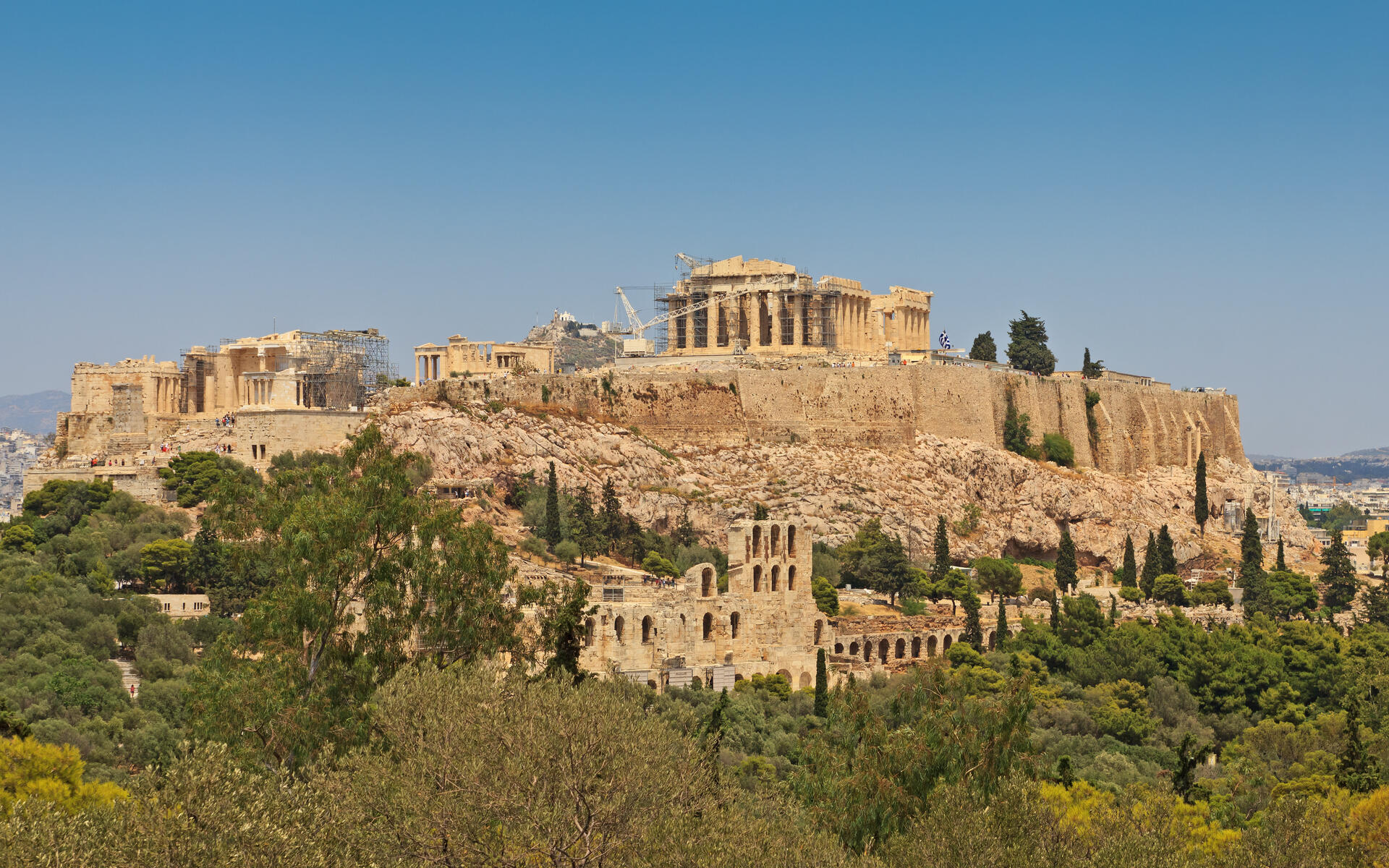
© A.Savin, CC BY-SA 3.0 Resized from original. (This derivative is under the same CC BY-SA license.)
World Heritage Research
Discover scientific research and academic studies that deepen our understanding of Acropolis, Athens from its history and significance to its conservation, management, and contemporary challenges.
-
The Erechtheion on the Acropolis of Athens
A long-standing debate about the location of the Erechtheion on Athens' Acropolis has been challenged by new evidence suggesting that the temple, traditionally associated with the Karyatid Temple, was instead situated on the 'Dörpfeld foundation,' a site of an Archaic building destroyed by the Persians in 480 BCE. This study argues against the prevailing view that the Erechtheion was relocated after its destruction, proposing that it remained recognized at the Dörpfeld foundation until antiquity's end. The research analyzes historical proposals and re-evaluates archaeological evidence to support this hypothesis, offering a significant reinterpretation of one of Athens' most iconic structures.
van Rookhuijzen, J. Z. (2021). The Erechtheion on the Acropolis of Athens. Kernos, 34, 69–121. https://doi.org/10.4000/kernos.3853
View Publication Record | Read Publication -
The Parthenon Treasury on the Acropolis of Athens
A critical reassessment of the Parthenon Treasury on the Acropolis of Athens challenges conventional identification, proposing instead that it corresponds to the west part of the Erechtheion rather than the Parthenon's west room. This conclusion is supported by a rigorous analysis of epigraphical, archaeological, and literary evidence from the 5th and 4th centuries BCE. The study revisits inventories of Athena's riches, which list multiple treasuries on the Acropolis, including the Parthenon, Hekatompedon, Proneos, Opisthodomos, and Archaios Neos. By synthesizing these disparate data sources, the research offers a new interpretation that reshapes our understanding of the spatial organization and religious significance of the Acropolis during its formative period.
van Rookhuijzen, J. Z. (2020). The Parthenon Treasury on the Acropolis of Athens. American Journal of Archaeology, 124(1), 3–35. https://doi.org/10.3764/aja.124.1.0003
View Publication Record | Read Publication -
Looking at the Acropolis of Athens from Modern Times to Antiquity
A novel approach to understanding heritage, particularly the Acropolis of Athens, reveals that multiple layers of perception shape human engagement with such sites. The study introduces 'medium' as a method to analyze how people comprehend and interact with cultural heritage, demonstrating that these perceptions can influence actions and policies related to preservation. By examining the Acropolis from modern times to antiquity, the research provides insights into the evolving significance of this iconic site, offering a framework for interpreting complex layers of heritage.
St Clair, W. (2014). 5. Looking at the Acropolis of Athens from Modern Times to Antiquity. Cultural Heritage Ethics, 57–102. https://doi.org/10.11647/obp.0047.05
View Publication Record | Read Publication -
Acropolis of Athens: Recording, Modeling and Visualising a Major Archaeological Site
A comprehensive digital documentation of the Acropolis of Athens was achieved through advanced geospatial technologies. The project successfully integrated polygonometric networks, photogrammetry, terrestrial laser scanning, and 3D modeling to create detailed topographic models, orthophotomosaics, and a geospatial database. These innovations enabled precise visualization and management of the Acropolis's rock formations, walls, and the Erehtheion, setting a benchmark for archaeological site preservation and analysis. Challenges in data acquisition and integration were addressed, demonstrating the feasibility of large-scale digital reconstruction for heritage conservation.
Tsingas, V. (2012). Acropolis of Athens: Recording, Modeling and Visualising a Major Archaeological Site. International Journal of Heritage in the Digital Era, 1(2), 169–190. https://doi.org/10.1260/2047-4970.1.2.169
View Publication Record | Read Publication -
Experience in-between architecture and context: the New Acropolis Museum, Athens
The New Acropolis Museum in Athens exemplifies how architecture's context and conditions can be understood through Gilles Deleuze's concept of the signaletic material, revealing a dynamic interplay between form, function, and experiential potential. This study demonstrates that architectural design, particularly in museum spaces, can afford multifaceted experiences—ranging from practical use to contemplative engagement with historical and geographical context. By analyzing visitor movement and perception within the museum, the research highlights how such designs actualize the 'in-between' encounters of architecture, context, and the experiencing subject, contributing to the broader understanding of architectural intentionality and its experiential dimensions.
Jakobsen, A. (2012). Experience in-between architecture and context: the New Acropolis Museum, Athens. Journal of Aesthetics & Culture, 4(1), 18158. https://doi.org/10.3402/jac.v4i0.18158
View Publication Record | Read Publication -
Geophysical prospection of a bronze foundry on the southern slope of the acropolis at athens, Greece
A geophysical survey of the Acropolis's southern slope in Athens, Greece, has uncovered evidence of additional bronze production pits, shedding new light on ancient manufacturing processes. The study, conducted in 2010, employed magnetometry (MAG), electrical resistivity tomography (ERT), and ground-penetrating radar (GPR) to map subsurface anomalies. Two major pits were identified: one previously excavated, whose extent was outlined, and another newly detected oval-shaped pit measuring 8–10 meters in length, 2–3 meters in width, and 2.5 meters deep, featuring steep vertical walls and possible entrances. Virtual models generated from LiDAR scans of the excavated pit aided interpretation, confirming the new pit as part of a bronze foundry complex. These findings prompt further excavations to explore this ancient production site.
Leopold, M., Gannaway, E., Völkel, J., Haas, F., Becht, M., Heckmann, T., Westphal, M., & Zimmer, G. (2011). Geophysical prospection of a bronze foundry on the southern slope of the acropolis at athens, Greece. Archaeological Prospection, 18(1), 27–41. Portico. https://doi.org/10.1002/arp.402
View Publication Record | Read Publication -
Non‐destructive Electrical Resistivity Tomography Survey at the South Walls of the Acropolis of Athens
A non-destructive electrical resistivity tomography (ERT) survey at the Acropolis of Athens revealed areas of increased moisture behind its south walls, offering new insights into the structure's internal composition. Unlike traditional methods, this study used bentonite mud electrodes to avoid damaging the site, adapting existing ERT processing algorithms for this unique application. The findings not only assessed the wall's thickness in specific locations but also demonstrated the feasibility and utility of ERT surveys for archaeologists and restoration scientists, providing valuable data without compromising the integrity of the historic site.
Tsourlos, P. I., & Tsokas, G. N. (2011). Non‐destructive Electrical Resistivity Tomography Survey at the South Walls of the Acropolis of Athens. Archaeological Prospection, 18(3), 173–186. Portico. https://doi.org/10.1002/arp.416
View Publication Record | Read Publication