World Heritage Identification Number: 537
World Heritage since: 1990
Category: Cultural Heritage
WHE Type: Religious Sites & Sacred Architecture
Transboundary Heritage: No
Endangered Heritage: No
Country: 🇬🇷 Greece
Continent: Europe
UNESCO World Region: Europe and North America
Map
Monasteries of Daphni, Hosios Loukas, and Nea Moni of Chios: A Triad of Byzantine Masterpieces
The Monasteries of Daphni, Hosios Loukas, and Nea Moni of Chios form a remarkable trio of Byzantine architectural and artistic masterpieces inscribed as a UNESCO World Heritage Site in 1990. These three monastic complexes, though geographically dispersed, share striking similarities in their design, construction, and decoration, reflecting the 'second golden age' of Byzantine art.
More to come…UNESCO Description of the World Heritage Site
Although geographically distant from each other, these three monasteries (the first is in Attica, near Athens, the second in Phocida near Delphi, and the third on an island in the Aegean Sea, near Asia Minor) belong to the same typological series and share the same aesthetic characteristics. The churches are built on a cross-in-square plan with a large dome supported by squinches defining an octagonal space. In the 11th and 12th centuries they were decorated with superb marble works as well as mosaics on a gold background, all characteristic of the 'second golden age of Byzantine art'.
UNESCO Justification of the World Heritage Site
Criterion (i): The monasteries at Daphni, Hosios Loukas and Nea Moni of Chios represent, with their admirable mosaics on a gold background, unique artistic achievements. On this basis each one of these indisputable masterpieces of Byzantine art could have been included on the World Heritage List on its own merits.
Criterion (iv): These three monasteries are outstanding examples of a type of construction characteristic of the middle period of Byzantine religious architecture. Nea Moni illustrates the most simple expression: an octagonal church with no added spaces. Hosios Loukas and Daphni are more complex. They have a central octagonal space surrounded by a series of bays that form a square. This more elaborate structure defines a hierarchy of volumes and functions and enables the implementation of an extensive iconographic and decorative plan. It is typical of other churches, like Christianou near Kyparissia, Panaghia Likodimou in Athens or Saint Sophia in Monemvasia. The two examples included in the property are, along with Saints Theodoroi of Mystras (included on the World Heritage List in 1989), the most representative by virtue of the perfection of their architecture, the beauty of their mosaics and paintings and their more satisfactory state of conservation.
Encyclopedia Record: Daphni Monastery
Daphni or Dafni is an eleventh-century Byzantine monastery eleven kilometers northwest of central Athens in the suburb of Chaidari, south of Athinon Avenue. It is situated near the forest of the same name, on the Sacred Way that led to Eleusis. The forest covers about 18 km2 (7 mi2), and surrounds a laurel grove. "Daphni" is the modern Greek name that means "laurel grove", derived from Daphneion (Lauretum).Additional Site Details
Area: 3.7 hectares
Number of Components: 3
(iv) — Outstanding example of a type of building or landscape
Coordinates: 38.3952777778 , 22.7466666667
Image
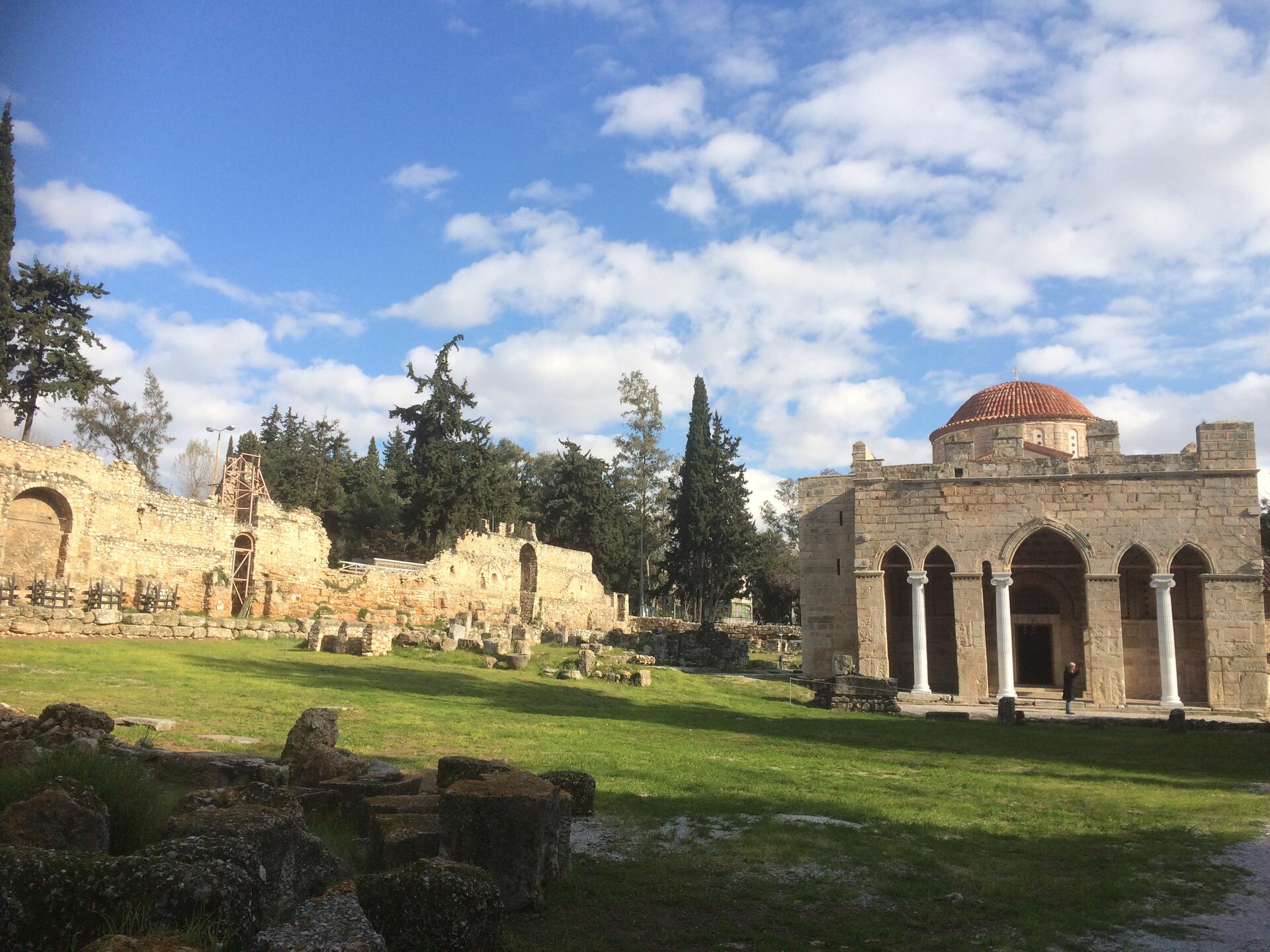
© Sp!ros, CC BY-SA 4.0 Resized from original. (This derivative is under the same CC BY-SA license.)