World Heritage Identification Number: 1290
World Heritage since: 2008
Category: Natural Heritage
WHE Type: Protected Areas & National Parks
Transboundary Heritage: No
Endangered Heritage: No
Country: 🇲🇽 Mexico
Continent: Americas
UNESCO World Region: Latin America and the Caribbean
Map
The Monarch Butterfly Biosphere Reserve: A Natural Wonder of the World
The Monarch Butterfly Biosphere Reserve (MBBR) is a unique and captivating natural wonder located in the Trans-Mexican Volcanic Belt pine-oak forests ecoregion, on the border of Michoacán and the State of Mexico, approximately 100 kilometers northwest of Mexico City. This extraordinary site was inscribed as a UNESCO World Heritage Site in 2008, recognizing its exceptional importance for biological diversity conservation.
More to come…UNESCO Description of the World Heritage Site
The 56,259 ha biosphere lies within rugged forested mountains about 100 km northwest of Mexico City. Every autumn, millions, perhaps a billion, butterflies from wide areas of North America return to the site and cluster on small areas of the forest reserve, colouring its trees orange and literally bending their branches under their collective weight. In the spring, these butterflies begin an 8 month migration that takes them all the way to Eastern Canada and back, during which time four successive generations are born and die. How they find their way back to their overwintering site remains a mystery.
UNESCO Justification of the World Heritage Site
Criterion (vii): The overwintering concentration of the monarch butterfly in the property is the most dramatic manifestation of the phenomenon of insect migration. Up to a billion monarch butterflies return annually, from breeding areas as far away as Canada, to land in close-packed clusters within 14 overwintering colonies in the oyamel fir forests of central Mexico. The property protects 8 of these colonies and an estimated 70% of the total overwintering population of the monarch butterfly’s eastern population.
Encyclopedia Record: Monarch Butterfly Biosphere Reserve
The Monarch Butterfly Biosphere Reserve is a World Heritage Site containing most of the overwintering sites of the eastern population of the monarch butterfly. The reserve is located in the Trans-Mexican Volcanic Belt pine-oak forests ecoregion on the border of Michoacán and State of Mexico, 100 km, northwest of Mexico City. Millions of butterflies arrive in the reserve annually. Butterflies only inhabit a fraction of the 56,000 hectares of the reserve from October–March. The biosphere's mission is to protect the butterfly species and its habitat.Additional Site Details
Area: 13,551.55 hectares
Number of Components: 3
Coordinates: 19.6063888889 , -100.2416666667
IUCN World Heritage Outlook
The 2025 Conservation Outlook on Monarch Butterfly Biosphere Reserve reports the following assessment:
Source: International Union for Conservation of Nature (IUCN) · View assessment
Image
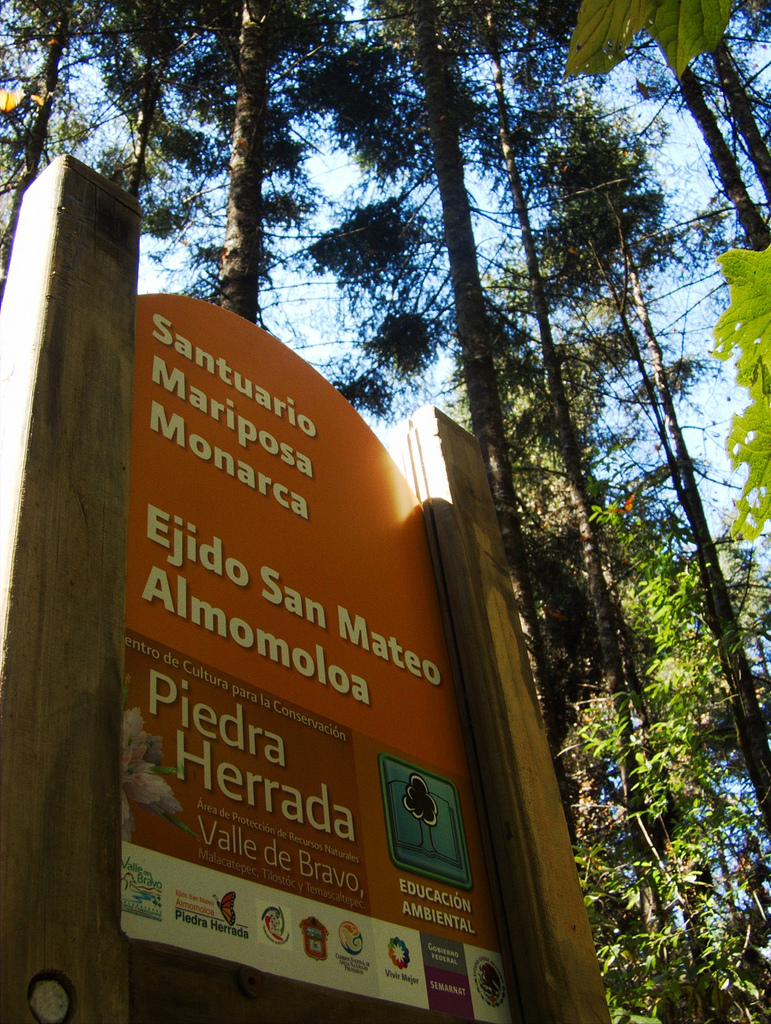
© Solo se puede ser libre Cuándo no se tiene nada que perder from Mexico D.F., México, CC BY 2.0 Resized from original.
World Heritage Research
Discover scientific research and academic studies that deepen our understanding of Monarch Butterfly Biosphere Reserve from its history and significance to its conservation, management, and contemporary challenges.
-
Using UAV (drone) technology to measure the dynamics of Abies religiosa (Kunth) Schltdl. & Cham. decline in the Monarch Butterfly Biosphere Reserve, Mexico, and its relationship to climate change
A significant decline in the health of Abies religiosa trees within Mexico's Monarch Butterfly Biosphere Reserve (MBBR) was linked to extreme drought conditions exacerbated by climate change. Using UAV technology, researchers detected a sharp drop in tree vigor—measured via NDVI and a new Monthly Dryness Index (MDI)—during a June 2023 heat wave (+2.7°C anomaly), with healthy trees plummeting from 37% to 18%. Regression models confirmed MDI's strong predictive power (R² ≥ 0.94) for tree vitality shifts, underscoring the species' vulnerability during dry seasons. This study highlights how drone-based remote sensing can track climate impacts on ecosystems in real time.
Gallardo-Salazar, J. L., Lindig-Cisneros, R., Lopez-Toledo, L., Endara-Agramont, A. R., Blanco-García, A., García-Serrano, E., Guadarrama-León, R., & Sáenz-Romero, C. (2026). Using UAV (drone) technology to measure the dynamics of Abies religiosa (Kunth) Schltdl. & Cham. decline in the Monarch Butterfly Biosphere Reserve, Mexico, and its relationship to climate change. The Forestry Chronicle, 1–18. https://doi.org/10.5558/tfc2026-001
View Publication Record | Read Publication -
High resolution thermal and multispectral remote sensing for detecting devitalized trees in Monarch Butterfly Biosphere Reserve
Researchers successfully demonstrated the use of high-resolution thermal and multispectral drone imaging to distinguish between healthy, devitalized, and dead oyamel trees (Abies religiosa) within the core zone of Mexico's Monarch Butterfly Biosphere Reserve. By integrating normalized difference vegetation index (NDVI), surface temperature (ST), and temperature-vegetation dryness index (TVDI) with field data, the study achieved statistically significant differentiation among tree health levels. This marks the first application of such technology in Mexico for monitoring forest decline symptoms in oyamel populations, setting a methodological precedent for conservation efforts.
Guadarrama-León, R., Sáenz-Romero, C., Rosas-Chavoya, M., Méndez-Montiel, J. T., Lindig-Cisneros, R. A., Blanco-García, A., & Gallardo-Salazar, J. L. (2026). High resolution thermal and multispectral remote sensing for detecting devitalized trees in Monarch Butterfly Biosphere Reserve. Forest Systems, 34(2), 20940. https://doi.org/10.5424/fs/2025342-20940
View Publication Record | Read Publication -
Evolution of Scientific Knowledge on the Monarch Butterfly Biosphere Reserve
Scientific research on the Monarch Butterfly Biosphere Reserve (MBBR) has shown sustained growth and thematic diversity, with 106 unique articles published between 1997 and 2025. Mexico leads in scientific output, followed by the United States and Canada, with the National Autonomous University of Mexico (UNAM) as the most productive institution. The study identified six key research domains: conservation and environmental management, socioeconomic aspects and governance, forest ecology, research methodologies, monarch butterfly biology, and climatic and hydrological phenomena. Notably, 2020 was the most productive year, while 2014 saw the highest citation count. This bibliometric analysis provides critical insights to inform conservation policies and strengthen sustainable management of the MBBR.
Pérez-Romero, M. E., Fernández-González, F. J., Del Río-Rama, M. d. l. C., & Venegas-Martínez, F. (2026). Evolution of Scientific Knowledge on the Monarch Butterfly Biosphere Reserve. Rper, (74), 97–121. https://doi.org/10.59072/rper.vi74.867
View Publication Record | Read Publication -
Modeling Tourist Affinities and Mediated Loyalty in Protected Natural Areas Using Fuzzy Logic
A novel application of fuzzy logic reveals that tourist loyalty in the Monarch Butterfly Biosphere Reserve is indirectly shaped by affinity-based visitor structures, with significant forgotten effects (up to 0.30) acting as mediating mechanisms between satisfaction, entertainment, relaxation, learning, perceived value, and revisit intention. The study identifies Generation X and postgraduate education levels as key factors polarizing visitor perceptions, challenging conventional models that assume direct loyalty construction. This research underscores the potential of fuzzy logic for strategic management in high-value ecological destinations, advocating for environmental edutainment models and diversified marketing tailored to differentiated visitor profiles.
Pérez-Romero, M. E., del Río-Rama, M. d. l. C., Álvarez-García, J., & Sánchez-Aguirre, D. (2026). Modeling Tourist Affinities and Mediated Loyalty in Protected Natural Areas Using Fuzzy Logic. Tourism and Hospitality, 7(5), 132. https://doi.org/10.3390/tourhosp7050132
View Publication Record | Read Publication -
Canopy openings in the Trans-Mexican Neovolcanic Belt: Characteristics, distribution, and conservation relevance in a biosphere reserve
Canopy openings in the Monarch Butterfly Biosphere Reserve (MBBR) are more prevalent in core zones and Abies religiosa forests, with higher densities observed on gentle slopes and at extreme elevations. These openings, often linked to pest outbreaks, reflect a mix of natural and human-induced disturbances, particularly within ejidos where timber harvesting is permitted. The study used NDVI data and Google Earth imagery to quantify these patterns, revealing critical areas for conservation prioritization—such as core zones and A. religiosa forests—to safeguard forest integrity and monarch butterfly overwintering habitat.
Guerrero-Marmolejo, A., Ramos, M. M., Ramírez, M. I., Oropeza-Sánchez, M. T., Salinas-Melgoza, M. Á., & Pérez-Salicrup, D. R. (2026). Canopy openings in the Trans-Mexican Neovolcanic Belt: Characteristics, distribution, and conservation relevance in a biosphere reserve. Trees, Forests and People, 26, 101420. https://doi.org/10.1016/j.tfp.2026.101420
View Publication Record | Read Publication -
Post-fire tree regeneration in mixed-conifer forests of the Monarch Butterfly Biosphere Reserve, Mexico
Post-fire tree regeneration in mixed-conifer forests of the Monarch Butterfly Biosphere Reserve, Mexico, exhibits high variability depending on elevation and fire history. Research reveals three distinct recruitment patterns: asynchronous establishment of Abies religiosa followed by Pinus pseudostrobus at higher elevations (3150 m), synchronous recruitment of both species at intermediate elevations (3100 m) following multiple fires, and exclusive regeneration of P. pseudostrobus and broad-leaved species at lower elevations (3050 m). The study analyzed tree-ring data from 258 trees across three sites to assess post-fire dynamics, finding that wet inter-annual periods did not significantly enhance recruitment. These findings underscore the complex interplay between fire, elevation, and species dominance, providing critical insights for forest management strategies in this ecologically significant region.
Sáenz-Ceja, J. E., & Pérez-Salicrup, D. R. (2026). Post-fire tree regeneration in mixed-conifer forests of the Monarch Butterfly Biosphere Reserve, Mexico. New Forests, 57(5). https://doi.org/10.1007/s11056-026-10216-y
View Publication Record | Read Publication -
Terrestrial Laser Scanning for Estimating the Volume and Biomass of Coniferous Stems in the Mariposa Monarca Biosphere Reserve, Mexico
Terrestrial laser scanning (TLS) emerges as a powerful, non-destructive tool for accurately estimating tree volume and biomass, offering a significant advancement over traditional methods that are labor-intensive and often destructive. A study in the Monarch Butterfly Biosphere Reserve (MBBR), Mexico, demonstrated that TLS-derived stem volume estimates (Vol_TLS) closely matched those from predictive models based on destructive sampling, with no significant differences found. The relationship between Vol_TLS and a model-based volume (Vol_TModel) showed an exceptionally strong fit (R² = 0.97, RMSE = 0.351 m³), outperforming another model comparison (R² = 0.93, RMSE = 0.537 m³). This validation highlights TLS as a reliable alternative for forest biomass assessment, particularly in ecologically sensitive areas like the MBBR, where conservation is paramount.
Hernández-Moreno, J. A., Velázquez-Martínez, A., Pérez-Salicrup, D. R., Bravo, F., MacFarlane, D. W., & Reyes-Hernández, V. J. (2025). Terrestrial Laser Scanning for Estimating the Volume and Biomass of Coniferous Stems in the Mariposa Monarca Biosphere Reserve, Mexico. Forests, 16(2), 334. https://doi.org/10.3390/f16020334
View Publication Record | Read Publication