World Heritage Identification Number: 1711
World Heritage since: 2024
Category: Cultural Heritage
WHE Type: Archaeological Sites
Transboundary Heritage: No
Endangered Heritage: No
Country: 🇮🇳 India
Continent: Asia
UNESCO World Region: Asia and the Pacific
Map
The Royal Necropolis of the Tai-Ahom: A Unique Cultural Landscape - Moidams
The Moidams, a unique mound-burial system, serve as a testament to the rich cultural heritage and religious practices of the Tai-Ahom dynasty in northeastern India. Inscribed as a UNESCO World Heritage Site in 2024, this remarkable archaeological landscape offers insights into the ancient civilization that thrived in the foothills of the Patkai Ranges in Assam.
More to come…UNESCO Description of the World Heritage Site
Set in the foothills of the Patkai Ranges in eastern Assam, the property contains the royal necropolis of the Tai-Ahom. For 600 years, the Tai-Ahom created moidams (burial mounds) accentuating the natural topography of hills, forests and water, thus forming a sacred geography. Banyan trees and the trees used for coffins and bark manuscripts were planted and water bodies created. Ninety moidams – hollow vaults built of brick, stone or earth – of different sizes are found within the site. They contain the remains of kings and other royals together with grave goods such as food, horses and elephants, and sometimes queens and servants. The Tai-Ahom rituals of “Me-Dam-Me-Phi” and “Tarpan” are practiced at the Charaideo necropolis. While moidams are found in other areas within the Brahmaputra Valley, those found at the property are regarded as exceptional.
UNESCO Justification of the World Heritage Site
Criterion (iii): Moidams – the Mound-Burial System of the Ahom Dynasty bear witness to 600 years of Tai-Ahom royal funerary architecture and customs and are a testimony to Tai-Ahom cultural traditions from the 13th to 19th centuries CE. The archaeological remains of the moidams are evidence of the architecture, layout, and manifestations of the Tai-Ahom beliefs and traditions. The continuing ritual practices of Tai-Ahom at the property are also significant in relation to this criterion.
Criterion (iv): Moidams – the Mound-Burial System of the Ahom Dynasty are an outstanding example of a Tai-Ahom necropolis that represents in a tangible way the Tai-Ahom funerary traditions and associated cosmologies. For around 600 years, the Tai-Ahom sculpted this landscape according to their cosmological beliefs. The undulating topography was accentuated by excavating ditches and marking the troughs with moidams. The natural vegetation was enhanced by planting sacred trees, and water bodies were added by channelising streams to fill them. Together these features symbolise the Tai universe, and a heaven-earth continuum.
Encyclopedia Record: Moidam
Frang-Mai-Dam or Moidam for short is a traditional tumulus of the Ahom religion. The royal maidams of Charaideo are listed as UNESCO world heritage site. Today, the people of the four clans namely Mo-Hung, Mo-Cham, Chaodang and Mo-Plong follow the tomb tradition of Ahom religion.Additional Site Details
Area: 96.5 hectares
Number of Components: 1
(iv) — Outstanding example of a type of building or landscape
Coordinates: 26.9411747222 , 94.87635
Image
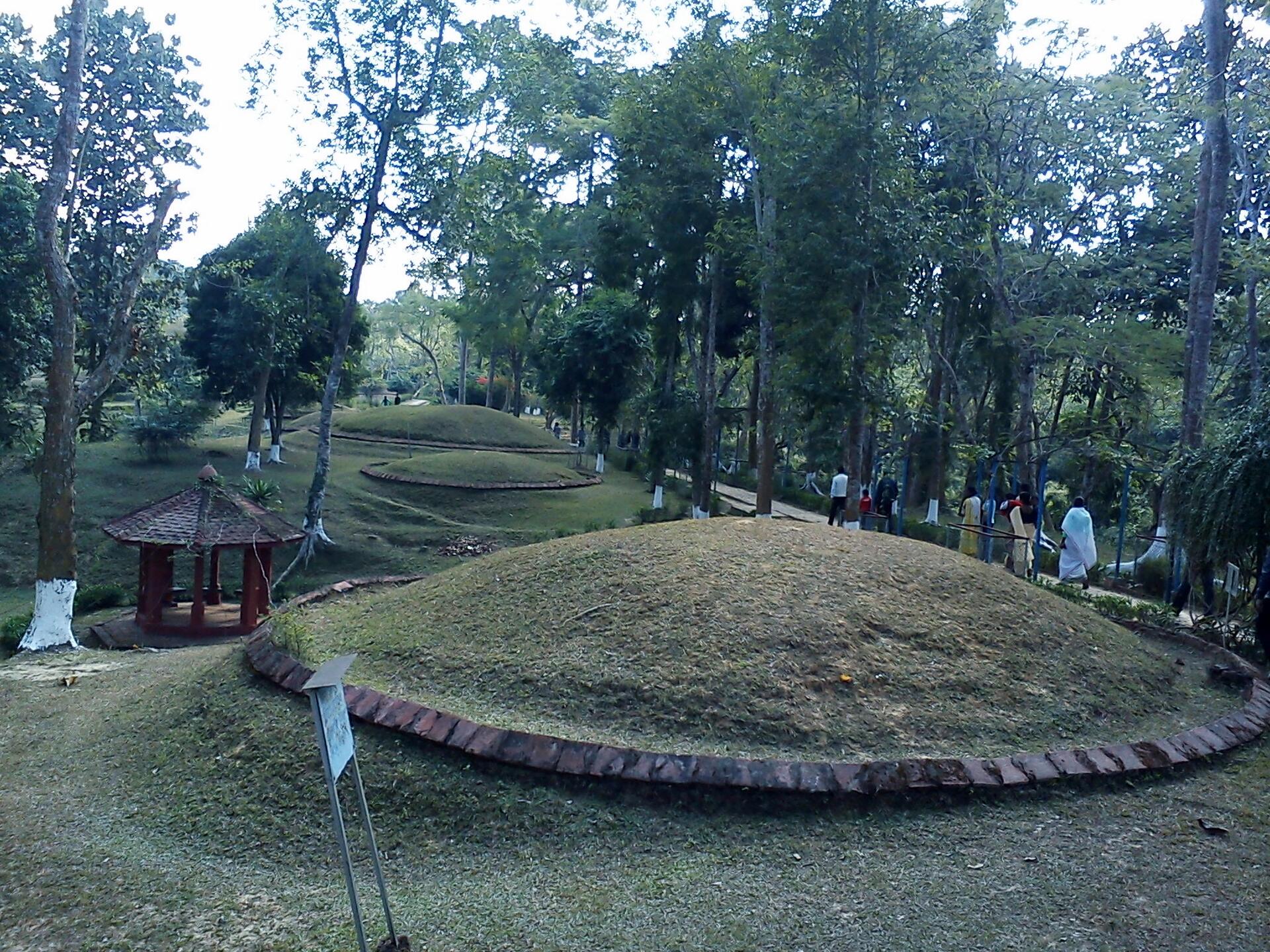
© Dhruba Jyoti Deka, CC BY-SA 3.0 Resized from original. (This derivative is under the same CC BY-SA license.)
World Heritage Research
Discover scientific research and academic studies that deepen our understanding of Moidams – the Mound-Burial System of the Ahom Dynasty from its history and significance to its conservation, management, and contemporary challenges.
-
Earthen Pyramids of Assam: Seven Hundred Years of Construction Legacy of Charaideo Moidams as a Unesco World Heritage Site
The Charaideo Moidams, inscribed as UNESCO World Heritage Sites on 26 July 2024, stand as the most enduring physical remnants of the Ahom dynasty (1228–1826 CE), embodying a 700-year legacy of earthen pyramid construction. These funerary mounds, or 'moidams,' showcase distinctive architecture and engineering with exceptional durability, preserving Ahom mortuary traditions and cultural heritage. The study highlights their significance as both spiritual and historical landmarks for the Tai-Ahom community in Northeast India, offering unique insights into ancient socio-cultural structures across South and Southeast Asia.
Changmai, T., & Hazarika, S. (2026). Earthen Pyramids of Assam: Seven Hundred Years of Construction Legacy of Charaideo Moidams as a Unesco World Heritage Site. International Journal for Multidisciplinary Research, 8(3). https://doi.org/10.36948/ijfmr.2026.v08i03.79927
View Publication Record | Read Publication -
Moidam of Dasarath Bohikhowa Barphukan in Khowang, Dibrugarh, Assam
A notable mound-burial system, or 'Moidam,' of Dasarath Bohikhowa Barphukan in Khowang, Dibrugarh, Assam, sheds light on the Ahom dynasty's burial traditions and the contributions of a prominent official. This structure, part of the Tai-Ahom entombment practice known as the 'Pyramids of Assam,' reflects the cultural and historical significance of the region. The study, relying primarily on secondary data from published sources and supported by field observations and local interviews, provides insights into Ahom society's hierarchical structures through the lens of this official's legacy. Such findings contribute to a broader understanding of the Moidam system's role in preserving Ahom heritage.
-, S. A., & -, P. S. (2025). Moidam of Dasarath Bohikhowa Barphukan in Khowang, Dibrugarh, Assam. International Journal for Multidisciplinary Research, 7(1). https://doi.org/10.36948/ijfmr.2025.v07i01.32269
View Publication Record | Read Publication -
(wl-2161)-Burial Mounds as a World Heritage Site - Charaideo’s Moidams
Charaideo’s Moidams, the burial mounds of the Ahom Dynasty (13th–19th Century AD), achieved UNESCO World Heritage recognition on July 26, 2024, marking a historic milestone as the first cultural site from North-East India to receive this distinction. These structures, unique in their mound-burial system, symbolize the Ahom Dynasty’s architectural ingenuity and cultural heritage. The essay highlights their significance through historical context, architectural analysis, and modern recognition, underscoring their role as a tangible link to Assam’s dynastic past.
Sahu, R. (2025). (wl-2161)-Burial Mounds as a World Heritage Site - Charaideo’s Moidams. Economic & Political Weekly, 60(25). https://doi.org/10.71279/epw.v60i25.41448
View Publication Record | Read Publication -
The Role of UNESCO World Heritage Site Charaideo Moidam in Promoting Tourism Through Tai-Ahom’s Intangible Cultural Heritage
Charaideo Moidam, a UNESCO World Heritage Site in Assam, India, serves as a pivotal link between the tangible heritage of Ahom royal burial mounds and the intangible cultural practices of the Tai-Ahom community. This study reveals that the site's potential as a center for cultural tourism can significantly boost global awareness of Tai-Ahom traditions while benefiting local communities. By analyzing archival research, the study highlights how Charaideo Moidam preserves oral traditions, ancestral rituals, and Indigenous knowledge systems, including the Tai-Ahom language. It also addresses challenges such as inadequate documentation, commercialization risks, and limited community involvement, offering recommendations for sustainable heritage management. The findings emphasize the site's role in cultural revival, education, and intergenerational knowledge transfer, ensuring the survival of Tai-Ahom heritage in contemporary times.
-, D. B., & -, P. K. (2024). The Role of UNESCO World Heritage Site Charaideo Moidam in Promoting Tourism Through Tai-Ahom’s Intangible Cultural Heritage. International Journal for Multidisciplinary Research, 6(6). https://doi.org/10.36948/ijfmr.2024.v06i06.34050
View Publication Record | Read Publication -
Beyond The Veil: Unraveling The Mysteries of The Ahom's Mortuary Traditions
A unique mortuary tradition, the 'Maidam Dia' grave, persists among the Ahom people of Assam despite the influence of Hinduism. This practice, dating back to the era of Swargadeo Chao-lung Sukapha, reflects a blend of indigenous Tai Ahom customs and evolving religious traditions. The study examines how these mortuary rituals have evolved over time, providing insights into the cultural resilience and adaptability of the Ahom community. By analyzing historical records and contemporary practices, the research offers a comprehensive overview of the transformation and continuity of Ahom burial customs.
Gitalee Changmai. (2023). Beyond The Veil: Unraveling The Mysteries of The Ahom’s Mortuary Traditions. Journal of Advanced Zoology, 44(S4), 173–180. https://doi.org/10.17762/jaz.v44is4.2450
View Publication Record | Read Publication -
En Route to Sibsagar: The Three Capitals of the Ahom Kingdom
A journey through the historical landscapes of the Ahom Kingdom, particularly focusing on its three capitals—Charaideo maidams, Garhgaon, and Rangpur—reveals a rich architectural heritage spanning from the 13th to the 18th centuries. The study highlights the evolution of these capitals, showcasing significant monuments such as the Kareng-ghar palace in Garhgaon and structures like Talatal-ghar and Rang-ghar in Rangpur, which date back to the 17th and 18th centuries. This exploration provides a detailed account of the Ahom Kingdom's urban development, cultural legacy, and architectural innovations, offering insights into its political and social dynamics during different periods.
Stolyarov, A. (2020). En Route to Sibsagar: The Three Capitals of the Ahom Kingdom. Oriental Courier, (1-2), 216. https://doi.org/10.18254/s268684310010401-9
View Publication Record | Read Publication -
An Analytical Study of Maidams of Ahom Kings in Comparison with Egyptian Pyramids.
A comparative analysis of the Maidams, the mound-burial structures of the Ahom Dynasty in Assam, India, reveals striking architectural and symbolic parallels with the Egyptian pyramids. The study highlights that both systems share complex construction techniques, hierarchical organization, and cultural significance, despite their geographical and temporal differences. Researchers employed a methodical approach to assess structural attributes, burial practices, and socio-political contexts, drawing on historical records and archaeological data. This comparative framework underscores the sophistication of Ahom burial traditions, challenging conventional narratives that emphasize Egyptian uniqueness in monumental architecture.
Mitra., D. (2017). AN ANALYTICAL STUDY OF MAIDAMS OF AHOM KINGS IN COMPARISON WITH EGYPTIAN PYRAMIDS. International Journal of Advanced Research, 5(5), 1694–1699. https://doi.org/10.21474/ijar01/4298
View Publication Record | Read Publication