World Heritage Identification Number: 707
World Heritage since: 1994
Category: Cultural Heritage
WHE Type: Buildings & Architectural Ensembles
Transboundary Heritage: No
Endangered Heritage: No
Country: 🇨🇳 China
Continent: Asia
UNESCO World Region: Asia and the Pacific
Map
The Historic Ensemble of the Potala Palace, Lhasa: A Testament to Tibetan Culture and History
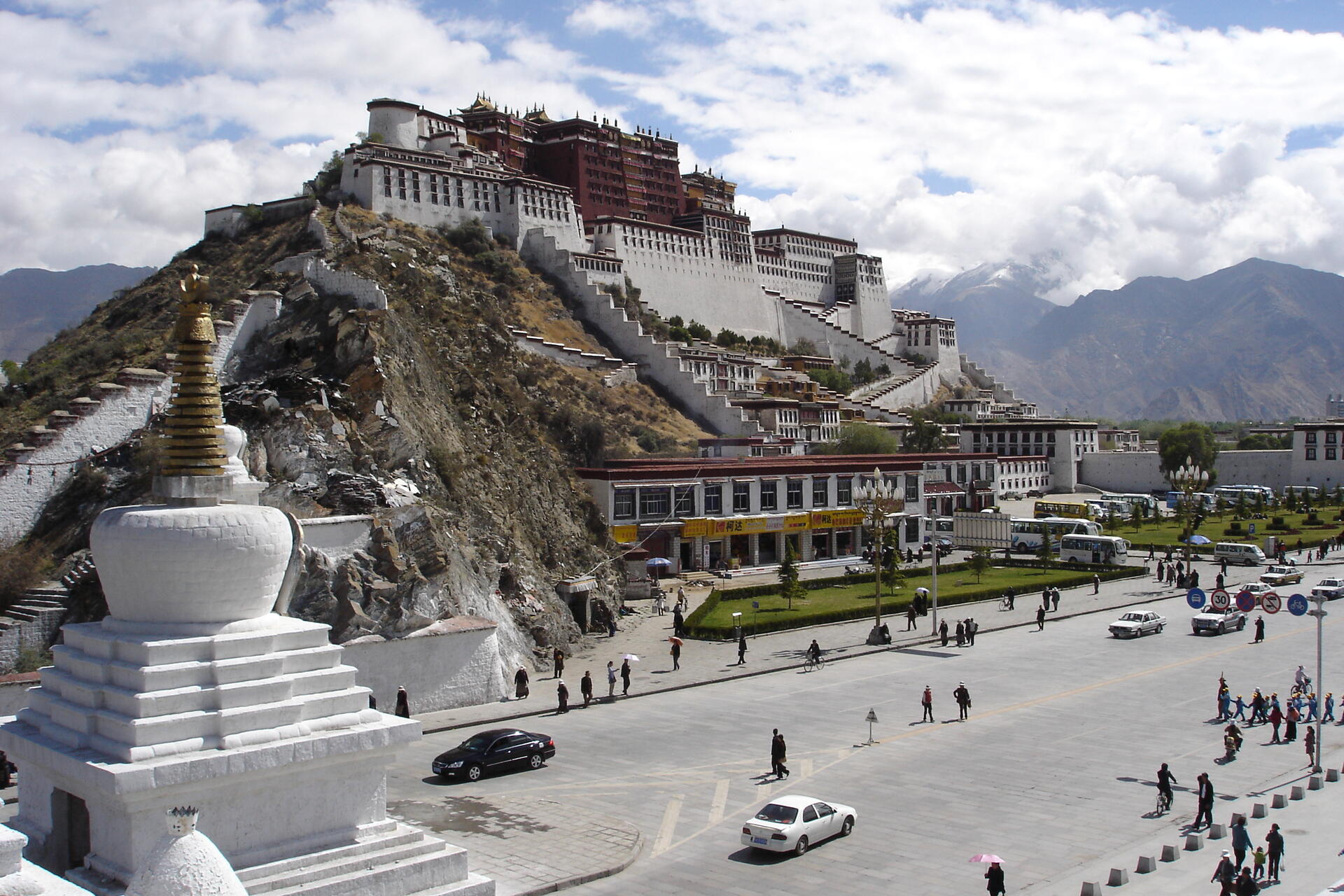
The Historic Ensemble of the Potala Palace, located in the heart of Lhasa, the capital city of the Tibet Autonomous Region in China, stands as a testament to the rich cultural and historical heritage of Tibet. Inscribed as a UNESCO World Heritage Site in 1994, the Potala Palace, along with the Jokhang Temple Monastery and Norbulingka, embodies the essence of Tibetan Buddhism and its significant role in the traditional administration of Tibet.
The Potala Palace, perched on Red Mountain in the center of the Lhasa Valley at an elevation of approximately 3,700 meters above sea level, served as the winter residence of the Dalai Lamas from the 17th century. The site itself, however, has religious and political significance dating back to the 7th century, when the original palace and temple structures were built by Songtsen Gampo.
The current palace complex, constructed mainly under the 5th Dalai Lama, exemplifies dzong-style architecture and reflects a harmonious blend of Tibetan, Nepalese, and Chinese influences, showcasing the diverse cultural currents that shaped Tibet over centuries.
The Potala Palace complex comprises two main sections: the White Palace and the Red Palace. The White Palace contains administrative offices as well as living quarters of the Dalai Lama, while the Red Palace is dedicated to religious functions, housing numerous chapels, shrines, and stupas containing the tombs of eight Dalai Lamas. Together, the two sections illustrate the close interconnection between governance and spiritual life in traditional Tibetan society.
One of the most notable features of the Potala Palace is its rich ornamentation, which includes thousands of murals, statues, and thangkas (Tibetan scroll paintings). These artistic works depict various scenes from Tibetan Buddhist mythology and history, providing valuable insights into the beliefs, customs, and traditions of the Tibetan people.
In addition to the Potala Palace, the Historic Ensemble also includes the Jokhang Temple Monastery, another essential religious site in Lhasa. Founded in the 7th century, the Jokhang Temple is considered one of the oldest and most sacred temples in all of Tibet. Its architecture is characterized by a fusion of Tibetan, Chinese, and Indian styles, creating a unique aesthetic that reflects the interconnectedness of these cultures.
Finally, the Historic Ensemble encompasses Norbulingka, the former summer palace of the Dalai Lamas. Constructed in the 18th century, this magnificent complex represents the pinnacle of Tibetan art and craftsmanship. With its lush gardens, grand halls, and exquisite artwork, Norbulingka offers a tranquil escape from the bustling city of Lhasa, providing visitors with a glimpse into the opulence and elegance of the Dalai Lama's court.
Today, the Dalai Lama no longer resides in the Potala Palace. Following the 1959 uprising, the 14th Dalai Lama, Tenzin Gyatso, fled to Dharamshala, India. While he formally devolved his political authority to an elected leadership in 2011, he remains the preeminent spiritual leader of the Tibetan people in 2026. His absence reflects the complex modern political landscape, yet the Potala Palace remains an enduring symbol of the unique blend of religion, governance, and art that defines Tibetan civilization.
In sum, the Historic Ensemble of the Potala Palace, Lhasa, is more than just a collection of architectural wonders; it is a living testament to the rich cultural and historical heritage of Tibet. By preserving these sites, we ensure that future generations can continue to appreciate the unique blend of religion, politics, and art that defines Tibetan civilization.
UNESCO Description of the World Heritage Site
The Potala Palace, winter palace of the Dalai Lama since the 7th century, symbolizes Tibetan Buddhism and its central role in the traditional administration of Tibet. The complex, comprising the White and Red Palaces with their ancillary buildings, is built on Red Mountain in the centre of Lhasa Valley, at an altitude of 3,700m. Also founded in the 7th century, the Jokhang Temple Monastery is an exceptional Buddhist religious complex. Norbulingka, the Dalai Lama's former summer palace, constructed in the 18th century, is a masterpiece of Tibetan art. The beauty and originality of the architecture of these three sites, their rich ornamentation and harmonious integration in a striking landscape, add to their historic and religious interest.
UNESCO Justification of the World Heritage Site
Criterion (i): The Historic Ensemble of the Potala Palace is an outstanding work of human imagination and creativity, for its design, its decoration and its harmonious setting within a dramatic landscape. The three-in-one historic ensemble of the Potala Palace, with Potala the palace-fort complex, Norbulingka the garden residence and the Jokhang Temple Monastery the temple architecture, each with its distinctive characteristics, forms an outstanding example of traditional Tibetan architecture.
Criterion (iv): The scale and artistic wealth of the Historic Ensemble of the Potala Palace, which represents the apogee of Tibetan architecture, make it an outstanding example of theocratic architecture, of which it was the last surviving example in the modern world.
Criterion (vi): The Historic Ensemble of the Potala Palace forms a potent and exceptional symbol of the integration of secular and religious authority.
Encyclopedia Record: Potala Palace
Potala Palace is a museum complex in Lhasa, the capital of the Tibet Autonomous Region of China. It was formerly the winter palace of the Dalai Lamas, built in the dzong style on Marpo Ri. From 1649 until 1959 it served as the Dalai Lamas' residence, after which it became chiefly a museum following the annexation of Tibet by the People's Republic of China.Additional Site Details
Area: 60.5 hectares
Number of Components: 3
(iv) — Outstanding example of a type of building or landscape
(vi) — Directly associated with events or living traditions
Coordinates: 29.65792 , 91.11717
World Heritage Research
Discover scientific research and academic studies that deepen our understanding of Historic Ensemble of the Potala Palace, Lhasa from its history and significance to its conservation, management, and contemporary challenges.
-
Research on Urban Functional Zone Identification and Spatial Interaction Characteristics in Lhasa Based on Ride-Hailing Trajectory Data
A new method combining ride-hailing trajectory data with Point of Interest (POI) data reveals that Lhasa's urban functional zones exhibit a 'highly composite core, relatively differentiated periphery' pattern. The study identified eight distinct functional zone types, including commercial-residential mixed and science-education-culture areas, with residential regions forming the base and the core area featuring multi-functional agglomeration. The spatial interaction network demonstrates small-world effects and a lognormal degree distribution, highlighting key hubs like Lhasa Station and the Potala Palace. Four functionally coupled communities were detected, forming a 'core leading, two wings supporting' center-subcenter spatial organization pattern. This approach offers a novel perspective for understanding plateau city structures and planning.
Teng, J., Li, S., Chen, J., Zhao, J., Wang, X., Yuan, L., Lin, J., Lang, C., Zhang, H., & Xie, W. (2026). Research on Urban Functional Zone Identification and Spatial Interaction Characteristics in Lhasa Based on Ride-Hailing Trajectory Data. Land, 15(4), 677. https://doi.org/10.3390/land15040677
View Publication Record | Read Publication -
The Power of Publishing in Early Modern Tibetan Buddhism
Tibetan woodblock publishing flourished during the late seventeenth and eighteenth centuries, marking a 'golden age' that significantly influenced Tibetan Buddhist culture, religion, and politics across Tibet, Mongolia, and China. This study reveals how the publication and dissemination of Tibetan books, initiated under the Fifth Dalai Lama's Potala Palace in Lhasa, played a pivotal role in shaping religious and political landscapes well into the twentieth century. The research traces the circulation of these texts through cosmopolitan Qing Beijing and monastic colleges along the Sino-Tibetan borderlands, demonstrating their multifaceted use in scholarship, ritual, and various reading practices. Mahāyāna Buddhist ideas are identified as a key driver behind this publishing boom, highlighting the profound impact of textual exchange on early modern Tibetan Buddhist societies.
Nourse, B. J. (2025). The Power of Publishing in Early Modern Tibetan Buddhism. https://doi.org/10.5771/9781666958010
View Publication Record | Read Publication -
Power of Publishing in Early Modern Tibetan Buddhism
Tibetan woodblock publishing reached its peak during the late seventeenth and eighteenth centuries, significantly shaping the religious and political landscapes of Tibet, Mongolia, and China. This 'golden age' of Tibetan printing was driven by Mahayana Buddhist ideas and facilitated the circulation of books for scholarship, exchange, ritual, and diverse reading practices. The study traces the publication and dissemination of Tibetan texts from the Potala Palace in Lhasa to cosmopolitan Qing Beijing and monastic colleges along the Sino-Tibetan borderlands, demonstrating its enduring influence into the twentieth century.
Nourse, B. J. (2025). Power of Publishing in Early Modern Tibetan Buddhism (, Ed.). Lexington Books. https://doi.org/10.5040/9781978747180
View Publication Record | Read Publication -
Lhasella potala Zhou, Da, Zahradnik & Bai 2025, sp. nov.
A new beetle species, Lhasella potala, has been discovered within the wooden structures of the Potala Palace, a UNESCO World Heritage Site in Lhasa, China. This species is characterized by its distinctive antennomeres V and VII, which are enlarged and strongly serrated, setting it apart from other known Ptinidae beetles. The discovery highlights the ecological significance of historic wooden structures as habitats for biodiversity. Researchers described the species' morphology, including its reddish-brown body with yellowish-brown pubescence, long and slim legs, and sexual dimorphism in antennae. The study also documented the larvae's role in degrading wood, contributing to our understanding of beetle-wood interactions in culturally significant sites.
Zhou, X., Pubu, Z., Zhang, W., Shen, R., Da, W., Gongga, Z., Zhaxi, P., & Bai, M. (2025). Lhasella potala Zhou, Da, Zahradnik & Bai 2025, sp. nov. Zenodo. https://doi.org/10.5281/ZENODO.19198039
View Publication Record | Read Publication -
Urban Infrastructure Development and Its Contribution to World Cultural Heritage Conservation in the Xizang Autonomous Region
A strong positive correlation exists between urban infrastructure development and tourism growth at UNESCO World Heritage Sites in Lhasa, with paved road length (r = 0.92) and public transport capacity (r = 0.85) being the most significant contributors. Analysis of data from 2015–2024 reveals that 89% of tourism variation is explained by infrastructure improvements, which have boosted Lhasa's economy and international standing. However, rapid urbanization poses risks to cultural authenticity, underscoring the need for balanced development aligned with UNESCO’s sustainable tourism policies. The study provides empirical evidence for developing nations facing similar challenges, though it calls for further qualitative research on visitor impacts and local perceptions to strengthen conservation strategies.
Hansamali, M. P., Perera, J. A. K. R., & Munasinghe, D. S. A. (2025). Urban Infrastructure Development and Its Contribution to World Cultural Heritage Conservation in the Xizang Autonomous Region. TRIVALENT ත්රිසංයුජ: Journal of Archaeology, Tourism & Anthropology, 5(1), 44–63. https://doi.org/10.4038/tjata.v5i1.124
View Publication Record | Read Publication -
Tourism at the roof of the world: young hosts assess tourism community futures in Lhasa, Tibet
Young Tibetan 'post-80s' youth prioritize environmental preservation, cultural appreciation, and open-minded tourism policies for Lhasa's future. This study reveals their nuanced perceptions of tourism assets—ranging from heritage sites to local customs—and identifies four distinct groups with varying levels of support for tourism as a livelihood choice. Using social representations theory and the Sustainable Livelihoods Framework, the research integrates emic and etic approaches through photo-elicitation interviews, focus groups, and surveys, offering insights into community-level aspirations in a non-Western urban context. Findings highlight the influence of cultural values, institutional arrangements, and vulnerability on tourism perceptions, while contrasting urban and suburban youth preferences for community-based development over external investment.
Wu, M.-Y. (2012). Tourism at the roof of the world: young hosts assess tourism community futures in Lhasa, Tibet [James Cook University]. https://doi.org/10.25903/CP2D-1H54
View Publication Record | Read Publication -
Spatial-temporal behaviour of hikers in the southeastern margin of Qinghai-Tibet Plateau: insights from volunteered geographic information
Hikers exhibit distinct spatial-temporal behaviors compared to traditional tourists, with significant implications for sustainable tourism planning and management. A study analyzing the southeastern margin of the Qinghai-Tibet Plateau—home to multiple UNESCO World Heritage Sites—revealed that hikers differ markedly in travel duration, mode, and destination preferences. Researchers leveraged volunteered geographic information (VGI) alongside seasonal intensity indices, kernel density analysis, line density analysis, and K-means clustering to map these patterns. The findings highlight critical insights for regional tourism development, particularly in balancing conservation with visitor engagement in this ecologically and culturally rich area.
Zhao, O., & Wang, J. (2023). Spatial-temporal behaviour of hikers in the southeastern margin of Qinghai-Tibet Plateau: insights from volunteered geographic information. Geocarto International, 38(1). https://doi.org/10.1080/10106049.2023.2296183
View Publication Record | Read Publication