World Heritage Identification Number: 338
World Heritage since: 1985
Category: Natural Heritage
WHE Type: Protected Areas & National Parks
Transboundary Heritage: No
Endangered Heritage: No
Country: 🇮🇳 India
Continent: Asia
UNESCO World Region: Asia and the Pacific
Map
Manas Wildlife Sanctuary: A Biodiverse Haven in the Himalayan Foothills
The Manas Wildlife Sanctuary, nestled in the picturesque foothills of the Himalayas, presents a captivating tapestry of diverse landscapes that seamlessly blend wooded hills, alluvial grasslands, and tropical forests. This enchanting expanse, located in the northeastern state of Assam, India, has been recognized as a UNESCO World Heritage Site since 1985 due to its exceptional biodiversity, striking scenery, and rich variety of habitats.
More to come…UNESCO Description of the World Heritage Site
On a gentle slope in the foothills of the Himalayas, where wooded hills give way to alluvial grasslands and tropical forests, the Manas sanctuary is home to a great variety of wildlife, including many endangered species, such as the tiger, pygmy hog, Indian rhinoceros and Indian elephant.
UNESCO Justification of the World Heritage Site
Criterion (vii): Manas is recognized not only for its rich biodiversity but also for its spectacular scenery and natural landscape. Manas is located at the foothills of the Eastern Himalayas. The northern boundary of the park is contiguous to the international border of Bhutan manifested by the imposing Bhutan hills. It spans on either side of the majestic Manas river flanked in the east and the west by reserved forests. The tumultuous river swirling down the rugged mountains in the backdrop of forested hills coupled with the serenity of the alluvial grasslands and tropical evergreen forests offers a unique wilderness experience.
Criterion (ix): The Manas-Beki system is the major river system flowing through the property and joining the Brahmaputra river further downstream. These and other rivers carry an enormous amount of silt and rock debris from the foothills resulting from the heavy rainfall, fragile nature of the rock and steep gradients of the catchments. This leads to the formation of alluvial terraces, comprising deep layers of deposited rock and detritus overlain by sandy loam and a layer of humus represented by bhabar tracts in the north. The terai tract in the south consists of fine alluvial deposits with underlying pans where the water table lies near to the surface. The area contained by the Manas-Beki system gets inundated during the monsoons but flooding does not last long due to the sloping relief. The monsoon and river system form four principal geological habitats: Bhabar savannah, Terai tract, marshlands and riverine tracts. The dynamic ecosystem processes support broadly three types of vegetation: semi-evergreen forests, mixed moist and dry deciduous forests and alluvial grasslands. The dry deciduous forests represent an early stage in succession that is constantly renewed by floods and is replaced by moist decidous forests away from water courses, which in turn are replaced by semi evergreen climax forests. The vegetation of Manas has tremendous regenerating and self-sustaining capabilities due to its high fertility and response to natural grazing by herbivorous animals.
Criterion (x): The Manas Wildlife Sanctuary provides habitat for 22 of India’s most threatened species of mammals. In total, there are nearly 60 mammal species, 42 reptile species, 7 amphibians and 500 species of birds, of which 26 are globally threatened. Noteworthy among these are the elephant, tiger, greater one-horned rhino, clouded leopard, sloth bear, and other species. The wild buffalo population is probably the only pure strain of this species still found in India. It also harbours endemic species like pygmy hog, hispid hare and golden langur as well as the endangered Bengal florican. The range of habitats and vegetation also accounts for high plant diversity that includes 89 tree species, 49 shrubs, 37 undershrubs, 172 herbs and 36 climbers. Fifteen species of orchids, 18 species of fern and 43 species of grasses that provide vital forage to a range of ungulate species also occur here.
Encyclopedia Record: Manas National Park
Manas National Park is a national park, Project Tiger reserve, and an elephant reserve in Assam, India. Located in the Himalayan foothills, it borders the Royal Manas National Park in Bhutan. The park is known for its rare and endangered endemic wildlife such as the Assam roofed turtle, hispid hare, golden langur and pygmy hog. It also hosts the only known population of pygmy hogs in the world. Manas is also famous for its population of the wild water buffalo. Because of its exceptional biodiversity, scenery, and variety of habitats, Manas National Park is a biosphere reserve and a UNESCO World Heritage Site.Additional Site Details
Area: 39,100 hectares
Number of Components: 1
(ix) — Outstanding example representing ecological and biological processes
(x) — Contains most important habitats for biodiversity
Coordinates: 26.725 , 91.03055556
IUCN World Heritage Outlook
The 2025 Conservation Outlook on Manas Wildlife Sanctuary reports the following assessment:
Source: International Union for Conservation of Nature (IUCN) · View assessment
Image
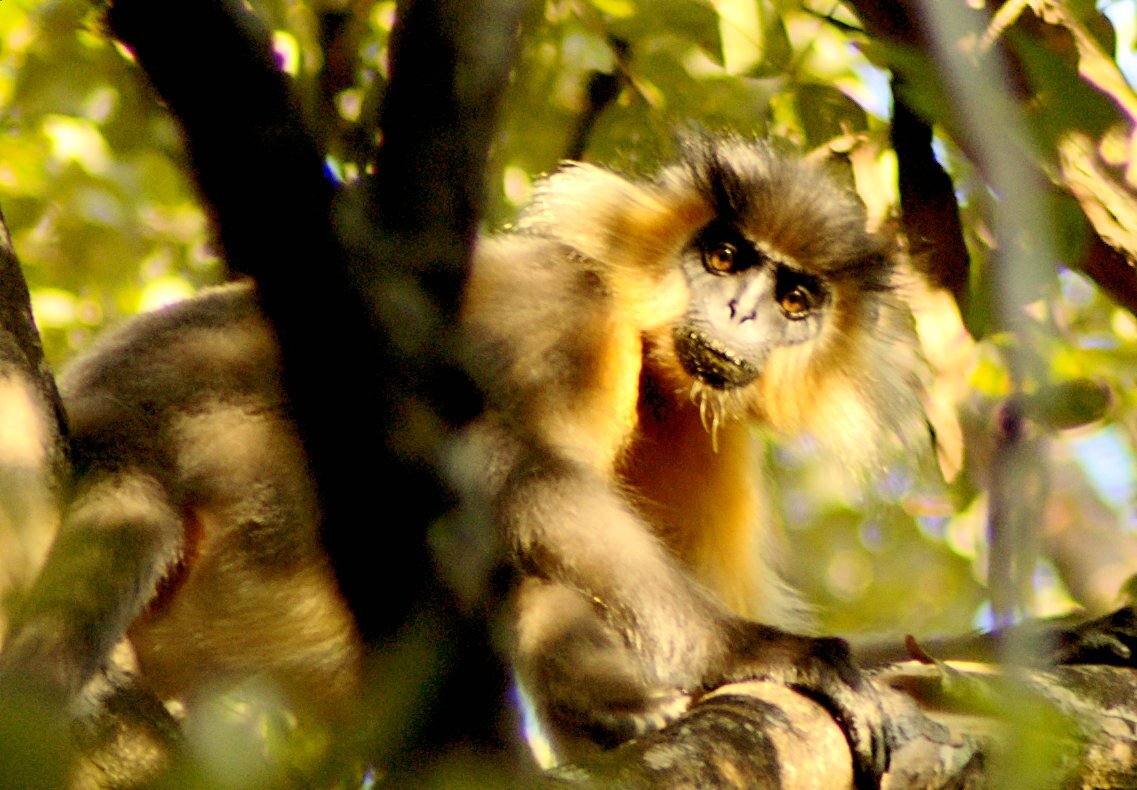
© Pankaj from Bangalore, India, CC BY-SA 2.0 Resized from original. (This derivative is under the same CC BY-SA license.)
World Heritage Research
Discover scientific research and academic studies that deepen our understanding of Manas Wildlife Sanctuary from its history and significance to its conservation, management, and contemporary challenges.
-
Forecasting climate-resilient conservation futures for the White-bellied Heron ( Ardea insignis ) in Bhutan using coupled model intercomparison project phase 6 climate scenario
Bhutan's largest population of the critically endangered White-bellied Heron (Ardea insignis), one of the world's rarest birds, faces significant climate-induced habitat shifts. Projections indicate a potential expansion of suitable habitat from 8,219 km² under baseline conditions to 13,784 km² by 2100, but with increased fragmentation and suitability loss in unprotected areas like Monggar and Pemagatshel. Protected zones such as Royal Manas National Park remain resilient, while others may become unsuitable due to climate change. This study, Bhutan's first nationwide climate-informed habitat model, combines 361 verified occurrence records (2001–2024) with 24 environmental predictors using a weighted ensemble modeling framework—integrating generalized linear models, generalized additive models, and random forest algorithms—to project future distributions under Shared Socioeconomic Pathway 3 scenarios. It highlights protection gaps, advocates for adaptive conservation strategies, and underscores the need for connectivity measures amid dynamic anthropogenic pressures.
Dendup, P., Chophel, U., Wangchuk, J., Phuntsho, D., Syldon, P., Dorji, T., Dhendup, P., Wangda, P., Namgyel, C., & Subba, M. (2026). Forecasting climate-resilient conservation futures for the White-bellied Heron ( Ardea insignis ) in Bhutan using coupled model intercomparison project phase 6 climate scenario. Avian Conservation and Ecology, 21(1). https://doi.org/10.5751/ace-03003-210102
View Publication Record | Read Publication -
Sustainable Conservation Livelihood activity: A case from the Royal Manas National Park, Bhutan.
A five-year evaluation of Bhutan's Jersey calf-sharing scheme in the Royal Manas National Park revealed significant conservation and livelihood benefits. The initiative, which distributed seed cows to 56 households with the condition to share female offspring, led to a 43.6% increase in Jersey cows, reduced forest grazing, lower livestock losses to carnivores, and improved dairy income. This approach also fostered equitable benefit sharing, strengthened community engagement, and promoted positive conservation attitudes. The study highlights the potential of such schemes as sustainable tools for balancing livelihood needs with wildlife conservation, particularly in multiple-use zones where human-wildlife interactions pose challenges.
Wangchuk, S., Wangchuk, S., Wangchuk, D., & Lhendup, J. (2026). Sustainable Conservation Livelihood activity: A case from the Royal Manas National Park, Bhutan. Parks, 75. https://doi.org/10.2305/wpgz3455
View Publication Record | Read Publication -
Climate Change And Biodiversity Loss In Manas National Park
Climate change is significantly accelerating biodiversity loss in Manas National Park, a UNESCO World Heritage Site in northeastern India. Rising temperatures, erratic rainfall, and increased flooding are altering habitat structures, particularly grasslands crucial for herbivores, leading to species migration, ecological imbalance, and heightened vulnerability of endangered fauna. These changes also exacerbate human-wildlife conflicts and promote the spread of alien species. The study, using secondary data sources such as government reports and academic articles, highlights the urgent need for climate-resilient conservation strategies, including habitat restoration, systematic monitoring, community-based resource management, strengthened policy frameworks, and transboundary cooperation to ensure long-term ecological sustainability.
Bhagyashree Pathak*. (2026). Climate Change And Biodiversity Loss In Manas National Park. International Journal of Scientific Research and Technology. https://doi.org/10.5281/ZENODO.21641419
View Publication Record | Read Publication -
Women Entrepreneurship in National Park: Challenges, Motivations, and Growth Potential with special reference to Manas National Park, India.
Despite being crucial contributors to revenue generation, women entrepreneurship remains underdeveloped in rural areas of Manas National Park, a key wildlife tourism destination. This study highlights significant barriers preventing women from establishing and running enterprises in the region, while also identifying motivations for those interested in venturing into entrepreneurship. The research employs a dual approach: analyzing existing women entrepreneurs' challenges and examining factors that inspire aspiring female business owners. Findings underscore the untapped potential of women-led businesses in supporting sustainable tourism growth within protected areas like Manas National Park.
(Ed.). (2025). Women Entrepreneurship in National Park: Challenges, Motivations, and Growth Potential with special reference to Manas National Park, India. European Economic Letters. https://doi.org/10.52783/eel.v15i1.2528
View Publication Record | Read Publication -
Conservation Challenges in the Eastern Buffer Zone of Manas National Park: A Case Study of Dihira Proposed Reserve Forest
A study on the Dihira Proposed Reserve Forest, part of Manas National Park's Eastern Buffer Zone, reveals significant progress in mitigating human-elephant conflicts and preserving elephant corridors through targeted conservation strategies. By integrating Geographic Information System (GIS) mapping with community-reported data and participatory approaches, researchers identified critical conflict zones and implemented sustainable livelihood initiatives, such as dairy and piggery farming, which increased household incomes by 15% to 30%. The installation of solar lights in high-risk areas reduced nighttime elephant incursions. This research demonstrates a successful model for balancing conservation with local economic needs, fostering coexistence between wildlife and communities.
Sarkar, N. S., Ganguly, M., Mahanta, R., Dutta, D. K., & Gautam, P. (2025). Conservation Challenges in the Eastern Buffer Zone of Manas National Park: A Case Study of Dihira Proposed Reserve Forest. Indian Forester. https://doi.org/10.36808/if/2025/v151i10/170694
View Publication Record | Read Publication -
Diversity and Microhabitat Association of Spider Fauna in Manas National Park, Assam, India
Manas National Park (MNP) in Assam, India, harbors a rich diversity of spider fauna, with 73 species recorded across 47 genera and 16 families. Family Araneidae was the most abundant, representing 28.77% of the total species. The study, conducted from September 2018 to August 2021, used semi-quantitative sampling in woodland, grassland, and riparian habitats, revealing that woodland areas hosted the highest diversity (54.17%). Orb-weaver spiders dominated (45.21%), with leaf surfaces being the most common microhabitat (42.47%). These findings underscore MNP's significance as a conservation priority area due to its high spider diversity, which serves as an indicator of ecosystem health.
Daimary, M. J., Saikia, P. K., Saikia, M. K., Borah, K. J., Saikia, B. P., & Sarma, K. (2024). Diversity and Microhabitat Association of Spider Fauna in Manas National Park, Assam, India. Environment and Ecology, 42(1), 163–180. https://doi.org/10.60151/envec/kyln9948
View Publication Record | Read Publication -
Carnivore Chronicles: Co-occurrence and habitat use in the tropical forest of Manas National Park, North-East India
Research in Manas National Park, India, reveals that most carnivore species exhibit random co-occurrence patterns with limited spatial overlap, suggesting minimal antagonism among them despite shared habitats. The study, using camera-trap data from 37 species over 11,388 trap nights, found that large carnivores like tigers and leopards show distinct habitat preferences influenced by prey availability, elevation, and human presence. Tigers favor areas with abundant large-medium prey but avoid forest roads, while leopards prefer habitats with medium and small prey. Small and meso-carnivores, including clouded leopards and dholes, thrive in dense vegetation and regions rich in small prey. The findings underscore the importance of protecting diverse habitats, mitigating human-wildlife conflicts, and maintaining healthy prey populations for the long-term conservation of carnivores in tropical forests.
Bhatt, U., & Lyngdoh, S. (2024). Carnivore Chronicles: Co-occurrence and habitat use in the tropical forest of Manas National Park, North-East India. Journal of Wildlife Science, 1(1), 16–30. https://doi.org/10.63033/jwls.gctq1198
View Publication Record | Read Publication