World Heritage Identification Number: 337
World Heritage since: 1985
Category: Natural Heritage
WHE Type: Protected Areas & National Parks
Transboundary Heritage: No
Endangered Heritage: No
Country: 🇮🇳 India
Continent: Asia
UNESCO World Region: Asia and the Pacific
Map
Kaziranga National Park: A Sanctuary for the One-Horned Rhinoceros
Kaziranga National Park, located in the northeastern Indian state of Assam, is a significant biodiversity hotspot that serves as a vital habitat for numerous endangered species. Established in 1908 as a reserve forest, it was declared a national park in 1974, and in 1985, it was inscribed as a UNESCO World Heritage Site.
More to come…UNESCO Description of the World Heritage Site
In the heart of Assam, this park is one of the last areas in eastern India undisturbed by a human presence. It is inhabited by the world's largest population of one-horned rhinoceroses, as well as many mammals, including tigers, elephants, panthers and bears, and thousands of birds.
UNESCO Justification of the World Heritage Site
Criterion (ix): River fluctuations by the Brahmaputra river system result in spectacular examples of riverine and fluvial processes. River bank erosion, sedimentation and formation of new lands as well as new water-bodies, plus succession between grasslands and woodlands represents outstanding examples of significant and ongoing, dynamic ecological and biological processes. Wet alluvial grasslands occupy nearly two-thirds of the park area and are maintained by annual flooding and burning. These natural processes create complexes of habitats which are also responsible for a diverse range of predator/prey relationships.
Criterion (x): Kaziranga was inscribed for being the world’s major stronghold of the Indian one-horned rhino, having the single largest population of this species, currently estimated at over 2,000 animals. The property also provides habitat for a number of globally threatened species including tiger, Asian elephant, wild water buffalo, gaur, eastern swamp deer, Sambar deer, hog deer, capped langur, hoolock gibbon and sloth bear. The park has recorded one of the highest density of tiger in the country and has been declared a Tiger Reserve since 2007. The park’s location at the junction of the Australasia and Indo-Asian flyway means that the park’s wetlands play a crucial role for the conservation of globally threatened migratory bird species. The Endangered Ganges dolphin is also found in some of the closed oxbow lakes.
Encyclopedia Record: Kaziranga National Park
Kaziranga National Park is a national park in the Golaghat, Sonitpur, Biswanath and Nagaon districts of the state of Assam, India. KNP has 5 ranges. The park, which hosts two-thirds of the world's Indian rhinoceroses, is a UNESCO World Heritage Site. According to a March 2018 census conducted jointly by the Forest Department of the Government of Assam and some recognized wildlife NGOs, the rhino population in Kaziranga National Park is 2,613. It comprises 1,641 adult rhinos and 385 calves.Additional Site Details
Area: 42,996 hectares
Number of Components: 1
(x) — Contains most important habitats for biodiversity
Coordinates: 26.66666667 , 93.41666667
IUCN World Heritage Outlook
The 2025 Conservation Outlook on Kaziranga National Park reports the following assessment:
Source: International Union for Conservation of Nature (IUCN) · View assessment
Image
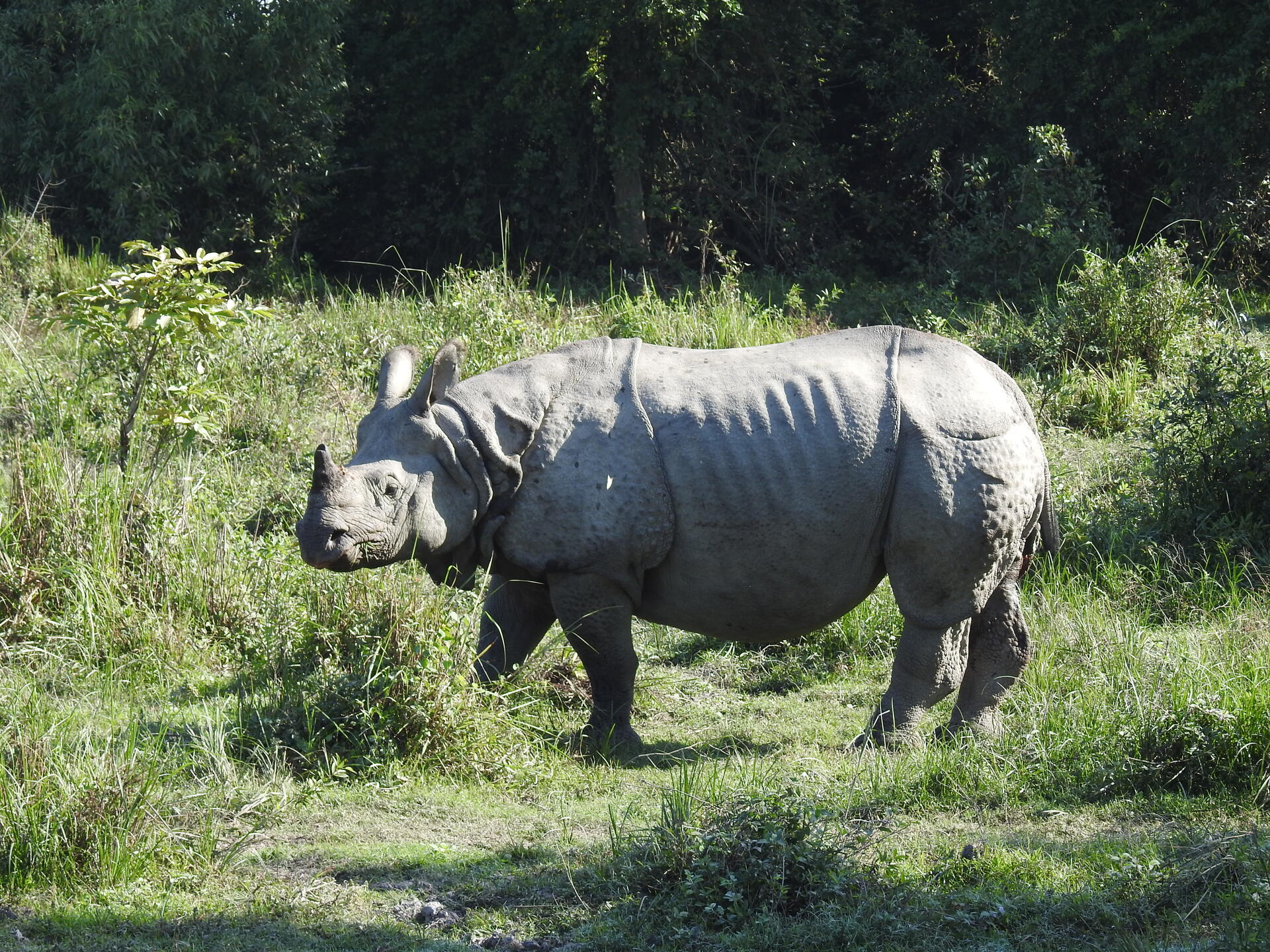
© Dr. Raju Kasambe, CC BY-SA 4.0 Resized from original. (This derivative is under the same CC BY-SA license.)