World Heritage Identification Number: 1083
World Heritage since: 2003
Category: Natural Heritage
WHE Type: Protected Areas & National Parks
Transboundary Heritage: No
Endangered Heritage: No
Country: 🇨🇳 China
Continent: Asia
UNESCO World Region: Asia and the Pacific
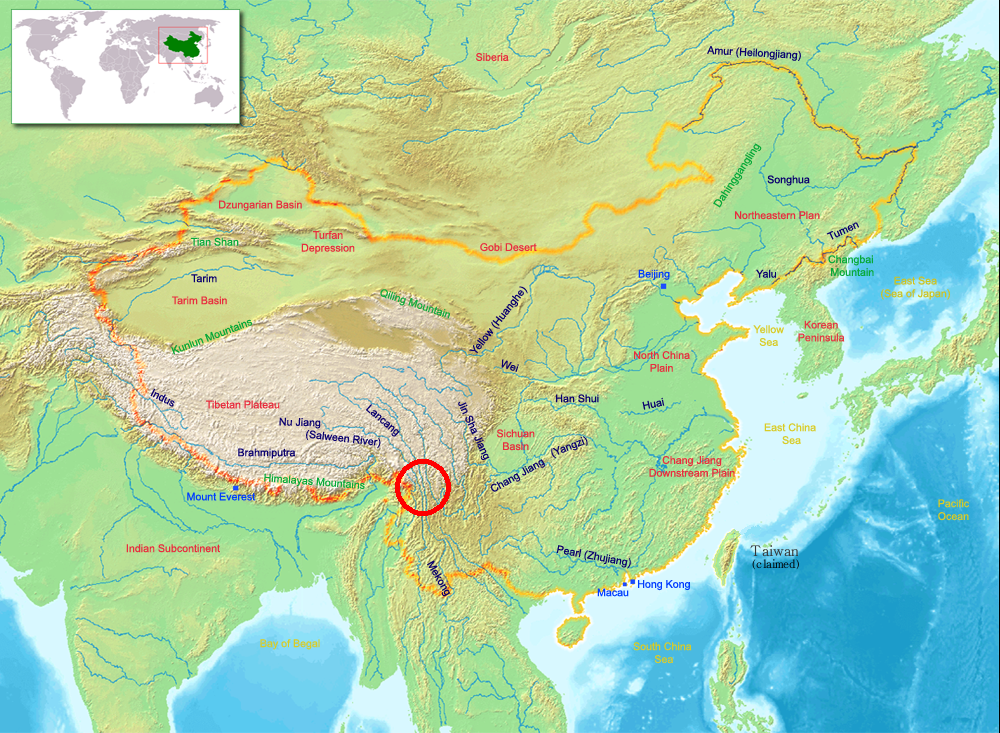
Map
A Journey Through the Three Parallel Rivers of Yunnan Protected Areas
The Three Parallel Rivers of Yunnan Protected Areas, inscribed as a UNESCO World Heritage Site in 2003, offers a unique exploration into the rich biodiversity and breathtaking landscapes of China's Yunnan Province. This expansive region, spanning approximately 1.7 million hectares, is situated within the boundaries of the Three Parallel Rivers National Park and encompasses sections of the upper reaches of three of Asia's greatest rivers: the Yangtze (Jinsha), Mekong, and Salween. These mighty waterways, running roughly parallel from north to south, carve their paths through steep gorges that reach depths of up to 3,000 meters and are flanked by towering peaks surpassing 6,000 meters.
More to come…UNESCO Description of the World Heritage Site
Consisting of eight geographical clusters of protected areas within the boundaries of the Three Parallel Rivers National Park, in the mountainous north-west of Yunnan Province, the 1.7 million hectare site features sections of the upper reaches of three of the great rivers of Asia: the Yangtze (Jinsha), Mekong and Salween run roughly parallel, north to south, through steep gorges which, in places, are 3,000 m deep and are bordered by glaciated peaks more than 6,000 m high. The site is an epicentre of Chinese biodiversity. It is also one of the richest temperate regions of the world in terms of biodiversity.
UNESCO Justification of the World Heritage Site
Criterion (vii): The deep, parallel gorges of the Jinsha, Lancang and Nu Jiang are the outstanding natural feature of the property; while large sections of the three rivers lie just outside the property boundaries, the river gorges are nevertheless the dominant scenic element in the area. High mountains are everywhere, with the glaciated peaks of the Meili, Baima and Haba Snow Mountains providing a spectacular scenic skyline. The Mingyongqia Glacier is a notable natural phenomenon, descending to 2700 m altitude from Mt Kawagebo (6740 m), and is claimed to be the glacier descending to the lowest altitude for such a low latitude (28° N) in the northern hemisphere. Other outstanding scenic landforms are the alpine karst (especially the 'stone moon' in the Moon Mountain Scenic Area above the Nu Jiang Gorge) and the 'tortoise shell' weathering of the alpine Danxia.
Criterion (viii): The property is of outstanding value for displaying the geological history of the last 50 million years associated with the collision of the Indian Plate with the Eurasian Plate, the closure of the ancient Tethys Sea, and the uplifting of the Himalaya Range and the Tibetan Plateau. These were major geological events in the evolution of the land surface of Asia and they are on-going. The diverse rock types within the property record this history and, in addition, the range of karst, granite monolith, and Danxia sandstone landforms in the alpine zone include some of the best of their type in the mountains of the world.
Criterion (ix): The dramatic expression of ecological processes in the Three Parallel Rivers property has resulted from a mix of geological, climatic and topographical effects. First, the location of the area within an active orographic belt has resulted in a wide range of rock substrates from igneous (four types) through to various sedimentary types including limestones, sandstones and conglomerates. An exceptional range of topographical features - from gorges to karst to glaciated peaks -- is associated with the property being at a collision point of tectonic plates. Add the fact that the area was a Pleistocene refugium and is located at a biogeographical convergence zone (i.e. with temperate and tropical elements) and the physical foundations for evolution of its high biodiversity are all present. Along with the landscape diversity with a steep gradient of almost 6000m vertical, a monsoon climate affects most of the area and provides another favourable ecological stimulus that has allowed the full range of temperate Palearctic biomes to develop.
Criterion (x): Northwest Yunnan is the area of richest biodiversity in China and may be the most biologically diverse temperate region on earth. The property encompasses most of the natural habitats in the Hengduan Mountains, one of the world's most important remaining areas for the conservation of the earth's biodiversity. The outstanding topographic and climatic diversity of the property, coupled with its location at the juncture of the East Asia, Southeast Asia, and Tibetan Plateau, biogeographical realms and its function as a N-S corridor for the movement of plants and animals (especially during the ice ages), marks it as a truly unique landscape, which still retains a high degree of natural character despite thousands of years of human habitation. As the last remaining stronghold for an extensive suite of rare and endangered plants and animals, the property is of Outstanding Universal Value.
Encyclopedia Record: Three Parallel Rivers
The Three Parallel Rivers of Yunnan Protected Areas is a UNESCO World Heritage Site in Yunnan province, China. It lies within the drainage basins of the upper reaches of the Jinsha (Yangtze), Lancang (Mekong) and Nujiang (Salween) rivers, in the Yunnan section of the Hengduan Mountains.Additional Site Details
Area: Not available
Number of Components: 1
(viii) — Outstanding example representing major earth stages
(ix) — Outstanding example representing ecological and biological processes
(x) — Contains most important habitats for biodiversity
Coordinates: 27.895 , 98.40638889
IUCN World Heritage Outlook
The 2025 Conservation Outlook on Three Parallel Rivers of Yunnan Protected Areas reports the following assessment:
Source: International Union for Conservation of Nature (IUCN) · View assessment
Image
©
- ChinaGeography.png: en:User:Alanmak Alan Mak
- derivative work: Takeaway (talk)
World Heritage Research
Discover scientific research and academic studies that deepen our understanding of Three Parallel Rivers of Yunnan Protected Areas from its history and significance to its conservation, management, and contemporary challenges.
-
Assessment of the “Capacity-Usage” Relationship of Recreational Service Functions in the River Corridors of the Three Parallel Rivers World Natural Heritage Site
Over 90% of the Three Parallel Rivers World Natural Heritage Site exhibits low coordination between recreational potential and actual usage, with significant spatial disparities. Riparian zones show higher recreational activity due to superior natural conditions and infrastructure, while upstream regions and steep canyons remain underutilized despite their potential. Tourist usage peaks in autumn, particularly along the Jinsha River, which demonstrates stable year-round appeal. The study introduces a dual-dimensional evaluation framework combining 'Potential Capacity-Usage Level' to assess recreational service functions, offering insights for sustainable management and regional development planning.
YANG, P., & QI, J. (2026). Assessment of the “Capacity-Usage” Relationship of Recreational Service Functions in the River Corridors of the Three Parallel Rivers World Natural Heritage Site. Landscape Architecture, 33(6), 132–143. https://doi.org/10.3724/j.fjyl.la20250586
View Publication Record | Read Publication -
Conservation Gap Within a Nature Reserve: A Case Study in the Biodiversity Hotspot of Rare and Endangered Plants at the Southern Gaoligong Mountains
A significant conservation gap of 76.86% exists within the southern Gaoligong Mountains, part of the UNESCO-listed Three Parallel Rivers of Yunnan Protected Areas, highlighting the inadequacy of current protected zones in safeguarding rare and endangered plant species. Using distribution data for 361 species and environmental variables, the study employed InVEST and random forest models to project current and future potential habitats under climate change scenarios. Findings reveal that only 23.14% of the identified suitable habitat is protected, with agricultural expansion exacerbating habitat loss. The research underscores the need for prioritizing vertical zone integrity in conservation strategies to ensure continuous protection of biodiversity.
Yang, Y.-J.-W., Hu, X.-R., Deng, M., & Tan, Y.-H. (2025). Conservation Gap Within a Nature Reserve: A Case Study in the Biodiversity Hotspot of Rare and Endangered Plants at the Southern Gaoligong Mountains. Integrative Conservation, 4(1), 71–84. Portico. https://doi.org/10.1002/inc3.82
View Publication Record | Read Publication -
Estimating the Non-Use Value of Laojun Mountain National Park: A Contingent Valuation Study with Cultural Identity Mediation in Yunnan, China
Laojun Mountain National Park, within China's Three Parallel Rivers World Heritage region, holds significant non-use value estimated at 79.697 to 260.841 billion yuan annually, based on a contingent valuation study analyzing 219 survey responses. Key determinants of willingness to pay (WTP) for conservation include education, income, occupation, cultural identity, and recognition of legacy values. Interaction effect logistic regression revealed that cultural identity's influence on WTP is moderated by income level and ecological awareness. Motivational analysis identified aesthetic appreciation, cultural meaning, and intergenerational ethics as primary drivers of conservation support, while refusal to pay was largely tied to expectations of governmental responsibility among low-income and less-educated respondents. This study advances bio-cultural valuation theory, informs Payment for Ecosystem Services (PES) scheme design, and highlights the need for integrating socio-cultural dimensions into sustainable conservation finance and policy strategies.
Yang, C., Wu, R., Tao, J., Jiang, Q., Zhao, J., Xu, J., & Liu, Q. (2025). Estimating the Non-Use Value of Laojun Mountain National Park: A Contingent Valuation Study with Cultural Identity Mediation in Yunnan, China. Sustainability, 17(20), 9346. https://doi.org/10.3390/su17209346
View Publication Record | Read Publication -
Ethnobotanical study on ritual plants used by Hani people in Yunnan, China
An ethnobotanical study identifies 36 plant species used by the Hani people in Yunnan, China, for 11 ritual practices tied to agriculture and livelihood. Rosaceae, Poaceae, and Fabaceae families dominate, with Rhus chinensis Mill, Oryza sativa L., Phyllostachys sulphurea (Carr.) A. et C. Riv., and Musa basjoo Siebold & Zucc. ex Iinuma being the most cited for their cultural significance. Conducted through interviews and participatory observations in 10 villages from 2021 to 2023, the research highlights the Hani people's deep connection between ritual practices, traditional ecological knowledge, and biodiversity conservation, particularly in the UNESCO-listed Honghe Hani Rice Terraces.
Ma, X., Luo, D., Xiong, Y., Huang, C., & Li, G. (2024). Ethnobotanical study on ritual plants used by Hani people in Yunnan, China. Journal of Ethnobiology and Ethnomedicine, 20(1). https://doi.org/10.1186/s13002-024-00659-y
View Publication Record | Read Publication -
Spatio-Temporal Changes and Habitats of Rare and Endangered Species in Yunnan Province Based on MaxEnt Model
Rare and endangered species in Yunnan Province are predominantly concentrated in the western mountainous region, Xishuangbanna–Wenshan high temperature area, and Kunming–Qujing dense vegetation cover, with their distribution expanding westward. However, climate change significantly impacts their migration, with precipitation emerging as a critical factor. Under low carbon emission scenarios (RCP2.6), species will spread to lower altitude hotspots by 2070, while high emissions (RCP8.5) could reduce high abundance areas by then. The study used the maximum entropy model (MaxEnt) to predict current and future potential habitats, identifying significant conservation gaps and highlighting the need for enhanced protection of existing hotspots. Addressing human-land use conflicts and adapting to climate change are crucial for improving biodiversity conservation in Yunnan, positioning it as a global leader in this effort.
Lian, Y., Bai, Y., Huang, Z., Ali, M., Wang, J., & Chen, H. (2024). Spatio-Temporal Changes and Habitats of Rare and Endangered Species in Yunnan Province Based on MaxEnt Model. Land, 13(2), 240. https://doi.org/10.3390/land13020240
View Publication Record | Read Publication -
Spatial Quantification of Cropland Soil Erosion Dynamics in the Yunnan Plateau Based on Sampling Survey and Multi-Source LUCC Data
Cropland soil erosion in Yunnan's Three Parallel Rivers UNESCO World Heritage Site is unsustainably high, with a mean rate of 40.47 tonnes per hectare per year and an erosion ratio of 70.11%, significantly exceeding other land types. Engineering controls can reduce erosion by over fivefold, but cropland area has declined by 10.55% in two decades, cutting soil loss by 12.12%. The study used a novel point-to-surface approach combining field data from 2817 sample units and multi-source land-use change (LUCC) data to quantify erosion dynamics. While forest expansion most effectively reduces erosion, grassland-to-cropland conversion drives 56.18% of increased soil loss. These findings underscore the need for careful policy balancing between conservation strategies in mountainous regions.
Chen, G., Zhao, J., Duan, X., Tang, B., Zuo, L., Wang, X., & Guo, Q. (2024). Spatial Quantification of Cropland Soil Erosion Dynamics in the Yunnan Plateau Based on Sampling Survey and Multi-Source LUCC Data. Remote Sensing, 16(6), 977. https://doi.org/10.3390/rs16060977
View Publication Record | Read Publication -
Effectiveness assessment of protected areas based on the states, trends, and relative changes in forest ecosystem: a case study in the Three Parallel Rivers Region, China
A comprehensive assessment of the Three Parallel Rivers Protected Areas in China reveals significant conservation effectiveness, with 86% of protected areas showing positive impacts on forest ecosystems from 2000 to 2020. The study introduces an integrated framework that evaluates conservation effectiveness by analyzing the state, trend, and relative changes in forest ecosystems within these areas. This approach avoids misjudgments common in traditional methods, particularly in steady-state climax communities. Key factors influencing forest ecosystem states include annual total precipitation, distance to roads, and management level, with national protected areas outperforming local ones. The framework's effectiveness is highlighted by its ability to accurately assess conservation outcomes in regions with high biodiversity and steady ecosystems, offering a robust tool for future global or country-level assessments.
Shen, H., Feng, C., Tian, J., Fan, L., Cao, M., & Wang, W. (2024). Effectiveness assessment of protected areas based on the states, trends, and relative changes in forest ecosystem: a case study in the Three Parallel Rivers Region, China. Frontiers in Ecology and Evolution, 12. https://doi.org/10.3389/fevo.2024.1321974
View Publication Record | Read Publication