World Heritage Identification Number: 779
World Heritage since: 1996
Category: Mixed Cultural Heritage and Natural Heritage
WHE Type: Religious Sites & Sacred Architecture
Transboundary Heritage: No
Endangered Heritage: No
Country: 🇨🇳 China
Continent: Asia
UNESCO World Region: Asia and the Pacific
Map
Mount Emei Scenic Area and Leshan Giant Buddha Scenic Area: A Unique Blend of Natural Beauty and Cultural Significance
The Mount Emei Scenic Area, located in the Sichuan province of southwestern China, is a UNESCO World Heritage Site that offers a unique blend of natural beauty and cultural significance. This site, which includes the Leshan Giant Buddha Scenic Area, was inscribed by UNESCO in 1996.
More to come…UNESCO Description of the World Heritage Site
The first Buddhist temple in China was built here in Sichuan Province in the 1st century A.D. in the beautiful surroundings of the summit Mount Emei. The addition of other temples turned the site into one of Buddhism's holiest sites. Over the centuries, the cultural treasures grew in number. The most remarkable is the Giant Buddha of Leshan, carved out of a hillside in the 8th century and looking down on the confluence of three rivers. At 71 m high, it is the largest Buddha in the world. Mount Emei is also notable for its exceptionally diverse vegetation, ranging from subtropical to subalpine pine forests. Some of the trees there are more than 1,000 years old.
UNESCO Justification of the World Heritage Site
Criterion (iv): On Mount Emei, there are over 30 temples, ten of them large and very old; they are in local traditional style and most are built on hillsides, taking advantage of the terrain. In the selection of the site, design, and construction they are masterpieces of great originality and ingenuity. The advanced architectural and building techniques are the quintessence of Chinese temple architecture. Associated with these temples are found some of the most important cultural treasures of China, including the remarkable Leshan Giant Buddha carved in the 8th century CE out of the hillside of Xijuo Peak. Facing the confluence of the Minjiang, Dadu and Qingyi rivers, it is the tallest Buddha sculpture in the world with a height of 71 meters.
Criterion (vi): On Mount Emei, the importance of the link between the tangible and intangible, the natural and the cultural, is uppermost. Mount Emei is a place of historical significance as one of the four holy lands of Chinese Buddhism. Buddhism was introduced into China in the 1st century CE via the Silk Road from India to Mount Emei, and it was on Mount Emei that the first Buddhist temple in China was built. The rich Buddhist cultural heritage of Mount Emei has a documented history of over 2,000 years, consisting of archaeological sites, important architecture, tombs, ritual spaces, and collections of cultural artefacts, including sculpture, stone inscriptions, calligraphy, painting, and music, among other traditional arts.
Criterion (x): Mount Emei is a site of special significance to conservation and to science for its high floral diversity. The biodiversity of the site is exceptionally rich: some 3,200 plant species in 242 families have been recorded, of which 31 are under national protection and more than 100 species are endemic. This is due to its transitional location at the edge of the Sichuan basin and the eastern Himalayan highlands. Within its elevation range of 2,600 m are found a great variety of vegetation zones including subtropical evergreen broad-leaved forest, mixed evergreen and deciduous broad-leaved forest, mixed broad-leaved and conifer forests, and subalpine conifer forest. This exceptional flora is also rich in animal species with some 2,300 species recorded, including several threatened at a global scale.
Encyclopedia Record: World Heritage site No. 779
The World Heritage Site (WHS) No. 779, Mount Emei Scenic Area, including Leshan Giant Buddha Scenic Area, includes:WHS No. 779-001: Mount Emei Scenic Area WHS No. 779-002: Leshan Giant Buddha Scenic Area,Additional Site Details
Area: 15,400 hectares
Number of Components: 2
(vi) — Directly associated with events or living traditions
(x) — Contains most important habitats for biodiversity
Coordinates: 29.5449 , 103.76925
IUCN World Heritage Outlook
The 2025 Conservation Outlook on Mount Emei Scenic Area, including Leshan Giant Buddha Scenic Area reports the following assessment:
Source: International Union for Conservation of Nature (IUCN) · View assessment
Image
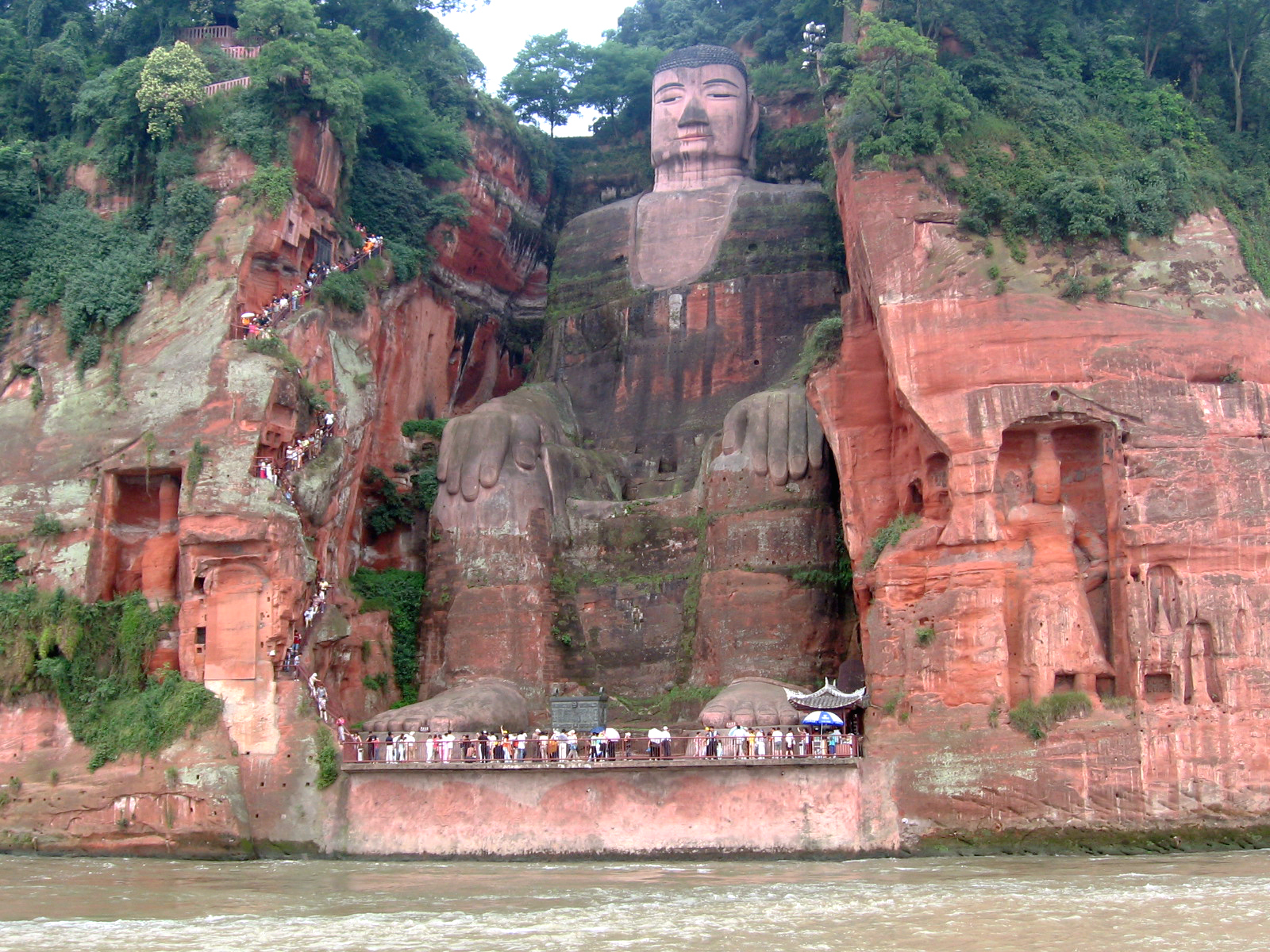
© Ariel Steiner, CC BY-SA 2.5 Resized from original. (This derivative is under the same CC BY-SA license.)