World Heritage Identification Number: 638
World Heritage since: 1992
Category: Natural Heritage
WHE Type: Protected Areas & National Parks
Transboundary Heritage: No
Endangered Heritage: No
Country: 🇨🇳 China
Continent: Asia
UNESCO World Region: Asia and the Pacific
Map
Huanglong Scenic and Historic Interest Area: A Unique Blend of Natural Beauty and Cultural Significance
The Huanglong Scenic and Historic Interest Area, located in the northwest part of Sichuan Province, China, is a captivating testament to the harmonious coexistence of natural beauty and cultural significance. Designated as a World Heritage Site by UNESCO in 1992, this region offers a unique blend of breathtaking landscapes, diverse ecosystems, and rich cultural heritage.
More to come…UNESCO Description of the World Heritage Site
Situated in the north-west of Sichuan Province, the Huanglong valley is made up of snow-capped peaks and the easternmost of all the Chinese glaciers. In addition to its mountain landscape, diverse forest ecosystems can be found, as well as spectacular limestone formations, waterfalls and hot springs. The area also has a population of endangered animals, including the giant panda and the Sichuan golden snub-nosed monkey.
UNESCO Justification of the World Heritage Site
Criterion (vii): Huanglong is renowned for its beautiful mountainous scenery, with relatively undisturbed and highly diverse forest ecosystems, combined with the more spectacular localised karst formations, such as travertine pools, waterfalls and limestone shoals. Its travertine terraces and lakes are certainly unique in all of Asia, and rate among the three most outstanding examples in the world.
Encyclopedia Record: Huanglong Scenic and Historic Interest Area
Huanglong is a scenic and historic interest area in the northwest part of Sichuan, China. It is located in the southern part of the Minshan mountain range, 370 kilometres (230 mi) north-northwest of the capital Chengdu. This area is known for its colorful travertine pools formed by calcite deposits, especially in Huanglonggou, as well as diverse forest ecosystems, snow-capped peaks, waterfalls and hot springs. Huanglong is also home to many endangered species including the giant panda and the Sichuan golden snub-nosed monkey. In addition, a large population of the endemic orchid species 'Cypripedium plectrochilum' was discovered at the site. Huanglong was declared a World Heritage Site by UNESCO in 1992 because of its outstanding travertine formations, waterfalls and limestone formations as well as its travertine terraces and lakes rating among the three most outstanding examples in the world.Additional Site Details
Area: 60,000 hectares
Number of Components: 1
Coordinates: 32.75417 , 103.82222
IUCN World Heritage Outlook
The 2025 Conservation Outlook on Huanglong Scenic and Historic Interest Area reports the following assessment:
Source: International Union for Conservation of Nature (IUCN) · View assessment
Image
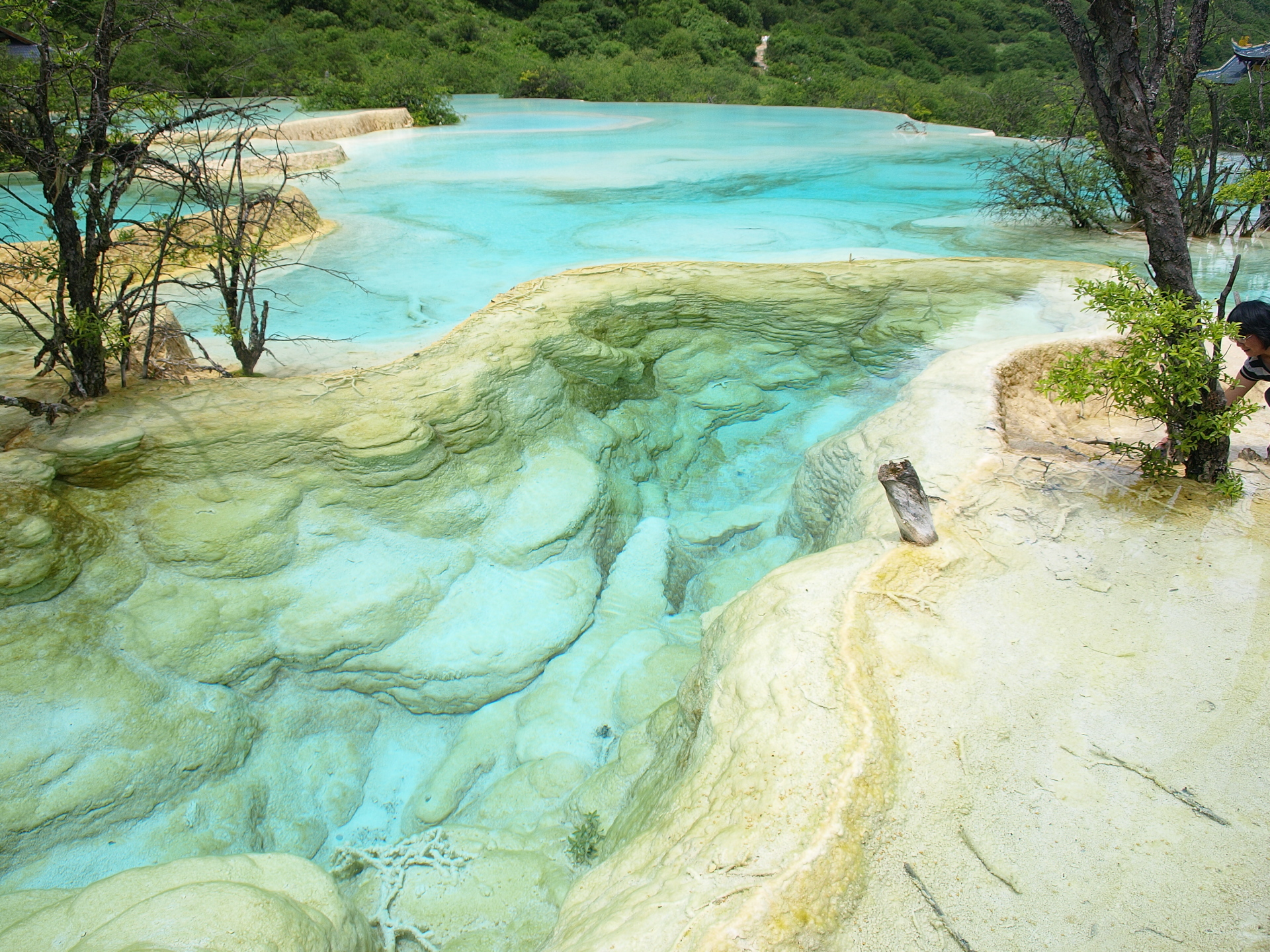
© Kounosu, CC BY-SA 3.0 Resized from original. (This derivative is under the same CC BY-SA license.)
World Heritage Research
Discover scientific research and academic studies that deepen our understanding of Huanglong Scenic and Historic Interest Area from its history and significance to its conservation, management, and contemporary challenges.
-
Hyperspectral identification of travertine state in Huanglong by the PSO-BPNN method
A novel hyperspectral identification method achieved high accuracy in distinguishing the state of travertine formations at Huanglong. The PSO-BPNN classifier, combining particle swarm optimization with backpropagation neural networks, demonstrated exceptional performance with an overall accuracy of 93%, F1-score of 92%, and Kappa coefficient of 97%. This method effectively categorized healthy travertine, blackened formations, those affected by algae erosion, and bare ground using hyperspectral data. The approach involved correlation analysis, sensitive band extraction, and real-world application on Micro-Hyperspectral imaging data, outperforming traditional BPNN classifiers.
Xu, M., Wang, W., Cai, J., Dai, Q., Fan, J., & Li, S. (2024). Hyperspectral identification of travertine state in Huanglong by the PSO-BPNN method. Geocarto International, 39(1). https://doi.org/10.1080/10106049.2024.2365886
View Publication Record | Read Publication