World Heritage Identification Number: 333
World Heritage since: 1985
Category: Natural Heritage
WHE Type: Protected Areas & National Parks
Transboundary Heritage: No
Endangered Heritage: No
Country: 🇵🇪 Peru
Continent: Americas
UNESCO World Region: Latin America and the Caribbean
Map
Exploring the Breathtaking Beauty of Huascarán National Park
The Huascarán National Park, located in the heart of Peru, offers a captivating blend of natural wonders and rich biodiversity. This expansive protected area spans over 340,000 hectares, making it one of the largest national parks in South America. Established in 1975, it was later recognized as a World Heritage Site by UNESCO in 1985 due to its exceptional natural beauty and unique ecosystem.
More to come…UNESCO Description of the World Heritage Site
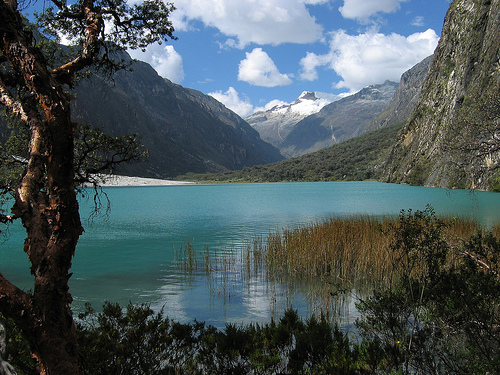
Situated in the Cordillera Blanca, the world's highest tropical mountain range, Mount Huascarán rises to 6,768 m above sea-level. The deep ravines watered by numerous torrents, the glacial lakes and the variety of the vegetation make it a site of spectacular beauty. It is the home of such species as the spectacled bear and the Andean condor.
UNESCO Justification of the World Heritage Site
Criterion (vii) : Huascaran National Park covers a considerable part of the Cordillera Blanca, the highest tropical mountain range in the World. The most overwhelming visual feature is the aggregation of 27 snow-capped peaks above 6,000 m.a.s.l, in particular the Nevado Huascaran or Mount Huascaran, Peru's highest elevation at 6,768 m.a.s.l. From the property's lowest elevations at around 2500 m.a.s.l. to the summits, there is a stunning altitudinal difference of more than 4 kilometres spanning varied and rugged terrain and vegetation. The snow-covered peaks, the tropical glaciers and glacial lakes, the high plateaus intersected by torrential creeks running in deep ravines and the variety of vegetation types form a spectacular landscape of rare beauty. Among the rich flora, the famous Queen of the Andes, known for its colossal inflorescence, stands out. The diverse fauna includes charismatic mammals and birds, such as Vicuna, Spectacled Bear and Puma, as well as the Andean Condor and the Giant Hummingbird.
Criterion (viii) : Huascaran is located in the High Andes and includes high plateaus of Puna grasslands, where 6,000 m peaks and glaciers form a globally notable mountainous region, including over 600 glaciers, almost 300 lakes and 41 tributaries of three important rivers: the Santa, Pativilca and Maranon. Underlying the exceptional landscape of Huascaran National Park is a broad spectrum of remarkable ongoing geological features and processes shaping the impressive geomorphology. The area's geological history and structures are very complex, with serrated peaks and the rugged topography originate from the uplifting of Mesozoic sediments, which were severely folded and faulted by complex tectonic activity at the end of the Cretaceous period and subject to volcanism in the Pliocene and Pleistocene epochs. To this day there is strong seismic activity in the area, major earthquakes, such as in 1945, 1962 and 1970 serving as cruel reminders. Glaciation is a major element in the geomorphology and hydrology of the property. It is estimated that as much a quarter of the volume of glacial ice in the Cordillera may have disappeared since the late 1960s, a process which is likely to further change the visual face of Huascaran National Park.
Encyclopedia Record: Huascarán National Park
Huascarán National Park is a Peruvian national park that comprises most of the mountain range known as Cordillera Blanca which is part of the central Andes, in the region of Ancash. The park covers an area of 340,000 hectares and is managed by the Peruvian Network of Protected Natural Areas, or SERNANP. It was designated as a World Heritage Site in 1985 by UNESCO, is also a well-known mountaineering spot, and harbors a unique biodiversity with plant species such as the Queen of the Andes, trees of the genera Polylepis and Buddleja, and animals such as spectacled bears, condors, vicunas, and tarucas.Additional Site Details
Area: 340,000 hectares
Number of Components: 1
(viii) — Outstanding example representing major earth stages
Coordinates: -9.33333 , -77.4
IUCN World Heritage Outlook
The 2025 Conservation Outlook on Huascarán National Park reports the following assessment:
Source: International Union for Conservation of Nature (IUCN) · View assessment
World Heritage Research
Discover scientific research and academic studies that deepen our understanding of Huascarán National Park from its history and significance to its conservation, management, and contemporary challenges.
-
Small event, big impact: insights from Vallunaraju cascade event on April 28, 2025
A small-scale glacial lake outburst flood (GLOF) in the Cordillera Blanca, Peru, demonstrated significant downstream impacts despite its modest initial volume. The 28 April 2025 Vallunaraju cascade event, triggered by a rockfall into two small lakes, released approximately 42 million cubic meters of water but caused severe damage due to sediment entrainment, increasing the total moving mixture volume six to seven times to 296 million cubic meters. This sediment-amplified cascade resulted in two fatalities and substantial infrastructure damage, including bridges, houses, and water systems, highlighting the underassessed risks posed by small and medium-sized lakes in hazard prioritization frameworks. The study underscores the need for integrated assessments that account for trigger susceptibility, sediment availability, and exposure controls to better predict and mitigate GLOF impacts in such regions.
Cusicanqui, D., Loarte, E., Gómez, W., Villafane, H., Cook, K. L., Piton, G., Lehmann, B., Magnin, F., Racoviteanu, A. E., Zerathe, S., Filhol, S., Medina, K., Cruz, R., Concha, R., Torres-Lázaro, J. C., & Lacroix, P. (2026). Small event, big impact: insights from Vallunaraju cascade event on April 28, 2025. Npj Natural Hazards, 3(1). https://doi.org/10.1038/s44304-026-00229-0
View Publication Record | Read Publication -
Reappraisal of the Genetic Diversity Patterns in Puya raimondii—The Queen of the Andes: Insights from Molecular Marker Analysis Reveal an Inbreeding Reproductive Strategy
Puya raimondii, known as the 'Queen of the Andes,' exhibits alarmingly low genetic diversity and high levels of inbreeding, suggesting it is a genetically fragile and endangered species. Molecular marker analysis revealed a fixation index of 0.740 and minimal gene flow (0.02–0.03), with most genetic variation occurring between populations rather than within them. Researchers hypothesize that this narrow genetic base stems from an inbreeding reproductive strategy, intense environmental selective pressures—such as extreme temperature fluctuations and prolonged dry periods—and a lengthy life cycle that limits recombination. These factors collectively point to P. raimondii's vulnerability, with implications for its conservation in Huascarán National Park, Peru.
Draga, S., Sgorbati, S., & Barcaccia, G. (2025). Reappraisal of the Genetic Diversity Patterns in Puya raimondii—The Queen of the Andes: Insights from Molecular Marker Analysis Reveal an Inbreeding Reproductive Strategy. Plants, 14(3), 321. https://doi.org/10.3390/plants14030321
View Publication Record | Read Publication -
Poaceae Species Suitable for Andean Livestock Farming in the Peruvian Andes Reported in GBIF and Local Studies
Research identifies 63 Poaceae species suitable for Andean livestock farming, including genera such as Agrostis, Bromus, and Festuca, with only 52 recorded in GBIF. The study highlights significant gaps in spatial coverage of biodiversity data, particularly in Peru's Sierra region, where records are concentrated in high-tourist areas like Huascarán National Park. This underscores the urgent need for improved monitoring strategies to support conservation efforts and sustainable livestock farming practices amidst ongoing ecosystem degradation.
Yaranga, R. M., Orellana, J. A., & Pizarro, S. E. (2025). Poaceae Species Suitable for Andean Livestock Farming in the Peruvian Andes Reported in GBIF and Local Studies. Geography, Earth Science and Environment: Research Highlights Vol. 4, 81–113. https://doi.org/10.9734/bpi/geserh/v4/4046
View Publication Record | Read Publication -
Atopsyche (Dolochorema) huascarani Rázuri-Gonzales & Holzenthal, 2025, sp. nov.
Scientists have discovered and described a new species of caddisfly, Atopsyche (Dolochorema) huascarani, from Huascarán National Park in Peru. This species is distinguished by its unique genital morphology, particularly the absence of ventrolateral branches in the phallic apparatus, setting it apart from related species like A. irregularis and A. bispinosa. The discovery was made through detailed morphological analysis of type specimens collected using light traps at Laguna Llaca, highlighting the rich biodiversity of the region. The study contributes to our understanding of caddisfly taxonomy and the importance of high-altitude ecosystems in Peru.
Rázuri-Gonzales, E., & Holzenthal, R. W. (2025). Atopsyche (Dolochorema) huascarani Rázuri-Gonzales & Holzenthal, 2025, sp. nov. Zenodo. https://doi.org/10.5281/ZENODO.17885645
View Publication Record | Read Publication -
Mountain wetland soil carbon stocks of Huascarán National Park, Peru
Wetlands in Huascarán National Park, Peru, store 24.4 Tg of carbon, with peatlands accounting for 97% and wet meadows just 3%. This stark contrast highlights the disproportionate carbon storage capacity of peatlands compared to wet meadows. The study employed stratified randomized sampling, combining full peat cores with a rapid sampling protocol to efficiently estimate carbon stocks across four wetland types: cushion peat, graminoid peat, cushion wet meadow, and graminoid wet meadow. Findings validate rapid peat sampling as an effective method for remote fieldwork, offering a scalable approach for monitoring wetland carbon stocks. This research provides critical data for land-use planning and climate policy, emphasizing the need to prioritize peatland conservation in high-altitude tropical regions.
Chimner, R. A., Resh, S. C., Hribljan, J. A., Battaglia, M., Bourgeau-Chavez, L., Bowser, G., & Lilleskov, E. A. (2023). Mountain wetland soil carbon stocks of Huascarán National Park, Peru. Frontiers in Plant Science, 14. https://doi.org/10.3389/fpls.2023.1048609
View Publication Record | Read Publication -
Ecological Change and Livestock Governance in a Peruvian National Park
Research in Peru's Huascarán National Park reveals critical insights into the ecological impacts of livestock grazing on high-elevation ecosystems, particularly wetlands. The study finds that while wet meadows are well-suited for traditional grazing systems, peatlands above 4000 meters are highly vulnerable to livestock trampling. Additionally, limited ecological space at higher elevations restricts both land use expansion and potential habitats for species of concern. This research integrates land cover data with pastoralist insights to explore adaptive strategies for balancing livelihoods, biodiversity, and ecosystem services in protected areas. The findings underscore the need for improved governance to enhance the adaptive capacity of communities and park managers.
Young, K., Alata, E., Chimner, R., Boone, R., Bowser, G., Bourgeau-Chavez, L., Fuentealba, B., Gilbert, J., Ñaupari, J., Polk, M., Resh, S., Turin, C., & Zarria-Samanamud, M. (2023). Ecological Change and Livestock Governance in a Peruvian National Park. Land, 12(11), 2051. https://doi.org/10.3390/land12112051
View Publication Record | Read Publication -
First records of Sphingidae, Saturniidae, and Arctiinae (Lepidoptera) in the forests of Polylepis sericea in the Huascarán National Park, Ancash, Peru
A groundbreaking inventory of nocturnal Lepidoptera taxa (Sphingidae, Saturniidae, and Arctiinae) in the Polylepis forests of Huascarán National Park, Peru, reveals seven previously unrecorded species and 155 individuals. This study marks the first documentation of these taxa in the park, with three species also representing new records for the Ancash region and one for Peru. Conducted using mixed light traps over four months (November 2015 to August 2016), the findings underscore the ecological significance of Polylepis forests as a unique Andean biome threatened by climate change and anthropogenic pressures. The discovery highlights critical gaps in our understanding of high-altitude biodiversity, providing essential data for conservation strategies and policy-making.
Ancajima, G. P., & Grados, J. (2022). First records of Sphingidae, Saturniidae, and Arctiinae (Lepidoptera) in the forests of Polylepis sericea in the Huascarán National Park, Ancash, Peru. Entomological Communications, 4, ec04019. https://doi.org/10.37486/2675-1305.ec04019
View Publication Record | Read Publication