World Heritage Identification Number: 330
World Heritage since: 1985
Category: Cultural Heritage
WHE Type: Archaeological Sites
Transboundary Heritage: No
Endangered Heritage: No
Country: 🇵🇪 Peru
Continent: Americas
UNESCO World Region: Latin America and the Caribbean
Map
Exploring the Prehistoric Wonders: An In-depth Look at the Chavin Archaeological Site
The Chavin archaeological site, nestled within the heart of the Peruvian Andes, stands as a testament to the rich cultural heritage of ancient civilizations. Inscribed as a UNESCO World Heritage Site in 1985, this remarkable location offers a unique glimpse into the lives of the people who inhabited the region more than three millennia ago.
More to come…UNESCO Description of the World Heritage Site
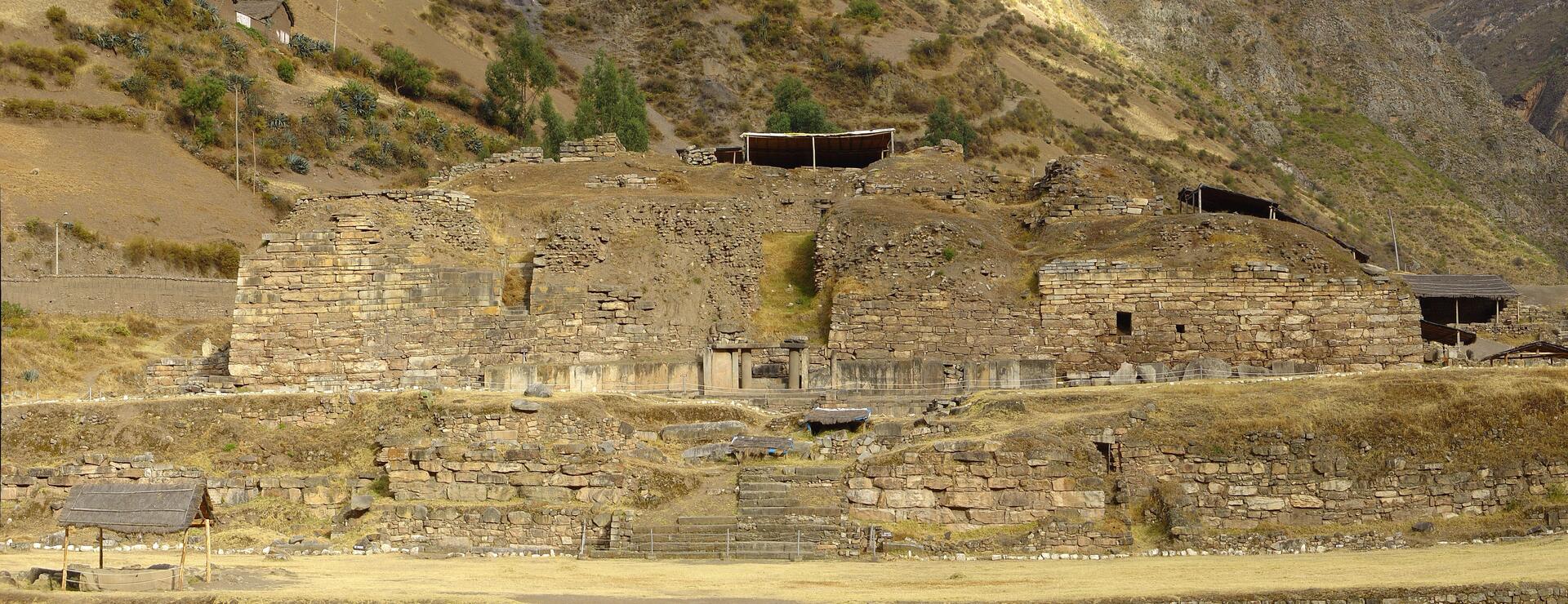
The archaeological site of Chavin gave its name to the culture that developed between 1500 and 300 B.C. in this high valley of the Peruvian Andes. This former place of worship is one of the earliest and best-known pre-Columbian sites. Its appearance is striking, with the complex of terraces and squares, surrounded by structures of dressed stone, and the mainly zoomorphic ornamentation.
UNESCO Justification of the World Heritage Site
Criterion (iii): The Chavin Archaeological Site, eponym of one of the ancient civilizations of South America, is an exceptional example of the architectural, technological and symbolic creations of the early pre-Columbian societies in the Peruvian Andes. Its appearance is breath-taking, with a series of terraces and squares, with a complex system of internal galleries, and decorated with anthropomorphic and zoomorphic iconographic elements of extraordinary beauty. It was an important centre of ideological, cultural and religious convergence and dissemination around a cult spread over a wide territory of the Andes.
Encyclopedia Record: Chavín de Huántar
Chavín de Huántar is an archaeological site in Peru, containing ruins and artifacts constructed as early as 1200 BC, and occupied until around 400–500 BC by the Chavín, a major pre-Inca culture. The site is located in the Ancash Region, 434 kilometers (270 mi) north of Lima, at an elevation of 3,180 meters (10,430 ft), east of the Cordillera Blanca at the start of the Conchucos Valley.Additional Site Details
Area: 14.79 hectares
Number of Components: 1
Coordinates: -9.5927725444 , -77.1784535027
World Heritage Research
Discover scientific research and academic studies that deepen our understanding of Chavin (Archaeological Site) from its history and significance to its conservation, management, and contemporary challenges.
-
Tom Patterson and the origins of early Peruvian civilization
A groundbreaking re-evaluation of early Peruvian civilizations challenges long-held assumptions about the nature of pre-Chavin monumental complexes. Thomas C. Patterson's work, spanning decades, demonstrates that these U-shaped pyramid structures—such as Huaca La Florida—predate the rise of Chavin de Huantar and were not chiefdoms or states, as previously thought. By applying historical materialism, Patterson reframes our understanding of Andean societal emergence, emphasizing historically specific social formations over neo-evolutionary stages. His research, rooted in excavations at Ancón, surveys of the Lurin Valley, and analyses of pottery sequences, reveals the intricate interdependence between coastal dwellers and inland farmers during the Preceramic period, offering a nuanced perspective on the origins of complex societies in Peru.
Burger, R. L. (2024). Tom Patterson y los orígenes de la civilización peruana temprana. Arqueología Y Sociedad, (41), 9–22. https://doi.org/10.15381/arqueolsoc.2024n41.e28186
View Publication Record | Read Publication -
Rituals of the Past: Prehispanic and Colonial Case Studies in Andean Archaeology
Rituals of the Past: Prehispanic and Colonial Case Studies in Andean Archaeology reveals that ritual practices, despite being overlooked by archaeologists, are archaeologically visible due to their repetitive nature. The volume demonstrates how these rituals were embedded in power relations, social transformations, and daily practices across pre-Hispanic, colonial, and postcolonial Andes. It employs a diverse range of methodologies, including excavation-based approaches, spatial and GIS data analysis, ethnohistorical, historical, and linguistic data, showcasing the interpretive potential of an interdisciplinary perspective. The study highlights significant temporal and methodological scope, spanning from 1200 BC to contemporary times, with a focus on ritual spaces at Chavin de Huantar and other sites.
Sharratt, N. (2021). Rituals of the Past: Prehispanic and Colonial Case Studies in Andean Archaeology. Ethnohistory, 68(1), 155–156. https://doi.org/10.1215/00141801-8702468
View Publication Record | Read Publication