World Heritage Identification Number: 912
World Heritage since: 1999
Category: Cultural Heritage
WHE Type: Archaeological Sites
Transboundary Heritage: No
Endangered Heritage: No
Country: 🇨🇳 China
Continent: Asia
UNESCO World Region: Asia and the Pacific
Map
Exploring the Dazu Rock Carvings: A Testament to Ancient Chinese Culture
The Dazu Rock Carvings, a UNESCO World Heritage Site since 1999, offer a unique glimpse into the rich cultural heritage of ancient China. Located in the Dazu District of Chongqing, these rock carvings date back as far as the 7th century, providing a testament to the harmonious synthesis of Buddhism, Taoism, and Confucianism during this period.
More to come…UNESCO Description of the World Heritage Site
The steep hillsides of the Dazu area contain an exceptional series of rock carvings dating from the 9th to the 13th century. They are remarkable for their aesthetic quality, their rich diversity of subject matter, both secular and religious, and the light that they shed on everyday life in China during this period. They provide outstanding evidence of the harmonious synthesis of Buddhism, Taoism and Confucianism.
UNESCO Justification of the World Heritage Site
Criterion (i): The Dazu Carvings represent the pinnacle of Chinese rock art in their high aesthetic quality and their diversity of style and subject matter.
Criterion (ii): Tantric Buddhism from India and Chinese Taoist and Confucian beliefs came together at Dazu to create a highly original and influential manifestation of spiritual harmony.
Criterion (iii): The eclectic nature of religious belief in late Imperial China is given material expression in the exceptional artistic heritage of the Dazu rock art.
Encyclopedia Record: Dazu Rock Carvings
The Dazu Rock Carvings are a series of Chinese religious sculptures and carvings and UNESCO World Heritage Site located in Dazu District, Chongqing, China. The carvings date back as far as the 7th century AD, depicting and influenced by Buddhist, Confucian and Taoist beliefs. Some are in rock-cut cave shrines, in the usual Chinese Buddhist style, but many others are rock reliefs carved into the open rock faces. Listed as a World Heritage Site in 1999, the Dazu Rock Carvings are made up of 75 protected sites containing some 50,000 statues, with over 100,000 Chinese characters forming inscriptions and epigraphs. The sites are located in Chongqing Municipality within the steep hillsides throughout Dazu District, located about 165 kilometers west of the urban area of Chongqing. The highlights of the rock grotto are found on Mount Baoding and Mount Beishan.Additional Site Details
Area: 20.41 hectares
Number of Components: 5
(ii) — Significant interchange of human values
(iii) — Unique or exceptional testimony to a cultural tradition
Coordinates: 29.70111 , 105.705
Image
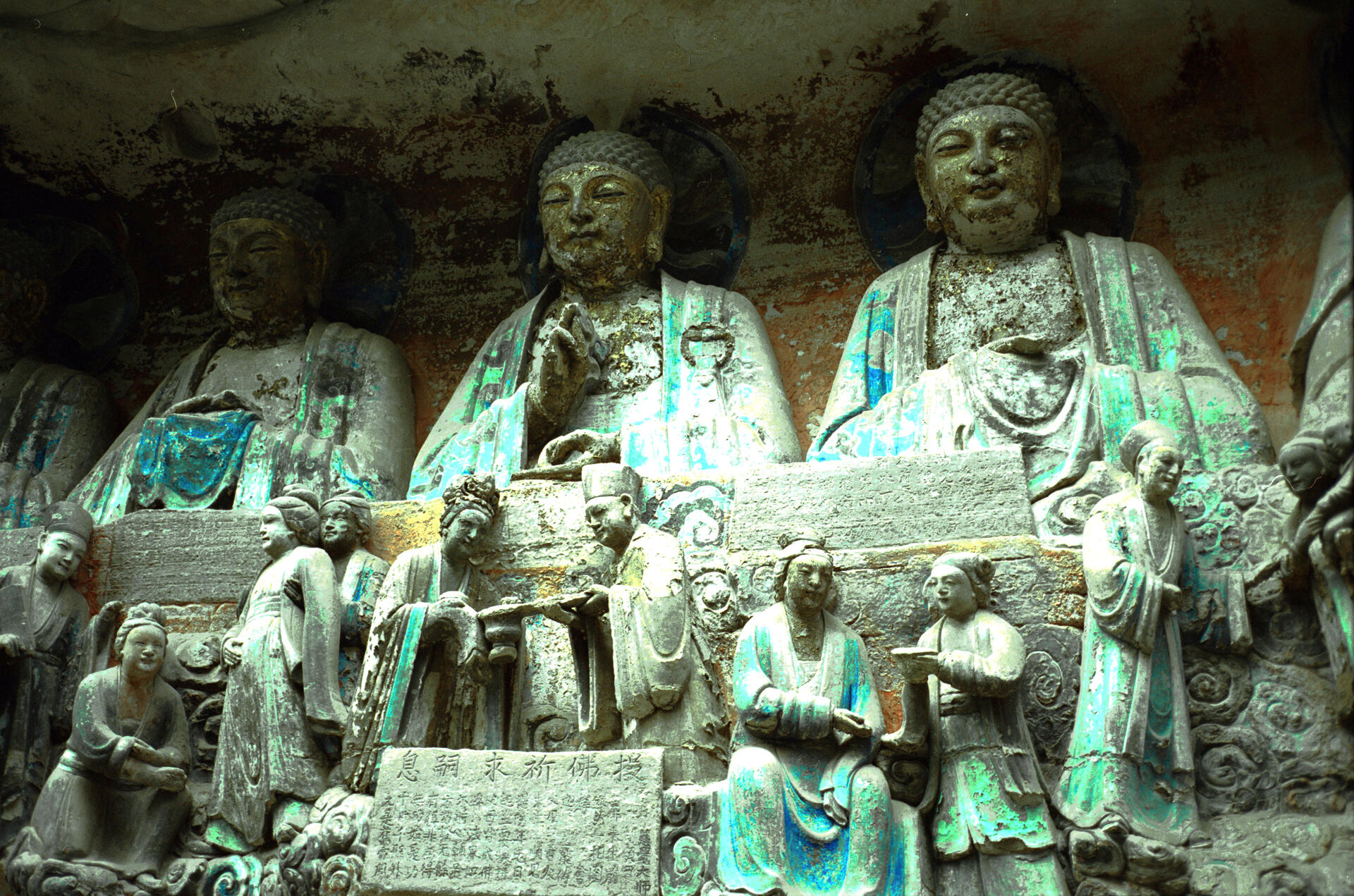
© Gisling, CC BY-SA 3.0 Resized from original. (This derivative is under the same CC BY-SA license.)
World Heritage Research
Discover scientific research and academic studies that deepen our understanding of Dazu Rock Carvings from its history and significance to its conservation, management, and contemporary challenges.
-
The Secularization of Ancient Chinese Religion: A Case Study of the Dazu Rock Carvings
The Dazu Rock Carvings, flourishing during the Northern and Southern Song dynasties, represent a significant shift toward secularization in ancient Chinese religious art. These carvings, situated in Chongqing, integrate Confucian, Daoist, and Buddhist themes while reflecting local customs and social life, marking them as distinct in Chinese cave temple art. Through documentary analysis, iconographic methods, and fieldwork, the study examines the visual features of Bodhisattva images and narrative scenes, identifying key factors driving this secular transformation. The findings suggest a path of secularization and indigenization shaped by the interaction between foreign cultural elements and local traditions, offering new perspectives for contemporary artistic practice.
Deng, L. (2026). The Secularization of Ancient Chinese Religion: A Case Study of the Dazu Rock Carvings. Communications in Humanities Research, 78(1), 235–240. https://doi.org/10.54254/2753-7064/2026.ht31374
View Publication Record | Read Publication -
Re-carving meanings: negotiating social value and conservation in southwest China’s rock carvings
Heritage conservation of China’s rock carvings, such as the Thousand-Hand Guanyin at Dazu and grassroots repainting efforts at Anyue, actively reshapes social values tied to these sites. The study reveals that conservation practices—whether state-led or community-driven—are not neutral but dynamically redefine cultural meanings, blending religious devotion, aesthetic judgment, and institutional intervention. By analyzing fieldwork data, policy frameworks, and heritage theory, the research demonstrates how carved stone monuments retain 'living' significance, reflecting ongoing contestations over their ontological status and role in contemporary heritage regimes.
Gao, Q. (2026). Re-carving meanings: negotiating social value and conservation in southwest China’s rock carvings. World Archaeology, 1–20. https://doi.org/10.1080/00438243.2026.2626037
View Publication Record | Read Publication -
From stone to spirit: cultural sustainability, ritual practice, and digital preservation of the Dazu Rock Carvings in Chinese heritage
Dazu Rock Carvings showcase a unique evolution of religious artistry and cultural continuity from the Late Tang to Southern Song periods. The study identifies five key typologies—monumental narrative reliefs, votive niches, lay feast shrines, protective deity niches, and hybrid forms—that reveal shifts in religious expression, political context, and community engagement. Through iconographic and spatial analysis, the research demonstrates how visual culture served as a tool for moral instruction, social cohesion, and identity construction. Additionally, it highlights the role of contemporary digital technologies, such as 3D scanning and virtual preservation, in safeguarding this living heritage for future generations.
Sun, Y. (2026). From stone to spirit: cultural sustainability, ritual practice, and digital preservation of the Dazu Rock Carvings in Chinese heritage. Advances in Humanities Research, 13(5), 64–80. https://doi.org/10.54254/2753-7080/2026.33019
View Publication Record | Read Publication -
Research on Similarity Matching of Dazu Rock Carvings in China Based on a Trimodal Fusion of pHash, SIFT, and MSRoVGG
A novel quantitative model for assessing the similarity of cultural relics, such as China's Dazu Rock Carvings from the Song Dynasty, achieves 100% recognition accuracy for identical statue types within the same niche while effectively distinguishing between different iconographic types. This breakthrough addresses the limitations of traditional qualitative expert assessments by integrating a trimodal feature fusion approach: Perceptual Hash (pHash) for global structural screening, SIFT for high-dimensional texture feature extraction and local keypoint matching, and an improved MSRoVGG deep learning architecture for semantic-level verification. The model demonstrates robust capabilities in typological classification and stylistic differentiation, capturing nuanced variations in artistic styles and vestimentary features between Buddhist and secular figures.
Xue Yang, & Jie Tang. (2026). Research on Similarity Matching of Dazu Rock Carvings in China Based on a Trimodal Fusion of pHash, SIFT, and MSRoVGG. Zenodo. https://doi.org/10.5281/ZENODO.19847401
View Publication Record | Read Publication -
Evaluation of mechanical properties and durability of nanolime synthesized by an anion-exchange method for the consolidation of Dazu Rock Carvings
Nanolime synthesized via anion-exchange method significantly enhances the mechanical resistance of weathered sandstone at Dazu Rock Carvings while preserving its visual and hydro-physical properties. The treatment increased uniaxial compressive strength by approximately 26%, with negligible changes in color, porosity, or permeability. Accelerated aging tests demonstrated superior durability compared to traditional lime water treatments, retaining higher hardness and elastic modulus. Field monitoring showed rapid recovery of surface hardness within 24 hours, followed by continued strengthening over 100 days. The study highlights the potential of anion-exchange-derived nanolime as a mineral-compatible consolidation treatment for weathered sandstone, though further long-term field studies are needed to assess its durability and service-life performance.
Hao, Z., Wang, S., Zhang, W., Galli, A., Ma, B., Zhang, Y., & Cai, Y. (2026). Evaluation of mechanical properties and durability of nanolime synthesized by an anion-exchange method for the consolidation of Dazu Rock Carvings. Frontiers in Materials, 13. https://doi.org/10.3389/fmats.2026.1912625
View Publication Record | Read Publication -
A Novel Optimization Approach for Revolutionizing Architectural Design in Chinese Cultural Heritage
A novel approach combining machine learning and augmented reality (AR) significantly enhances the accuracy of defect identification in Chinese cultural heritage architecture, achieving an F1 score of 95.47% and an accuracy of 93.29%. The study leverages an Ensemble Ant Colony Fused Convolutional Capsule Neural Network (EAC-CCNN) to analyze high-resolution images of structures like the Dazu Rock Carvings, Nanchan Temple, and Foguang Temple. By integrating this model with Building Information Modeling (BIM), researchers developed a safety management system that improves defect detection, promotes collaboration, and aids in the preservation of cultural heritage assets. The approach demonstrates potential for training machine learning models to recognize patterns, correct errors, and make informed predictions under varying conditions.
Li, X., & Yang, X. (2025). A Novel Optimization Approach for Revolutionizing Architectural Design in Chinese Cultural Heritage. HighTech and Innovation Journal, 6(1), 151–164. https://doi.org/10.28991/hij-2025-06-01-011
View Publication Record | Read Publication -
From Ancient Techniques to Modern Solutions: In Situ Synthesis of C‐S‐H for Sandstone Conservation
A breakthrough in heritage conservation has been achieved with the development of a C-S-H-based grouting material, inspired by ancient Roman techniques. This innovative solution effectively addresses water-induced erosive damage in sandstone, particularly in the Beishan Grottoes of the Dazu Rock Carvings. Molecular dynamics simulations revealed that hydrogen bonding at the interface between C-S-H mortar and sandstone is crucial for adhesion. The study systematically optimized the mechanical properties and pore structure of C-S-H-based mortars by varying calcium-to-silica (C/S) ratio, water-to-binder ratio, binder/aggregate ratio, and polycarboxylate superplasticizer content. Optimal performance was found with a C/S ratio of 0.8, water/binder ratio of 2.0, binder/aggregate ratio of 1:3, and 4 wt% superplasticizer. Laboratory experiments confirmed the excellent compatibility of this material with sandstone, offering a promising solution for the conservation of the Beishan Grottoes.
Jia, M., Yan, H., Xu, Q., Grifa, C., Zhao, G., Jiang, S., Wang, J., Wei, Z., Liu, H., & Ma, X. (2025). From Ancient Techniques to Modern Solutions: In Situ Synthesis of C‐S‐H for Sandstone Conservation. Advanced Science, 12(29). Portico. https://doi.org/10.1002/advs.202503333
View Publication Record | Read Publication