World Heritage Identification Number: 1039
World Heritage since: 2001
Category: Cultural Heritage
WHE Type: Archaeological Sites
Transboundary Heritage: No
Endangered Heritage: No
Country: 🇨🇳 China
Continent: Asia
UNESCO World Region: Asia and the Pacific
Map
A Journey Through Time: The Yungang Grottoes - A Testament to Ancient Chinese Artistry
The Yungang Grottoes, nestled within the rolling hills of Datong City in the Shanxi Province, stand as a testament to the rich cultural heritage and artistic prowess of ancient China. Inscribed as a UNESCO World Heritage Site in 2001, these intricate Buddhist cave temples offer a unique glimpse into the spiritual and artistic landscape of the Northern Wei Dynasty (386-534 AD).
More to come…UNESCO Description of the World Heritage Site
The Yungang Grottoes, in Datong city, Shanxi Province, with their 252 caves and 51,000 statues, represent the outstanding achievement of Buddhist cave art in China in the 5th and 6th centuries. The Five Caves created by Tan Yao, with their strict unity of layout and design, constitute a classical masterpiece of the first peak of Chinese Buddhist art.
UNESCO Justification of the World Heritage Site
Criterion (i): The assemblage of statuary of the Yungang Grottoes is a masterpiece of early Chinese Buddhist cave art.
Criterion (ii): The Yungang cave art represents the successful fusion of Buddhist religious symbolic art from south and central Asia with Chinese cultural traditions, starting in the 5th century CE under Imperial auspices.
Criterion (iii): The power and endurance of Buddhist belief in China are vividly illustrated by the Yungang grottoes.
Criterion (iv): The Buddhist tradition of religious cave art achieved its first major impact at Yungang, where it developed its own distinct character and artistic power.
Encyclopedia Record: Yungang Grottoes
The Yungang Grottoes, formerly the Wuzhoushan Grottoes, are ancient Chinese Buddhist temple grottoes built during the Northern Wei dynasty near the city of Datong, then called Pingcheng, in the province of Shanxi. They are excellent examples of rock-cut architecture and one of the three most famous ancient Buddhist sculptural sites of China. The others are Longmen and Mogao.Additional Site Details
Area: 348.75 hectares
Number of Components: 1
(ii) — Significant interchange of human values
(iii) — Unique or exceptional testimony to a cultural tradition
(iv) — Outstanding example of a type of building or landscape
Coordinates: 40.10972 , 113.12222
Image
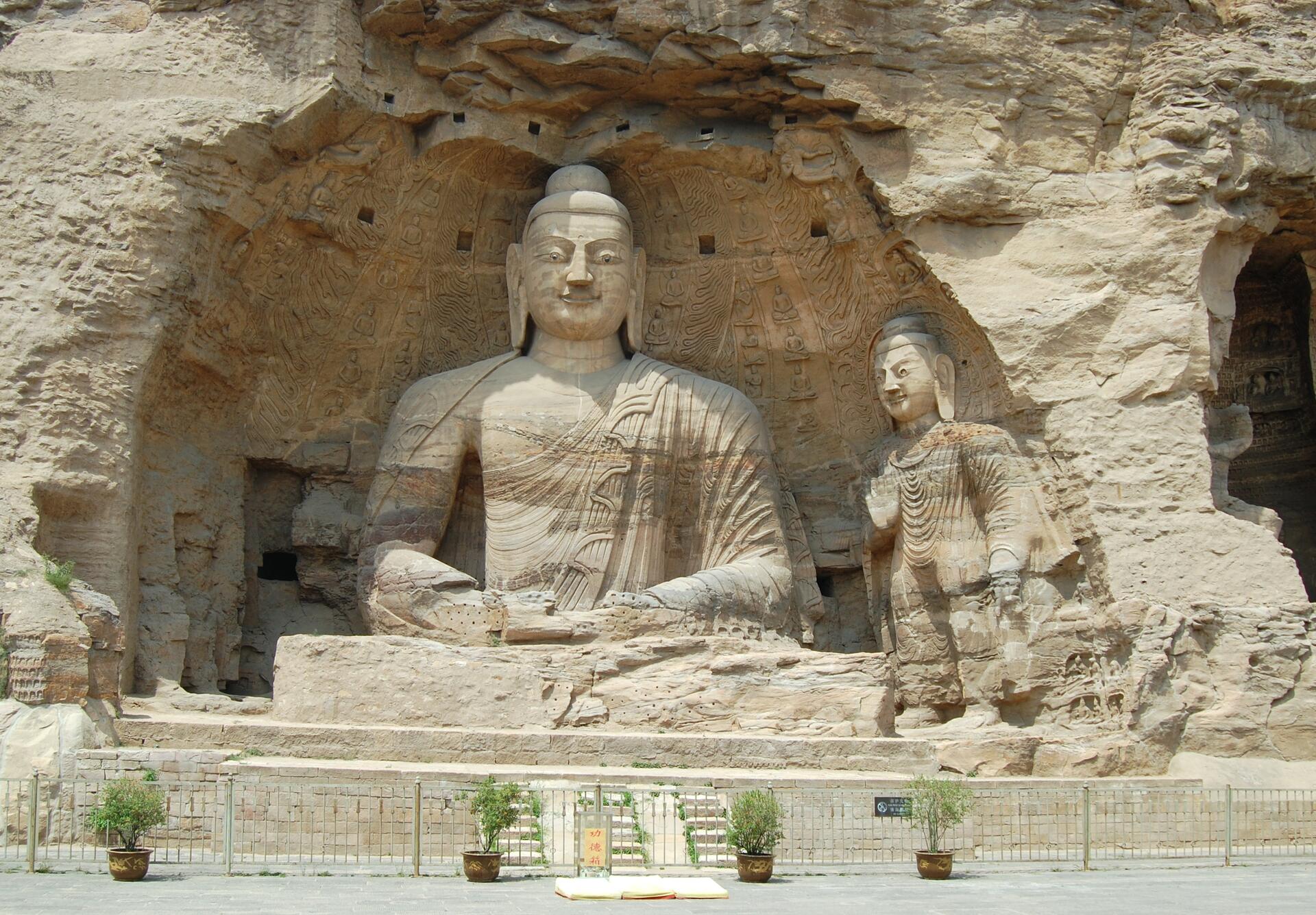
© Marcin Białek, CC BY-SA 4.0 Resized from original. (This derivative is under the same CC BY-SA license.)