World Heritage Identification Number: 308
World Heritage since: 1984
Category: Natural Heritage
WHE Type: Protected Areas & National Parks
Transboundary Heritage: No
Endangered Heritage: No
Country: 🇺🇸 United States of America
Continent: Americas
UNESCO World Region: Europe and North America
Map
Exploring Yosemite: Nature, Geology, and History in California’s Iconic Park
Yosemite National Park, located in the central eastern portion of the state of California, USA, is a testament to the grandeur and diversity of nature. Established on October 1, 1890, this expansive park spans over 1,187 square miles (3,070 km²), making it one of the oldest national parks in the United States. Inscribed as a UNESCO World Heritage Site in 1984, Yosemite National Park is renowned globally for its stunning geological features, diverse ecosystems, and rich cultural history.
The park is situated within four counties – primarily Tuolumne and Mariposa, but also extending northwards into Mono County and southwards towards Madera County. It shares borders with the Sierra National Forest to the southeast and the Stanislaus National Forest to the northwest. The park is under the management of the National Park Service, which ensures its preservation and conservation for future generations.
One of the most striking aspects of Yosemite National Park is its breathtaking granite landscapes. The park boasts towering cliffs, cascading waterfalls, crystal-clear streams, and vast meadows that offer an unparalleled display of granite relief sculpted by glaciation. Notable among these formations are the 'hanging' valleys, U-shaped valleys, cirque lakes, polished domes, and moraines. Iconic formations include El Capitan, Half Dome, and Yosemite Falls, offering an unparalleled view of natural geological processes in action.
In addition to its geological splendor, Yosemite National Park is home to a remarkable array of flora and fauna. Yosemite’s elevation ranges from approximately 600 meters (2,000 feet) in Yosemite Valley to nearly 4,000 meters (13,100 feet) above sea level at Mount Lyell, the park’s highest peak. This variation creates a diverse range of ecosystems.
From the towering giant sequoias in the lower elevations to the alpine tundra communities at higher altitudes, the park offers a veritable smorgasbord of ecosystems teeming with life. Visitors may encounter iconic North American wildlife such as black bears, mountain lions, coyotes, bobcats, mule deer, bighorn sheep, and a wide variety of bird species.
Yosemite National Park is also steeped in cultural history, with evidence of human habitation dating back thousands of years. Native American tribes, including the Miwok and Ahwahneechee, have lived in the area for centuries, utilizing the park's resources for food, shelter, and spiritual guidance. European settlers arrived in the mid-19th century, and their influence can still be seen today in the park's historic buildings, such as the Wawona Hotel and the Ahwahnee Hotel.
The park continues to see high visitor numbers, with over 4.5 million visits annually, making it one of the most popular national parks in the United States. Visitors can explore Yosemite’s trails on foot or horseback, cycle along park roads, take guided tours, or enjoy scenic drives through its dramatic landscapes. The park’s visitor centers provide information on geology, wildlife, and history, helping visitors appreciate both the natural wonders and cultural heritage of the area.
Visiting Yosemite National Park is an experience that transcends mere tourism. It offers a chance to connect with the natural world, to appreciate the intricate dance between geology, ecology, and culture that has shaped this extraordinary landscape. Whether hiking through the park's numerous trails, gazing upon its awe-inspiring vistas, or simply taking a moment to breathe in the crisp mountain air, Yosemite National Park invites us to marvel at the wonders of our planet and to cherish the legacy we inherit from those who came before us.
UNESCO Description of the World Heritage Site
Yosemite National Park lies in the heart of California. With its 'hanging' valleys, many waterfalls, cirque lakes, polished domes, moraines and U-shaped valleys, it provides an excellent overview of all kinds of granite relief fashioned by glaciation. At 600–4,000 m, a great variety of flora and fauna can also be found here.
UNESCO Justification of the World Heritage Site
Criterion (vii): Yosemite has exceptional natural beauty, including five of the world's highest waterfalls, a combination of granite domes and walls, deeply incised valleys, three groves of giant sequoia, numerous alpine meadows, lakes and a diversity of life zones.
Criterion (viii): Glacial action combined with the granitic bedrock has produced unique and pronounced landform features including distinctive polished dome structures, as well as hanging valleys, tarns, moraines and U-shaped valleys. Granitic landforms such as Half Dome and the vertical walls of El Capitan are classic distinctive reflections of geologic history. No other area portrays the effects of glaciation on underlying granitic domes as well as Yosemite does.
Encyclopedia Record: Yosemite National Park
Yosemite National Park is a national park of the United States in California. It is bordered on the southeast by the Sierra National Forest and on the northwest by Stanislaus National Forest. The park is managed by the National Park Service and covers 1,187 sq mi (3,070 km2) in four counties – centered in Tuolumne and Mariposa, extending north and east to Mono and south to Madera. Designated a World Heritage Site in 1984, Yosemite is internationally recognized for its granite cliffs, waterfalls, clear streams, groves of giant sequoia, lakes, mountains, meadows, glaciers, and biological diversity. Almost 95 percent of the park is designated wilderness. Yosemite is one of the largest and least fragmented habitat blocks in the Sierra Nevada mountain range.Additional Site Details
Area: 307,934 hectares
Number of Components: 1
(viii) — Outstanding example representing major earth stages
Coordinates: 37.74611111 , -119.5966667
IUCN World Heritage Outlook
The 2025 Conservation Outlook on Yosemite National Park reports the following assessment:
Source: International Union for Conservation of Nature (IUCN) · View assessment
Image
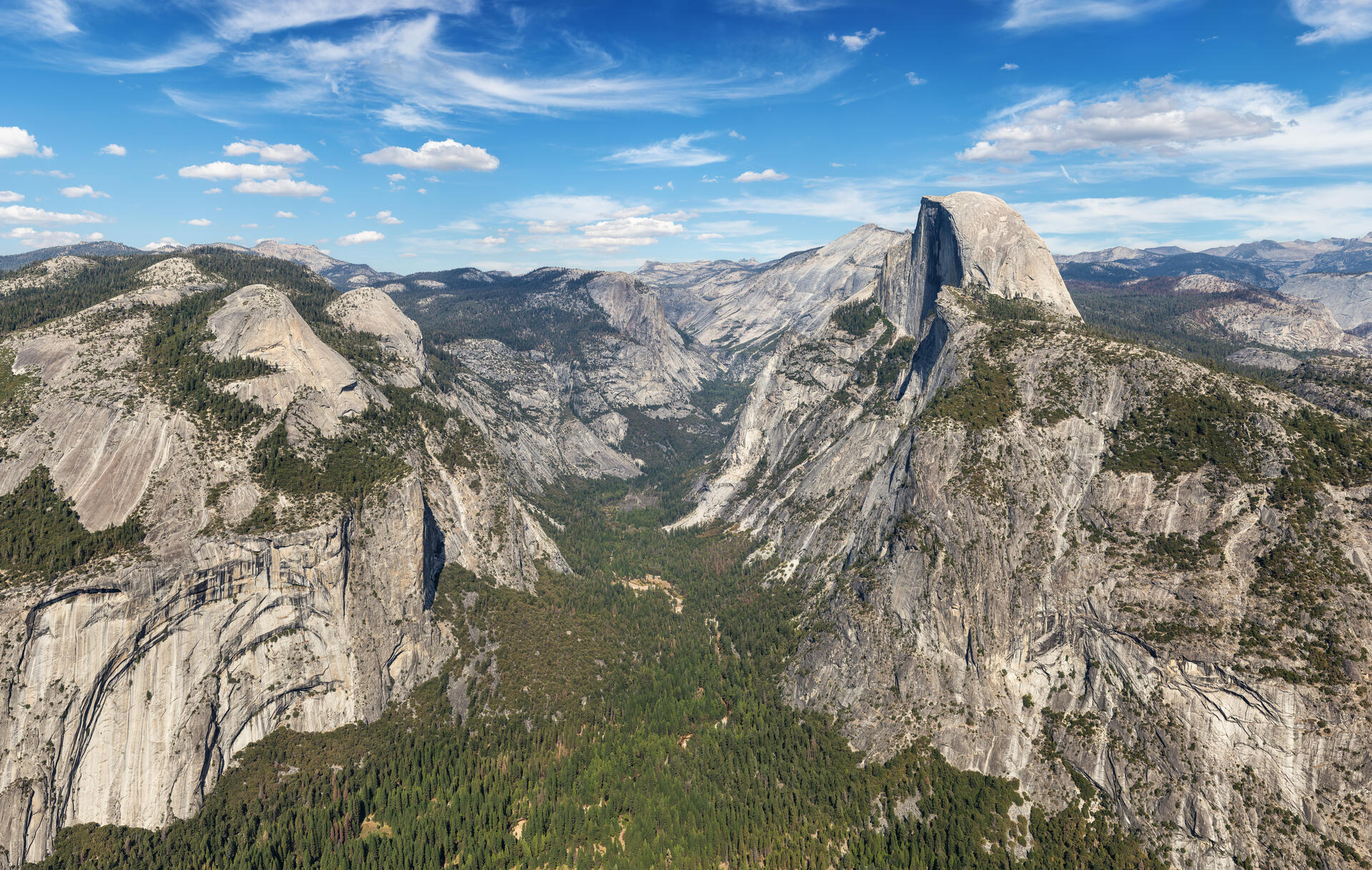
© Thomas Wolf, www.foto-tw.de, CC BY-SA 3.0 Resized from original. (This derivative is under the same CC BY-SA license.)
World Heritage Research
Discover scientific research and academic studies that deepen our understanding of Yosemite National Park from its history and significance to its conservation, management, and contemporary challenges.
-
On Fire and Water: The Intersection of Wetlands and Burning Strategies in Managing the Anthropogenic Plant Communities of Yosemite National Park
Historical fire suppression and hydrological manipulation by the U.S. National Park Service (NPS) have significantly altered culturally significant plant communities in Yosemite National Park, compounding the effects of conifer encroachment on anthropogenic meadows. Research reveals that Native American tribes historically used periodic burning to maintain preferred plant communities, with wetlands playing a crucial cultural and ecological role. Ethnographic investigations show that wetland species were dominant among culturally important plants, and traditional burning practices adapted to seasonal water-table fluctuations in these environments. This study combines historical literature reviews, ethnographic accounts, and guidance from tribal elders to highlight the intersection of fire and water management in shaping culturally significant landscapes.
Deur, D., & Bloom, R. (2024). On Fire and Water: The Intersection of Wetlands and Burning Strategies in Managing the Anthropogenic Plant Communities of Yosemite National Park. Natural Science and Indigenous Knowledge, 201–232. https://doi.org/10.1017/9781009416665.008
View Publication Record | Read Publication -
Safe harbor: translocating California red‐legged frogs to a climate refuge in Yosemite National Park
A successful translocation of California red-legged frogs (Rana draytonii) to Yosemite National Park demonstrates that climate refuges can serve as safe harbors for endangered species, even if marginally outside their historical range. The study challenged traditional restoration goals by prioritizing dynamic adaptation over literal historical baselines, addressing threats like drought, urbanization, and invasive predators, including American bullfrogs (Lithobates catesbeianus). Researchers combined ex situ conservation efforts—such as captive breeding and chytrid fungus inoculation studies at the San Francisco Zoo—with in situ translocation to establish a resilient population. The approach also highlighted the potential for low-cost egg-mass translocations in amphibians, offering a scalable model for biodiversity conservation amid rapid environmental change. This novel strategy not only advanced the species' recovery but also provided a framework for U.S. National Park Service to adopt flexible, forward-looking restoration methods in an era of climate uncertainty.
Adams, A. J., Grasso, R. L., & Mazur, R. L. (2023). Safe harbor: translocating California red‐legged frogs to a climate refuge in Yosemite National Park. Animal Conservation, 26(5), 606–608. Portico. https://doi.org/10.1111/acv.12863
View Publication Record | Read Publication -
Wildfire-driven entry closures influence visitor displacement and spending to alternative park entrance corridors and gateway communities around Yosemite National Park
Wildfire-driven road closures at Yosemite National Park lead visitors to displace to nearby open entrance gates, significantly increasing attendance by about 50% and boosting need-based spending like gasoline. However, these displaced visitors do not contribute substantially to gateway communities through routine-based activities such as dining. The study analyzed county sales tax revenue during fire-related closures, revealing that economic impacts vary by spending category rather than visitor presence alone. While agencies could leverage this through-flux with targeted marketing and informational kiosks in gateway communities, current displacement patterns limit tourism-dependent economies' benefits.
Brown, M., & Jenkins, J. S. (2023). Wildfire-driven entry closures influence visitor displacement and spending to alternative park entrance corridors and gateway communities around Yosemite National Park. Journal of Outdoor Recreation and Tourism, 43, 100675. https://doi.org/10.1016/j.jort.2023.100675
View Publication Record | Read Publication -
Second-Entry Burns Reduce Mid-Canopy Fuels and Create Resilient Forest Structure in Yosemite National Park, California
Repeated burning in Yosemite National Park significantly reduces mid-canopy fuel loads and enhances forest resilience, biodiversity, and ecosystem health without further improvement after a second fire. Researchers analyzed long-term fire histories, LiDAR data, and topo-climatic datasets to assess how fire interactions with climate shape forest structure across elevation-driven gradients. They found that while tree density and mid-canopy strata cover decreased after two fires, subsequent burns did not alter these patterns further. This study provides critical insights for refining fire management prescriptions, balancing wildfire risk mitigation, and promoting ecosystem resilience in protected areas like Yosemite.
Hankin, L. E., & Anderson, C. T. (2022). Second-Entry Burns Reduce Mid-Canopy Fuels and Create Resilient Forest Structure in Yosemite National Park, California. Forests, 13(9), 1512. https://doi.org/10.3390/f13091512
View Publication Record | Read Publication -
Science and the evolving management of environmental hazards at Yosemite National Park
Yosemite National Park faces escalating environmental hazards, including wildland fires, tree mortality, extreme floods, and rockfalls/slides, which are increasingly severe due to climate change and development pressures. Research reveals that drought correlates with higher tree mortality rates, warmer precipitation advances peak streamflow, prolonged cold triggers rockfalls, and extended precipitation increases slides. These interconnected hazards pose significant risks given the park's high seasonal visitation. The study synthesizes administrative and environmental histories using archival records and long-term data to illustrate how science has evolved in guiding policy and management strategies over time.
Jenkins, J. (2022). Science and the evolving management of environmental hazards at Yosemite National Park. Parks Stewardship Forum, 38(3). https://doi.org/10.5070/p538358969
View Publication Record | Read Publication -
Feldspar recycling across magma mush bodies during the voluminous Half Dome and Cathedral Peak stages of the Tuolumne intrusive complex, Yosemite National Park, California, USA
Research reveals that the Tuolumne intrusive complex (TIC) in Yosemite National Park underwent significant feldspar recycling during its Half Dome and Cathedral Peak stages, indicating dynamic magma-mush interactions. The study found that contacts between major plutonic units are gradational zones up to 3 km thick, with distinct K-feldspar compositions in the equigranular Half Dome (eHD) and evidence of mixing between porphyritic Half Dome (pHD) and Cathedral Peak (CP) magmas. Plagioclase populations in eHD and CP suggest hybridization to form pHD, implying an evolving magmatic system with crystal-melt exchanges before final crystallization. Field mapping, petrographic analysis, and geochemical studies of feldspar populations provided these insights.
Oppenheim, L. F., Memeti, V., Barnes, C. G., Chambers, M., Krause, J., & Esposito, R. (2021). Feldspar recycling across magma mush bodies during the voluminous Half Dome and Cathedral Peak stages of the Tuolumne intrusive complex, Yosemite National Park, California, USA. Geosphere, 17(2), 322–351. https://doi.org/10.1130/ges02286.1
View Publication Record | Read Publication -
Long-Term Rodent Surveillance after Outbreak of Hantavirus Infection, Yosemite National Park, California, USA, 2012
A six-year rodent surveillance study in Yosemite National Park, California, found that deer mouse populations and hantavirus seroprevalence remained lower following a 2012 outbreak, though the latter difference was not statistically significant. The research, conducted by the California Department of Public Health, involved 17 trapping events across developed areas of Yosemite Valley and Tuolumne Meadows to monitor deer mouse (Peromyscus maniculatus) abundance and Sin Nombre orthohantavirus seroprevalence. The decline in rodent populations is likely attributed to intensified rodent exclusion efforts and reduced peridomestic habitat, suggesting that human interventions may influence both rodent dynamics and disease risk in high-traffic areas of national parks.
Danforth, M. E., Messenger, S., Buttke, D., Weinburke, M., Carroll, G., Hacker, G., Niemela, M., Andrews, E. S., Jackson, B. T., Kramer, V., & Novak, M. (2020). Long-Term Rodent Surveillance after Outbreak of Hantavirus Infection, Yosemite National Park, California, USA, 2012. Emerging Infectious Diseases, 26(3), 560–567. https://doi.org/10.3201/eid2603.191307
View Publication Record | Read Publication