World Heritage Identification Number: 27
World Heritage since: 1978
Category: Cultural Heritage
WHE Type: Archaeological Sites
Transboundary Heritage: No
Endangered Heritage: No
Country: 🇺🇸 United States of America
Continent: Americas
UNESCO World Region: Europe and North America
Map
Exploring the Cultural Legacy: Mesa Verde National Park
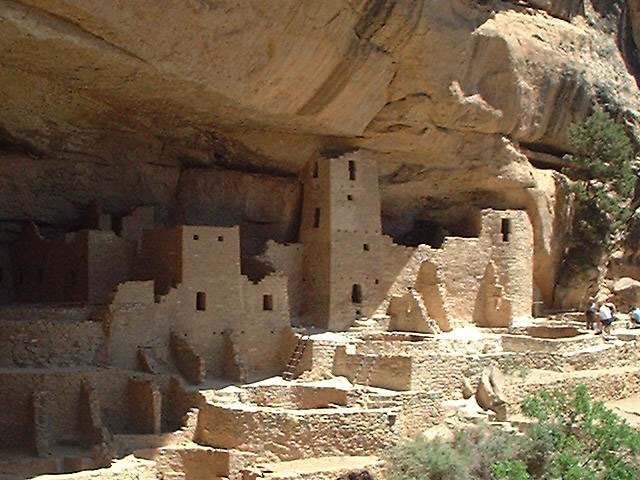
Mesa Verde National Park, a designated UNESCO World Heritage Site since 1978, stands as a testament to the rich cultural history of the Ancestral Pueblo people who inhabited the area between the 6th and 12th centuries. Situated in southwestern Colorado, this national park offers a unique glimpse into the lives of these early American civilizations, providing insights into their architectural prowess, farming practices, and societal structures.
More to come…UNESCO Description of the World Heritage Site
A great concentration of ancestral Pueblo Indian dwellings, built from the 6th to the 12th century, can be found on the Mesa Verde plateau in south-west Colorado at an altitude of more than 2,600 m. Some 4,400 sites have been recorded, including villages built on the Mesa top. There are also imposing cliff dwellings, built of stone and comprising more than 100 rooms.
UNESCO Justification of the World Heritage Site
Criterion (iii): The exceptional archaeological sites of the Mesa Verde landscape provide eloquent testimony to the ancient cultural traditions of Native American tribes. They represent a graphic link between the past and present ways of life of the Puebloan Peoples of the American Southwest.
Encyclopedia Record: Mesa Verde National Park
Mesa Verde National Park is a national park of the United States and UNESCO World Heritage Site located in Montezuma County, Colorado, and the only World Heritage Site in Colorado. The park protects some of the best-preserved Ancestral Puebloan ancestral sites in the United States.Additional Site Details
Area: 21,043 hectares
Number of Components: 1
Coordinates: 37.26166667 , -108.4855556
World Heritage Research
Discover scientific research and academic studies that deepen our understanding of Mesa Verde National Park from its history and significance to its conservation, management, and contemporary challenges.
-
Natural resource conditions at Mesa Verde National Park: Findings and management considerations for selected resources
A comprehensive Natural Resource Condition Assessment (NRCA) at Mesa Verde National Park reveals critical stressors threatening its ecosystems, with climate change, increased fire incidence, and the spread of non-native plants identified as primary drivers. The study evaluated six focal resources—avifauna, deer & elk, rare plants, the Mancos River, upland vegetation, and seeps & springs—using condition assessments and gap analyses where data was limited. Key findings indicate deteriorating conditions for passerines, hummingbirds, rare plants, and riparian ecosystems, while also highlighting significant knowledge gaps in raptor populations, deer & elk dynamics, and upland vegetation outside piñon-juniper woodlands. Management recommendations are provided to address these challenges, offering actionable insights for preserving the park's biodiversity and ecological integrity.
Jones, A., McTague, S., Mozelewski, T., Crafford, R., Maguire, A., & Suraci, J. (2025). Natural resource conditions at Mesa Verde National Park: Findings and management considerations for selected resources (, Ed.). National Park Service. https://doi.org/10.36967/2311540
View Publication Record | Read Publication -
A Summary of 25 Years of Research on Water Supplies of the Ancestral Pueblo People
A 25-year study reveals that the ancestral Pueblo people of Mesa Verde National Park ingeniously managed limited water resources through sophisticated reservoir systems. Researchers identified four mounded areas as ancient reservoirs, which required frequent dredging due to high sediment runoff—a testament to their resourcefulness and organizational skills. The investigation, conducted by a multidisciplinary team from Wright Water Engineers and the Wright Paleohydrological Institute, combined climate research, lab analyses, field surveys, and sediment layer analysis to uncover how these communities harvested and maintained water access in the arid Four Corners region between 750 and 1280 CE. The findings highlight their advanced understanding of water management in a challenging environment.
Wright, K. R. (2024). A Summary of 25 Years of Research on Water Supplies of the Ancestral Pueblo People. Water, 16(17), 2462. https://doi.org/10.3390/w16172462
View Publication Record | Read Publication -
Long-term trend in the aquatic macroinvertebrate community of the Mancos River at Mesa Verde National Park: Aquatic macroinvertebrate monitoring 2008-2019
A long-term study (2008–2019) of the Mancos River at Mesa Verde National Park reveals significant declines in sensitive aquatic macroinvertebrate taxa, driven by thermal and hydrologic stress. Key findings include excessive summer stream temperatures exceeding Colorado’s water quality standards and concurrent low-flow periods, both linked to declines in intolerant species such as Trichoptera and Ephemeroptera-Plecoptera-Trichoptera (EPT) taxa. The study used multi-metric indices to demonstrate ecological impairment at two monitoring sites, attributing these trends to climate-related stresses. Future management must prioritize tracking thermal and hydrologic conditions to mitigate impacts on stream ecosystems.
Stumpf, S., Ploughe, L., & Calvo, C. (2024). Long-term trend in the aquatic macroinvertebrate community of the Mancos River at Mesa Verde National Park: Aquatic macroinvertebrate monitoring 2008-2019 (, Ed.). National Park Service. https://doi.org/10.36967/2306058
View Publication Record | Read Publication -
"Mesa Verde Belongs to You": A Spatial Analysis of Mesa Verde National Park
Mesa Verde National Park, spanning over 50,000 acres of federally protected land, serves as a critical lens to examine the intersections of colonialism, wilderness, and archaeology. This study reveals that MVNP perpetuates settler-indigenous dynamics through its construction of wilderness, preservation of archaeological sites, and interpretation of ancestral Puebloan material culture. By applying Delle's theoretical framework of space as material culture, the research analyzes the material, cognitive, and social dimensions of the park to uncover how these practices reify colonial relationships. The findings underscore the need for decolonization efforts within such protected spaces, offering a pathway to challenge and transform these entrenched dynamics.
Gregory, G. (2024). "Mesa Verde Belongs to You": A Spatial Analysis of Mesa Verde National Park. University of Chicago. https://doi.org/10.6082/BGKW3-KSH07
View Publication Record | Read Publication -
Post-Fire Effects on the Globally Imperiled Chapin Mesa Milkvetch (Astragalus schmolliae), 2001–2019
A crown fire in Mesa Verde National Park in 2002 initially boosted the population of Chapin Mesa milkvetch (Astragalus schmolliae), a globally imperiled, endemic plant. However, by 2019, the density of juvenile and adult plants in burned areas had declined to half that of unburned areas, with near-zero recruitment observed in burned transects. This reversal is likely due to intensified competition from invasive grasses like cheatgrass (Bromus tectorum) and western wheatgrass (Pascopyrum smithii), which now dominate the post-fire landscape. The study, spanning 18 years, highlights the need for targeted management strategies to mitigate competition and preserve old-growth pinon-juniper woodland ecosystems critical for the survival of this imperiled species.
Rondeau, R. J., Anderson, D. G., Handwerk, J. E., & Spector, T. (2022). Post-Fire Effects on the Globally Imperiled Chapin Mesa Milkvetch (Astragalus schmolliae), 2001–2019. Natural Areas Journal, 42(1). https://doi.org/10.3375/21-14
View Publication Record | Read Publication -
Life at Mesa Verde: An Analysis of Health and Trauma from Wetherill Mesa, Mesa Verde National Park
A systematic analysis of bioarchaeological data from Wetherill Mesa burials at Mesa Verde National Park reveals that residents of Pueblo III cliff dwellings experienced significant physiological stress, likely due to resource scarcity, overcrowding, and unsanitary living conditions. This stress may have contributed to the depopulation of the Four Corners region during the late 13th century. Additionally, skeletal fracture data suggest a decrease in trauma during this period, though evidence of culturally mediated violence or violent attacks at Long House hints at insecurity that could have further motivated migration.
Edmonds, E. R., & Martin, D. L. (2022). Life at Mesa Verde: An Analysis of Health and Trauma from Wetherill Mesa, Mesa Verde National Park. Kiva, 88(4), 489–521. https://doi.org/10.1080/00231940.2022.2089817
View Publication Record | Read Publication -
Effects of Recent Wildfires in Piñon-Juniper Woodlands of Mesa Verde National Park, Colorado, USA
Recent wildfires in Mesa Verde National Park have significantly altered the resilience and recovery dynamics of piñon-juniper woodlands, with sprouting woodlands (SPW) showing greater resistance to fire compared to obligate seeding woodlands (OSW). SPW stands recovered faster pre-fire structure and species composition, while OSW stands experienced slower recovery and increased invasion by nonnative plant species. No reestablishment of piñon or juniper trees has been observed post-fire. If current trends persist, some SPW areas may transition to persistent shrublands, while OSW areas could shift to novel herbaceous vegetation dominated by nonnative species. This study highlights the vulnerability of these ecosystems to climate-driven changes and fire frequency, with implications for similar woodlands across the region.
Floyd, M. L., Romme, W. H., & Hanna, D. D. (2021). Effects of Recent Wildfires in Piñon-Juniper Woodlands of Mesa Verde National Park, Colorado, USA. Natural Areas Journal, 41(1). https://doi.org/10.3375/043.041.0105
View Publication Record | Read Publication