World Heritage Identification Number: 492
World Heritage since: 1992
Category: Cultural Heritage
WHE Type: Historic Cities & Urban Areas
Transboundary Heritage: No
Endangered Heritage: No
Country: 🇺🇸 United States of America
Continent: Americas
UNESCO World Region: Europe and North America
Map
Taos Pueblo: A Timeless Testimony to Ancient Puebloan Culture
The Taos Pueblo, located approximately one mile north of the modern city of Taos, New Mexico, stands as a testament to the enduring legacy of the Puebloan people. This remarkable archaeological site, inhabited for over a thousand years, has earned its designation as a UNESCO World Heritage Site since 1992.
More to come…UNESCO Description of the World Heritage Site
Situated in the valley of a small tributary of the Rio Grande, this adobe settlement – consisting of dwellings and ceremonial buildings – represents the culture of the Pueblo Indians of Arizona and New Mexico.
UNESCO Justification of the World Heritage Site
Criterion (iv): Taos Pueblo is a remarkable example of a traditional type of architectural ensemble from the pre-Hispanic period of the Americas unique to this region and one which, because of the living culture of its community, has successfully retained most of its traditional forms up to the present day.
Encyclopedia Record: Taos Pueblo
Taos Pueblo is an ancient pueblo belonging to a Taos-speaking (Tiwa) Native American tribe of Puebloan people. It lies about 1 mile (1.6 km) north of the modern city of Taos, New Mexico. Taos Pueblo has been designated a UNESCO World Heritage Site.Additional Site Details
Area: 19.01 hectares
Number of Components: 1
Coordinates: 36.438 , -105.546
Image
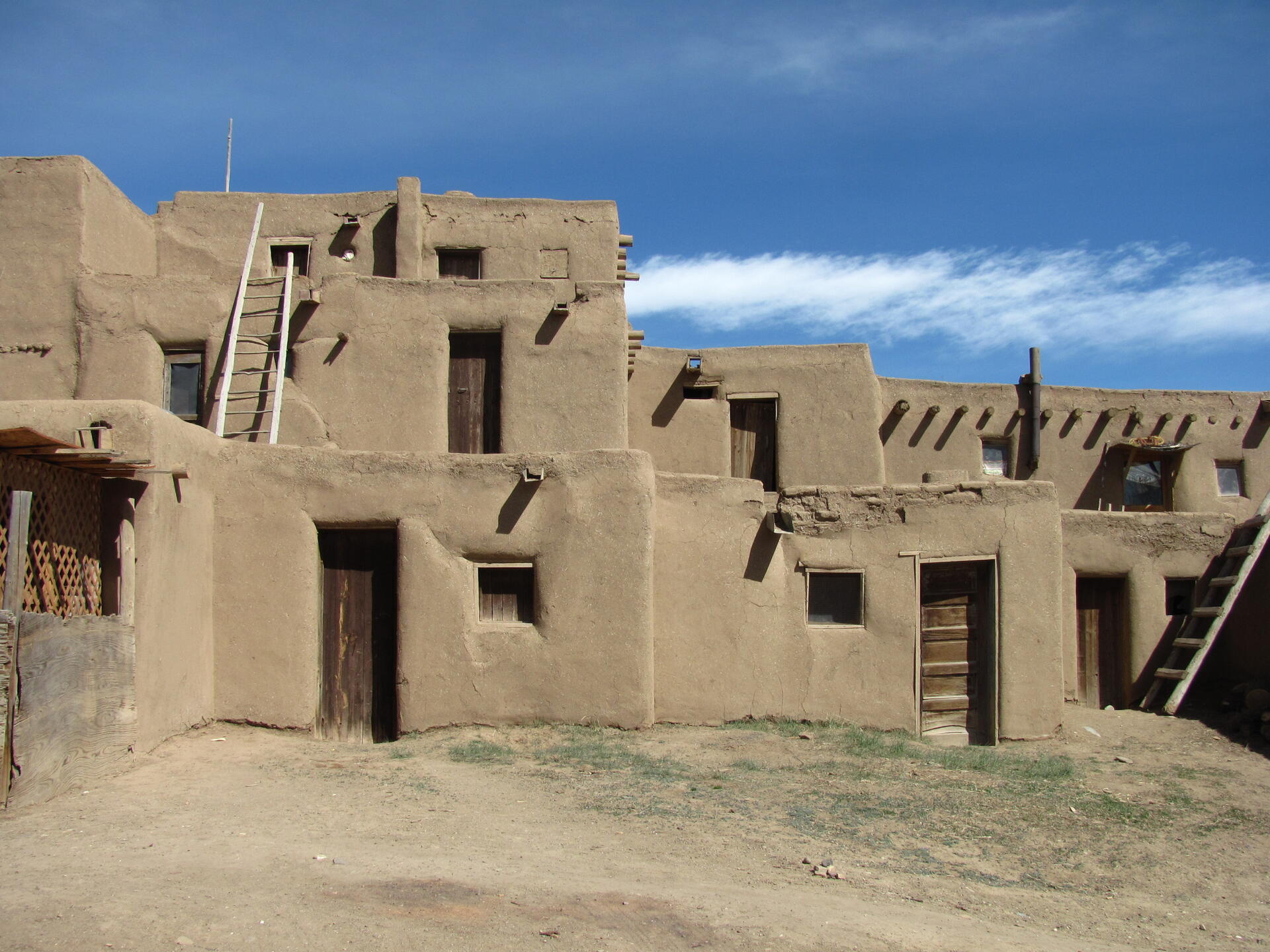
© John Phelan, CC BY-SA 3.0 Resized from original. (This derivative is under the same CC BY-SA license.)
World Heritage Research
Discover scientific research and academic studies that deepen our understanding of Taos Pueblo from its history and significance to its conservation, management, and contemporary challenges.
-
Richard Nixon, Gough Whitlam, and Indigenous Land Rights
A comparative analysis reveals that the successful implementation of Indigenous land rights in the 1970s, exemplified by U.S. President Richard Nixon's return of Blue Lake to Taos Pueblo and Australian Prime Minister Gough Whitlam's transfer of Wattie Creek to the Gurindji people, required a convergence of grassroots pressure, public support, and political will from national leaders. Both leaders used these actions as symbolic milestones in shaping their legacies, demonstrating how Indigenous land rights policies emerged at the intersection of national leadership, public policy, and legacy-building. The study highlights the critical role of sympathetic political contexts in advancing Indigenous self-determination amid settler-colonial resistance.
Kotlowski, D. (2026). Richard Nixon, Gough Whitlam, and Indigenous Land Rights. Pacific Historical Review, 95(3), 281–316. https://doi.org/10.1525/phr.2026.95.3.281
View Publication Record | Read Publication -
The Bioarchaeology of the Pithouse to Pueblo Transition in the Northern Rio Grande
A bioarchaeological study of Ancestral Pueblo populations in the northern Rio Grande region, including Taos Pueblo, reveals distinct community profiles marked by similarities and local variations. These differences are linked to dietary resources, mobility patterns, population growth, and social stress during the Pithouse to Pueblo transition (AD 600-1600). Seasonal food shortages and subsistence practices significantly influenced population density and community integration, highlighting the complex interplay between environmental conditions and human adaptation.
Akins, N. J., Palkovich, A. M., Whitley, C. B., & Larsen, C. S. (2025). The Bioarchaeology of the Pithouse to Pueblo Transition in the Northern Rio Grande. Bioarchaeology of the Southwest, 265–291. https://doi.org/10.5744/florida/9781683405122.003.0007
View Publication Record | Read Publication -
Taos Valley Groundwater Structure
A new groundwater structural model for Taos Valley reveals that faults frequently disrupt water levels, with warm, saline waters rising along these fault planes to precipitate minerals. This finding provides critical insights into the region's aquifer dynamics, influenced by recent watershed management actions such as forest thinning and deep drilling required by the Taos Pueblo Water Rights Settlement Agreement (Abeyta Settlement). The study compiled geological data from water wells across the valley, plotted at a 1:24,000 scale for precise topographic mapping. Drillers' logs distinguished between hard basalt and soft clastic formations, while structural cross-sections highlighted lateral offsets caused by faults, offering a detailed understanding of groundwater behavior in this complex geological setting.
Benson, T., Williams, S., Fire, S., & Powell, G. (2023). Taos Valley Groundwater Structure. New Mexico Geological Society, 2023 Annual Spring Meeting, Proceedings Volume, Theme: “Geological Responses to Wildfires”. https://doi.org/10.56577/sm-2023.2911
View Publication Record | Read Publication -
Modernist Activities and Native Acts in and around Northern New Mexico
Indigenous artists in Northern New Mexico, including Maria Martínez (San Ildefonso Pueblo), Lynn Riggs (Cherokee), and Tony Luján (Taos Pueblo), were not mere subjects of Anglo-European modernism but active participants who strategically engaged with modernist practices between 1887 and 1934. They adapted traditional artistic forms, navigated complex markets, and capitalized on tourism and real estate opportunities, demonstrating how Indigenous individuals leveraged modernity for personal and collective benefit. This study highlights their dynamic roles in the transition to New Mexican statehood while challenging conventional narratives of modernism.
Gano, G. M. (2022). Modernist Activities and Native Acts in and around Northern New Mexico. The Routledge Handbook of North American Indigenous Modernisms, 29–43. https://doi.org/10.4324/9781003030485-4
View Publication Record | Read Publication -
Unseen Women in Psychedelic History
Historical accounts of psychedelic research often overlook the significant contributions of women, whose roles range from pioneering exploration to therapeutic impact. This study reveals underreported stories of women like Mabel Luhan, Valentina Wasson, Mary Barnard, Gertrude Paltin, and Kay Parley, who played pivotal roles in psychedelic investigation but remain marginalized or unknown. While figures such as Wasson are subsumed under more prominent counterparts (e.g., her husband), others like Luhan have been recognized for their contributions without full acknowledgment of their broader influence, particularly in the politics of peyote at Taos Pueblo. The study highlights gaps in documentation and celebratory recognition, emphasizing how women's work in psychedelic exploration—whether for spiritual development or therapeutic purposes—has been systematically overlooked.
Mangini, M. (2021). Unseen Women in Psychedelic History. Journal of Humanistic Psychology, 64(4), 635–652. https://doi.org/10.1177/00221678211029186
View Publication Record | Read Publication -
Taos conversation
A poetic reflection on the Taos Pueblo, a UNESCO World Heritage Site in New Mexico, describes how immersive experiences in wilderness—such as hiking and sleeping under the stars—can provoke somatic shifts that alter human perception of the environment. The work blurs boundaries between self and nature, suggesting embodied encounters may deepen awareness and inform language about the natural world. This approach contrasts with conventional scientific narratives, offering an alternative method for fostering environmental consciousness through intimate, sensory engagement.
Pallant, C. (2021). Taos conversation. Journal of Dance & Somatic Practices, 13(1), 235–238. https://doi.org/10.1386/jdsp_00053_1
View Publication Record | Read Publication -
Diet of a Recently Reintroduced River Otter (Lontra Canadensis) Population in Taos County, New Mexico
River otters reintroduced to New Mexico after a nearly 60-year absence primarily consume crayfish (66.2%) and fish (61.8%), with significant seasonal variation in their diet. The study, the first of its kind in New Mexico, analyzed 877 scat samples from Taos County, revealing that Salmonidae and Catostomidae were the most frequently identified fish families. This research provides critical insights for otter management in the state and aligns with dietary patterns observed in other U.S. studies.
Wolf-Gonzalez, Gabriela Alexandra. (2020). DIET OF A RECENTLY REINTRODUCED RIVER OTTER (LONTRA CANADENSIS) POPULATION IN TAOS COUNTY, NEW MEXICO. University of Kentucky Libraries. https://doi.org/10.13023/ETD.2020.107
View Publication Record | Read Publication