World Heritage Identification Number: 1528
World Heritage since: 2023
Category: Cultural Heritage
WHE Type: Buildings & Architectural Ensembles
Transboundary Heritage: No
Endangered Heritage: No
Country: 🇪🇸 Spain
Continent: Europe
UNESCO World Region: Europe and North America
Map
Talayotic Menorca: Archaeological Treasures of the Prehistoric Balearic Island
The Talayotic Menorca, inscribed as a UNESCO World Heritage Site in 2023, offers a captivating glimpse into the rich cultural history of the prehistoric communities that inhabited the island of Menorca in the western Mediterranean Sea. These archaeological sites, nestled within agro-pastoral landscapes, provide an exceptional testimony to the occupation of the island spanning from the Bronze Age (1600 BCE) to the Late Iron Age (123 BCE).
More to come…UNESCO Description of the World Heritage Site
Located on the island of Menorca in the western Mediterranean Sea, these archaeological sites are situated in agro-pastoral landscapes. A testimony to the occupation of the island by prehistoric communities, these sites display a diversity of prehistoric settlements and burial places. The materials, forms and locations of structures dating from the Bronze Age (1600 BCE) to the Late Iron Age (123 BCE) show the evolution of a “cyclopean” architecture built with very large blocks of stone. Astronomical orientations and visual interconnections between prehistoric structures indicate networks with possible cosmological meanings.UNESCO Justification of the World Heritage Site
Criterion (iii): The high density of prehistoric sites on Menorca and their unusual level of preservation represent an outstanding demonstration of prehistoric dry stone building techniques. The structures unique to this island such as the burial navetas, circular houses and taulas, together with talayots and other dry-stone structures associated with the spatial organisation and occupation of the landscape by prehistoric communities in a challenging island environment, are an exceptional testimony to a tradition of cyclopean architecture and its evolution over a period of approximately 1,500 years.
Criterion (iv): Talayotic Menorca represents an outstanding ensemble of prehistoric cyclopean architecture that demonstrates the organisation and practices of communities from the Bronze Age through to the Late Iron Age. Navetas, talayots, taulas and circular houses within the serial property’s nine component parts illustrate the evolution of the occupation of the island and represent an important source of knowledge about life during this period. The distribution of the prehistoric sites in the agropastoral landscape of Menorca illustrates a spatial organisation that, due to the preservation of large amounts of evidence, is still readable to a large extent, showing visual interconnections between cyclopean structures as well as potential sacred, symbolic and political connotations.
Encyclopedia Record: Talaiotic culture
The Talaiotic culture or Talaiotic period is the name used to describe the society that existed on the Gymnesian Islands during the Iron Age. Its origins date from the end of the second millennium BC, when the inaccurately named Pre-Talaiotic Culture underwent a crisis and evolved into the Talaiotic Culture. Its name is derived from the talaiots, which are the most abundant and emblematic structures from the prehistoric period of the Balearic Islands.Additional Site Details
Area: 3,527 hectares
Number of Components: 9
(iv) — Outstanding example of a type of building or landscape
Coordinates: 39.9975 , 3.9088888889
Image
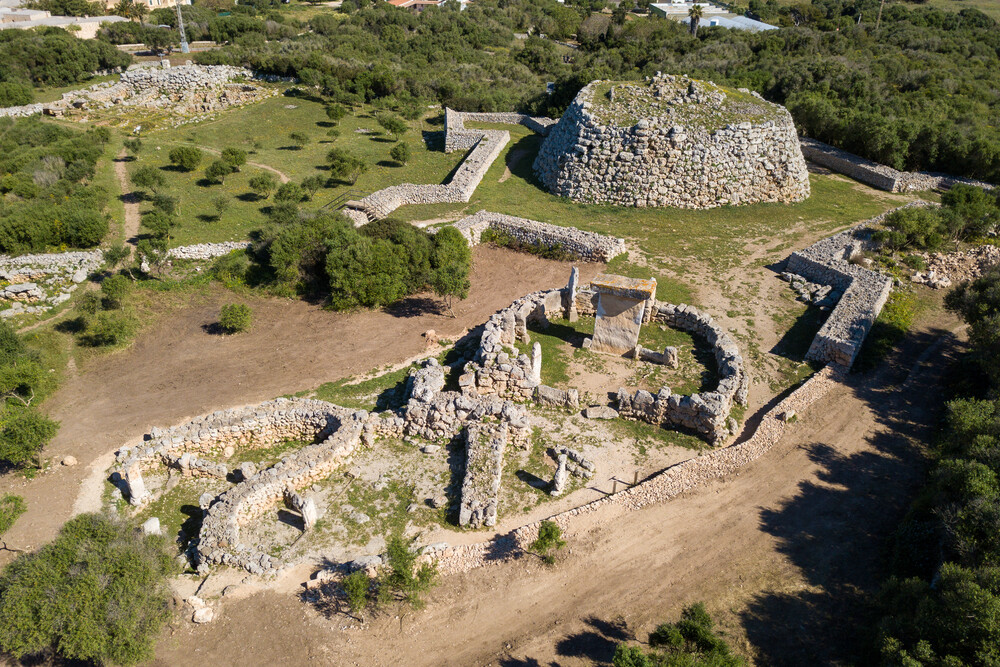
© CIMe. Used with permission.
World Heritage Research
Discover scientific research and academic studies that deepen our understanding of Talayotic Menorca from its history and significance to its conservation, management, and contemporary challenges.
-
The unique Balearic Megalithic “Taulas” (Tables): Paleolithic/Neolithic pre- Iberian lineal scripts found in the Taula complex of So Na Caçana (Menorca Island, Spain)
Researchers have uncovered Paleolithic/Neolithic lineal scripts within the Taula complex of So Na Caçana, Menorca, challenging the long-held assumption that these unique Balearic Megalithic monuments date only to the 1st millennium BC. The discovery suggests a deeper connection between these scripts and ancient writing systems across the Mediterranean, including potential precursors to the Iberian-Tartessian signary. The study proposes that the Mother Goddess religion may have preserved these scripts for millennia, while also linking them to linguistic and genetic traits stemming from a 'green' Sahara migration during desertification around 10,000 years BC. So Na Caçana, meaning 'The property of the She-Hunter,' further contextualizes the cultural significance of these findings.
Arnaiz-Villena, A., Ruiz-del-Valle, V., & Lledo, T. (2025). The unique Balearic Megalithic “Taulas” (Tables): Paleolithic/Neolithic pre- Iberian lineal scripts found in the Taula complex of So Na Caçana (Menorca Island, Spain). International Journal of Modern Anthropology, 3(23), 142–167. https://doi.org/10.4314/ijma.v3i23.2
View Publication Record | Read Publication -
Island archaeology, identity and resilience in Menorca through the Roman Epoch
Menorca's Talayotic Culture distinguished itself from Mallorca through unique monumental architecture, specifically the 'taulas.' This study suggests that these structures served as symbols of social resilience and identity preservation for indigenous Menorcans during the Roman epoch. The research proposes that the construction of visible monuments may have been a conscious effort to differentiate from Mallorca and assert sovereignty amid increasing foreign cultural interactions, including Roman influence. The findings challenge prevailing narratives about Rome's presence in Menorca, indicating a more complex and nuanced relationship than previously understood.
Amundson, M. A. (2021). Island archaeology, identity and resilience in Menorca through the Roman Epoch. Island Studies Journal, 16(2), 198–214. https://doi.org/10.24043/isj.148
View Publication Record | Read Publication -
La iconografía púnica en hipogeos de Menorca (Islas Baleares). Nuevos datos para la construcción de una realidad histórica
Recent archaeological studies, including the excavation of Talayotic settlements and hypogeal caves in Menorca (Balearic Islands), have uncovered a significant corpus of Phoenician iconography. These engravings and paintings, dating from the 6th century BC to 123 BC, provide new evidence linking Menorca culturally and economically to Carthage and Ibiza during the pre-Roman period. The findings challenge previous assumptions about the island's isolation, suggesting instead a vibrant exchange of symbols, beliefs, and trade networks with the broader Phoenician world. This research sheds light on the historical context of these sites, contributing to our understanding of Phoenician influence in the western Mediterranean.
Carbonell Pastor, S., Prados Martínez, F., & De Nicolás Mascaró, J. (2020). La iconografía púnica en hipogeos de Menorca (Islas Baleares) : nuevos datos para la construcción de una realidad histórica [JD]. Folia Phoenicia, 4. https://doi.org/10.19272/202013201004
View Publication Record | Read Publication -
Water collection systems in the prehistory of Menorca: the Circle 6 cistern at Torre d’en Galmés
A large prehistoric cistern, excavated at the Talayotic settlement of Torre d’en Galmés on Menorca, reveals sophisticated water collection systems used by pre-Talayotic and Talayotic communities (2300–123 BCE). The cistern, which fell into disuse after the 7th and 8th century CE, provides insights into how these societies managed water scarcity, particularly in arid limestone regions. The study links this structure to known architectural features of domestic spaces from the 3rd and 2nd centuries BCE and compares it with other prehistoric and historic water storage systems on the island. By analyzing the cistern's design and function alongside broader settlement patterns, researchers highlight its significance in understanding ancient water management strategies in Menorca.
De Salort Giménez, C., Corral García, B., Astiz, C. L., Pons Machado, J., Rodríguez Florit, A., & Robledo Ardila, P. (2020). Water collection systems in the prehistory of Menorca: the Circle 6 cistern at Torre d’en Galmés. Boletín Geológico Y Minero, 131(1), 147–164. https://doi.org/10.21701/bolgeomin.131.1.009
View Publication Record | Read Publication -
De arqueología menorquina: Maria Lluïsa Serra Belabre y los círculos talayóticos de Sant Vicenç d’Alcaidús (Alaior, Menorca).
Maria Lluïsa Serra Belabre's pioneering research on Talayotic architecture, particularly at Sant Vicenç d'Alcaidús (Alaior, Menorca), offers key insights into the architectural forms of prehistoric island communities. Her work, based on extensive field studies and archival analysis, challenges conventional interpretations by proposing novel theories about Talayotic housing structures. Serra's meticulous approach, combining on-site investigations with historical documentation, provides a comprehensive framework for understanding the socio-cultural dynamics of prehistoric Menorca. This study underscores the significance of Sant Vicenç d'Alcaidús as a critical site for interpreting broader patterns in Balearic island archaeology.
Torres Gomariz, O. (2016). De arqueología menorquina: Maria Lluïsa Serra Belabre y los círculos talayóticos de Sant Vicenç d’Alcaidús (Alaior, Menorca). Panta Rei, (1). https://doi.org/10.6018/pantarei/2016/2
View Publication Record | Read Publication -
New data from fortified coastal settlement of Cap de Forma, Maó-Menorca (Balearic Islands)
New radiometric data from the fortified coastal settlement of Cap de Forma, Menorca, reveals insights into the early Talayotic period, a significant phase in the island's prehistory. The study, focusing on three living spaces adjacent to an atypical cyclopean monument, provides chronological context for artifacts and structures dating back to the beginning of this period. Located on a strategic isthmus near a natural harbor, the site offers a rare glimpse into the architectural and cultural practices of Talayotic settlements. The research employs radiometric techniques to interpret recent archaeological findings, contributing to our understanding of the region's protohistorical development.
Depalmas, A., Bulla, C., & Fundoni, G. (2015). New data from fortified coastal settlement of Cap de Forma, Maó-Menorca (Balearic Islands). Mediterranean Geoarchaeology Workshop, Shaping the Mediterranean basin: islands, coastlines and cultures across time. https://doi.org/10.13125/MGW-1558
View Publication Record | Read Publication -
Chronological Framework for the Early Talayotic Period in Menorca: The Settlement of Cornia Nou
New radiocarbon dating evidence from the prehistoric site of Cornia Nou, Menorca, reveals key phases in the early Talayotic period. Analysis of 27 samples indicates three distinct occupation phases: 1100–900 BC (Phase 4), 900–800 BC (Phase 5), and 800–600 BC (Phase 6). Additionally, the western talayot's construction likely predates the 1st millennium cal BC. This study, conducted by a team linked to the Museum of Menorca over six years, provides critical insights into the chronological framework of this significant Talayotic settlement.
Anglada, M., Ferrer, A., Plantalamor, L., Ramis, D., van Strydonck, M., & De Mulder, G. (2014). Chronological Framework for the Early Talayotic Period in Menorca: The Settlement of Cornia Nou. Radiocarbon, 56(2), 411–424. https://doi.org/10.2458/56.16962
View Publication Record | Read Publication -
New Data from Fortified Coastal Settlement of Cap de Forma, Mahon, Menorca (Balearic Islands)
Radiometric analysis of archaeological layers at the fortified coastal settlement of Cap de Forma, Menorca, reveals new insights into the early Talayotic period. The study, conducted on a site adjacent to a cyclopean monument and necropolis near an ancient harbor, identified three living spaces dating back to the beginning of this protohistorical phase (c. 1200–900 BCE). This challenges previous assumptions about the chronological horizon of the site's artifacts, which were predominantly linked to later periods. The findings suggest a more complex settlement pattern and longer occupation than previously thought, providing critical evidence for understanding the transition from pre-Talayotic to Talayotic societies in the Balearic Islands.
Depalmas, A. (2014). New Data from Fortified Coastal Settlement of Cap de Forma, Mahon, Menorca (Balearic Islands). Radiocarbon, 56(2), 425–437. https://doi.org/10.2458/56.17169
View Publication Record | Read Publication