World Heritage Identification Number: 804
World Heritage since: 1997
Category: Cultural Heritage
WHE Type: Buildings & Architectural Ensembles
Transboundary Heritage: No
Endangered Heritage: No
Country: 🇪🇸 Spain
Continent: Europe
UNESCO World Region: Europe and North America
Map
A Symphony of Architecture and Culture: Palau de la Música Catalana and Hospital de Sant Pau, Barcelona
The Palau de la Música Catalana and the Hospital de Sant Pau, both located in Barcelona, Spain, stand as testaments to the artistic vision and architectural genius of Lluís Domènech i Montaner. Together, they form a single UNESCO World Heritage property, inscribed in 1997 in recognition of their outstanding contribution to Catalan Modernism and world architecture. These landmarks combine exceptional aesthetics, innovative design, and profound cultural significance.
Palau de la Música Catalana: A Concert Hall of Exquisite Design
Built between 1905 and 1908, the Palau de la Música Catalana was commissioned by Orfeó Català, a prominent choral society that played a vital role in the Catalan cultural renaissance. Since its inauguration, the building has served as a vibrant center for music and performance, hosting concerts, conferences, and other events that celebrate Catalan culture.
The exterior of the Palau is adorned with intricate mosaics, sculptures, stained glass, and ornamental brickwork, showcasing the talents of some of the leading artists and craftsmen of the period.
The interior is equally remarkable, featuring an impressive concert hall illuminated by a spectacular stained-glass skylight in the form of an inverted dome. Ornate balconies, sculptural details, and a magnificent organ contribute to the hall's unique atmosphere. The auditorium's design promotes a close connection between performers and audiences, creating an intimate and engaging cultural experience.
Hospital de Sant Pau: A Sanctuary for Healing and Artistry
Designed by Lluís Domènech i Montaner and constructed in phases between 1902 and 1930, the Hospital de Sant Pau was conceived as a pioneering healthcare complex that combined advanced medical principles with artistic excellence. Following Domènech i Montaner's involvement, portions of the project were completed under the direction of his son, Pere Domènech i Roura.
The complex consists of numerous pavilions arranged within extensive landscaped grounds and connected by underground passages. Each pavilion was designed for a specific medical function and features distinctive façades adorned with colorful mosaics, sculptures, ceramic decoration, and wrought-iron details. The hospital incorporated state-of-the-art medical facilities for the early twentieth century and reflected innovative ideas about hygiene, ventilation, natural light, and patient well-being.
Although the historic Modernist complex no longer functions as Barcelona's principal hospital, it has been carefully restored and repurposed as a cultural, educational, and institutional center. Today, it welcomes visitors from around the world through exhibitions, events, and guided tours that highlight its architectural and historical significance.
Legacy and Significance
Together, the Palau de la Música Catalana and the Hospital de Sant Pau represent two of the finest achievements of Catalan Modernism and serve as enduring symbols of Barcelona's rich cultural heritage. Their inclusion on the UNESCO World Heritage List recognizes not only their exceptional architectural and artistic value but also their contribution to the broader development of modernist architecture worldwide.
These landmarks continue to embody the ideals of creativity, innovation, and social progress that inspired their creation. By preserving them, we ensure that future generations can appreciate their beauty, craftsmanship, and cultural importance. Their enduring legacy serves as a reminder of the power of art, architecture, and human ingenuity to enrich society and shape the character of cities.
UNESCO Description of the World Heritage Site
These are two of the finest contributions to Barcelona's architecture by the Catalan art nouveau architect Lluís Domènech i Montaner. The Palau de la Música Catalana is an exuberant steel-framed structure full of light and space, and decorated by many of the leading designers of the day. The Hospital de Sant Pau is equally bold in its design and decoration, while at the same time perfectly adapted to the needs of the sick.
UNESCO Justification of the World Heritage Site
Criterion (i): The Palau de la Música Catalana and the Hospital de Sant Pau in Barcelona are masterpieces of the imaginative and exuberant Modernista style that flowered in early 20th century Barcelona. They are the work of Lluís Domènech i Montaner, one of the acknowledged leaders of this influential architectural movement.
Criterion (ii): The Palau de la Música Catalana and the Hospital de Sant Pau in Barcelona are outstanding examples of the Catalan Modernista style, movement that played an important role in the evolution of 20th century architecture.
Criterion (iv): The Palau de la Música Catalana and the Hospital de Sant Pau are two of the finest (and earliest) examples of the Modernist style in architecture and of exceptional importance, both as manifestations of human creative genius and works of art.
Encyclopedia Record: Palau de la Música Catalana
Palau de la Música Catalana is a concert hall in Barcelona, Catalonia, Spain. Designed in the Catalan modernista style by the architect Lluís Domènech i Montaner, it was built between 1905 and 1908 for Orfeó Català, a choral society founded in 1891 that was a leading force in the Catalan cultural movement that came to be known as the Renaixença. It was inaugurated on 9 February 1908.Additional Site Details
Area: 6.87 hectares
Number of Components: 2
(ii) — Significant interchange of human values
(iv) — Outstanding example of a type of building or landscape
Coordinates: 41.38778 , 2.175
Image
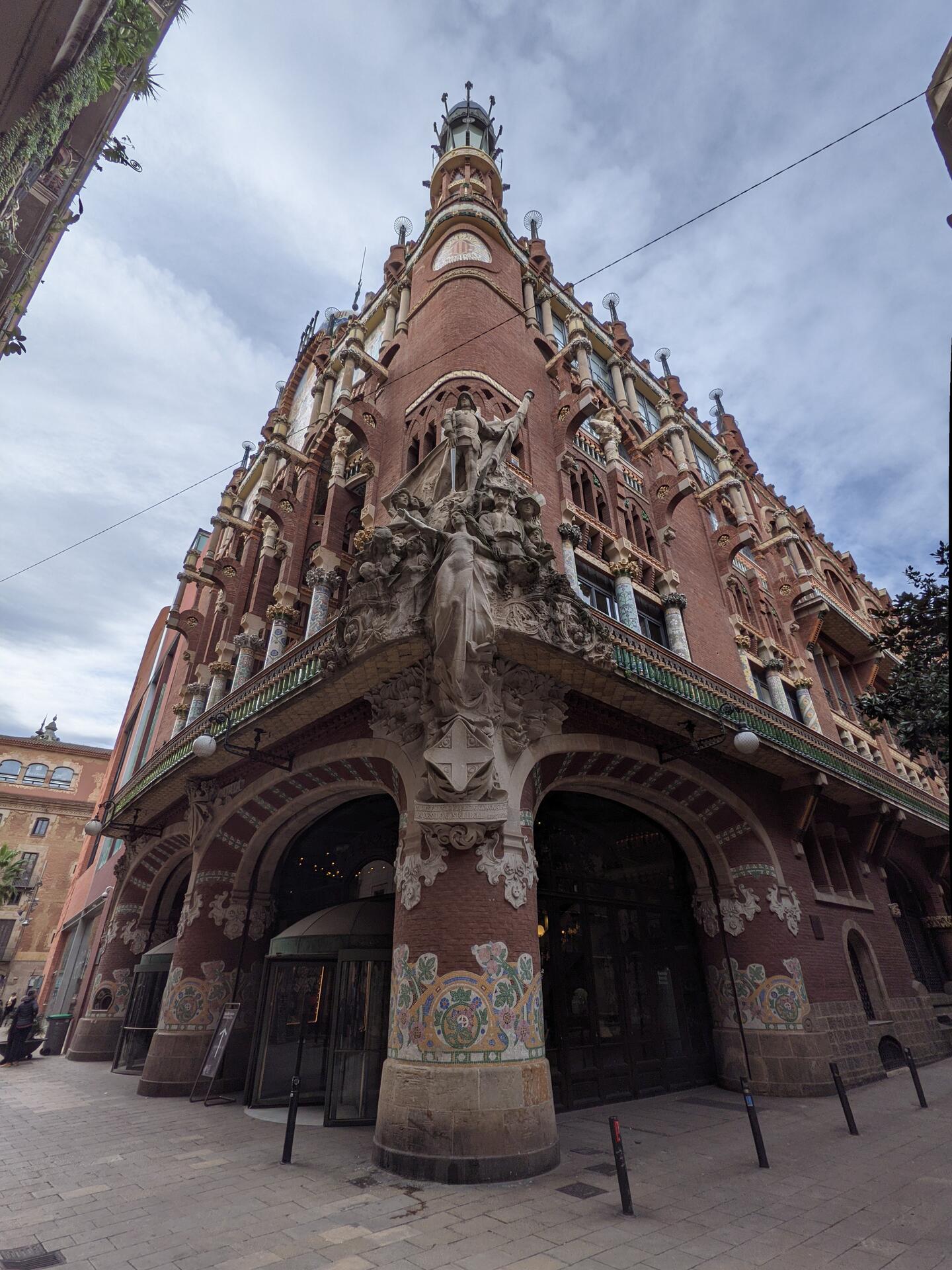
© Doomuu, CC BY-SA 4.0 Resized from original. (This derivative is under the same CC BY-SA license.)
World Heritage Research
Discover scientific research and academic studies that deepen our understanding of Palau de la Música Catalana and Hospital de Sant Pau, Barcelona from its history and significance to its conservation, management, and contemporary challenges.
-
A historical overview of Higini Arau’s proposal for calculating reverberation time (1988)
Higini Arau’s 1988 proposal for calculating reverberation time offers a significant advancement over Sabine's classical formula by accounting for the non-uniform distribution of absorbing materials in concert halls. This innovation, developed during the acoustic renovation of Palau de la Música Catalana, introduced a three-directional (X, Y, Z) decay rate quantification that more accurately models sound behavior in real-world auditoriums. Arau’s work, initially published in Acustica and later refined in 1998, gained recognition through comparisons with other formulae and was integrated into leading international acoustic design software by the 2000s. This historical overview assesses the enduring impact of Arau’s proposal on global academic discourse.
Álvarez, J., Graus, R., & Martín-Nieva, H. (2025). A historical overview of Higini Arau’s proposal for calculating reverberation time (1988). Proceedings of the 11th Convention of the European Acoustics Association Forum Acusticum / EuroNoise 2025, 925–931. https://doi.org/10.61782/fa.2025.0012
View Publication Record | Read Publication -
MªTeresa Castells Mas: enfermera pionera en la gestión de los quirófanos del Hospital de la Santa Creu i Sant Pau de Barcelona
This biographical account highlights MªTeresa Castells Mas as a pioneering figure in surgical nursing, whose leadership and contributions were instrumental in shaping the field. Her career, documented through oral history, underscores her role as a trailblazer in quirúrgica management at the Hospital de la Santa Creu i Sant Pau (Barcelona). A graduate of the Escuela Santa Madrona and trained in surgical nursing, she played a pivotal role in the hospital's nursing reforms under Adela Simón. Her expertise extended to training the first cohort of surgical nurses and establishing Barcelona’s pioneering cardiac surgery nursing team. Later, her career at Hospital de Bellvitge included significant administrative roles. This narrative provides invaluable insight into the evolution of surgical nursing practices and the early development of cardiac surgery in Barcelona.
Buil, N., Sillero Sillero, A., & Galbany-Estragués, P. (2023). MªTeresa Castells Mas: enfermera pionera en la gestión de los quirófanos del Hospital de la Santa Creu i Sant Pau de Barcelona. Temperamentvm, e14510. https://doi.org/10.58807/temperamentvm20236083
View Publication Record | Read Publication -
Mª Rosa Garín Solé: pionera de la enfermería perfusionista en el Hospital de la Santa Creu i Sant Pau de Barcelona
Mª Rosa Garín Solé, the first perfusionist at the Hospital de la Santa Creu i Sant Pau (HSCSP) in Barcelona, pioneered the role of nurse perfusionists, significantly advancing cardiac surgery outcomes. Her career, spanning from 1954 to 1994, included leading the HSCSP's first cardiac transplant in 1984 and founding the Spanish Association of Perfusion Nurses (AEP) in 1978, which she later chaired. This qualitative study, based on an in-depth interview, recovers her professional trajectory, highlighting her contributions to nursing history and patient care. Recognized with Catalonia's President Francesc Macià Medal in 2006, Garín Solé's legacy underscores the impact of nurse perfusionists on surgical advancements.
Buil, N., Sillero Sillero, A., Lorenzo Vaquerizo, L. M., & Galbany-Estragués, P. (2023). Mª Rosa Garín Solé: pionera de la enfermería perfusionista en el Hospital de la Santa Creu i Sant Pau de Barcelona. Temperamentvm, e14472. https://doi.org/10.58807/temperamentvm20236084
View Publication Record | Read Publication -
Evaluating the Impact of Immediate Lymphatic Reconstruction for the Surgical Prevention of Lymphedema
Immediate lymphatic reconstruction significantly reduces the risk of lymphedema following breast cancer surgery, according to a study conducted at Hospital de la Santa Creu i Sant Pau. The research demonstrated that performing lymphatic reconstruction during mastectomy or axillary lymph node dissection effectively prevents lymphedema in 90% of patients, compared to conventional methods with higher complication rates. The study employed a retrospective analysis of 100 patients, evaluating clinical outcomes and complications over a two-year period. This approach offers a promising surgical strategy for preserving quality of life post-treatment.
Abdelfattah, U., Pons, G., & Masià, J. (2022). Evaluating the Impact of Immediate Lymphatic Reconstruction for the Surgical Prevention of Lymphedema. Plastic & Reconstructive Surgery, 151(3), 522e–523e. https://doi.org/10.1097/prs.0000000000009942
View Publication Record | Read Publication -
«Rèquiem a la memòria de Salvador Espriu» (Xavier Benguerel, 1989): hermenéutica y simbolismo musical en el referente poético de una misa de difuntos.
Xavier Benguerel's 'Rèquiem a la memòria de Salvador Espriu' (1989), premiered at Palau de la Música Catalana, integrates seven poems by Salvador Espriu into a Tridentine Mass structure, creating a unique funeral work that blends religious ritual with poetic symbolism. This study reveals how Benguerel's musical choices—such as meditative profane interruptions—enhance the dramatic intent of Espriu's poetry while maintaining liturgical coherence. The analysis employs hermeneutic methods to assess the alignment between text and music, demonstrating Benguerel's distinctive approach to constructing funeral symbolism in sacred-commemoration works.
Ramos Contioso, S. (2022). «Rèquiem a la memòria de Salvador Espriu» (Xavier Benguerel, 1989): hermenéutica y simbolismo musical en el referente poético de una misa de difuntos. ENCLAVES. Revista de Literatura, Música Y Artes Escénicas, (2), 164–182. https://doi.org/10.12795/enclaves.2022.i02.13
View Publication Record | Read Publication -
The Catalan Guitar, Part 2: Two New E-books by Josep María Mangado
Two seminal e-books by Josep María Mangado Artigas shed new light on the history of the guitar in Catalonia, particularly its performance and cultural significance from 1769 to 1940. The first, La guitarra en Cataluña, provides an in-depth exploration of notable Catalan guitarists such as José Ferrer, Sor, Brocá, Viñas, Bosch, Costa, and Más, while the second, Los conciertos de guitarra en el Palau de la Música Catalana, traces the evolution of guitar concerts at this iconic Barcelona venue from its inception in 1908 to the premiere of Joaquín Rodrigo's Concierto de Aranjuez in 1940. Mangado’s meticulous archival research, combining historical documentation with musical analysis, reveals the guitar’s pivotal role in Catalan musical identity and its integration into broader European concert traditions. These works offer a comprehensive narrative that bridges gaps in existing literature, enriching our understanding of guitar performance history in Catalonia.
Long, R. (2021). The Catalan Guitar, Part 2: Two New E-books by Josep María Mangado. Soundboard Scholar, 7(1), 1–14. https://doi.org/10.56902/sbs.2021.7.20
View Publication Record | Read Publication -
Decision-Making Tool for Enhancing the Sustainable Management of Cultural Institutions: Season Content Programming at Palau De La Música Catalana
A novel multi-criteria decision-making (MCDM) model has been successfully applied to assess the sustainability of musical season programming, marking a first for cultural institutions. This approach, traditionally used in other sectors, introduces a Season Value Index (SVI) that enables more sustainable decisions based on established criteria. The method's robustness was validated through sensitivity analysis across different scenarios. The study utilized qualitative interviews with Catalan cultural professionals and real data from the Palau de la Música Catalana's 2015–2016 season, demonstrating its practical applicability and potential for broader adoption in cultural management.
Casanovas-Rubio, M. d. M., Christen, C., Valarezo, L. M., Bofill, J., Filimon, N., & Armengou, J. (2020). Decision-Making Tool for Enhancing the Sustainable Management of Cultural Institutions: Season Content Programming at Palau De La Música Catalana. Sustainability, 12(14), 5785. https://doi.org/10.3390/su12145785
View Publication Record | Read Publication