World Heritage Identification Number: 456
World Heritage since: 1988
Category: Cultural Heritage
WHE Type: Buildings & Architectural Ensembles
Transboundary Heritage: No
Endangered Heritage: No
Country: 🇬🇷 Greece
Continent: Europe
UNESCO World Region: Europe and North America
Map
Paleochristian and Byzantine Monuments of Thessalonika: A Testament to the City's Rich History
The Paleochristian and Byzantine Monuments of Thessalonika, inscribed as a UNESCO World Heritage Site in 1988, offer a captivating glimpse into the rich history of this ancient city in Macedonia, Greece. Founded in 315 B.C., Thessaloniki served as a crucial hub for the spread of Christianity and was adorned with impressive architectural marvels that continue to stand as testaments to the city's significance during the Middle Ages.
More to come…UNESCO Description of the World Heritage Site
Founded in 315 B.C., the provincial capital and sea port of Thessalonika was one of the first bases for the spread of Christianity. Among its Christian monuments are fine churches, some built on the Greek cross plan and others on the three-nave basilica plan. Constructed over a long period, from the 4th to the 15th century, they constitute a diachronic typological series, which had considerable influence in the Byzantine world. The mosaics of the rotunda, St Demetrius and St David are among the great masterpieces of early Christian art.
UNESCO Justification of the World Heritage Site
Criterion (i): The mosaics of the Rotunda, Saint Demetrius and Hosios David’s (Latomou Monastery) are among the great masterpieces of Early Christian art.
Criterion (ii): The influence of the Thessalonian churches on the development of the monumental arts was considerable first in the Byzantine and later the Serbian world, whether in the Early Christian period, the Middle Byzantine era or the Palaeologan Renaissance.
Criterion (iv): The Christian monuments of Thessalonika are outstanding examples of churches built according to central, basilical and transitional architectural types over a period going from the 4th to the 15th century. For this reason they constitute a series which is a typological point of reference.
Encyclopedia Record: Paleochristian and Byzantine monuments of Thessaloniki
The city of Thessaloniki in Macedonia, Greece, for several centuries the second-most important city of the Byzantine Empire, played an important role for Christianity during the Middle Ages and was decorated by impressive buildings. Because of Thessaloniki's importance during the early Christian and Byzantine periods, the city contains several Paleochristian monuments that have significantly contributed to the development of Byzantine art and architecture throughout the Byzantine Empire and Serbia. The evolution of Imperial Byzantine architecture and the prosperity of Thessaloniki go hand in hand, especially during the first years of the Empire, when the city continued to flourish. Despite the capture of Thessaloniki by the Ottoman Empire in 1430, the Christian monuments were not destroyed, and travelers such as Paul Lucas and Abdulmejid I document the city's wealth in Christian monuments during the Ottoman control of the city.Additional Site Details
Area: 5.327 hectares
Number of Components: 15
(ii) — Significant interchange of human values
(iv) — Outstanding example of a type of building or landscape
Coordinates: 40.63833 , 22.965
Image
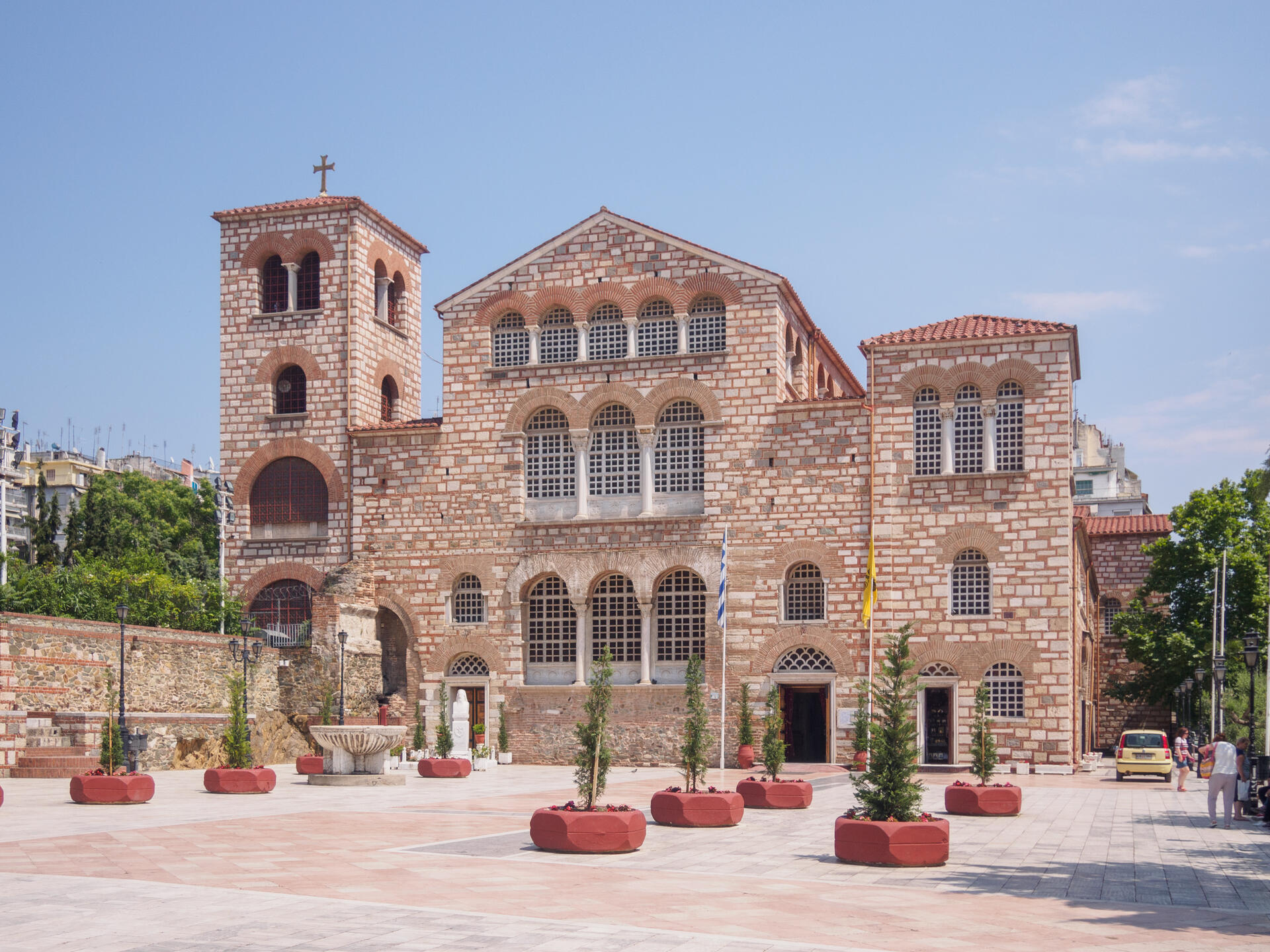
© C messier, CC BY-SA 4.0 Resized from original. (This derivative is under the same CC BY-SA license.)
World Heritage Research
Discover scientific research and academic studies that deepen our understanding of Paleochristian and Byzantine Monuments of Thessalonika from its history and significance to its conservation, management, and contemporary challenges.
-
To the Iconography of the Saint Warrior Horseman in the Byzantine Sphragistics of the 12th – 13th Centuries. Saint Demetrios of Thessalonika
Research on the iconography of Saint Demetrios of Thessalonika reveals that the depiction of him as a warrior horseman, found on two 12th–13th century seals in the State Hermitage Museum, likely originated from a shared prototype—possibly an honored icon housed in the Basilica of Saint Demetrios. This rare and late formation suggests it may be the final evolution of saint warrior imagery in Byzantine art. The study employed comparative analysis of sphragistics, numismatics, and other monuments to date these seals, confirming their origin during a period when such representations were uncommon. The findings highlight the significance of Thessalonika's cultural and religious heritage within the broader context of Byzantine iconography.
Stepanenko, V. (2020). To the Iconography of the Saint Warrior Horseman in the Byzantine Sphragistics of the 12th – 13th Centuries. Saint Demetrios of Thessalonika. Vestnik Volgogradskogo Gosudarstvennogo Universiteta. Serija 4. Istorija. Regionovedenie. Mezhdunarodnye Otnoshenija, (6), 111–120. https://doi.org/10.15688/jvolsu4.2019.6.9
View Publication Record | Read Publication -
Image-based 3D Shape Reconstruction of Byzantine and Paleochristian Monuments
Advanced image-based 3D reconstruction techniques have successfully captured the intricate details of Thessaloniki's Paleochristian and Byzantine monuments, offering unprecedented precision for cultural heritage preservation. By leveraging state-of-the-art algorithms and commercial software, researchers generated highly accurate 3D surface models of iconic structures, providing a digital toolkit that bridges gaps in traditional documentation methods. This approach not only preserves historical data but also enables deeper analysis of architectural features, textures, and structural integrity—key for conservation efforts. The study highlights the potential of these technologies to revolutionize how heritage sites are studied and protected.
Symeonidis, C., Karakostas, I., Martinopoulou, E., & Pitas, I. (2019). Image-based 3D Shape Reconstruction of Byzantine and Paleochristian Monuments. Digital Presentation and Preservation of Cultural and Scientific Heritage, 9, 21–26. https://doi.org/10.55630/dipp.2019.9.1
View Publication Record | Read Publication