World Heritage Identification Number: 1517
World Heritage since: 2016
Category: Cultural Heritage
WHE Type: Archaeological Sites
Transboundary Heritage: No
Endangered Heritage: No
Country: 🇬🇷 Greece
Continent: Europe
UNESCO World Region: Europe and North America
Map
The Archaeological Site of Philippi: A Testament to Ancient Civilizations and Early Christianity
The Archaeological Site of Philippi, nestled at the foot of an acropolis in northeastern Greece, offers a captivating glimpse into the rich tapestry of history that spans from Classical Greece to the formative years of Christianity. Inscribed as a UNESCO World Heritage Site in 2016, this remarkable location boasts an impressive array of architectural remnants, bearing testament to the city's illustrious past and its significance in shaping the course of Western civilization.
More to come…UNESCO Description of the World Heritage Site
The remains of this walled city lie at the foot of an acropolis in north-eastern Greece, on the ancient route linking Europe and Asia, the Via Egnatia. Founded in 356 BC by the Macedonian King Philip II, the city developed as a “small Rome” with the establishment of the Roman Empire in the decades following the Battle of Philippi, in 42 BCE. The vibrant Hellenistic city of Philip II, of which the walls and their gates, the theatre and the funerary heroon (temple) are to be seen, was supplemented with Roman public buildings such as the Forum and a monumental terrace with temples to its north. Later the city became a centre of the Christian faith following the visit of the Apostle Paul in 49-50 CE. The remains of its basilicas constitute an exceptional testimony to the early establishment of Christianity.
UNESCO Justification of the World Heritage Site
Criterion (iii): Philippi is an exceptional testimony to the incorporation of regions into the Roman Empire as demonstrated by the city’s layout and architecture as a colony resembling a “small Rome”. The remains of its churches are exceptional testimony to the early establishment and growth of Christianity.
Criterion (iv): The monuments of Philippi exemplify various architectural types and reflect the development of architecture during the Roman and Early Christian period. The Forum stands out as an example of such a public space in the eastern Roman provinces. The Octagon Church, the transept Basilica, and the domed Basilica stand out as types of Early Christian architecture.
Encyclopedia Record: Philippi
Philippi was a major mainland Greek city northwest of the nearby island, Thasos. Its original name was Crenides after its establishment by Thasian colonists in 360/359 BC. The city was renamed by Philip II of Macedon in 356 BC and abandoned in the 14th century after the Ottoman conquest. The present village of Filippoi is located near the ruins of the ancient city and is part of the region of East Macedonia and Thrace in Kavala, Greece. The archaeological site was classified as a UNESCO World Heritage Site in 2016 because of its exceptional Roman architecture, its urban layout as a smaller reflection of Rome itself, and its importance in early Christianity.Additional Site Details
Area: 87.545 hectares
Number of Components: 1
(iv) — Outstanding example of a type of building or landscape
Coordinates: 41.0147222222 , 24.2852777778
Image
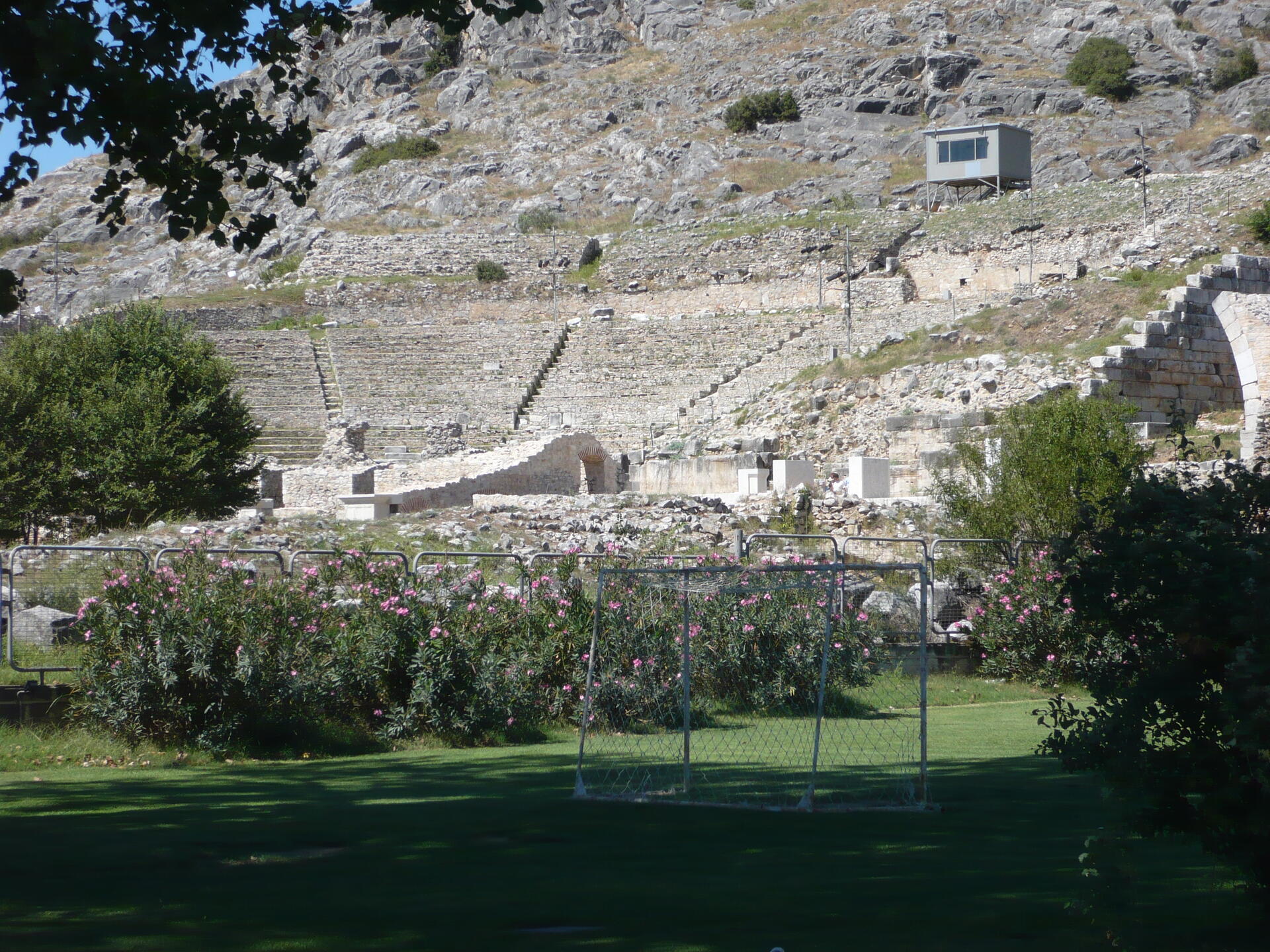
© Batr41, CC BY-SA 4.0 Resized from original. (This derivative is under the same CC BY-SA license.)
World Heritage Research
Discover scientific research and academic studies that deepen our understanding of Archaeological Site of Philippi from its history and significance to its conservation, management, and contemporary challenges.
-
Archaeological fieldwork and research in Roman Macedonia: 2014–2024
Recent archaeological research in Roman-period Macedonia (2014–2024) has revealed a dynamic and interconnected landscape, challenging traditional models of rural habitation. Large-scale infrastructure projects, such as Thessaloniki’s Metro and the Trans Adriatic Pipeline, exposed dense settlement patterns, sophisticated urban grids, monumental public architecture, and diverse burial grounds, highlighting the city's evolution from Hellenistic to Late Antiquity periods. Rural investigations uncovered small cemeteries, artisanal workshops, agricultural estates, and infrastructure, emphasizing continuous rural habitation, intensified agricultural activity, and advanced land management strategies. Interdisciplinary approaches, including geoarchaeology and bioarchaeology, further illuminated socio-economic networks and daily life in both urban and rural communities.
Evangelidis, V. (2025). 5 Archaeological fieldwork and research in Roman Macedonia: 2014–2024. Archaeological Reports, 71, 105–129. https://doi.org/10.1017/s0570608425100227
View Publication Record | Read Publication -
Molecular Characterization and Ex Situ Conservation of Wild Grapevines Grown in the Area Around the Neolithic Settlement of Dikili Tash, Greece
A recent archaeological excavation at the Neolithic settlement of Dikili Tash, near the UNESCO World Heritage Site of Philippi in Greece, has uncovered charred grapevine pips and pressings dating back to 4300 BC. The majority of these pips were identified as Vitis vinifera ssp. sylvestris, a wild grapevine species that still thrives in the surrounding valley, Mt Pangaion, and Mt Lekani. Microsatellite analysis of 51 modern samples revealed their genetic relationships, providing insights into the historical distribution and conservation potential of this ancient species. Cuttings from these vines are now being cultivated ex situ at ELGO-DIMITRA's greenhouse facilities in Athens, aiming to establish Greece's first V. sylvestris conservation site. This research bridges archaeology and genetics, offering a window into Neolithic agricultural practices while advancing efforts to preserve wild grapevine biodiversity.
Merkouropoulos, G., Ganopoulos, I., Doupis, G., Maul, E., & Röckel, F. (2025). Molecular Characterization and Ex Situ Conservation of Wild Grapevines Grown in the Area Around the Neolithic Settlement of Dikili Tash, Greece. Agriculture, 15(12), 1301. https://doi.org/10.3390/agriculture15121301
View Publication Record | Read Publication -
Digital Heritage Narrative: Principles and Practice. The Case of the UNESCO-Listed Archaeological Site of Philippi, Greece
A novel digital storytelling approach has been successfully applied to the UNESCO-listed Archaeological Site of Philippi, Greece, demonstrating its potential to elicit cognitive-emotional experiences and communicate cultural values effectively. The study introduces a multimedia eBook, 'Birthplace of the Empire,' which leverages socio-historical content, unexpected art momentum, and cognitive load management to create an engaging digital artwork. This approach inspires critical thinking and participatory practices among audiences, fostering a deeper connection with the site's multicultural and multigenerational significance. The research is part of the EU-funded project BSB/831/HERiPRENEURSHIP, aiming to upgrade heritage-based offers and create new investment opportunities in tourism and cultural industries.
Papathanasiou-Zuhrt, D. (2024). Digital Heritage Narrative: Principles and Practice. The Case of the UNESCO-Listed Archaeological Site of Philippi, Greece. Strategic Innovative Marketing and Tourism, 203–210. https://doi.org/10.1007/978-3-031-51038-0_23
View Publication Record | Read Publication -
Rock-Cut Monuments at Macedonian Philippi – Taking Image Analysis to the Religioscape
A groundbreaking study at the UNESCO World Heritage Site of Philippi introduces a novel approach to analyzing rock-cut monuments, revealing their significant role within the city's religious landscape. By leveraging 3D modeling and spatial analysis, researchers have documented over 100 reliefs, predominantly featuring Artemis/Diana, providing unprecedented insights into their distribution, inter-visibility, and reachability. This method offers a more comprehensive understanding of the monuments' context and their potential for female ritual practices in ancient Macedon. The study also highlights the vulnerability of these archaeological sites to natural corrosion and vandalism, underscoring the importance of digital documentation for preservation and future research.
Graml, C., Diosono, F., & Hunziker, M. (2024). Rock-Cut Monuments at Macedonian Philippi – Taking Image Analysis to the Religioscape. Open Archaeology, 10(1). https://doi.org/10.1515/opar-2024-0018
View Publication Record | Read Publication -
The Contribution of Information Technologies to the Protection of World Cultural and Natural Heritage Monuments "The Case of Ancient Philippi, Greece"
A novel methodology, INBO (IN-DEX + BOOKLET), integrating Artificial Intelligence (AI), Virtual and Augmented Reality, and the Internet of Things (IoT) has been developed to enhance the protection of UNESCO World Heritage Sites. This approach aims to improve real-time monitoring and emergency response for cultural heritage monuments, enabling timely and informed decision-making to prevent damage from natural or man-made hazards. The Ancient City of Philippi in Northern Greece serves as a pilot study for this methodology, demonstrating its potential effectiveness in safeguarding vulnerable heritage sites.
Kravari, K., Emmanouloudis, D., Korka, E., & Vlachopoulou, A. (2022). THE CONTRIBUTION OF INFORMATION TECHNOLOGIES TO THE PROTECTION OF WORLD CULTURAL AND NATURAL HERITAGE MONUMENTS "THE CASE OF ANCIENT PHILIPPI, GREECE". Zenodo. https://doi.org/10.5281/ZENODO.6640266
View Publication Record | Read Publication -
Martyria
Early Christian martyr shrines, known as martyria, emerged as significant cultic centers, but their archaeological study is hampered by limited pre-fourth-century evidence. This research bridges the gap between textual and archaeological records, revealing that while early descriptions from Smyrna and Rome provide insight into primitive practices, later fourth-century sites in Rome and Philippi show the expansion of martyria as focal points for Christian worship. The study highlights a caveat: smaller or private shrines may remain invisible to archaeology, suggesting a broader but underdocumented phenomenon.
Eastman, D. L. (2019). Martyria. The Oxford Handbook of Early Christian Archaeology, 89–104. https://doi.org/10.1093/oxfordhb/9780199369041.013.6
View Publication Record | Read Publication -
Philippi: How Christianity Began in Europe By EduardVerhoef. London: Bloomsbury, 2013. Pp. xii+114. Paper, $29.95.
Archaeological research at the UNESCO World Heritage Site of Philippi, combined with historical analysis, reveals key insights into the early development and social structure of Christianity in Europe. Eduard Verhoef's work highlights that the first-century Philippian church was likely composed of working-class individuals, including Lydia, who may have owned a spacious home serving as a gathering place for believers. By integrating field visits to archaeological sites with regional inscriptions and artifacts, Verhoef estimates that Philippi had around 10,000 inhabitants during this period, providing a vivid context for understanding Paul's letter to the Philippians and Acts of the Apostles. The study underscores how archaeological evidence can bring ancient texts to life, offering a tangible glimpse into the early Christian community's size and social dynamics.
Gupta, N. K. (2016). Philippi: How Christianity Began in Europe By EduardVerhoef. London: Bloomsbury, 2013. Pp. xii+114. Paper, $29.95. Religious Studies Review, 42(1), 47. Portico. https://doi.org/10.1111/rsr.12340
View Publication Record | Read Publication -
Strategic Participatory Planning in Archaeological Management in Greece: The Philippi Management Plan for Nomination to UNESCO’s World Heritage List
Strategic participatory planning in archaeological heritage management can significantly enhance the effectiveness of management plans, such as those for UNESCO World Heritage Site nominations. A case study from Philippi, Greece, reveals that conventional approaches often treat the management plan as an endpoint rather than a continuous process. The research identifies constraints and benefits of participatory planning, arguing for more critical evaluations to improve this approach in Greece and globally. This paper advocates for deeper analysis of the planning process itself to foster long-term improvements.
Sakellariadi, A. (2013). Strategic Participatory Planning in Archaeological Management in Greece: The Philippi Management Plan for Nomination to UNESCO’s World Heritage List. Conservation and Management of Archaeological Sites, 15(1), 13–29. https://doi.org/10.1179/1350503313z.00000000044
View Publication Record | Read Publication -
Chapter 20. Philippi
The archaeological site of Philippi reveals a significant cultural continuity between the Hellenistic and Roman periods, with no traces found of Thasian colonial structures built between 360-356 BC. Leon Heuzey's 1860 expedition marked its first systematic investigation, uncovering evidence that Augustus' Colonia Iulia Augusta Philippensis maintained urban organization aligned with its Hellenistic predecessor. This Roman colony thrived as a key administrative and agricultural center, controlling extensive surrounding lands through Neapolis port.
Koukouli-Chrysanthaki, Ch. (2011). Chapter 20. Philippi. Brill’s Companion to Ancient Macedon, 437–425. https://doi.org/10.1163/9789004209237_022
View Publication Record | Read Publication