World Heritage Identification Number: 216
World Heritage since: 1983
Category: Cultural Heritage
WHE Type: Buildings & Architectural Ensembles
Transboundary Heritage: No
Endangered Heritage: No
Country: 🇧🇬 Bulgaria
Continent: Europe
UNESCO World Region: Europe and North America
Map
Rila Monastery: A Symbol of Slavic Cultural Identity
The Rila Monastery, officially known as the Monastery of Saint John of Rila, stands as a significant cultural and historical landmark in Bulgaria. Situated within the picturesque Rila Mountain range, this Eastern Orthodox monastery serves as a sanctuary for approximately 60 monks and attracts numerous pilgrims from around the world. Inscribed as a UNESCO World Heritage Site in 1983, the Rila Monastery offers a unique glimpse into the rich history, art, and spirituality of medieval Bulgaria.
More to come…UNESCO Description of the World Heritage Site
Rila Monastery was founded in the 10th century by St John of Rila, a hermit canonized by the Orthodox Church. His ascetic dwelling and tomb became a holy site and were transformed into a monastic complex which played an important role in the spiritual and social life of medieval Bulgaria. Destroyed by fire at the beginning of the 19th century, the complex was rebuilt between 1834 and 1862. A characteristic example of the Bulgarian Renaissance (18th–19th centuries), the monument symbolizes the awareness of a Slavic cultural identity following centuries of occupation.
UNESCO Justification of the World Heritage Site
Criterion (vi): Rila Monastery is considered a symbol of the 19th Century Bulgarian Renaissance which imparted Slavic values upon Rila in trying to reestablish an uninterrupted historic continuity.
Encyclopedia Record: Rila Monastery
The Monastery of Saint John of Rila, also known as Rila Monastery ("Sveti Ivan Rilski", is the largest and most famous Eastern Orthodox monastery in Bulgaria. It is situated in the southwestern Rila Mountains, 117 km south of the capital Sofia in the deep valley of the Rilska River at an elevation of 1,147 m above sea level, inside of Rila Monastery Nature Park and in close vicinity of the Rila Monastery Forest Nature Reserve. The monastery is named after its founder, the hermit Saint Ivan of Rila, and houses approximately 60 monks. The monastery is a popular pilgrimage site for many Orthodox Christians.Additional Site Details
Area: 10.7 hectares
Number of Components: 5
Coordinates: 42.133298 , 23.340187
Image
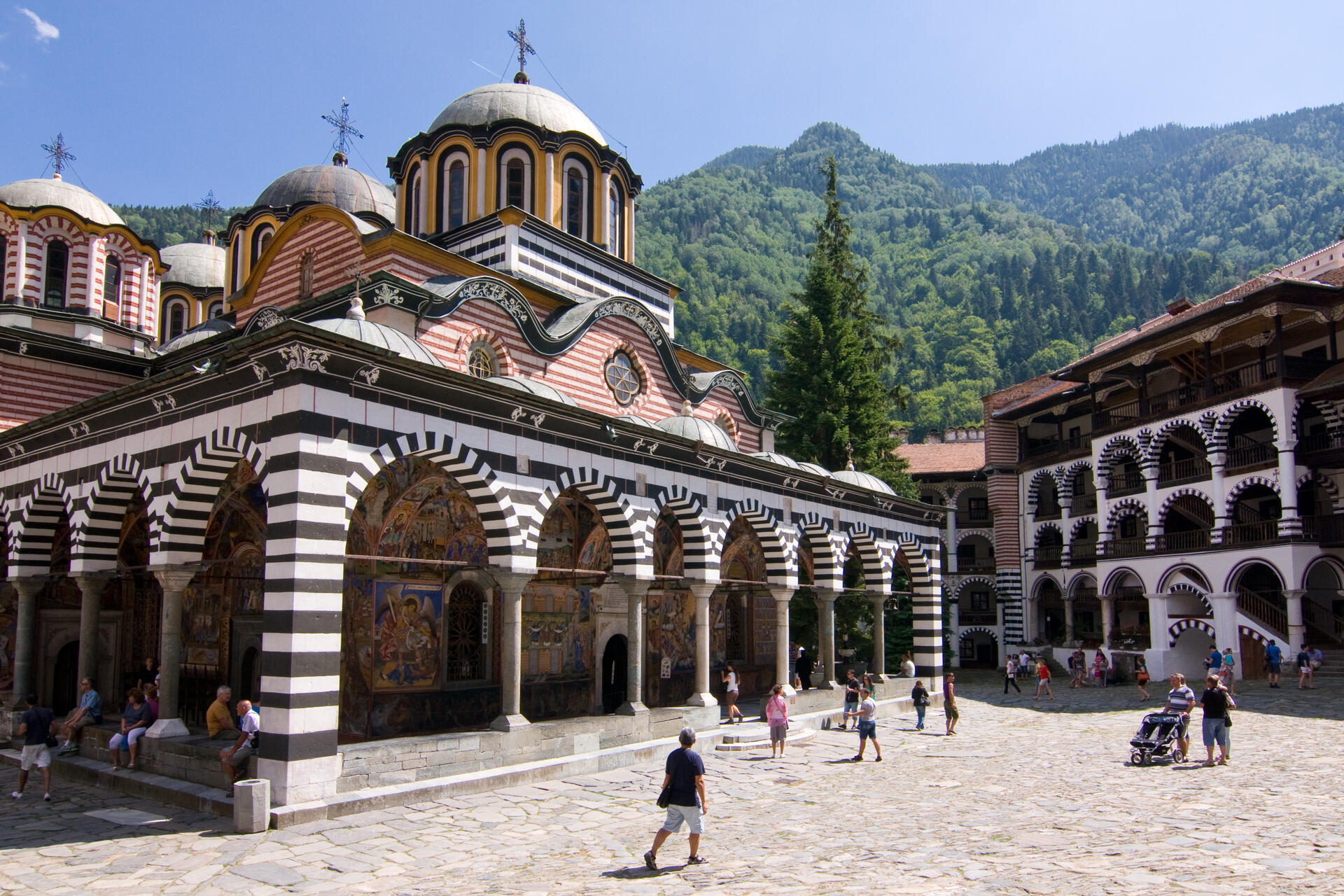
© Raggatt2000, CC BY-SA 3.0 Resized from original. (This derivative is under the same CC BY-SA license.)
World Heritage Research
Discover scientific research and academic studies that deepen our understanding of Rila Monastery from its history and significance to its conservation, management, and contemporary challenges.
-
Murals and Prints of St. John of Rila and the Revival Pilgrimage
This research reveals the enduring influence of St. John of Rila's imagery on Bulgarian Orthodox pilgrimage traditions, particularly during the Ottoman era when religious expression was suppressed. It highlights how murals and prints depicting his life served as silent yet powerful testimonies to faith, preserving narratives of sacrifice and reverence for generations. The study meticulously analyzes early depictions, Revival-era murals, and Rila Monastery's pilgrim prints, offering a nuanced understanding of iconography’s role in cultural and spiritual resilience.
Mihailov, P. (2025). Murals and Prints of St. John of Rila and the Revival Pilgrimage. Forum Theologicum Sardicense, (1), 155–164. https://doi.org/10.60061/fths.2020.1.155-164
View Publication Record | Read Publication -
Development of Byzantine Musical Notation and the Role of the New Method of 1814 in Bulgarian Church Music
A significant reform in Byzantine musical notation, introduced by Chrysanthos of Madytos and colleagues in 1814, revolutionized church music pedagogy and liturgical practice in the Bulgarian lands. This New Method simplified and systematized the traditional neumatic notation, drastically reducing training time and enabling broader participation in church singing. The study highlights Rila Monastery's pivotal role in adopting and disseminating this reform, which not only streamlined musical education but also supported national awakening and preserved Orthodox identity. By synthesizing Byzantine musical heritage with Bulgarian linguistic and folk traditions, the New Method established a distinct national style that remains integral to the spiritual life of the Bulgarian Orthodox Church.
Georgieva, V. (2025). DEVELOPMENT OF BYZANTINE MUSICAL NOTATION AND THE ROLE OF THE NEW METHOD OF 1814 IN BULGARIAN CHURCH MUSIC. Collection of Papers from the Harmony in Diversity Conference Sofia, December 10th, 2025. https://doi.org/10.70300/drwo1251
View Publication Record | Read Publication -
Tourist Behavioural Patterns: Readiness for Sustainable Travel Choices
Tourists visiting Rila Monastery show varying degrees of awareness and adherence to responsible tourism practices, with willingness to make sustainable choices influenced by factors such as cost and convenience. A survey-based study found that while many visitors express support for sustainability principles, actual behavior often lags behind these intentions. Notably, a significant portion would consider paying more for eco-friendly services if they were clearly linked to preserving the site's cultural and environmental integrity. This research highlights the gap between pro-sustainability attitudes and practices, providing empirical data to guide strategies for promoting responsible tourism in Bulgaria's UNESCO-listed destinations.
Stanoeva, L. (2025). TOURIST BEHAVIOURAL PATTERNS: READINESS FOR SUSTAINABLE TRAVEL CHOICES. Tourism and the New Reality, 1, 197–209. https://doi.org/10.56065/tnr2025.197
View Publication Record | Read Publication -
Wildfire risk assessment and mapping – an approach for Natura 2000 forest sites
A novel wildfire risk assessment approach for Natura 2000 forest sites, including the UNESCO World Heritage Site Rila Monastery, demonstrates that spatially detailed fire risk maps can effectively support emergency response efforts. The study integrates 29 indicators across five thematic groups—hazards, vulnerability, and emergency capacity—to evaluate risk at the smallest forestry subdivision level using geospatial technologies. Tested in two Bulgarian sites, this methodology identified high-risk zones during a real fire event on October 30, 2022, enabling targeted interventions such as fire tower placement and visitor information systems. This scalable tool addresses gaps in regional-scale risk assessments, offering a practical framework for conservation and resource management in vulnerable natural heritage areas.
Borisova, B., Todorova, E., Ihtimanski, I., Glushkova, M., Zhiyanski, M., Georgieva, M., Stoyanov, T., Bozhilova, M., Atanasova, M., & Dimitrov, S. (2024). Wildfire risk assessment and mapping – an approach for Natura 2000 forest sites. Trees, Forests and People, 16, 100532. https://doi.org/10.1016/j.tfp.2024.100532
View Publication Record | Read Publication -
Preliminary results of the monitoring of protected red wood ants in Rila Mountain, Bulgaria
A recent eight-year monitoring study in Rila Mountain, Bulgaria, revealed significant changes in the nest density of red wood ant species, with Formica rufa and F. pratensis showing declines in some areas, likely due to increased habitat shading. The research, conducted across three sites including the Parangalitza Biosphere Reserve and the Rila Monastery region, identified four species: F. rufa (most abundant), F. lugubris, F. pratensis, and F. exsecta. Using transect sampling in 2014 and 2022, the study marked 35 nests initially and 76 nests later, highlighting the need for continued monitoring to assess population trends and the effectiveness of conservation measures.
Antonova, V., Kyonev, D., & Marinov, M. (2024). Preliminary results of the monitoring of protected red wood ants in Rila Mountain, Bulgaria. Historia Naturalis Bulgarica, 46(10), 253–263. https://doi.org/10.48027/hnb.46.101
View Publication Record | Read Publication -
Materials and Techniques of the Mural Paintings in the Church-Ossuary of the Rila Monastery, Bulgaria
A groundbreaking analysis reveals that the 1795 mural paintings in Rila Monastery's Church-Ossuary, created by Athonite painters, employed a traditional yet innovative palette of pigments and binders. The study identified natural pigments like yellow ochre, red ochre, green earth, and calcite alongside synthetic ones such as smalt, red lead, cinnabar, and verdigris using advanced techniques including ATR-FTIR, SEM-EDS, and ELISA. Notably, blue backgrounds were painted with a smalt-based mixture bound by carbohydrates, diverging from the post-Byzantine egg tempera technique used elsewhere in the murals. This analysis suggests that the Athonite artists' methods became a benchmark for Bulgarian icon-painters, offering new insights into historical artistic practices and material science.
Stamboliyska, B., Tapanov, S., Velcheva, E., Atanasova-Vladimirova, S., Ranguelov, B., Guncheva, M., Stoyanov, S., & Yancheva, D. (2024). Materials and Techniques of the Mural Paintings in the Church-Ossuary of the Rila Monastery, Bulgaria. Minerals, 14(11), 1115. https://doi.org/10.3390/min14111115
View Publication Record | Read Publication -
The Epistle of St. Euthymius of Tarnovo to Monk Cyprian RAS No. 317
A previously unpublished epistolary text by St. Patriarch Euthymius of Tarnovo, preserved in manuscript No. 317 at the Romanian Academy of Sciences (RAS), reveals deep theological erudition and intertextual connections with patristic literature. The study establishes the biblical metatext and traces its distribution through monastic transcripts, including those from the Rila Monastery's collection (No. 61). This epistle, rooted in the Bulgarian Hesychast tradition of Athos, Paroria, and Tarnovgrad, provides a rare window into medieval monastic practices and theological discourse. The research combines archeographic analysis with textual scholarship to reconstruct the manuscript's provenance and significance.
Gavazova, N. (2024). The Epistle of St. Euthymius of Tarnovo to Monk Cyprian RAS No. 317. Tarnovo Literary School, 12(1), 27–56. https://doi.org/10.54664/qbft1658
View Publication Record | Read Publication