World Heritage Identification Number: 780
World Heritage since: 1996
Category: Cultural Heritage
WHE Type: Archaeological Sites
Transboundary Heritage: No
Endangered Heritage: No
Country: 🇬🇷 Greece
Continent: Europe
UNESCO World Region: Europe and North America
Map
Archaeological Site of Aigai (Vergina): The First Capital of Ancient Macedonia
The Archaeological Site of Aigai, now known as Vergina, is a significant archaeological location situated in northern Greece. This site holds immense historical importance as it was once the first capital of the Kingdom of Macedonia, a region that spanned much of northwestern Greece and parts of southeastern Europe during classical antiquity.
More to come…UNESCO Description of the World Heritage Site
The city of Aigai, the ancient first capital of the Kingdom of Macedonia, was discovered in the 19th century near Vergina, in northern Greece. The most important remains are the monumental palace, lavishly decorated with mosaics and painted stuccoes, and the burial ground with more than 300 tumuli, some of which date from the 11th century B.C. One of the royal tombs in the Great Tumulus is identified as that of Philip II, who conquered all the Greek cities, paving the way for his son Alexander and the expansion of the Hellenistic world.
UNESCO Justification of the World Heritage Site
Criterion (i): Both the cemetery and the city contain original and unique historical, artistic and aesthetic achievements of the late classical art of extraordinarily high quality and historical importance, such as the architectural form of the royal palace and the magnificent wall paintings of the so-called Macedonian tombs, as well as objects such as the ivory portrait and miniature art, metal, gold and silver work. Many of these achievements were created by great artists of ancient Greece, such as Leochares and Nikomachos.
Criterion (iii): Τhe site represents an exceptional testimony to a significant development in European civilization, at the transition from the classical city state to the imperial structure of the Hellenistic and Roman periods. This is vividly demonstrated in particular by the remarkable series of royal tombs and their rich contents.
Encyclopedia Record: Aegae (Macedonia)
Aegae or Aigai was the original capital of Macedon, the ancient kingdom of the Makedones in Emathia in northern Greece. The site is located on the foothills of the Pierian Mountains, between the modern towns of Vergina and Palatitsia, and overlooks the Central Macedonian Plain. The city was abandoned in the 3rd century and was rediscovered in the 19th.Additional Site Details
Area: 1,420.81 hectares
Number of Components: 2
(iii) — Unique or exceptional testimony to a cultural tradition
Coordinates: 40.47139 , 22.31833
Image
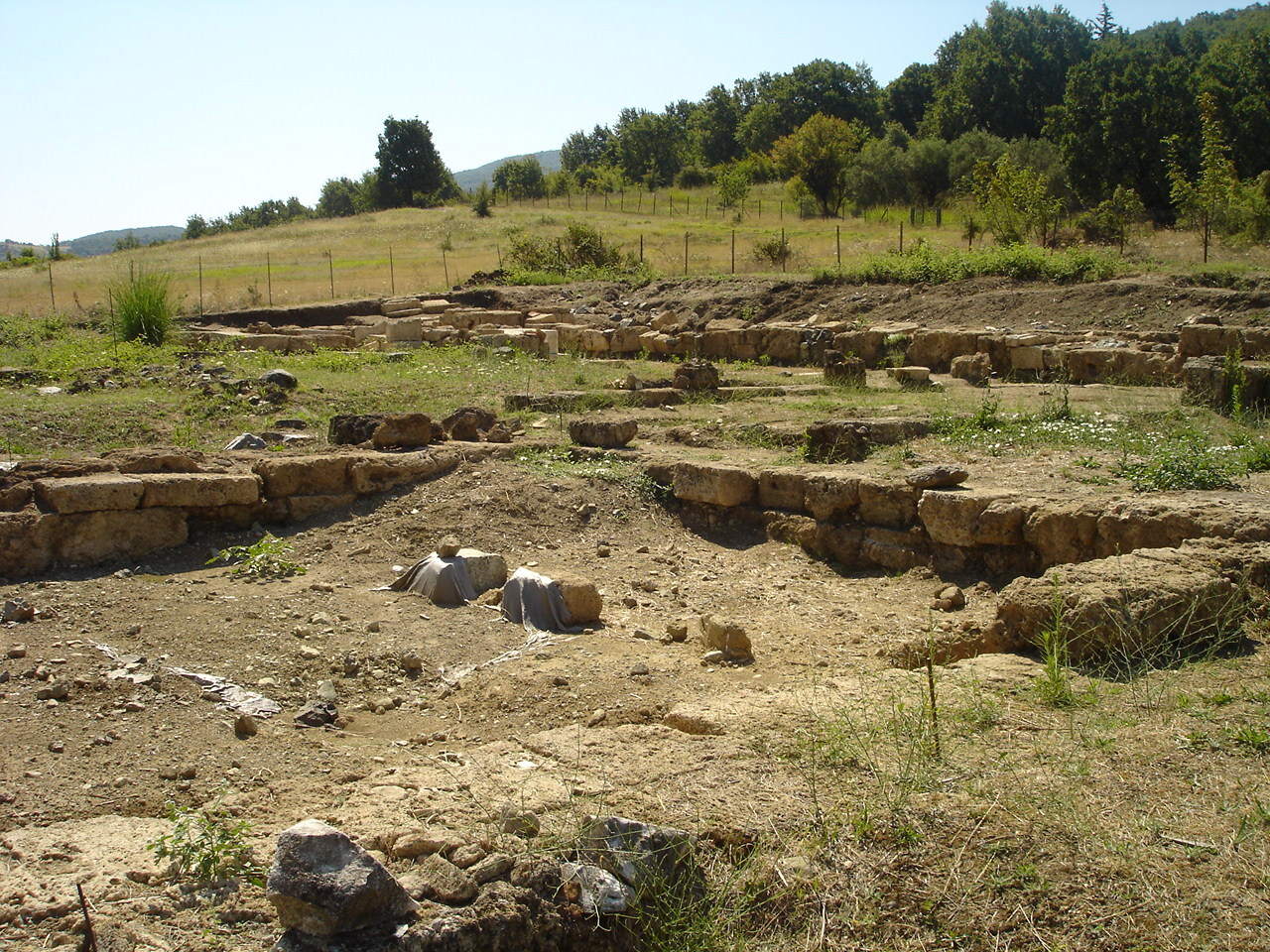
© Македонец, CC BY-SA 4.0 Resized from original. (This derivative is under the same CC BY-SA license.)
World Heritage Research
Discover scientific research and academic studies that deepen our understanding of Archaeological Site of Aigai (modern name Vergina) from its history and significance to its conservation, management, and contemporary challenges.
-
Aerial Remote Sensing for Precision Archaeology Using RGB–Multispectral Image Fusion of UAS Data
A novel RGB–multispectral image fusion workflow for precision archaeology achieves sub-centimeter accuracy, preserving nearly all spectral information despite acquisition gaps. The method combines PPK-based georeferencing with UAS data, enabling high-resolution documentation of archaeological sites like Aigai's Sanctuary of Eukleia and Philippi's funerary ensemble. Digital surface models (DSMs) and orthophotomosaics were generated at resolutions of ~2 cm (RGB) and ~14 cm (MS), with fusion improving MS resolution to 1 cm while maintaining spectral fidelity (average correlation ≈0.99 for Philippi, ≈0.85 for Aigai). The approach offers a reliable tool for material classification and pathology detection in archaeological features.
Dimitris, K. (2026). Aerial Remote Sensing for Precision Archaeology Using RGB–Multispectral Image Fusion of UAS Data. Drones and Autonomous Vehicles, 3(2), 10009. https://doi.org/10.70322/dav.2026.10009
View Publication Record | Read Publication -
The use of ultrasonics in the frequency range of 50MHz up to 175 MHz for cultural heritage objects’ 3D μtomography
High-frequency ultrasonics (50–175 MHz) enables non-destructive 3D μtomography of fragile cultural heritage objects, revealing internal structures without sampling. This approach provides critical data for conservation efforts at the Archaeological Site of Aigai (modern Vergina), particularly for the tomb of King Philip II. The method leverages advanced imaging to document intricate details, addressing the limitations posed by the fragility and value of artifacts. By avoiding destructive procedures, it offers a precise alternative for studying internal features, advancing both preservation strategies and our understanding of ancient craftsmanship.
Karagiannis, G., Karagiannis, T., & Karagiannis, E. (2025). The use of ultrasonics in the frequency range of 50MHz up to 175 MHz for cultural heritage objects’ 3D μtomography. 2025 IEEE International Ultrasonics Symposium (IUS), 1–3. https://doi.org/10.1109/ius62464.2025.11201679
View Publication Record | Read Publication -
Assessment of the Planimetric and Vertical Accuracy of UAS-LiDAR DSM in Archaeological Site
A study at the Sanctuary of Eukleia in Aigai (Vergina, Greece) demonstrates that UAS-LiDAR technology can achieve high planimetric and vertical accuracy in archaeological site mapping, with LiDAR-derived DSMs showing a planimetric accuracy of 1.4 cm in X and 0.9 cm in Y, and a vertical accuracy of 7.5 cm. While RGB-PPK products outperformed LiDAR in vertical precision (2.4 cm), UAS-LiDAR proved superior for mapping under dense vegetation, such as streambanks, due to its ability to penetrate canopies. The research involved acquiring RGB, multispectral images, and LiDAR data using a Hesai XT32M2X system mounted on a WingtraOne GEN II UAS, with accuracy assessed through field-measured checkpoints and RTK-GNSS calibration.
Kaimaris, D. (2025). Assessment of the Planimetric and Vertical Accuracy of UAS-LiDAR DSM in Archaeological Site. Geomatics, 5(4), 61. https://doi.org/10.3390/geomatics5040061
View Publication Record | Read Publication -
The Necropolis of Aigai. Archaeology of an Exceptional Funerary Landscape
Research on the necropolis of Aigai reveals a dynamic funerary landscape that evolved over 1,000 years, from the 7th century BC to the 3rd century AD. The study identifies distinct phases in the necropolis's development, showing a shift in its center from southeastern slopes facing Lydia to northwestern slopes overlooking key routes like Gryneion and Pergamon. A typology of funerary monuments—ranging from Orientalizing tumuli to Hellenistic and Roman terraces—was established, alongside the discovery of a structured network of roads and extra-urban sanctuaries that shaped the necropolis's organization. This comprehensive analysis, based on systematic surveys, new excavations, and re-examination of previous findings, offers unprecedented insights into the topographical evolution and social significance of this exceptional archaeological site.
Verger, S., Sezgin, Y., & Pace, R. (2025). The Necropolis of Aigai. Archaeology of an Exceptional Funerary Landscape. In Hellenistic Funerary Culture in Pergamon and the Aeolis. Deutsches Archäologisches Institut. https://doi.org/10.34780/BZK87G71
View Publication Record | Read Publication -
Demography and Health Status of Hellenistic People from Pergamon, Elaia and Aigai
A study of Hellenistic skeletal remains from Pergamon, Elaia, and Aigai reveals significant insights into the demography and health status of ancient populations. Analysis of 60 individuals indicated a high prevalence of diseases, including infections linked to poor heating and indoor air pollution, as well as stress markers suggesting early-life hardships. Stable isotope analyses further showed that those buried in monumental structures had higher protein intake compared to others, hinting at social stratification. Radiocarbon dating also uncovered the reuse of tombs across different historical periods, from Classical to Byzantine times. This research contributes to our understanding of Hellenistic paleodemography and paleopathology, offering a window into the health challenges and dietary practices of ancient societies in Asia Minor.
Teegen, W.-R. (2025). Demography and Health Status of Hellenistic People from Pergamon, Elaia and Aigai. In Hellenistic Funerary Culture in Pergamon and the Aeolis. Deutsches Archäologisches Institut. https://doi.org/10.34780/4FM2VX63
View Publication Record | Read Publication -
A Plastic Vase in the Form of an Actor from the New Bouleuterion of Aigai
Excavations at the UNESCO World Heritage Site of Aigai (modern Vergina) uncovered a remarkable plastic vase shaped as an actor, one of the most significant artifacts found in the city. The vase, discovered in a bedrock pit within the New Bouleuterion—a mid-2nd century BC structure built upon an older 4th-century BC edifice—sheds light on Roman-era vase production traditions in Asia Minor. The study analyzes the vase's archaeological context, craftsmanship, iconography, and style, contributing to a deeper understanding of Hellenistic and Roman cultural practices at this once-thriving urban center. Aigai's continuous use from the 7th century BC to AD 260 is further illuminated by the high-quality artifacts unearthed during the 2007 excavations.
Sezgin, Y., & Şakar, G. (2023). A Plastic Vase in the Form of an Actor from the New Bouleuterion of Aigai. Anatolia Antiqua, XXXI, 87–107. https://doi.org/10.4000/12dd3
View Publication Record | Read Publication -
Plaster Characteristics of Byzantine Wall Paintings in Western Anatolia
A study on Byzantine wall paintings from western Anatolia reveals that plaster characteristics vary significantly between sites, with Aigai displaying techniques such as marmorino and intonachino, indicative of earlier periods, while Anaia and Başpınar exhibit magnesium-rich lime plasters similar to post-iconoclastic period samples. The research used scanning electron microscopy (SEM-EDS), X-ray diffraction (XRD), and reflected light microscopy (RLM) to analyze plaster stratigraphy and microstructural properties from three sites: Anaia Church, Başpınar Church in Olympos, and a Byzantine setting and chapel in Aigai. The findings suggest intentional layering techniques aligned with painting methods, providing insights that can guide conservation efforts for these cultural heritage sites.
Şerifaki, K., & Böke, H. (2022). PLASTER CHARACTERISTICS OF BYZANTINE WALL PAINTINGS IN WESTERN ANATOLIA. Materiali in Tehnologije, 56(5). https://doi.org/10.17222/mit.2022.555
View Publication Record | Read Publication