World Heritage Identification Number: 1518
World Heritage since: 2016
Category: Cultural Heritage
WHE Type: Archaeological Sites
Transboundary Heritage: No
Endangered Heritage: No
Country: 🇹🇷 Türkiye
Continent: Asia
UNESCO World Region: Europe and North America
Map
Ani: A Medieval City of Architectural Innovation
The Archaeological Site of Ani, inscribed as a UNESCO World Heritage Site in 2016, offers a captivating glimpse into the rich history and architectural evolution of the Middle Ages. Situated on a secluded plateau in northeastern Turkey, this ancient city overlooks a ravine that serves as a natural border with Armenia.
More to come…UNESCO Description of the World Heritage Site
This site is located on a secluded plateau of northeast Turkey overlooking a ravine that forms a natural border with Armenia. This medieval city combines residential, religious and military structures, characteristic of a medieval urbanism built up over the centuries by Christian and then Muslim dynasties. The city flourished in the 10th and 11th centuries CE when it became the capital of the medieval Armenian kingdom of the Bagratides and profited from control of one branch of the Silk Road. Later, under Byzantine, Seljuk and Georgian sovereignty, it maintained its status as an important crossroads for merchant caravans. The Mongol invasion and a devastating earthquake in 1319 marked the beginning of the city’s decline. The site presents a comprehensive overview of the evolution of medieval architecture through examples of almost all the different architectural innovations of the region between the 7th and 13th centuries CE.
UNESCO Justification of the World Heritage Site
Criterion (ii): Ani was a meeting place for Armenian, Georgian and diverse Islamic cultural traditions that were reflected in the architectural design, material and decorative details of the monuments. New styles, which emerged as a result of cross-cultural interactions, have turned into a new architectural language peculiar to Ani. The creation of this new language expressed in the design, craftsmanship and decoration of Ani has also been influential in the wider region of Anatolia and Caucasia.
Criterion (iii): Ani bears exceptional testimony to Armenian cultural, artistic, architectural and urban design development and it is an extraordinary representation of Armenian religious architecture known as the “Ani school”, reflecting its techniques, style and material characteristics.
Criterion (iv): With its military, religious and civil buildings, Ani offers a wide panorama of medieval architectural development thanks to the presence at the site of almost all the architectural types that emerged in the region in the course of the six centuries from 7th to 13th centuries AD. It is also considered a rare settlement where nearly all of the plan types developed in Armenian Church architecture between the 4th and 8th centuries AD can be seen together. The urban enclosure of Ani is also an important example of a medieval architectural ensemble with its monumentality, design and quality, as well as the tunnels and caves beneath Ani plateau, which connect to the surrounding volcanic tufa setting of deep river valleys.
Encyclopedia Record: Ani
Ani is a ruined medieval Armenian city now situated in Turkey's province of Kars, next to the closed border with Armenia.Additional Site Details
Area: 250.7 hectares
Number of Components: 1
(iii) — Unique or exceptional testimony to a cultural tradition
(iv) — Outstanding example of a type of building or landscape
Coordinates: 40.5 , 43.5666666667
Image
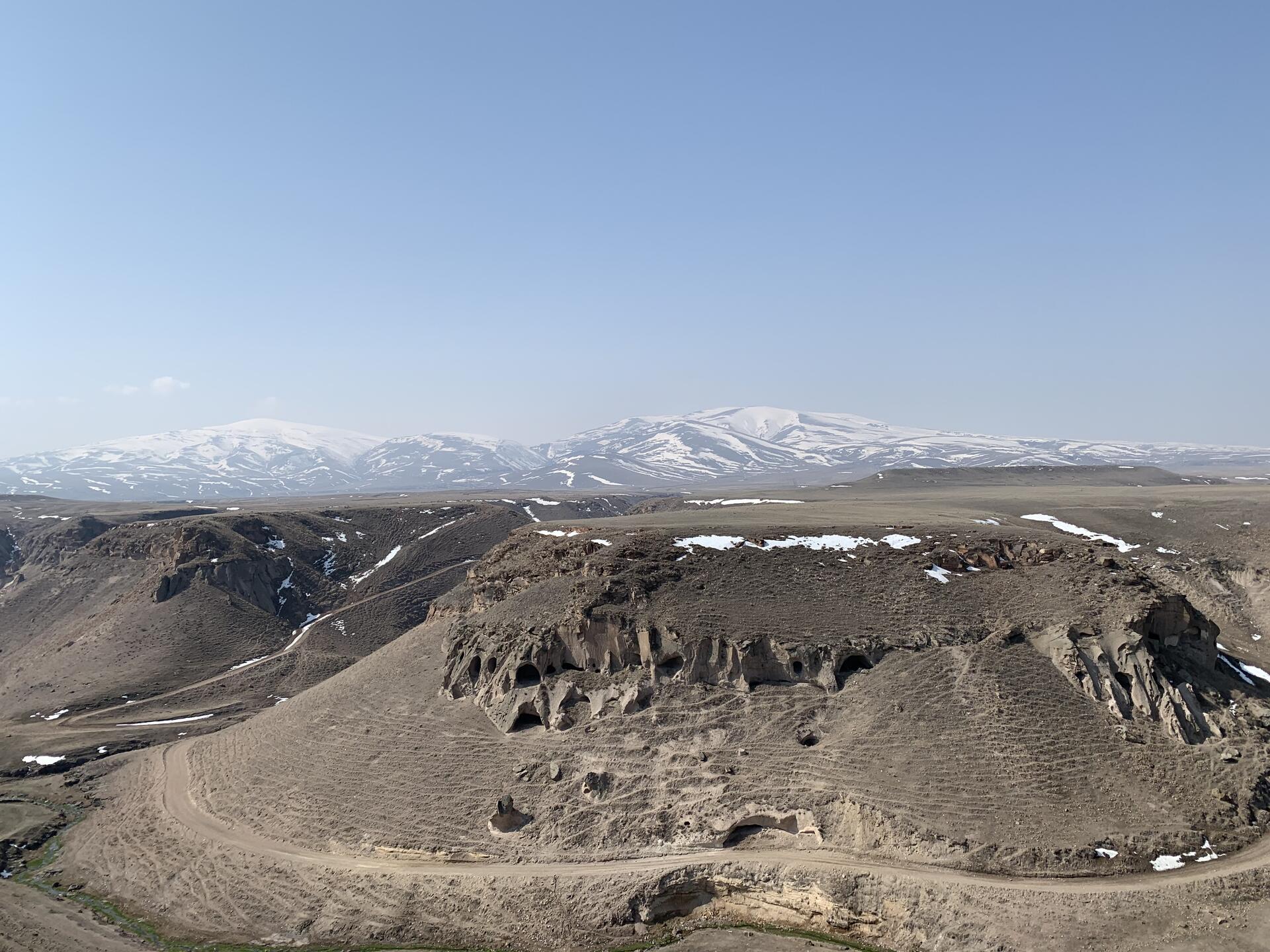
© Héctor Ochoa 'Robot8A', CC BY-SA 4.0 Resized from original. (This derivative is under the same CC BY-SA license.)
World Heritage Research
Discover scientific research and academic studies that deepen our understanding of Archaeological Site of Ani from its history and significance to its conservation, management, and contemporary challenges.
-
Monasteries in the vicinity of Armenian capitals (7th–13th centuries ad): Archaeology of architectural and urban context
A comparative analysis of monastic development near Armenia's medieval capitals, Vagharshapat and Ani, reveals distinct patterns shaped by political and religious dynamics. While monasteries around Vagharshapat flourished under the patronage of Catholicoses from the 4th to 7th centuries AD, those near Ani surged in the early 11th century under Bagratuni kings and nobles, lacking a centralized program. The study, based on archaeological excavations and site inspections, highlights how monastic complexes transformed landscapes, marking visual boundaries of elite culture. Notably, Ani's monasteries were strategically located along riverbanks, reflecting its rugged terrain. This research underscores the interplay between urban development, religious authority, and topographical constraints in shaping Armenia's sacred architecture.
Kazaryan, A. Yu. (2024). Monasteries in the vicinity of Armenian capitals (7th–13th centuries ad): Archaeology of architectural and urban context. Rossijskaâ Arheologiâ, (2), 51–64. https://doi.org/10.31857/s0869606324020041
View Publication Record | Read Publication -
Civilization Lost and Re-discovered, International Efforts for Advocacy and Conservation of Ani Archaeological Site
Ani, the medieval Armenian capital known as the 'City of 1,001 Churches,' stands as a testament to a civilization lost due to earthquakes and conflict. Its ruins, abandoned by the 17th century, have been the focus of international conservation efforts since its inclusion on the World Monuments Watch in 1996. This study highlights Ani's preservation as a model for global collaboration, integrating experts from Türkiye, Armenia, Iran, Russia, and the United States to address regional coordination, international cooperation, and cultural exchange. The decades-long project emphasizes advocacy and conservation strategies that protect this significant built heritage while fostering cross-border dialogue.
Chao, H., & Bell, J. S. (2023). Civilization Lost and Re-discovered, International Efforts for Advocacy and Conservation of Ani Archaeological Site. Restauro Archeologico, 30(1). https://doi.org/10.36253/rar-14303
View Publication Record | Read Publication -
Patrimonio per la Pace in un Mondo Pieno di Conflitti
UNESCO World Heritage Site inscription can both foster peace and exacerbate conflict, as demonstrated by the case of Ani's 2016 listing. While intended to promote global harmony, cultural heritage recognition may trigger social or ethnic tensions when linked to human rights issues. The study analyzes the 40th Committee meeting in Istanbul, where Ani was inscribed, alongside unofficial discussions about Turkish military interventions at Diyarbakır Fortress—a Kurdish-majority site. Activists criticized UNESCO's perceived indifference amid accusations of heritage destruction, underscoring the complex consequences of World Heritage listing processes.
Dinler, M. (2023). Patrimonio per la Pace in un Mondo Pieno di Conflitti. Restauro Archeologico, 30(1). https://doi.org/10.36253/rar-14351
View Publication Record | Read Publication -
Russian travellers on the architectural heritage of Ani
Russian travelers' accounts of Ani, the medieval capital of Armenia, provide invaluable documentary insights into its architectural heritage, which has since suffered significant damage. Their 19th-century observations stimulated scientific interest, positioning Ani as a key site for Russian medieval studies, archaeology, and architecture. These literary and artistic works offer rare descriptions of monuments in their pre-20th-century condition, serving as critical historical references.
Kazaryan, A. (2023). Russian travellers on the architectural heritage of Ani. Проект Байкал, (75), 153–160. https://doi.org/10.51461/pb.75.31
View Publication Record | Read Publication -
An Experimental Approach for the Documentation with Terrestrial Laser Scanning of the 1035 AD Church of the Redeemer
A groundbreaking approach using terrestrial laser scanning (LiDAR) successfully documented the 1035 AD Church of the Redeemer in Ani, a UNESCO-listed medieval site. The study demonstrated that parametric features and algorithms like RANSAC could automatically extract complex surfaces and inscriptions from historical artifacts with high accuracy. This method, tested on Armenian Bagratid-era architecture, offers a new tool for cultural heritage preservation, enabling precise 3D modeling and analysis of intricate structures without manual intervention. The findings highlight the potential of automated LiDAR processing to revolutionize documentation efforts at World Heritage Sites.
Kucak, R. A. (2022). AN EXPERIMENTAL APPROACH FOR THE DOCUMENTATION WITH TERRESTRIAL LASER SCANNING OF THE 1035 AD CHURCH OF THE REDEEMER. Zenodo. https://doi.org/10.5281/ZENODO.7072729
View Publication Record | Read Publication -
The Study of the Architectural Heritage of Ani: Current Issues and Recent Publications
Recent geopolitical shifts have propelled the study of Ani, a medieval Armenian capital and UNESCO World Heritage Site, into a new phase marked by intensified conservation efforts and expanded international collaboration. This analysis traces the evolution of architectural research on Ani from its early 20th-century investigations to contemporary studies, identifying key stages and methodological directions that emerged post-1990s. The work highlights the challenges and opportunities for large-scale monographic study, providing a foundation for future research while emphasizing the site's significance as a cultural and historical landmark.
Kazaryan, A. Yu. (2022). The Study of the Architectural Heritage of Ani: Current Issues and Recent Publications. Actual Problems of Theory and History of Art, 12, 110–122. https://doi.org/10.18688/aa2212-01-06
View Publication Record | Read Publication -
The Ruins of Ani: A Journey to Armenia’s Medieval Capital and its Legacy by Krikor Balakian
Ani, the medieval Armenian capital and Silk Road node, stands as a symbol of both cultural heritage and destruction. Krikor Balakian's 1910 monograph, 'Illustrated Description of the Ruins of Ani,' offers a unique blend of travel account, history, and scholarly study, providing detailed descriptions and illustrations of surviving structures like churches, palaces, and citadels. This work, recently translated into English, sheds light on the site's rich history, from its ninth-century founding to its depopulation in the fourteenth century, while also critiquing external invasions and Armenian disunity. Balakian's account serves as both a travel guide and an appeal for financial support for ongoing excavations and a newly established museum, which were later looted and destroyed. The monograph also reviews past scholarship on Ani, culminating in praise for Nicholas Marr's excavation work.
Arlen, J. S. (2019). The Ruins of Ani: A Journey to Armenia’s Medieval Capital and its Legacy by Krikor Balakian. Comitatus: A Journal of Medieval and Renaissance Studies, 50(1), 210–213. https://doi.org/10.1353/cjm.2019.0025
View Publication Record | Read Publication -
Armenian Medieval Architecture along Boundary Akhurian River. French Researches in Turkey and Armenia
A French archaeological team's 15-year study of fortified sites and ruined churches along the Akhurian River, which now serves as a modern border between Turkey and Armenia, has uncovered new interpretations of Ani's ancient history. The research, focusing on less-studied monuments in the Shirak region, revealed that despite conflicts and the decline of commerce, the area remained prosperous during the 12th and 13th centuries. This work also facilitated collaboration with Armenian scholars, shedding light on the region's medieval architecture and historical significance.
Dangles, P. (2018). Armenian Medieval Architecture along Boundary Akhurian River. French Researches in Turkey and Armenia. Proceedings of the 2017 International Conference on Art Studies: Science, Experience, Education (ICASSEE 2017). https://doi.org/10.2991/icassee-17.2018.29
View Publication Record | Read Publication