
World Heritage Identification Number: 960
World Heritage since: 2000
Category: Cultural Heritage
WHE Type: Religious Sites & Sacred Architecture
Transboundary Heritage: No
Endangered Heritage: No
Country: 🇦🇲 Armenia
Continent: Asia
UNESCO World Region: Europe and North America
Map
The Monastery of Geghard and the Upper Azat Valley: A Testament to Armenian Medieval Architecture
The Monastery of Geghard, nestled within the picturesque Upper Azat Valley in the Kotayk Province of Armenia, stands as a remarkable testament to the pinnacle of Armenian medieval architecture. This architectural marvel, enshrined as a UNESCO World Heritage Site since 2000, offers a captivating blend of history, culture, and breathtaking natural beauty.
More to come…UNESCO Description of the World Heritage Site
The monastery of Geghard contains a number of churches and tombs, most of them cut into the rock, which illustrate the very peak of Armenian medieval architecture. The complex of medieval buildings is set into a landscape of great natural beauty, surrounded by towering cliffs at the entrance to the Azat Valley.
UNESCO Justification of the World Heritage Site
Criterion (ii): The Monastery of Geghard, with its remarkable rock-cut churches and tombs, is an exceptionally well preserved and complete example of medieval Armenian monastic architecture and decorative art, with many innovatory features which had a profound influence on subsequent developments in the region.
Encyclopedia Record: Geghard
Geghard is a medieval monastery in the Kotayk province of Armenia, which is partially carved out of the adjacent mountain, surrounded by cliffs. It is listed as a UNESCO World Heritage Site with enhanced protection status.Additional Site Details
Area: 2.7 hectares
Number of Components: 1
Coordinates: 40.140439 , 44.818525
Image
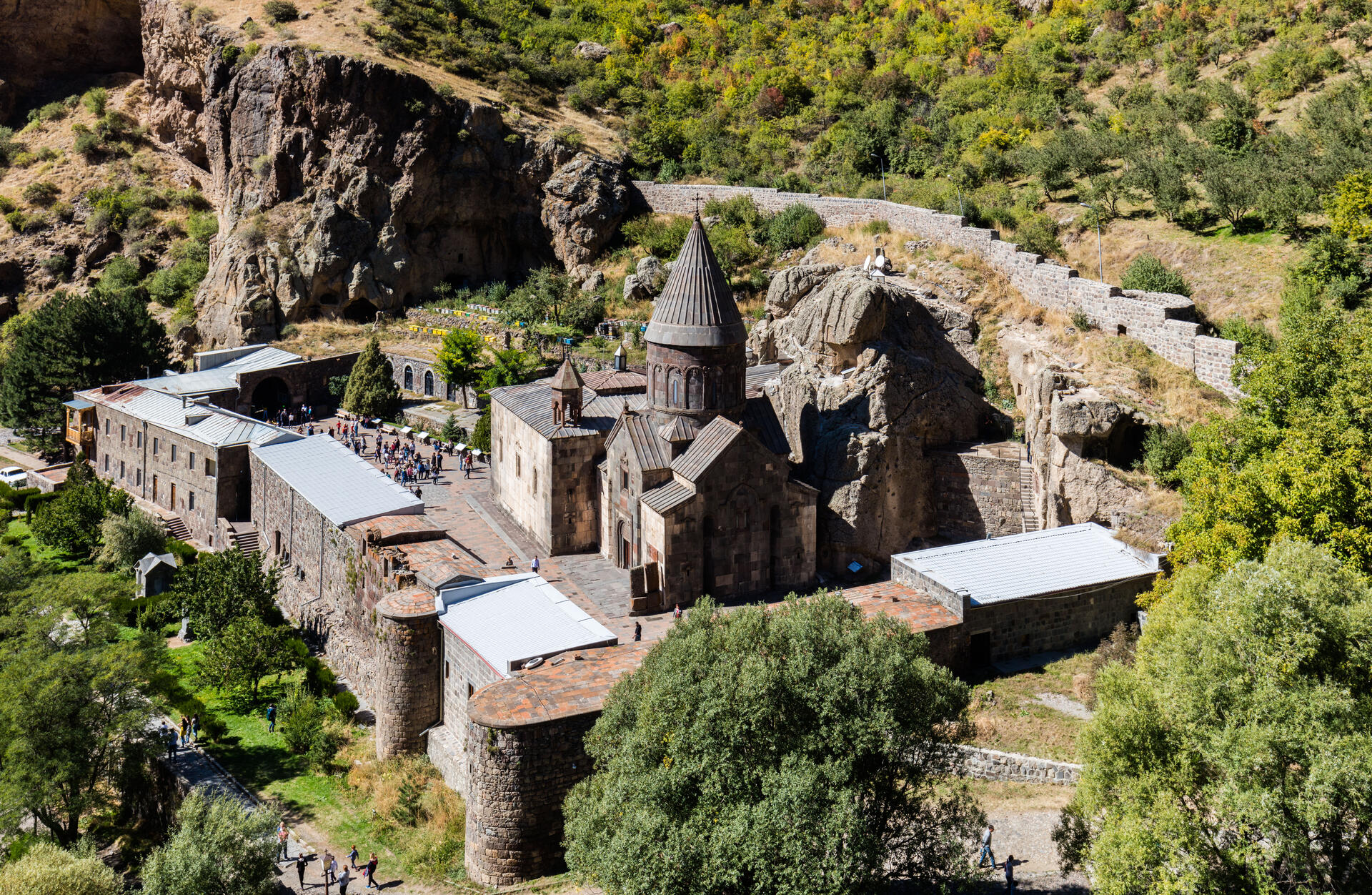
© Diego Delso, CC BY-SA 4.0 Resized from original. (This derivative is under the same CC BY-SA license.)
World Heritage Research
Discover scientific research and academic studies that deepen our understanding of Monastery of Geghard and the Upper Azat Valley from its history and significance to its conservation, management, and contemporary challenges.
-
Cheilosia (Cheilosia) aerea Dufour 1848
A new taxonomic insight clarifies the identity of Cheilosia (Cheilosia) aerea, a fly species previously confused with others in the proxima group due to shared morphological traits. Distinguishing features include pilose posterodorsal corners of the anterior anepisternum and more pruinose terga with increased black pile, supported by genetic clustering with high bootstrap support (BS = 100%). The study, based on collections from Armenia and Georgia between 2019 and 2022, also resolves synonymies proposed in earlier literature. C. aerea is distributed across the Western Palaearctic and Central Asia, with observations spanning altitudes of 1368 to 2078 meters.
Bot, S., Mengual, X., Meutter, F. V. de, & Skevington, J. H. (2025). Cheilosia (Cheilosia) aerea Dufour 1848. Zenodo. https://doi.org/10.5281/ZENODO.17514843
View Publication Record | Read Publication -
Cheilosia (Taeniochilosia) nigripes
A recent study identified and characterized the hoverfly species Cheilosia (Taeniochilosia) nigripes within the UNESCO World Heritage Site of the Monastery of Geghard and the Upper Azat Valley, Armenia. This species is distinguished by its shiny sterna II–IV, a trait unique among Taeniochilosia in the Caucasus, and exhibits morphological differences from European and Russian Far East specimens, including more extensive pruinosity and distinct pile characteristics. The research involved field collections across multiple provinces in Armenia and Georgia from 2018 to 2023, utilizing both direct sampling and Malaise traps. A total of 456 specimens were examined, contributing new data on the species' distribution and morphology. The study enhances understanding of hoverfly biodiversity in this culturally significant region.
Bot, S., Mengual, X., Meutter, F. V. de, & Skevington, J. H. (2025). Cheilosia (Taeniochilosia) nigripes. Zenodo. https://doi.org/10.5281/ZENODO.17514946
View Publication Record | Read Publication -
Preventive Conservation of Cultural Heritage in Armenia: A Preliminary Study of the Internal Surfaces in the Geghard Monastery
A preliminary study of the internal stone surfaces at Geghard Monastery, a 13th-century UNESCO World Heritage Site in Armenia, reveals critical insights into material degradation and environmental impacts on cultural heritage. The research, conducted by Ca’ Foscari University of Venice and the National University of Architecture and Construction of Armenia, identified significant factors contributing to the deterioration of the caved 'Proshian family room.' Through a multi-disciplinary approach—including visual surveys, environmental monitoring, water absorption tests, and ultrasonic measurements—the study provides foundational data for future preventive conservation efforts. These findings highlight the vulnerability of Armenian monasteries to geological hazards and environmental conditions, offering actionable pathways for preserving such sites against further degradation.
(Ed.). (2024). Preventive Conservation of Cultural Heritage in Armenia: A Preliminary Study of the Internal Surfaces in the Geghard Monastery. Journal of Architectural and Engineering Research, (6). LOCKSS. https://doi.org/10.54338/27382656-2024.6-003
View Publication Record | Read Publication -
Conceptual Approaches to Solving the Issue of Reinforcing the Rock - Cut Structures of Geghard Monastery Complex
A comprehensive study of the rock-cut structures at Geghard Monastery identifies critical vulnerabilities and proposes effective reinforcing solutions. Through visual, instrumental, and laboratory analyses, researchers documented extensive damage—including cracks, crevices, destructions, and erosions—and assessed the physical and mechanical properties of sandstone samples. The study recommends the use of Mapegrout, a ready-made dry mixture mortar from Mapei, for crack filling due to its proven efficacy in similar underground structures. Additionally, it evaluates the compatibility of reinforcing materials with sandstone, ensuring long-term structural stability. These findings provide actionable insights for preserving Geghard Monastery's unique rock-cut architecture while addressing the root causes of degradation.
Arzumanyan, †. A. A., Arzumanyan, A. A., Qaramyan, H. H., & Muradyan, N. G. (2021). Conceptual Approaches to Solving the Issue of Reinforcing the Rock - Cut Structures of Geghard Monastery Complex. Journal of Architectural and Engineering Research, 1(2), 3–9. https://doi.org/10.54338/27382656-2021.1-9
View Publication Record | Read Publication
