World Heritage Identification Number: 989
World Heritage since: 2000
Category: Cultural Heritage
WHE Type: Archaeological Sites
Transboundary Heritage: No
Endangered Heritage: No
Country: 🇪🇸 Spain
Continent: Europe
UNESCO World Region: Europe and North America
Map
The Archaeological Site of Atapuerca: A Window into Human Evolution
The Archaeological Site of Atapuerca, situated in the rugged landscape of the Sierra de Atapuerca in the province of Burgos, northern Spain, offers a unique glimpse into the early history of humanity. Inscribed as a UNESCO World Heritage Site in 2000, this significant archaeological location has provided valuable insights into the lives, behaviors, and evolutionary pathways of our distant human ancestors.
More to come…UNESCO Description of the World Heritage Site
The caves of the Sierra de Atapuerca contain a rich fossil record of the earliest human beings in Europe, from nearly one million years ago and extending up to the Common Era. They represent an exceptional reserve of data, the scientific study of which provides priceless information about the appearance and the way of life of these remote human ancestors.
UNESCO Justification of the World Heritage Site
Criterion (iii): The earliest and most abundant evidence of humankind in Europe is to be found in the caves of the Sierra de Atapuerca.
Criterion (v): The fossil remains in the Sierra de Atapuerca constitute an exceptional reserve of information about the physical nature and the way of life of the earliest human communities in Europe.
Encyclopedia Record: Archaeological site of Atapuerca
The archaeological site of Atapuerca is located in the province of Burgos in the north of Spain and is notable for its evidence of early human occupation. Bone fragments from around 800,000 years ago, found in its Gran Dolina cavern, provide the oldest known evidence of hominid settlement in Western Europe and of hominid cannibalism anywhere in the world.Additional Site Details
Area: 284.119 hectares
Number of Components: 1
(v) — Outstanding example of traditional human settlement
Coordinates: 42.3497222222 , -3.5152777778
Image
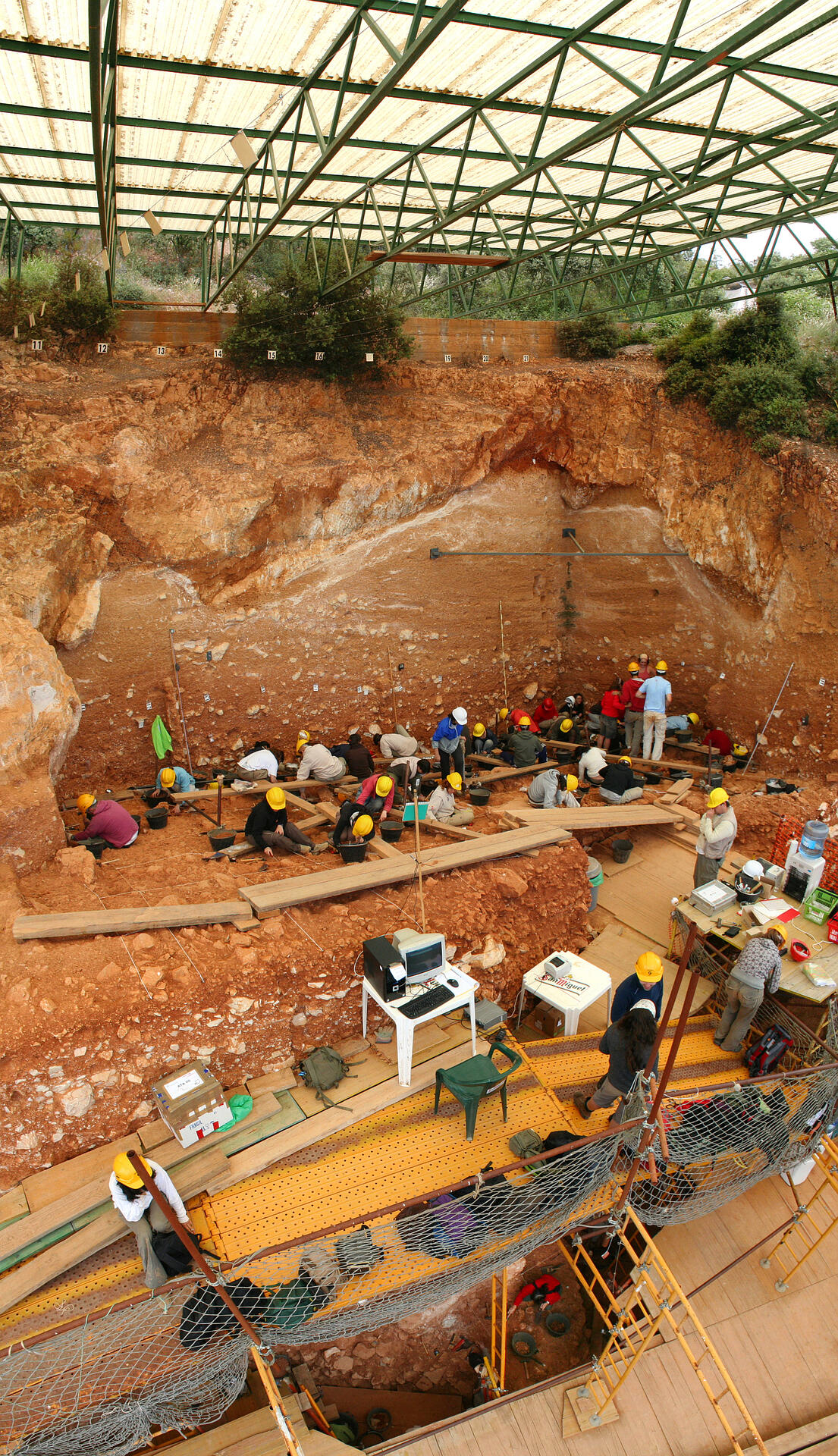
© Mario Modesto Mata, CC BY-SA 3.0 Resized from original. (This derivative is under the same CC BY-SA license.)
World Heritage Research
Discover scientific research and academic studies that deepen our understanding of Archaeological Site of Atapuerca from its history and significance to its conservation, management, and contemporary challenges.
-
Extended-range luminescence chronologies for the Middle Pleistocene units at the Sima del Elefante archaeological site (Sierra de Atapuerca, Burgos, Spain)
New luminescence dating reveals that the Sima del Elefante archaeological site in Spain's Sierra de Atapuerca was occupied between 576,000 and 237,000 years ago, with a significant cave entrance likely closing around 200,000 years ago. The study used single-grain TT-OSL and multi-grain pIR-IR chronologies to date the upper Middle Pleistocene units (TE18 and TE19), which contain Acheulean and transitional lithic assemblages, as well as fossil remains of large and small mammals. U-series dating of a stalagmitic crust further confirmed these findings. The research provides crucial insights into Lower Paleolithic technological dynamics and past human occupation patterns in the Atapuerca karst system.
Demuro, M., Arnold, L. J., Parés, J.-M., Aranburu, A., Huguet, R., Vallverdú, J., Arsuaga, J.-L., Bermúdez de Castro, J.-M., & Carbonell, E. (2022). Extended-range luminescence chronologies for the Middle Pleistocene units at the Sima del Elefante archaeological site (Sierra de Atapuerca, Burgos, Spain). Quaternary Geochronology, 71, 101318. https://doi.org/10.1016/j.quageo.2022.101318
View Publication Record | Read Publication -
Archaeological chert artifacts from Atapuerca sites (Burgos, Spain): Characterization, causes of decay and selection of compatible consolidating products
Chert artifacts from the Atapuerca archaeological sites, particularly those containing moganite alongside quartz, exhibit significant weathering and decay, unlike their quartz-only counterparts. This study identifies the need for consolidation treatments specifically tailored to moganite-bearing cherts due to their powdery nature and greater susceptibility to deterioration. The research evaluates both traditional consolidants (acrylic resin and ethyl silicate) and novel nanoparticle-based products (SiO2 and a mixture of SiO2 and Ca(OH)2 nanoparticles) using non-destructive techniques such as peeling tests, spectrophotometry, and optical surface roughness analysis, followed by destructive methods like SEM and XRD. The findings aim to guide conservators in selecting the most compatible treatments to preserve these delicate artifacts while maintaining their physical and aesthetic properties.
Zornoza-Indart, A., Lopez-Arce, P., & López-Polín, L. (2020). Archaeological chert artifacts from Atapuerca sites (Burgos, Spain): Characterization, causes of decay and selection of compatible consolidating products. Conservar Património. https://doi.org/10.14568/cp2019037
View Publication Record | Read Publication -
Pleistocene geodynamic evolution of the Arlanzón valley: implications for the formation of the endokarst system and the open air archaeological sites of the Sierra de Atapuerca (Burgos, España)
A new analysis of the Arlanzón valley's Pleistocene geodynamic evolution reveals that tectonic uplift accelerated incision rates, shaping the valley's fluvial terraces and influencing the formation of sub-horizontal cave levels in the Sierra de Atapuerca. This study links three key cave levels (T2, T3, and T4/T5) to specific terrace elevations, suggesting rapid phreatic passage development compared to slower vadose entrenchments. The research also highlights how the exhumation of a Neogene limestone layer provided Neanderthals with accessible flint sources during MIS 3 and 4. By integrating LiDAR-derived terrace heights and chronological data, the study reconstructs downcutting phases, offering insights into the valley's complex geological history and its archaeological significance.
Benito-Calvo, A., Ortega, A. I., Navazo, M., Moreno, D., Pérez-González, A., Parés, J. M., Bermúdez de Castro, J. M., & Carbonell, E. (2024). Pleistocene geodynamic evolution of the Arlanzón valley: implications for the formation of the endokarst system and the open air archaeological sites of the Sierra de Atapuerca (Burgos, España). Boletín Geológico Y Minero, 129(1-2), 59–82. https://doi.org/10.21701/bolgeomin.129.1.003
View Publication Record | Read Publication -
New Luminescence Ages for the Galería Complex Archaeological Site: Resolving Chronological Uncertainties on the Acheulean Record of the Sierra de Atapuerca, Northern Spain
New luminescence dating techniques applied to the Galería Complex at Atapuerca reveal that the site's archaeological deposits are significantly younger (up to 50%) than previously estimated using polymineral thermoluminescence (TL) chronologies. The study employed post-infrared infrared stimulated luminescence (pIR-IR) and thermally transferred optically stimulated luminescence (TT-OSL) dating, which provided more precise ages for the Middle Pleistocene deposits. Key findings include an age of up to 370 thousand years (ka) for the basal sterile sands and a depositional period during Marine Isotope Stage (MIS) 9 (~313±14 ka) for the lowermost sub-unit containing Mode II Acheulean lithics. Overlying units, rich in archaeopalaeontological remains, were deposited during late MIS 8 or early MIS 7 (~240 ka). These results suggest that pIR-IR and single-grain TT-OSL dating are effective for resolving Middle Pleistocene chronologies at Atapuerca, offering a refined timeline for the site's Acheulean record.
Demuro, M., Arnold, L. J., Parés, J. M., Pérez-González, A., Ortega, A. I., Arsuaga, J. L., Bermúdez de Castro, J. M., & Carbonell, E. (2014). New Luminescence Ages for the Galería Complex Archaeological Site: Resolving Chronological Uncertainties on the Acheulean Record of the Sierra de Atapuerca, Northern Spain. PLoS ONE, 9(10), e110169. https://doi.org/10.1371/journal.pone.0110169
View Publication Record | Read Publication