World Heritage Identification Number: 311
World Heritage since: 1985
Category: Cultural Heritage
WHE Type: Historic Cities & Urban Areas
Transboundary Heritage: No
Endangered Heritage: No
Country: 🇪🇸 Spain
Continent: Europe
UNESCO World Region: Europe and North America
Map
The Old Town of Segovia and Its Iconic Aqueduct: A Testament to Ancient Engineering and Spanish History
The Old Town of Segovia and Its Iconic Aqueduct, inscribed as a UNESCO World Heritage Site in 1985, offers a captivating blend of ancient Roman engineering marvels and the rich history of Spain's medieval past. Situated in the heart of the Inner Plateau of the Iberian Peninsula, this enchanting city nestles along the meandering banks of the Eresma River.
More to come…UNESCO Description of the World Heritage Site
The Roman aqueduct of Segovia, probably built c. A.D. 50, is remarkably well preserved. This impressive construction, with its two tiers of arches, forms part of the setting of the magnificent historic city of Segovia. Other important monuments include the Alcázar, begun around the 11th century, and the 16th-century Gothic cathedral.
UNESCO Justification of the World Heritage Site
Criterion (i): Segovia comprises an array of monuments, which in terms of beauty and exemplary historical significance, are truly outstanding, with the Aqueduct, the Alcázar, and the Cathedral among its major structures.
Criterion (iii): The Old Town of Segovia illustrates a complex, historical reality through its urban layout and architectural developments. It is a prime example of the coexistence of different, cultural communities throughout time.
Criterion (iv): Segovia provides an outstanding testimony of a Western city based on a number of diverse, cultural traditions. All the component parts of the built environment, from domestic architecture to the great religious and military structures, can be found here in a broad range of construction techniques and styles that reflect this unique, cultural diversity.
Encyclopedia Record: Segovia
Segovia is a city in the autonomous community of Castile and León, Spain. It is the capital and most populated municipality of the Province of Segovia. Segovia is located in the Inner Plateau of the Iberian Peninsula, near the northern slopes of the Sistema Central mountain range. Housing is nestled on a bend of the Eresma river.Additional Site Details
Area: 134.28 hectares
Number of Components: 1
(iii) — Unique or exceptional testimony to a cultural tradition
(iv) — Outstanding example of a type of building or landscape
Coordinates: 40.94847222 , -4.11675
Image
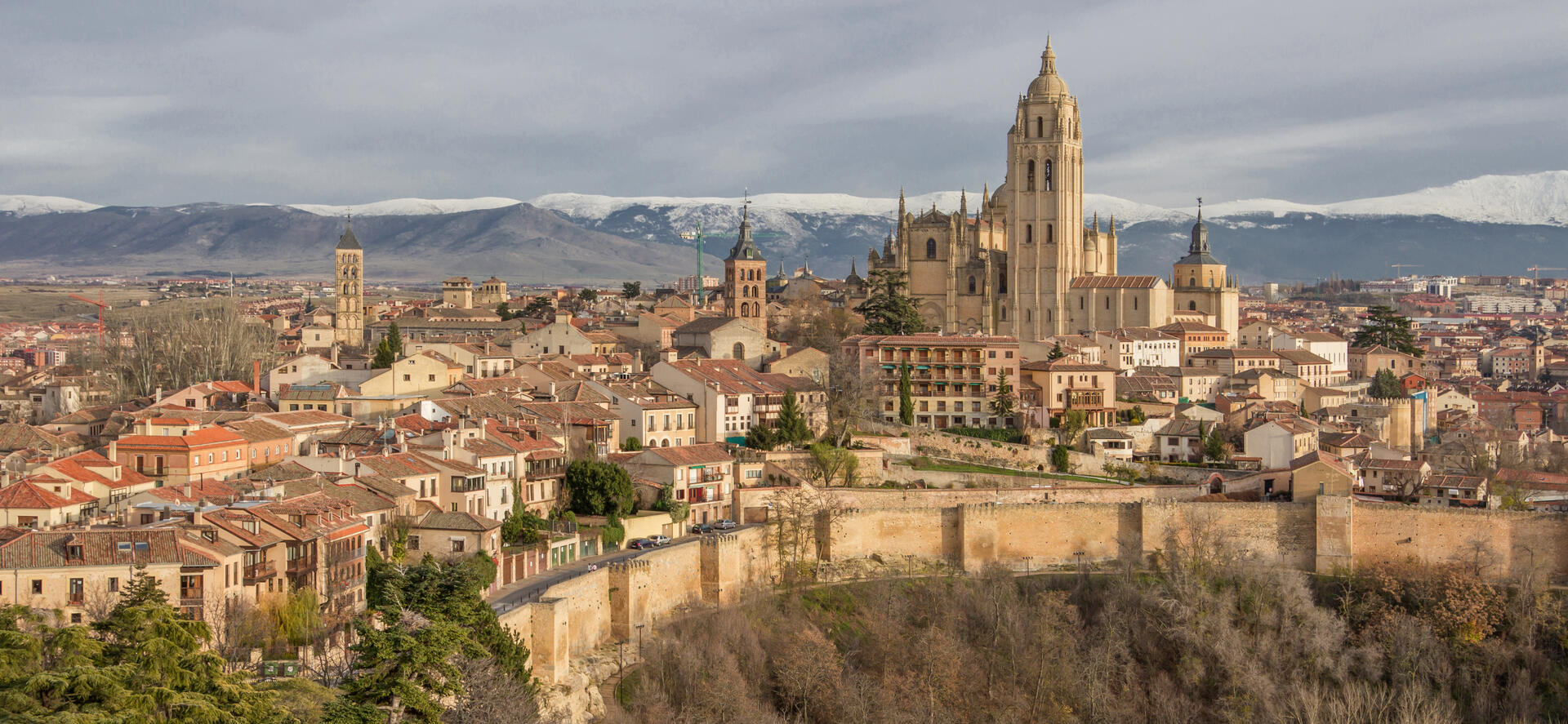
© Carlos Delgado, CC BY-SA 3.0 Resized from original. (This derivative is under the same CC BY-SA license.)