World Heritage Identification Number: 811
World Heritage since: 1997
Category: Cultural Heritage
WHE Type: Historic Cities & Urban Areas
Transboundary Heritage: No
Endangered Heritage: No
Country: 🇨🇳 China
Continent: Asia
UNESCO World Region: Asia and the Pacific
Map
Exploring the Ancient Heartbeat of Lijiang: A Journey Through the Old Town of Lijiang
The Old Town of Lijiang, nestled within the picturesque valley of the Diqing Prefecture in Yunnan Province, China, stands as a testament to the rich cultural tapestry woven by the intermingling of diverse civilizations over millennia. Inscribed as a UNESCO World Heritage Site in 1997, this ancient settlement offers a unique glimpse into the harmonious blend of architectural styles, traditions, and beliefs that have shaped its history.
More to come…UNESCO Description of the World Heritage Site
The Old Town of Lijiang, which is perfectly adapted to the uneven topography of this key commercial and strategic site, has retained a historic townscape of high quality and authenticity. Its architecture is noteworthy for the blending of elements from several cultures that have come together over many centuries. Lijiang also possesses an ancient water-supply system of great complexity and ingenuity that still functions effectively today.
UNESCO Justification of the World Heritage Site
Criterion (ii): From the 12th century onward, the Old Town of Lijiang was an important goods distribution center for trade between Sichuan, Yunnan and Tibet, and is where the Silk Road in the south joins the Ancient Chama (Tea and Horse) Roads. The Old Town of Lijiang became an important center for the economic and cultural communication between various ethnic groups such as the Naxi, Han, Tibetan and Bai. Cultural and technological exchanges over the past 800 years resulted in the particular local architecture, art, urban planning and landscape, social life, customs, arts and crafts and other cultural features which incorporate the quintessence of Han, Bai, Tibetan and other ethnic groups, and at the same time show distinctive Naxi features. In particular, the murals in the religious architecture and other buildings reflect the harmonious co-existence of Confucianism, Taoism, and Buddhism.
Criterion (iv): The three parts of the Old Town of Lijiang: Dayan Old Town (including the Heilong Pool), Baisha housing cluster and Shuhe housing cluster, fully reflect the social, economic and cultural features of the different periods, following the natural topography of mountains and water sources to form an outstanding settlement combining the residential traditions of Naxi, Han, Bai and Tibetan people.
Criterion (v): The Old Town of Lijiang has integrated the mountains, rivers, trees and architecture to create a human habitat featuring the unity between man and nature. With mountains extending to the plain as the protective screen in the north and the plains in the east and south, the Old Town enjoys a sound geometrical relationship and ecological layout. A forked water system originates from the snow-capped mountain and runs through the villages and the farmland. Heilong Pool and the scattered wells and springs constitute a complete water system, meeting the needs for fire prevention, daily life and production in the town. Water plays an important role in the Old Town’s unique architectural style, urban layout and landscape as the main street and small alleys front onto the canals and some buildings and numerous bridges are constructed across the canals. As an excellent example of human habitat showing a harmony between man and nature, the Old Town is a remarkable tribute to human ingenuity in land use.
Encyclopedia Record: Old Town of Lijiang
Dayan, commonly called the Old Town of Lijiang is the historical center of Lijiang City, in Yunnan, China. It is a UNESCO World Heritage Site.Additional Site Details
Area: 145.6 hectares
Number of Components: 4
(iv) — Outstanding example of a type of building or landscape
(v) — Outstanding example of traditional human settlement
Coordinates: 26.86667 , 100.23333
Image
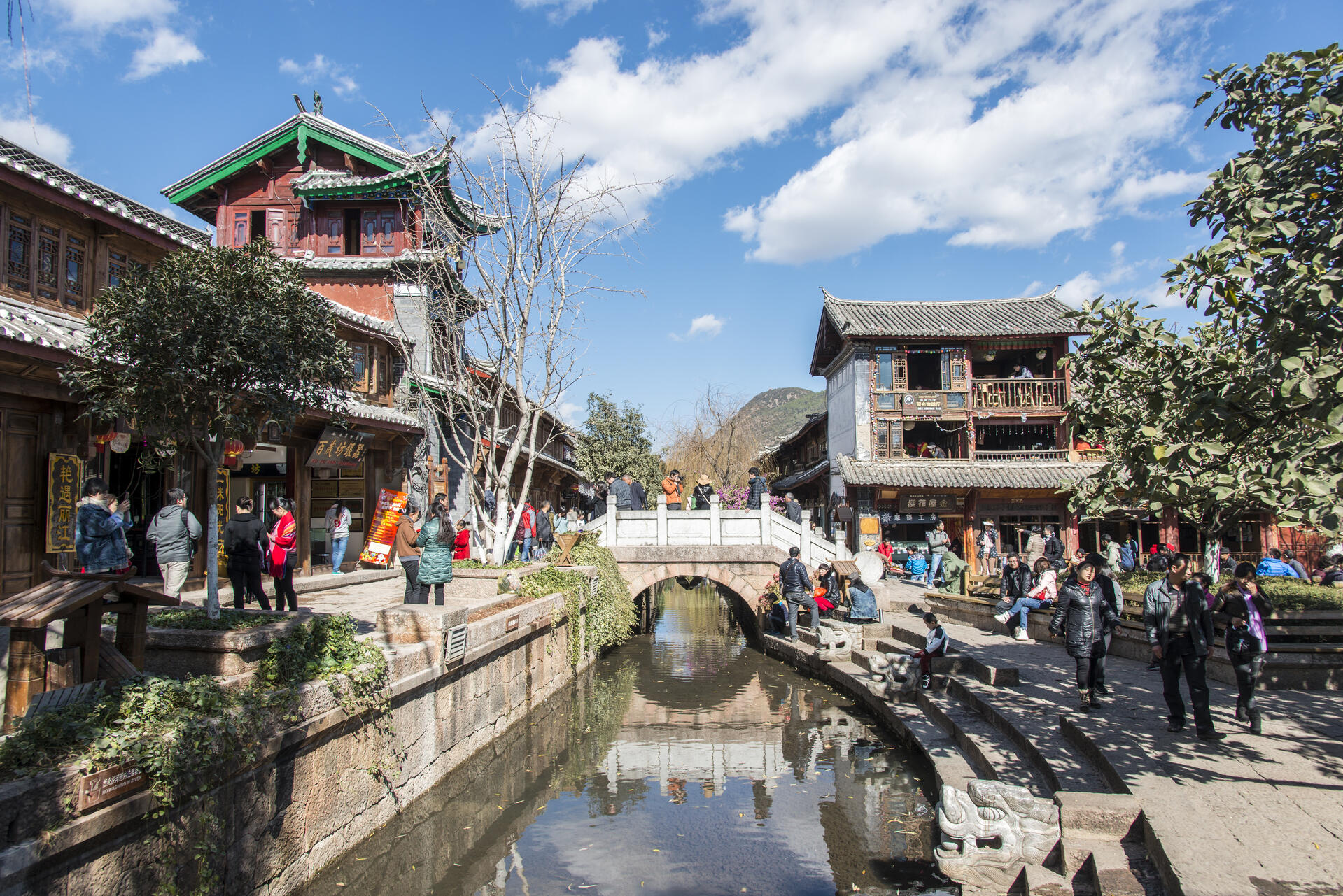
© chensiyuan, CC BY-SA 4.0 Resized from original. (This derivative is under the same CC BY-SA license.)
World Heritage Research
Discover scientific research and academic studies that deepen our understanding of Old Town of Lijiang from its history and significance to its conservation, management, and contemporary challenges.
-
A Study Of Language Usage In The Old Town Of Lijiang
In the Old Town of Lijiang, a UNESCO World Heritage Site and major tourism destination in China, Chinese dominates public signage visibility, while Dongba script serves as a culturally significant marker in bottom-up linguistic landscapes. Multilingualism is more pronounced in Dayan Old Town compared to Shuhe, with English appearing prominently in top-down signs due to its global influence. The study analyzed digital photos of signs to quantify language proportions and preferences, revealing nuanced dynamics in language use within multi-ethnic rural areas. These findings offer insights for future research on linguistic landscapes in tourism-suspended cities.
YULING, J., & CHE LAH, S. (2023). A Study Of Language Usage In The Old Town Of Lijiang. International Journal of Language, Literacy and Translation, 6(2), 135–148. https://doi.org/10.36777/ijollt2023.6.2.083
View Publication Record | Read Publication -
Promoting conservation or change? The UNESCO label of world heritage (re)shaping urban morphology in the Old Town of Lijiang, China
The UNESCO World Heritage label significantly reshapes urban morphology, often prioritizing physical conservation over traditional social fabric. A study on Lijiang's Old Town found that while architectural structures and historic characteristics were well-preserved post-inscription, neighborhood networks and cultural cohesion eroded due to heritage-led development. The research introduces the Conzenian approach as a framework for monitoring Outstanding Universal Values (OUV) and employs spatial plan analysis alongside multi-stakeholder interviews to assess urban morphology from macro to micro levels. This method reveals a tension between conservation efforts and economic growth, offering insights into balancing heritage preservation with sustainable urban development in China and globally.
Li, J., Dai, T., Yin, S., Zhao, Y., Ikiz Kaya, D., & Yang, L. (2022). Promoting conservation or change? The UNESCO label of world heritage (re)shaping urban morphology in the Old Town of Lijiang, China. Frontiers of Architectural Research, 11(6), 1121–1133. https://doi.org/10.1016/j.foar.2022.05.008
View Publication Record | Read Publication -
The relationship between tourists’ perceptions of customized authenticity and loyalty to guesthouses in heritage destinations: an empirical study of the world heritage of Lijiang Old Town, China
A study of 397 tourists in Lijiang Old Town, China, reveals that perceptions of customized authenticity—specifically object-related and existential dimensions—significantly influence guesthouse loyalty. Tourists' sense of being at home in heritage destinations acts as a mediator between their perception of authenticity and loyalty. The research introduces new measurement scales for assessing these dimensions, extending the understanding of authenticity in the context of guesthouses within UNESCO World Heritage Sites.
Shi, T. (., Jin, W., & Li, M. (2020). The relationship between tourists’ perceptions of customized authenticity and loyalty to guesthouses in heritage destinations: an empirical study of the world heritage of Lijiang Old Town, China. Asia Pacific Journal of Tourism Research, 25(11), 1137–1152. https://doi.org/10.1080/10941665.2020.1825006
View Publication Record | Read Publication -
Studying Languages in the Linguistic Landscape of Lijiang Old Town
Linguistic landscape research reveals significant differences between the language use patterns on Fuhui Street and Xinhua Street in Lijiang Old Town. The study highlights variations in bilingual and multilingual signage, particularly involving Chinese, Dongba scripts, and English, alongside differing attitudes among local stakeholders and tourists towards these languages. Employing both quantitative and qualitative methods—digital photography for data collection, supplemented by questionnaires and interviews—the research provides insights into the complex interplay of language use in a culturally rich urban setting.
Xia, N., & Li, L. (2016). Studying Languages in the Linguistic Landscape of Lijiang Old Town. International Journal of English Linguistics, 6(2), 105. https://doi.org/10.5539/ijel.v6n2p105
View Publication Record | Read Publication -
Traditional Chinese ecological wisdom and its practical meaning: a case study of the river system in Lijiang Old Town
Lijiang Old Town's river system exemplifies the enduring practical value of traditional Chinese ecological wisdom, demonstrating how ancient principles can address modern environmental challenges. The study reveals that the town's design—rooted in harmonious coexistence with nature—effectively mitigated water pollution and improved water quality through innovative practices like street washing, bridge market culture, and water conservation folklore (e.g., three-hole wells). By integrating these traditional methods into contemporary management, Lijiang achieved significant improvements: sewage treatment rates surged from 45.2% (2008) to 86.82% (2012), and downstream water quality upgraded from 'worst grade V' (2010) to 'grade III' (2014). The research highlights the resilience of ecological wisdom in modern sustainability efforts, offering a blueprint for balancing urban development with environmental stewardship.
LIU Guodong, 刘国栋, TIAN Kun, 田昆, YUAN Xingzhong, 袁兴中, & SUN Jinfang, 孙晋芳. (2016). Traditional Chinese ecological wisdom and its practical meaning: a case study of the river system in Lijiang Old Town. Acta Ecologica Sinica, 36(2). https://doi.org/10.5846/stxb201407151444
View Publication Record | Read Publication -
Photography-based analysis of tourists’ temporal–spatial behaviour in the Old Town of Lijiang
A novel photography-based approach reveals key temporal and spatial patterns of tourist behavior in the UNESCO-listed Old Town of Lijiang, offering new insights for sustainable tourism management. Analyzing 1308 publicly shared photos, researchers estimated tourists' daily visit frequencies, movement traces, and hotspots, demonstrating the potential of photo-sharing data to track visitor distribution with high accuracy. This method provides a non-intrusive alternative to traditional surveys, enabling more precise planning of resources and conservation efforts in historically significant areas.
Li, C., Zhao, Y., Sun, X., Su, X., Zheng, S., Dong, R., & Shi, L. (2011). Photography-based analysis of tourists’ temporal–spatial behaviour in the Old Town of Lijiang. International Journal of Sustainable Development & World Ecology, 18(6), 523–529. https://doi.org/10.1080/13504509.2011.601471
View Publication Record | Read Publication -
Ancient water supply system of the old town of Lijiang, Yunnan Province, China
The ancient water supply system of Lijiang's Old Town, recognized by UNESCO for its complexity and functionality, remains effective despite modern challenges. This study evaluates the system's resilience, highlighting its ingenious design that has sustained 25,000 inhabitants across 3.8 km² at an altitude of 2,400 meters. Researchers analyzed the system's structure and performance, contrasting it with contemporary urban developments to assess its adaptability. The findings underscore the system's historical significance while addressing its vulnerability to modernization.
Koenig, A., & Fung, S. C. C. (2010). Ancient water supply system of the old town of Lijiang, Yunnan Province, China. Water Supply, 10(3), 383–393. https://doi.org/10.2166/ws.2010.113
View Publication Record | Read Publication