World Heritage Identification Number: 1111
World Heritage since: 2013
Category: Cultural Heritage
WHE Type: Agriculture Landscapes, Parks & Gardens
Transboundary Heritage: No
Endangered Heritage: No
Country: 🇨🇳 China
Continent: Asia
UNESCO World Region: Asia and the Pacific
Map
The Resilient Harmony of the Cultural Landscape of Honghe Hani Rice Terraces
The Cultural Landscape of Honghe Hani Rice Terraces, inscribed as a UNESCO World Heritage Site in 2013, offers a captivating glimpse into the harmonious coexistence of human civilization and nature. Situated in the Yuanyang County of Honghe Prefecture, Yunnan, China, this cultural landscape covers an expansive area of 16,603 hectares, nestled within the towering Ailao Mountains and extending to the banks of the Hong River.
More to come…UNESCO Description of the World Heritage Site
The Cultural Landscape of Honghe Hani Rice Terraces, China covers 16,603-hectares in Southern Yunnan. It is marked by spectacular terraces that cascade down the slopes of the towering Ailao Mountains to the banks of the Hong River. Over the past 1,300 years, the Hani people have developed a complex system of channels to bring water from the forested mountaintops to the terraces. They have also created an integrated farming system that involves buffalos, cattle, ducks, fish and eel and supports the production of red rice, the area’s primary crop. The inhabitants worship the sun, moon, mountains, rivers, forests and other natural phenomena including fire. They live in 82 villages situated between the mountaintop forests and the terraces. The villages feature traditional thatched “mushroom” houses. The resilient land management system of the rice terraces demonstrates extraordinary harmony between people and their environment, both visually and ecologically, based on exceptional and long-standing social and religious structures.
UNESCO Justification of the World Heritage Site
Criterion (iii): The Honghe-Hani terraces are an outstanding reflection of elaborate and finely tuned agricultural, forestry and water distribution systems that are reinforced by long-standing and distinctive socio-economic-religious systems. Red rice, the main crop of the terraces is farmed on the basis of a complex, integrated farming and breeding system within which ducks fertilise the young rice plants, while chickens and pigs contribute fertiliser to more mature plants, water buffalo slough the fields for the next year’s planting and snails growing in the water of the terraces consume various pests. The rice growing process is sustained by elaborate socio-economic-religious systems that strengthen peoples’ relationship with the environment, through obligations to both their own lands and to the wider community, and affirm the sacredness of nature. This system of dual interdependence known as the ‘Man-God Unity social system’ and its physical manifestation in the shape of the terraces together form an exceptional still living cultural tradition.
Criterion (v): The Honghe Hani Rice terraced landscape reflects in an exceptional way a specific interaction with the environment mediated by integrated farming and water management systems, and underpinned by socio-economic-religious systems that express the dual relationship between people and gods and between individuals and community, a system that has persisted for at least a millennium, as can be shown by extensive archival sources.
Encyclopedia Record: Honghe Hani Rice Terraces
The Honghe Hani Rice Terraces are the system of Hani rice-growing terraces located in Yuanyang County, Honghe Prefecture, Yunnan, China. The terraces' history spans around 1,200 years. The total area stretches across 1,000,000 acres and four counties: Yuanyang, Honghe, Jinpin and Lüchun, although the core area of the terraces is located in Yuanyang County. In 2013, 16,603 hectares of the Honghe Hani Rice Terraces were listed as a World Heritage Site, because of their outstanding resilient construction, unique social-ecological system, and importance to the Hani people.Additional Site Details
Area: 16,603.22 hectares
Number of Components: 1
(v) — Outstanding example of traditional human settlement
Coordinates: 23.0932777778 , 102.7799805556
Image
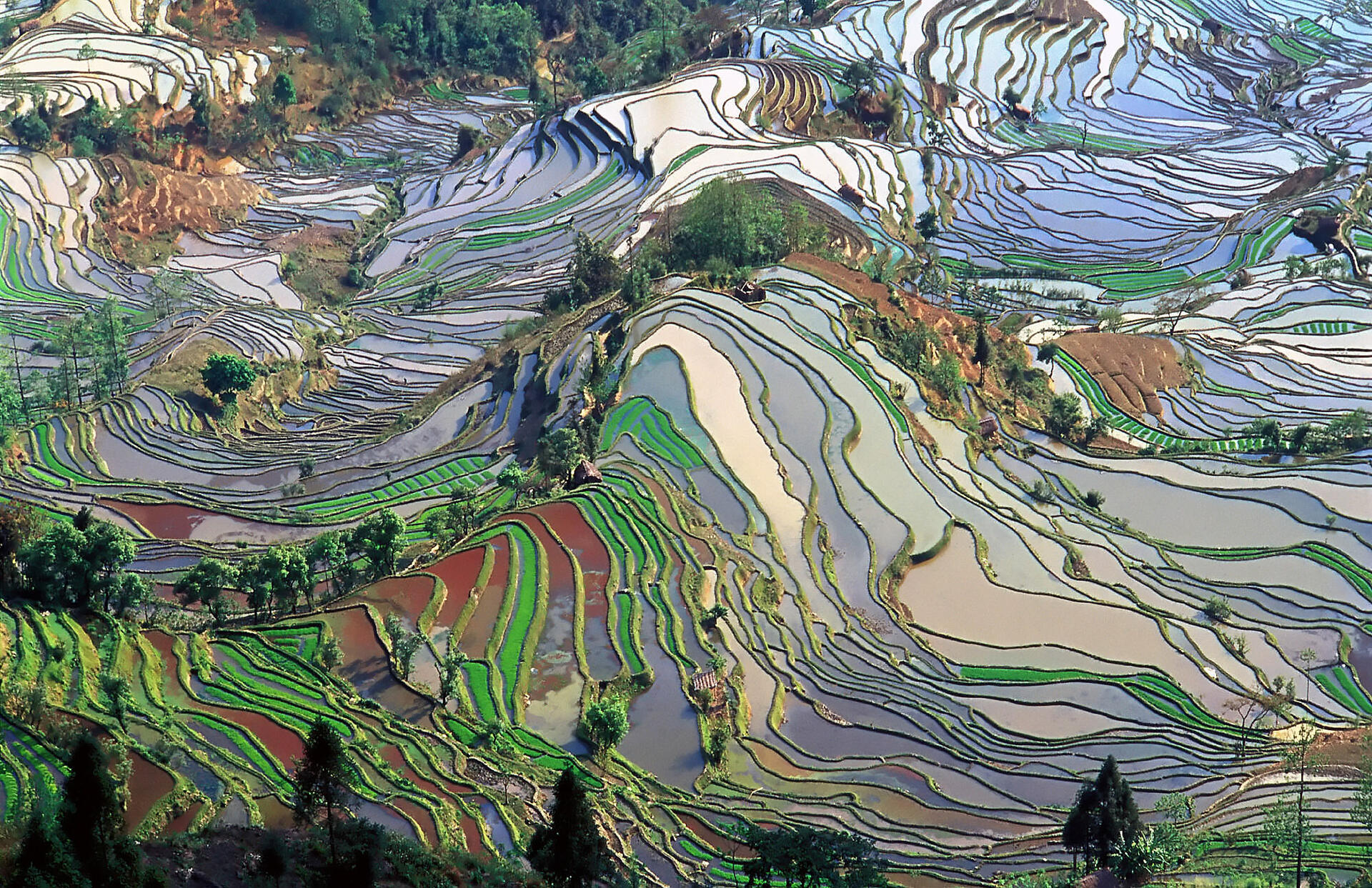
© Jialiang Gao, www.peace-on-earth.org, CC BY-SA 3.0 Resized from original. (This derivative is under the same CC BY-SA license.)
World Heritage Research
Discover scientific research and academic studies that deepen our understanding of Cultural Landscape of Honghe Hani Rice Terraces from its history and significance to its conservation, management, and contemporary challenges.
-
An Integrated Water System: The Cultural Landscape of Honghe Hani Rice Terraces
The Cultural Landscape of Honghe Hani Rice Terraces, inscribed on the World Heritage List in 2013, serves as a model for sustainable development by integrating traditional farming, irrigation, and water management practices with the spiritual relationship of the Hani people to nature. This landscape exemplifies a comprehensive water management system that aligns with multiple United Nations Sustainable Development Goals (SDGs), including SDG 6 (clean water and sanitation), SDG 11 (sustainable cities and communities), SDG 12 (responsible consumption and production), and SDG 13 (climate action). The study highlights the resilience of this system in traditional farming practices, offering insights into conserving and recreating holistic water systems amid climate change challenges such as flooding and drought. It underscores the importance of safeguarding this cultural landscape against socioeconomic pressures while maintaining its ecological and cultural integrity.
Dai, T., & Hein, C. (2025). An Integrated Water System: The Cultural Landscape of Honghe Hani Rice Terraces. Blue Papers, 4(2). https://doi.org/10.58981/bluepapers.2025.2.14
View Publication Record | Read Publication -
Balancing Hydrological Sustainability and Heritage Conservation: A Decadal Analysis of Water-Yield Dynamics in the Honghe Hani Rice Terraces
A decade-long decline in water yield, driven by cropland fragmentation and tourism growth, threatens the hydrological sustainability of the Honghe Hani Rice Terraces. Research using the InVEST model and geographic detector analysis revealed that while built-up areas exhibited the highest water yield (980 mm per unit in 2018), there was a significant 31% drop by 2020, with persistent-yield hotspots in forested central-eastern terraces. Land-use patterns accounted for 80–95% of yield variability, exacerbated by temperature interactions. Forests contributed 68.7 million m³ over the decade, underscoring their hydrological importance. The study advocates for reforestation in critical recharge zones, terrace restoration, and regulated tourism to balance water security with cultural heritage conservation.
Huang, L., Lyu, Y., Miao, L., & Li, S. (2025). Balancing Hydrological Sustainability and Heritage Conservation: A Decadal Analysis of Water-Yield Dynamics in the Honghe Hani Rice Terraces. Hydrology, 12(6), 135. https://doi.org/10.3390/hydrology12060135
View Publication Record | Read Publication -
A Dialogue between the Humanities and Social Sciences: Cultural Landscapes and Their Transformative Potential for Social Innovation
Cultural landscapes, such as the UNESCO-listed Honghe Hani Rice Terraces, hold significant potential for fostering social innovation in rural regions. This interdisciplinary study demonstrates how integrating landscape semantics and participatory methodologies can address critical challenges like out-migration, unemployment, and aging populations. The research introduces the Social Grid Model to analyze social networks, institutions, and cognitive frames, alongside the Structured Democratic Dialogue, which revitalizes both 'active' and 'inactive' cultural landscapes by empowering local communities. Through case studies in Greece (Koumasa) and China (Honghe Hani Rice Terraces), the study illustrates how collective action can promote tangible and intangible heritage, offering a blueprint for sustainable rural development.
Panagiotopoulos, D., Wallenwein, F., Mildenberger, G., & Schimpf, G.-C. (2023). A Dialogue between the Humanities and Social Sciences: Cultural Landscapes and Their Transformative Potential for Social Innovation. Heritage, 6(12), 7674–7705. https://doi.org/10.3390/heritage6120404
View Publication Record | Read Publication -
An integrated mechanism and challenges of mountainous sustainable development: A review of Hani Terraces, China
Mountainous agricultural systems, which support 15% of the global population, face increasing sustainability challenges due to social transitions. The Honghe Hani Rice Terrace System (HHRTS) in China, a double world-level heritage site, demonstrates strong resilience despite these pressures. A comprehensive review reveals that its sustainability hinges on three interconnected dimensions: economic, environmental, and social stability. Economic sustainability relies on sufficient water and land resources alongside diverse employment opportunities, while environmental sustainability is maintained through balanced landscape structures, rich biodiversity, and ecological farming practices. Social stability depends on well-developed social systems, efficient management, and cultural guidance. Traditional knowledge and cultures play a pivotal role in preserving the terraced landscapes but are diminishing with industrialization and urbanization. The study proposes a dynamic evolution mechanism driven by economic and social factors, transitioning from agricultural to industrial societies based on the theory of planned behavior. It offers valuable local insights, experiences, and an analytical framework for reconstructing sustainable mountainous agricultural systems during socio-economic transformations.
Zhang, Y., Zhang, A., & Ma, Y. (2023). An integrated mechanism and challenges of mountainous sustainable development: A review of Hani Terraces, China. Sustainable Development, 32(1), 101–118. Portico. https://doi.org/10.1002/sd.2651
View Publication Record | Read Publication -
Genetic Diversity and Association Mapping of Grain-Size Traits in Rice Landraces from the Honghe Hani Rice Terraces System in Yunnan Province
Researchers identified significant genetic markers linked to key grain-size traits in rice landraces from the UNESCO-listed Honghe Hani Rice Terraces, offering potential for crop improvement. Analyzing 96 landraces over multiple years using SSR markers, they found strong associations between specific genetic variants and traits like grain length, width, thickness, length-width ratio, and thousand-grain weight. These markers explained phenotypic variation ranging from 10% to 43%, with notable heritability (>70%) for these traits. The study also revealed two distinct genetic groups within the landraces, predominantly indica rice, highlighting the terraces' role as a reservoir of valuable genetic diversity.
Ma, M., Lei, E., Wang, T., Meng, H., Zhang, W., & Lu, B. (2023). Genetic Diversity and Association Mapping of Grain-Size Traits in Rice Landraces from the Honghe Hani Rice Terraces System in Yunnan Province. Plants, 12(8), 1678. https://doi.org/10.3390/plants12081678
View Publication Record | Read Publication -
Farmers’ landslide risk perceptions and willingness for restoration and conservation of world heritage site of Honghe Hani Rice Terraces, China
A study reveals that farmers in the UNESCO World Heritage Site of Honghe Hani Rice Terraces, China, while threatened by landslide risks due to personal experiences, show a strong desire for knowledge enhancement on restoration and conservation practices. Despite feeling vulnerable due to poor preparedness and inefficient disaster information, they exhibit high trust in authorities' decisions, indicating potential for collaborative efforts in safeguarding the terraces and sustaining tourism. The research, based on 125 in-person interviews conducted post-landslide event in June 2018, underscores the need for targeted training activities to foster conservation practices and community resilience.
Gao, X., Roder, G., Jiao, Y., Ding, Y., Liu, Z., & Tarolli, P. (2020). Farmers’ landslide risk perceptions and willingness for restoration and conservation of world heritage site of Honghe Hani Rice Terraces, China. Landslides, 17(8), 1915–1924. https://doi.org/10.1007/s10346-020-01389-4
View Publication Record | Read Publication -
Indigenous Wellbeing and Enterprise
Indigenous tourism can both benefit and challenge Indigenous communities, affecting socio-economic status, political rights, and environmental sustainability. This study highlights successful entrepreneurial efforts within two Asian Indigenous communities that balance self-determination with external collaboration to conserve cultural heritage while responding to gentrification pressures from tourism. In the Honghe Hani Rice Terraces UNESCO World Heritage Site in China, local communities are engaging in tourism-related entrepreneurship, enhancing their capabilities and resources. Meanwhile, the Chi-mei community in Taiwan demonstrates how partnerships with national museums can foster economic growth and heritage conservation. These case studies illustrate pathways for Indigenous communities to achieve socio-economic development while preserving their cultural identity.
Colbourne, R., & Anderson, R. B. (Eds.). (2020). Indigenous Wellbeing and Enterprise. https://doi.org/10.4324/9780429329029
View Publication Record | Read Publication -
Locally situated rights and the ‘doing’ of responsibility for heritage conservation and tourism development at the cultural landscape of Honghe Hani Rice Terraces, China
A study at the UNESCO World Heritage Site of Honghe Hani Rice Terraces reveals that local villagers, particularly ethnic minorities, bear the primary responsibility for conserving the cultural landscape through traditional agricultural and religious practices, yet they face significant inequities in accessing tourism benefits and compensation. The research highlights how state-led conservation approaches, focused on material heritage and technical methods, often disregard the roles and needs of local residents, reinforcing unequal power dynamics. Conducted through participant observations and semi-structured interviews, this work underscores the tension between local rights and responsibilities in heritage management, emphasizing the need for more inclusive and equitable practices to sustain these landscapes for future generations.
Gao, J., Lin, H., & Zhang, C. (2020). Locally situated rights and the ‘doing’ of responsibility for heritage conservation and tourism development at the cultural landscape of Honghe Hani Rice Terraces, China. Journal of Sustainable Tourism, 29(2-3), 193–213. https://doi.org/10.1080/09669582.2020.1727912
View Publication Record | Read Publication -
Self-gentrification as a pro-active response to tourism development
Indigenous communities can proactively respond to tourism-driven gentrification by developing their own entrepreneurial ventures, a strategy termed 'self-gentrification.' This approach allows them to conserve cultural heritage while improving socio-economic status. The study examines two case studies: the Honghe Hani Rice Terraces UNESCO World Heritage Site in China and the Chi-mei community in Taiwan. Both demonstrate how Indigenous communities can leverage tourism opportunities without losing autonomy or cultural identity. The research highlights the potential of self-gentrification as a sustainable model for balancing development, heritage conservation, and Indigenous rights.
Chan, J. H., Chen, S.-Y., Ji, Z., Zhang, Y., & Qi, X. (2020). Self-gentrification as a pro-active response to tourism development. Indigenous Wellbeing and Enterprise, 165–191. https://doi.org/10.4324/9780429329029-8
View Publication Record | Read Publication -
The role of self-gentrification in sustainable tourism: Indigenous entrepreneurship at Honghe Hani Rice Terraces World Heritage Site, China
Indigenous Hani and Yi communities at the Honghe Hani Rice Terraces UNESCO World Heritage Site face threats to their traditional rice cultivation practices due to gentrification driven by outsiders and state policies, coupled with high Indigenous migration rates. However, some Indigenous individuals are adopting entrepreneurial strategies learned from interactions with tourists and gentrifiers, improving their socio-economic status through a process termed 'self-gentrification.' This study introduces the concept of self-gentrification as a means to conserve heritage landscapes and Indigenous ways of life while mitigating the negative impacts of external gentrification. The research employs interviews and non-participant observations with inhabitants and newcomers to analyze these dynamics, offering potential solutions for sustainable tourism in World Heritage Sites.
Chan, J. H., Iankova, K., Zhang, Y., McDonald, T., & Qi, X. (2019). The role of self-gentrification in sustainable tourism: Indigenous entrepreneurship at Honghe Hani Rice Terraces World Heritage Site, China. Sustainable Tourism and Indigenous Peoples, 196–213. https://doi.org/10.4324/9781315112053-12
View Publication Record | Read Publication -
The Change Mechanism of Human-Environment Interactions from the Perspective of Contextualization: A Case Study of the Honghe Hani Rice Terraces as a World Cultural Heritage Site
A new framework rooted in event ecology reveals that the drying of terraces at Honghe Hani Rice Terraces, often blamed on tourism-driven water overuse, is actually driven by reduced precipitation and deforestation. Local residents exaggerated tourism’s role due to social conflicts stemming from unequal access to tourism benefits. The study underscores the need for context-sensitive analysis—incorporating political, economic, and social factors—to objectively assess human-environment interactions and promote sustainable heritage management.
Hua, H., Zhou, S., Ding, Z., & Pan, Y. (2018). The Change Mechanism of Human-Environment Interactions from the Perspective of Contextualization: A Case Study of the Honghe Hani Rice Terraces as a World Cultural Heritage Site. Sustainability, 10(7), 2230. https://doi.org/10.3390/su10072230
View Publication Record | Read Publication -
Values and Conservation of Honghe Hani Rice Terraces System as a GIAHS Site
The Honghe Hani Rice Terraces System (HHRTS), a 1300-year-old traditional agricultural system, demonstrates significant economic, ecological, aesthetic, cultural, and research values. Designated as both a Globally Important Agricultural Heritage System (GIAHS) in 2010 and a World Heritage Site in 2013, the HHRTS highlights unique features such as distinctive rice varieties, ecologically clean production systems, and sustainable water and soil management practices. While traditional farming methods face challenges like low efficiency and single-industry dependency, these constraints create ideal conditions for green agriculture, organic farming, and ecological food production due to the pristine farmland environment. The study proposes that protecting this system requires multi-faceted economic compensation strategies, including ecotourism development and policy coordination among governments, corporations, and local communities.
Yongxun, Z., Qingwen, M., Wenjun, J., & Moucheng, L. (2016). Values and Conservation of Honghe Hani Rice Terraces System as a GIAHS Site. Journal of Resources and Ecology, 7(3), 197–204. https://doi.org/10.5814/j.issn.1674-764x.2016.03.007
View Publication Record | Read Publication -
Hani Rice Terraces of Honghe - The Harmonious Landscape of Nature and Humans
The Honghe Hani Rice Terraces, a UNESCO World Heritage Site inscribed in 2013, represent a unique cultural landscape shaped by the Hani people's millennia-old rice farming traditions. This study reveals that the terraces' spectacular spatial structure—integrating forest, water, and village systems—is sustained by a harmonious blend of physical factors and deep-rooted cultural practices, including land-use management and spiritual values. The research highlights how this landscape, now a global attraction for scholars and tourists, faces challenges from modern tourism and development, raising critical questions about its long-term preservation.
Zhan, G., & Jin, Z. (2015). Hani Rice Terraces of Honghe - The Harmonious Landscape of Nature and Humans. Landscape Research, 40(6), 655–667. https://doi.org/10.1080/01426397.2015.1060299
View Publication Record | Read Publication -
Human-Environment System Boundaries: A Case Study of the Honghe Hani Rice Terraces as a World Heritage Cultural Landscape
A new methodology framework for demarcating boundaries of UNESCO World Heritage Cultural Landscapes was developed, using the Honghe Hani Rice Terraces (HHRT) as a case study. The research identified four types of boundaries—river basin, water-allocation organization, economic network, and perceptual—and integrated them to assess sustainability. Findings revealed that parts of HHRT's core boundary do not meet criteria for environmental sustainability, social justice, or the creation of new human-environment systems. This approach provides a holistic perspective for future administrative decisions in similar landscapes.
Hua, H., & Zhou, S. (2015). Human-Environment System Boundaries: A Case Study of the Honghe Hani Rice Terraces as a World Heritage Cultural Landscape. Sustainability, 7(8), 10733–10755. https://doi.org/10.3390/su70810733
View Publication Record | Read Publication -
Terrace Agriculture of the Hani People – Cultural Heritage of the South-West China
The Cultural Landscape of Honghe Hani Rice Terraces, recognized by UNESCO in 2013, exemplifies the enduring integration of indigenous agricultural practices with natural landscapes. This study highlights how the Hani and Yi peoples have sustained terrace agriculture for over 1,300 years, preserving both cultural traditions and ecological balance. The research emphasizes the unique morphology of terraced slopes and ancient cultivation techniques that facilitate the growth of red rice, a staple crop in the region. These practices not only support sustainable agriculture but also contribute to erosion prevention and landslide mitigation. Additionally, the landscape's seasonal fluctuations and aesthetic appeal reflect a harmonious blend of human activity and natural beauty, symbolizing the ethnic minorities' way of life and associated ritual customs.
Kladovshchikova, M. (2015). Terrace Agriculture of the Hani People – Cultural Heritage of the South-West China. Vestnik Volgogradskogo Gosudarstvennogo Universiteta. Serija 11. Estestvennye Nauki, (1), 75–93. https://doi.org/10.15688/jvolsu11.2015.1.8
View Publication Record | Read Publication