World Heritage Identification Number: 479
World Heritage since: 1995
Category: Cultural Heritage
WHE Type: Historic Cities & Urban Areas
Transboundary Heritage: No
Endangered Heritage: No
Country: 🇱🇦 Lao People's Democratic Republic
Continent: Asia
UNESCO World Region: Asia and the Pacific
Map
A Cultural Melting Pot: The Town of Luang Prabang
The Town of Luang Prabang, located in the heart of Laos, stands as a testament to the harmonious blend of traditional Laotian culture and European colonial influences. Inscribed as a UNESCO World Heritage Site in 1995, this historic city offers a unique insight into a significant phase of cultural fusion that has shaped Southeast Asia's architectural landscape.
More to come…UNESCO Description of the World Heritage Site
Luang Prabang is an outstanding example of the fusion of traditional architecture and Lao urban structures with those built by the European colonial authorities in the 19th and 20th centuries. Its unique, remarkably well-preserved townscape illustrates a key stage in the blending of these two distinct cultural traditions.
UNESCO Justification of the World Heritage Site
Criterion (ii): Luang Prabang reflects the exceptional fusion of Lao traditional architecture and 19th and 20th century European colonial style buildings.
Criterion (iv): Luang Prabang is an outstanding example of an architectural ensemble built over the centuries combining sophisticated architecture of religious buildings, vernacular constructions and colonial buildings.
Criterion (v): The unique townscape of Luang Prabang is remarkably well preserved, illustrating a key stage in the blending of two distinct cultural traditions.
Encyclopedia Record: Luang Prabang
Luang Prabang, historically known as Xieng Thong (ຊຽງທອງ) and alternatively spelled Luang Phabang or Louangphabang, is the capital of Luang Prabang Province in north-central Laos. Its name, meaning “Royal Buddha Image,” derives from the Phra Bang, a statue symbolizing Lao sovereignty. Designated a UNESCO World Heritage Site in 1995, the city is recognized for blending traditional Lao architecture, European colonial buildings, and over 30 Buddhist temples. The protected area encompasses 33 of its 58 villages, where daily rituals like the morning alms-giving ceremony persist.Additional Site Details
Area: 820 hectares
Number of Components: 1
(iv) — Outstanding example of a type of building or landscape
(v) — Outstanding example of traditional human settlement
Coordinates: 19.88889 , 102.13333
Image
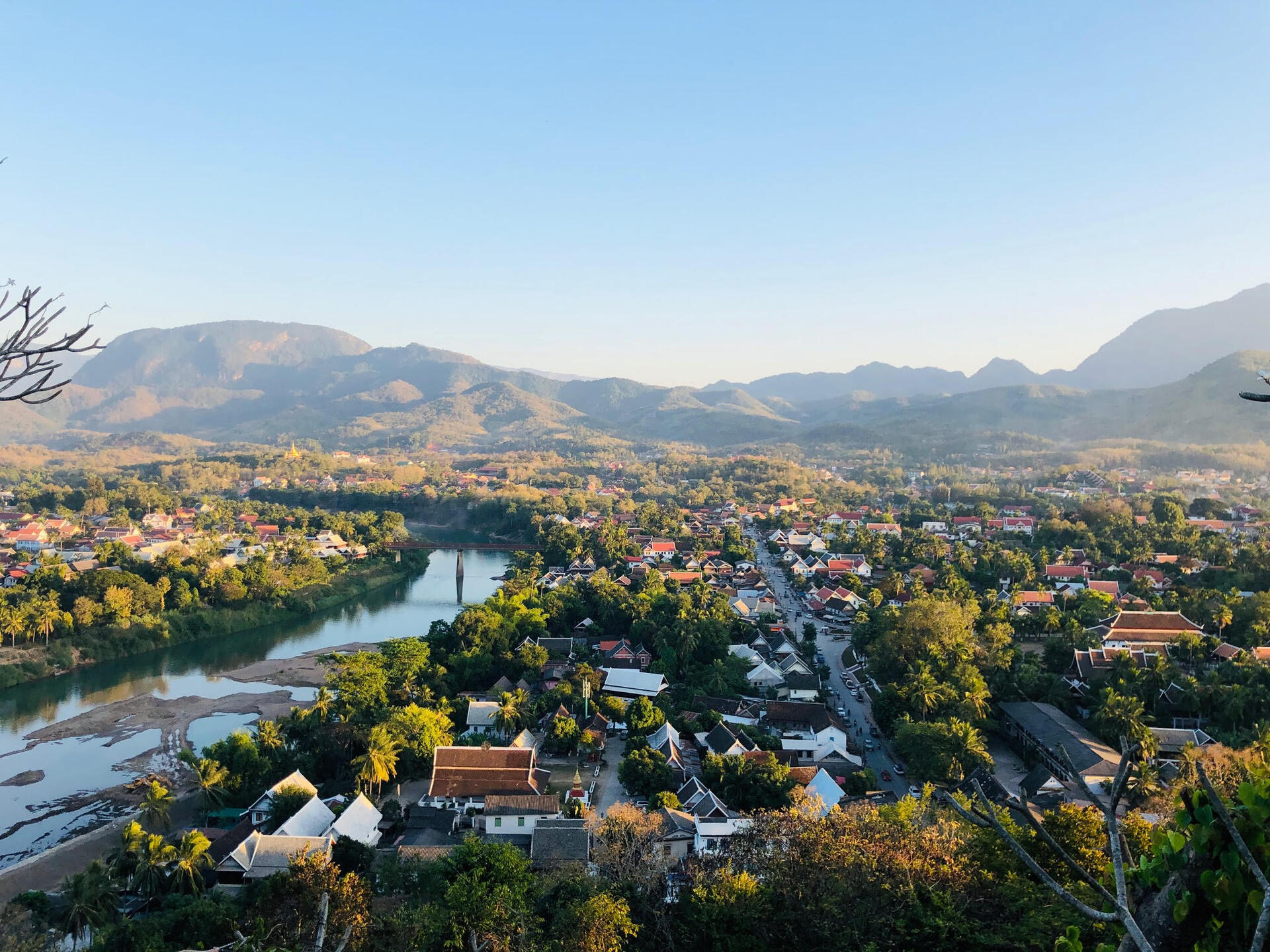
© Shelly Zohar, CC BY-SA 4.0 Resized from original. (This derivative is under the same CC BY-SA license.)
World Heritage Research
Discover scientific research and academic studies that deepen our understanding of Town of Luang Prabang from its history and significance to its conservation, management, and contemporary challenges.
-
Sustainable Tourism in the World Heritage Town Luang Prabang, Lao PDR
Luang Prabang has made notable progress in sustainable tourism while facing persistent challenges. The study highlights the critical role of local institutions in balancing economic growth with cultural heritage preservation and rural development, aligning with SDG 11: Sustainable Cities and Communities. Despite advancements, issues such as urban-rural disparities, inadequate infrastructure, and political resistance persist. The research employs qualitative methods to analyze stakeholder perspectives, identifying synergies and trade-offs among multiple SDGs. Future prospects for Luang Prabang depend on addressing these challenges through targeted policies, enhanced education, and inclusive development strategies.
Somsamone, V. (2023). Sustainable Tourism in the World Heritage Town Luang Prabang, Lao PDR. Academic Society for Appropriate Technology, 9(3), 162–175. https://doi.org/10.37675/jat.2023.00332
View Publication Record | Read Publication -
UNESCO World Heritage Sites: shared shrines or contested sanctuaries? The case of the Buddhist temples of Luang Prabang, Laos
Buddhist temples in Luang Prabang, Laos, inscribed as UNESCO World Heritage Sites in 1995, represent 'shared shrines' or 'contested sanctuaries,' reflecting intersecting cosmological perceptions. These include local Laotian Buddhist beliefs, the state's modernist vision, and Western heritage narratives tied to colonial nostalgia. Long-term ethnographic research since 2006 reveals ongoing debates among locals, officials, and tourists over rituals, time, and material culture, creating a fragile balance of conflicting cosmologies. The study highlights how these sites become ambiguous spaces where harmony is temporary, shaped by divergent worldviews.
Bear, L., Avieli, N., & Feldman, J. (2020). UNESCO World Heritage Sites: shared shrines or contested sanctuaries? The case of the Buddhist temples of Luang Prabang, Laos. Journal of Heritage Tourism, 16(1), 1–19. https://doi.org/10.1080/1743873x.2020.1759609
View Publication Record | Read Publication -
The “old” and the “new”: events and placemaking in Luang Prabang, Laos
Two festivals in Luang Prabang, Laos—a centuries-old tradition and a recent innovation—reveal that place-making is not static but a dynamic interplay of past, present, and future. The study challenges the separation of 'events' from 'place,' arguing this dichotomy undermines both lived experience and analytical depth. Through fieldwork spanning 2008–2016, including interviews, observations, and participation in Lai Heua Fai (2013) and the Luang Prabang Film Festival (2015), researchers demonstrate how these events spatially construct identity, blending tradition with contemporary markers of place attachment. This work redefines place-making as an ongoing process where 'old' and 'new' are continuously reconstituted, offering new perspectives on heritage site evolution in a globalized world.
Staiff, R., & Bushell, R. (2017). The “old” and the “new”: events and placemaking in Luang Prabang, Laos. International Journal of Event and Festival Management, 8(1), 55–65. https://doi.org/10.1108/ijefm-05-2016-0036
View Publication Record | Read Publication -
Investigating the drivers of mobile learning acceptance among young adults in the World Heritage town of Luang Prabang, Laos
A study on mobile learning acceptance among young adults in Luang Prabang, Laos, reveals that perceived usefulness, ease of use, and enjoyment directly influence their intention to adopt mobile learning for heritage site awareness. Social influence and self-efficacy indirectly impact this acceptance through perceived usefulness and ease of use, respectively. Using structural equation modeling with data from 349 higher education students, the research provides actionable insights for policy recommendations in Luang Prabang, contributing to global understanding of mobile learning adoption in least developed countries.
Poong, Y. S., Yamaguchi, S., & Takada, J.-i. (2016). Investigating the drivers of mobile learning acceptance among young adults in the World Heritage town of Luang Prabang, Laos. Information Development, 33(1), 57–71. https://doi.org/10.1177/0266666916638136
View Publication Record | Read Publication -
Impact of learning content on World Heritage Site preservation awareness in town of Luang Prabang, Lao PDR: Application of Protection Motivation Theory
Learning content designed using Protection Motivation Theory (PMT) significantly enhances threat and coping appraisals related to World Heritage Site preservation, as demonstrated in a study involving 212 participants from Luang Prabang, Lao PDR. The research employed a repeated-measures t-test to evaluate the impact of PMT-based learning content on respondents' perceptions and behaviors toward heritage site protection. Findings indicate that structured educational interventions can effectively influence awareness and proactive measures for preservation.
Poong, Y. S., Yamaguchi, S., & Takada, J. (2015). Impact of learning content on World Heritage Site preservation awareness in town of Luang Prabang, Lao PDR: Application of Protection Motivation Theory. ISPRS Annals of the Photogrammetry, Remote Sensing and Spatial Information Sciences, II-5/W3, 251–256. https://doi.org/10.5194/isprsannals-ii-5-w3-251-2015
View Publication Record | Read Publication -
The Cultural Tourism Management under Context of World Heritage Sites: Stakeholders’ Opinions between Luang Prabang Communities, Laos and Muang-kao Communities, Sukhothai,Thailand
A comparative study of stakeholder perspectives on cultural tourism management in UNESCO World Heritage Sites reveals three key groups shaping policy and promotion: government agencies, entrepreneurs, and the general public. In Luang Prabang, Laos, and Muang-kao, Thailand, stakeholders emphasize preservation under the 'Live World Heritage Town' concept while advocating for broader public participation. Government bodies like the Heritage House (Laos) and Tourism Authority of Thailand oversee heritage management, while entrepreneurs drive tourism services and training. The public supports government-led efforts but insists on active involvement in heritage conservation, reflecting differing yet aligned priorities between these UNESCO-protected sites established in 1995 (Luang Prabang) and 1991 (Sukhothai). This qualitative research highlights the balance between governance, economic engagement, and community-driven preservation in sustaining cultural tourism.
Khlaikaew, K. (2015). The Cultural Tourism Management under Context of World Heritage Sites: Stakeholders’ Opinions between Luang Prabang Communities, Laos and Muang-kao Communities, Sukhothai,Thailand. Procedia Economics and Finance, 23, 1286–1295. https://doi.org/10.1016/s2212-5671(15)00563-8
View Publication Record | Read Publication -
The Influence of French Colonial Rule on Lao Architecture with a Focus on Residential Buildings
French colonial rule (1893–1953) left a lasting architectural imprint on Lao PDR, blending traditional Lao and French elements into climate-adapted designs that persist today. Luang Prabang, a UNESCO World Heritage Site since 1995, exemplifies this fusion, where colonial villas subtly influenced local residential structures while retaining cultural authenticity. The study analyzes how social, economic, and climatic factors reshaped these styles, emphasizing their compatibility with tropical conditions. By examining historical adaptations, the research highlights the resilience of Lao architecture in preserving heritage amid foreign influences.
Vongvilay, X., Shin, J.-E., Kang, Y.-H., Kim, E.-D., & Choi, J.-H. (2015). The Influence of French Colonial Rule on Lao Architecture with a Focus on Residential Buildings. Journal of Asian Architecture and Building Engineering, 14(2), 279–286. https://doi.org/10.3130/jaabe.14.279
View Publication Record | Read Publication -
The rhetoric of Lao/French fusion: beyond the representation of the Western tourist experience of cuisine in the world heritage city of Luang Prabang, Laos
Luang Prabang's 'Lao-French fusion cuisine' is a selective and partial representation that masks the dynamic, multifaceted nature of food traditions in the UNESCO World Heritage city. This study reveals how the rhetoric of fusion, shaped by Luang Prabang's self-presentation to Western tourists, simplifies complex culinary interactions—including local farming, market dynamics, imports from neighboring countries, and social group distinctions—to create a fixed, touristic image. The research examines contestations around cuisine representation, highlighting how this narrative excludes broader food scenarios and freezes fluid processes into static depictions.
Staiff, R., & Bushell, R. (2013). The rhetoric of Lao/French fusion: beyond the representation of the Western tourist experience of cuisine in the world heritage city of Luang Prabang, Laos. Journal of Heritage Tourism, 8(2-3), 133–144. https://doi.org/10.1080/1743873x.2013.767808
View Publication Record | Read Publication -
Capacity-building for sustainable urban development: Town of Luang Prabang, Lao People's Democratic Republic
Sustainable urban development in Luang Prabang, a UNESCO World Heritage Site since 1995, hinges on balancing cultural preservation with modern growth. The study highlights the site's significance as a symbol of national identity and independence, while addressing challenges posed by rapid urbanization. It explores capacity-building strategies to ensure sustainable development that respects its historical and environmental value. The research employs a multidisciplinary approach, analyzing urban planning, tourism management, and community engagement to propose actionable frameworks for preserving Luang Prabang's unique heritage amidst developmental pressures.
Yang, M. (2012). Capacity-building for sustainable urban development: Town of Luang Prabang, Lao People’s Democratic Republic. World Heritage, 94–106. https://doi.org/10.1017/cbo9781139567657.012
View Publication Record | Read Publication -
Routledge Handbook of Heritage in Asia
The Routledge Handbook of Heritage in Asia reveals the complex interplay between heritage conservation, politics, and globalization in Asian contexts. It highlights how cultural memory, religious shifts, and colonial legacies shape heritage management practices, often leading to conflicts between preservation efforts and local identities. The handbook also underscores the need for specialized conservation expertise and examines the political dimensions of heritage, including its role in nation-building and intangible cultural heritage safeguarding. Through case studies from across Asia, it explores how modernity and globalization challenge traditional heritage narratives while offering pathways for sustainable preservation.
Daly, P., & Winter, T. (Eds.). (2012). Routledge Handbook of Heritage in Asia. Routledge. https://doi.org/10.4324/9780203156001
View Publication Record | Read Publication -
Luang Prabang, sanctuaire Unesco et paradis gay
Luang Prabang, a UNESCO World Heritage Site since 1995, has undergone significant transformation due to tourism, evolving from its traditional image of Buddhist monasteries and colonial architecture into a dual identity. While it remains renowned for its cultural heritage, it is also increasingly recognized as a 'gay paradise,' a label that contrasts with local perceptions of tradition. This study highlights the tension between Luang Prabang's historical and contemporary identities, exploring how UNESCO recognition and tourism have reshaped the town's social dynamics. The research employs qualitative methods to analyze these shifts, revealing the complexities of heritage preservation and cultural identity in the context of globalization.
Berliner, D. (2011). Luang Prabang, sanctuaire Unesco et paradis gay. Genre, Sexualité et Société, 5. https://doi.org/10.4000/gss.1888
View Publication Record | Read Publication