World Heritage Identification Number: 575
World Heritage since: 1992
Category: Cultural Heritage
WHE Type: Archaeological Sites
Transboundary Heritage: No
Endangered Heritage: No
Country: 🇹🇭 Thailand
Continent: Asia
UNESCO World Region: Asia and the Pacific
Map
Unraveling the Mysteries of Ban Chiang Archaeological Site: A Prehistoric Treasure Trove in Southeast Asia
The Ban Chiang Archaeological Site, nestled in the lush landscapes of Nong Han district, Udon Thani province, Thailand, stands as a testament to the rich cultural heritage of Southeast Asia. Inscribed as a UNESCO World Heritage Site in 1992, this prehistoric settlement offers a unique glimpse into the early stages of human civilization in the region.
More to come…UNESCO Description of the World Heritage Site
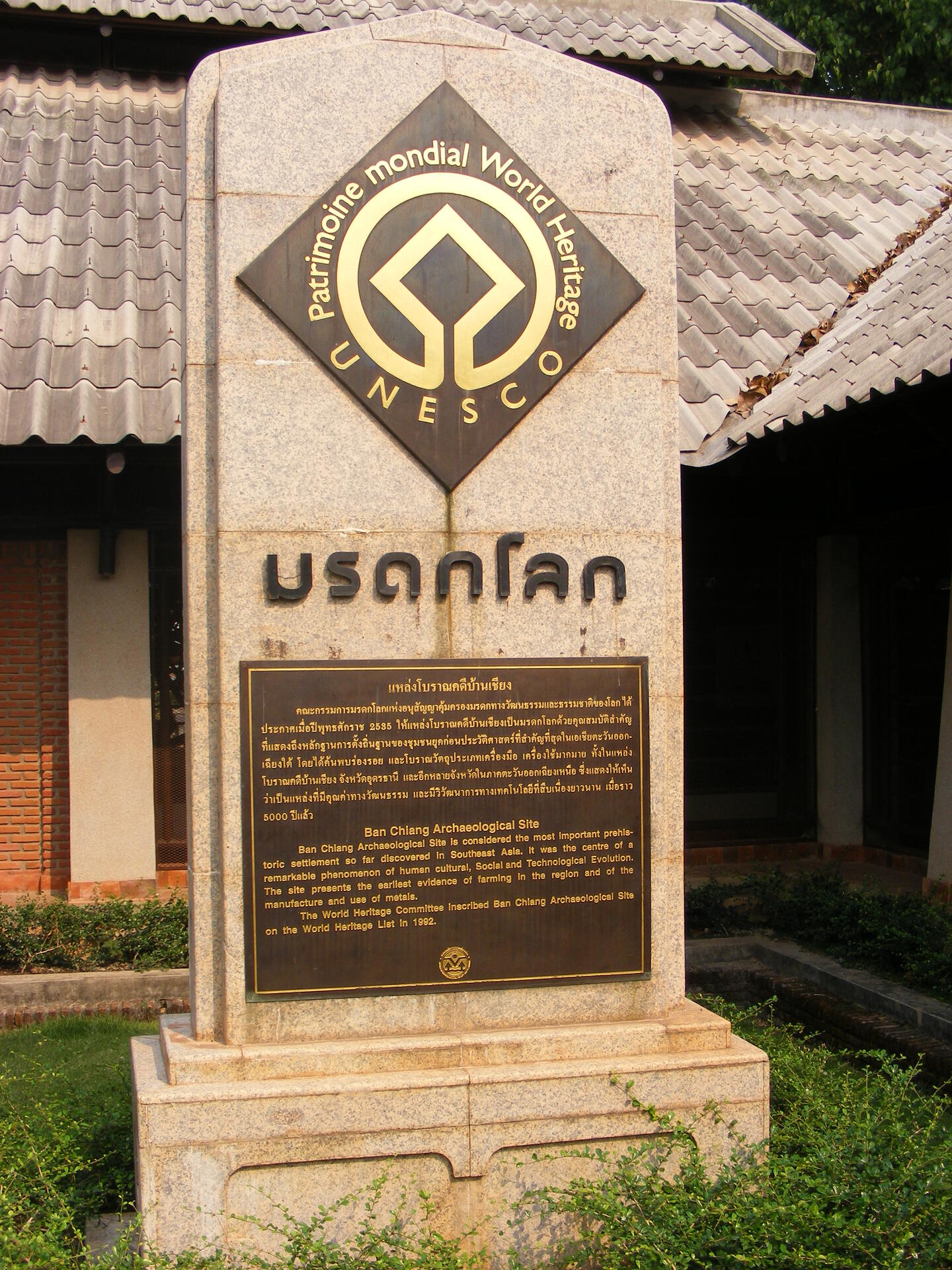
Ban Chiang is considered the most important prehistoric settlement so far discovered in South-East Asia. It marks an important stage in human cultural, social and technological evolution. The site presents the earliest evidence of farming in the region and of the manufacture and use of metals.
UNESCO Justification of the World Heritage Site
Criterion iii: Ban Chiang Archaeological Site was the centre of a remarkable phenomenon of human cultural, social, and technological evolution which occurred independently in this area of Southeast Asia and began at Ban Chiang around 1500 B.C. and spread widely over the whole region.
Encyclopedia Record: Ban Chiang
Ban Chiang is an archaeological site in Nong Han district, Udon Thani province, Thailand. It has been a UNESCO World Heritage Site since 1992. Discovered in 1966, the site first attracted interest due to its ancient red-painted pottery. More recently, it gained international attention in 2008 when the United States Department of Justice, following an undercover investigation begun in 2003, raided several museums for their role in trafficking in Ban Chiang antiquities.Additional Site Details
Area: 30 hectares
Number of Components: 1
Coordinates: 17.407772 , 103.237589
World Heritage Research
Discover scientific research and academic studies that deepen our understanding of Ban Chiang Archaeological Site from its history and significance to its conservation, management, and contemporary challenges.
-
Advancing the generation and integration of traditional motifs through AI-based techniques
AI-based techniques show promise for preserving and innovating traditional Thai motifs, Ban Chiang and Sangkhalok. Image fusion effectively generated Ban Chiang motifs with minimal computational resources, while Low-Rank Adaptation (LoRA) fine-tuning enhanced Sangkhalok motifs by introducing modern features. The study found that blending abstract Ban Chiang qualities with representational Sangkhalok styles improved motif integration and creativity, although challenges like color accuracy control were noted. This research highlights AI's potential as a tool for cultural preservation and artistic innovation, emphasizing the need for further refinement in achieving precise blending of artistic forms.
Siriborvornratanakul, T., & Rittikulsittichai, S. (2026). Advancing the generation and integration of traditional motifs through AI-based techniques. Discover Artificial Intelligence, 6(1). https://doi.org/10.1007/s44163-025-00642-w
View Publication Record | Read Publication -
Community Capitals Framework for Sustainable Development: A Qualitative Study of Creative Tourism in Ban Chiang World Heritage Site
Creative tourism strategies can drive sustainable socio-economic growth and cultural preservation at UNESCO World Heritage Sites, as demonstrated by Ban Chiang's community-based approach. This study reveals that integrating creative tourism with the Community Capitals Framework (CCF) enhances environmental conservation, economic empowerment, and social well-being through multilateral stakeholder collaboration. Using qualitative methods—including in-depth interviews, observations, and document analysis—the research highlights Ban Chiang’s successful model for heritage revitalization, offering practical insights for policymakers and practitioners to leverage creative tourism for positive transformation in similar destinations.
Suriyankietkaew, S., Krittayaruangroj, K., Thinthan, S., & Lumlongrut, S. (2025). Community Capitals Framework for Sustainable Development: A Qualitative Study of Creative Tourism in Ban Chiang World Heritage Site. Sustainability, 17(8), 3311. https://doi.org/10.3390/su17083311
View Publication Record | Read Publication -
Review of Ban Chiang, Northeast Thailand, Volume 2 (2A, 2B, 2C, 2D)
Ban Chiang, a UNESCO World Heritage Site in Northeast Thailand, is renowned for its extensive metal artifacts dating back over 3,000 years. A comprehensive review of four volumes (2A–2D) published between 2018 and 2021 reveals the site's sophisticated metallurgical traditions, including advanced techniques for bronze casting, iron smelting, and decorative metalwork. These volumes analyze metal remains from Ban Chiang and surrounding areas, providing insights into ancient trade networks, technological innovations, and cultural exchanges in Southeast Asia. The research employs a multidisciplinary approach, combining archaeological analysis with metallurgical studies to contextualize the artifacts within regional and temporal frameworks.
Lertchanrit, T. (2024). Review of Ban Chiang, Northeast Thailand, Volume 2 (2A, 2B, 2C, 2D). SPAFA Journal, 8, r1–r4. https://doi.org/10.26721/spafajournal.m976wn3898
View Publication Record | Read Publication -
Cartography for Cultural Tourism Attractions Around Ban Chiang Archaeological Site, Udon Thani, Thailand
A comprehensive mapping of cultural tourism attractions around the Ban Chiang Archaeological Site, Thailand, reveals four distinct categories: museums, religious sites, accommodations (homestays), and restaurants/street food. These attractions are primarily concentrated in communities surrounding the site, offering valuable insights for spatial planning and tourism development. The study employed field surveys, GPS coordinate recording, and Geographic Information Systems (GIS) to analyze the distribution and potential of these cultural assets. This cartographic approach not only aids local residents in planning and improving tourism infrastructure but also fosters community pride, economic growth, and sustainable tourism practices.
(Ed.). (2024). Cartography for Cultural Tourism Attractions Around Ban Chiang Archaeological Site, Udon Thani, Thailand. International Journal of Geoinformatics. https://doi.org/10.52939/ijg.v20i10.3631
View Publication Record | Read Publication -
Artefacts from Ban Chiang, Thailand: Pre-metal Age cord-marked pottery
A Pre-metal Age ceramic shard from Ban Chiang, Thailand, dating to 1659 ± 29 BC (3609 ± 29 BP), reveals higher firing temperatures and distinct mineralogical features compared to Bronze Age pottery. Analysis using electron microprobe, X-ray powder diffraction, FTIR spectroscopy, optical microscopy, and X-ray tomographic microscopy (XTM) showed that the Pre-metal Age sample (PSN2-S10E13) contains more quartz and mullite signals, indicating higher firing temperatures, while also exhibiting a higher pore volume percentage than the Bronze Age sample (5412-S6E15). Phyllosilicate signals were present in both samples, with quartz E-modes dominating their FTIR spectra. Optical thin sections revealed voids around micro-particles in the older shard. This study provides new insights into the technological advancements and material use during Thailand's Pre-metal Age.
Tanthanuch, W., Tancharakorn, S., Rojviriya, C., & Bismayer, U. (2023). Artefacts from Ban Chiang, Thailand: Pre-metal Age cord-marked pottery. Zeitschrift Für Kristallographie - Crystalline Materials, 238(7-8), 233–241. https://doi.org/10.1515/zkri-2023-0015
View Publication Record | Read Publication -
The Excavated Past: Grounded Evidence
Recent archaeological research at Ban Chiang sheds new light on the site's chronology and cultural significance from the second millennium BCE to 200 CE. The study, published in 'Designs on Pots,' integrates findings from metal and ceramic artifacts with burial analysis to refine regional dating and interpret regional interactions. Notably, it addresses debates around Ban Chiang's chronological placement relative to other Khorat plateau sites, providing a more precise framework for understanding its development. Speculations about infant and young child burials also offer insights into societal practices during this period.
Esterik, P. V. (2025). The Excavated Past: Grounded Evidence. Designs on Pots, 33–66. https://doi.org/10.5117/9789463728461_ch02
View Publication Record | Read Publication -
The Personal Past: Designs on Pots
This chapter delves into the intersection of personal narrative and archaeological research, focusing on painted pottery from Ban Chiang, Thailand. It highlights how individual experiences and chance encounters, such as tracing looted pottery across public and private collections, shape research agendas in anthropology. The study also addresses ethical considerations and advocacy in the field, while employing a blend of methodological rigor and theoretical reflection to explore the broader implications of archaeological findings.
Esterik, P. V. (2025). The Personal Past: Designs on Pots. Designs on Pots, 15–32. https://doi.org/10.5117/9789463728461_ch01
View Publication Record | Read Publication