
World Heritage Identification Number: 951
World Heritage since: 2003
Category: Natural Heritage
WHE Type: Protected Areas & National Parks
Transboundary Heritage: Yes
Endangered Heritage: No
Country: Lao People's Democratic Republic, Viet Nam
Continent: Asia
UNESCO World Region: Asia and the Pacific
Map
Transboundary Treasures: Exploring Phong Nha-Ke Bang National Park and Hin Nam No National Park
The Phong Nha-Ke Bang National Park and Hin Nam No National Park, a transboundary extension of Viet Nam's Phong Nha-Ke Bang National Park, offer a captivating blend of natural beauty, biodiversity, and cultural heritage. Inscribed by UNESCO in 2003, these two national parks lie within the Indo-Burma biodiversity hotspot, a region teeming with over 1,500 plant and 536 vertebrate species.
More to come…UNESCO Description of the World Heritage Site
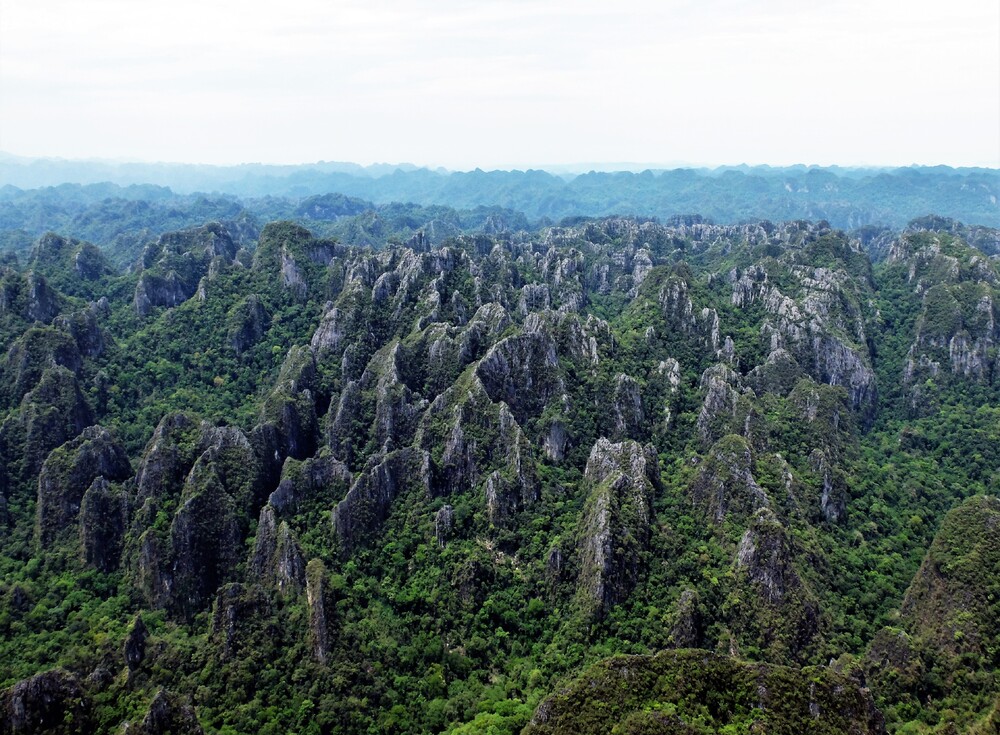
The Phong Nha-Ke Bang National Park and Hin Nam No National Park is a transboundary extension of Viet Nam’s Phong Nha-Ke Bang National Park, inscribed in 2003. Located in the Annamite mountains, it features rugged karst landscapes, deep caves—including the vast Xe Bang Fai Cave—as well as rich biodiversity and associated local traditional use. The park lies within the Indo-Burma biodiversity hotspot, home to over 1,500 plant and 536 vertebrate species, including many endemics and globally threatened species like the Red-Shanked Douc Langur and Sunda Pangolin. Unique species such as the Lao Rock Rat and Giant Huntsman Spider also inhabit the area. Its diverse ecosystems span lowland forests to high-altitude karst habitats.
UNESCO Justification of the World Heritage Site
Criterion (viii): The transboundary property is among the largest intact humid tropical karst systems globally. The distinctive topography and diversity of the karst landscape is formed from the complex interbedding of limestone karst with shales, sandstone and granite. On the surface, a diversity of polygonal karst features has been recorded nowhere else, at the time of extension. Underground, an extraordinary diversity of caves (including dry, terraced, dendritic and intersecting caves) provide evidence of past geological processes, from ancient, abandoned river passages or changes in river routes, to the deposition and later re-solution of giant speleothems. Of particular significance, are the Son Doong and Xe Bang Fai caves which contain the world’s largest documented cave passage in terms of diameter and continuity and, largest active river cave passage and single cave gour pool (water formed by calcite deposits) respectively.
Criterion (ix): The property protects globally significant ecosystems within the Northern Annamites Rainforests terrestrial ecoregion, Northern Annam and Southern Annam freshwater ecoregions and Annamite Range Moist Forests priority ecoregions. The complexity and relative intactness of the limestone landscape has led to the creation of multiple ecological niches and provided the opportunity for eco-evolutionary and speciation processes to occur at the landscape level. As a result, the Phong Nha-Ke Bang National Park and Hin Nam No National Park property is home to various highly-specialised and endemic species of flora and fauna both aboveground (such as a number of orchid and begonia species) and below-ground (with some invertebrate and fish species restricted to single cave systems).
Criterion (x): A rich terrestrial, freshwater and subterranean biodiversity can be found within the transboundary property, and reported species numbers, at the time of inscription and of the extension, are likely to be a significant under-representation of the actual species diversity. The over 2,700 species of vascular plants and 800 vertebrate species recorded in Phong Nha-Ke Bang National Park include 237 globally threatened species at the time of inscription and 400 species endemic to the central Lao People’s Democratic Republic and/or Viet Nam. Over 1,500 species of vascular plants (from 755 different genera) and 536 vertebrate species have been recorded in Hin Nam No National Park, including many globally threatened and endemic species, including the Giant Huntsman Spider, the largest spider by leg span globally and endemic to the Lao Khammouane Province. The species richness of the property is likely to exceed the individual richness of the two national parks respectively due to topographical and niche differences. Importantly, the property hosts 10-11 species of primates, four of which are endemic to the Annamite Mountain range. These include the largest remaining population of Southern White-cheeked Gibbon and the endemic Black Langur.
Encyclopedia Record: Hin Namno National Park
Hin Namno National Park is in Boualapha District, Khammouane Province, Laos. The park borders Phong Nha-Kẻ Bàng National Park of Vietnam to the east and Nakai-Nam Theun National Park of Laos to the north. Hin Namno National Park was created by prime ministerial decree in January 2020. It is managed by the Ministry of Agriculture and Forestry (MAF).Additional Site Details
Area: 217,447 hectares
Number of Components: 2
(ix) — Outstanding example representing ecological and biological processes
(x) — Contains most important habitats for biodiversity
Coordinates: 17.4275555556 , 105.9052777778
IUCN World Heritage Outlook
The 2025 Conservation Outlook on Phong Nha-Ke Bang National Park reports the following assessment:
Source: International Union for Conservation of Nature (IUCN) · View assessment
Image
© GIZ ProFEB/ Paul Williams. Used with permission.
World Heritage Research
Discover scientific research and academic studies that deepen our understanding of Phong Nha-Ke Bang National Park and Hin Nam No National Park from its history and significance to its conservation, management, and contemporary challenges.
-
Paleokarst in Phong Nha - Ke Bang - Hin Nam No and its Geomorphological and Geological Values
A groundbreaking discovery of paleokarst landforms in Phong Nha-Ke Bang National Park (Vietnam) and Hin Nam No National Park (Laos) reveals karstification dating back to the Triassic, predating previous estimates by millions of years. This study, confirmed through field surveys and thin-section analyses, identifies buried karst surfaces and filled fissures/caves developed on Devonian to Carboniferous-Permian limestones, providing critical evidence for karst evolution from the Triassic to Middle Jurassic. The findings suggest a new direction for karst research in Vietnam and propose that these paleokarst sites could represent significant Outstanding Universal Value (OUV) for the combined PNKB HNN region.
Tan, M. T., Thi Minh Nguyet, V., Van Tha, H., Van Thom, B., The Phuc, L., & Thi Tuat, L. (2024). Paleokarst in Phong Nha - Ke Bang - Hin Nam No and its Geomorphological and Geological Values. VNU Journal of Science: Earth and Environmental Sciences. https://doi.org/10.25073/2588-1094/vnuees.5065
View Publication Record | Read Publication -
The first record of living “Fossil” species (Laonestes aenigmanus) in Phong Nha - Ke Bang, Quang Binh province, Vietnam
Researchers confirm the presence of Laonestes aenigmamus, a living 'fossil' species thought extinct since the Miocene, in Phong Nha-Ke Bang National Park, Vietnam. This discovery extends its known range from Hin Nam No National Biodiversity Conservation Area (Lao PDR) to central Vietnam, marking it as the sole surviving member of an ancient rodent family. The study identified four specimens through morphological and skull analysis, proposing the Vietnamese name 'Truong son Rat' (Annamite Rat). Threats include hunting and forest destruction, with urgent conservation action recommended due to its limited distribution and ecological significance.
Dang, N. X., Nghia, N. X., Ha, N. M., Minh, L. D., Luong, N. D., & Tri, D. H. (2012). The first record of living “Fossil” species (Laonestes aenigmanus) in Phong Nha - Ke Bang, Quang Binh province, Vietnam. Tap Chi Sinh Hoc, 34(1). https://doi.org/10.15625/0866-7160/v34n1.668
View Publication Record | Read Publication