World Heritage Identification Number: 678
World Heritage since: 1993
Category: Cultural Heritage
WHE Type: Buildings & Architectural Ensembles
Transboundary Heritage: No
Endangered Heritage: No
Country: 🇻🇳 Viet Nam
Continent: Asia
UNESCO World Region: Asia and the Pacific
Map
Complex of Hué Monuments: A Cultural and Religious Centre of Unified Viet Nam
The Complex of Hué Monuments, inscribed as a UNESCO World Heritage Site in 1993, offers a captivating glimpse into the rich history and culture of Vietnam. Situated along the picturesque Perfume River, this architectural ensemble serves as a testament to the grandeur and significance of Hué as the political, cultural, and religious capital of the Nguyen Dynasty from 1802 to 1945.
More to come…UNESCO Description of the World Heritage Site
Established as the capital of unified Viet Nam in 1802, Hué was not only the political but also the cultural and religious centre under the Nguyen dynasty until 1945. The Perfume River winds its way through the Capital City, the Imperial City, the Forbidden Purple City and the Inner City, giving this unique feudal capital a setting of great natural beauty.
UNESCO Justification of the World Heritage Site
Criterion (iv): The Complex of Hue Monuments is an outstanding example of an eastern feudal capital.
Encyclopedia Record: Imperial City of Huế
The Imperial City or Imperial Palace also known as Đại Nội (大內), is a royal enclosure within the walled city of Huế, the former imperial capital of Vietnam during the Nguyễn dynasty. It contains the palaces that housed the imperial family, as well as shrines, gardens, and offices for mandarins. Constructed in 1804 under Emperor Gia Long as a new capital and later re-modelled and enlarged to its current scale in 1833, it mostly served as a ceremonial function and imperial residence during the French colonial period. After the end of the monarchy in 1945, it suffered heavy damage and neglect during the Indochina Wars through the 1980s. The Imperial City was designated as a UNESCO World Heritage Site in 1993 as part of the Complex of Huế Monuments and is undergoing restoration.Additional Site Details
Area: 315.47 hectares
Number of Components: 14
Coordinates: 16.46944 , 107.57778
Image
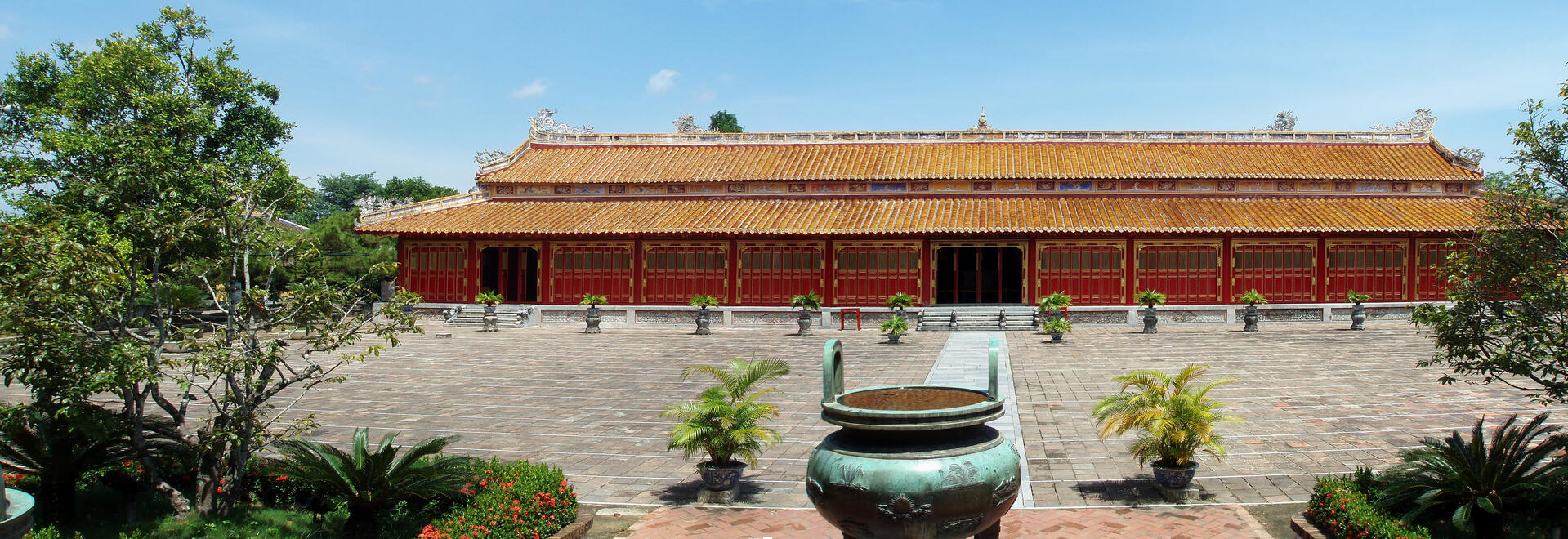
© https://www.flickr.com/photos/sixty4coupe/, CC BY-SA 2.0 Resized from original. (This derivative is under the same CC BY-SA license.)
World Heritage Research
Discover scientific research and academic studies that deepen our understanding of Complex of Hué Monuments from its history and significance to its conservation, management, and contemporary challenges.
-
Building typologies and architectural pattern transformations of the Hue Imperial Architecture, Vietnam
A systematic analysis of Hue Imperial Architecture reveals a modular design logic that integrates floor-plan configuration, truss type, and façade form to generate cohesive building categories and pattern variations. This approach ensured structural stability, functional flexibility, and visual harmony while enabling efficient large-scale construction. The study, leveraging classical Chinese sources, Nguyen-dynasty drawings, and extensive fieldwork across key sites like the citadel and mausoleums, identifies five major building types and 22 architectural patterns. These findings highlight the advanced nature of premodern craft techniques, offering practical insights for heritage conservation and contemporary architectural practice.
Le, V. A. (2026). Building typologies and architectural pattern transformations of the Hue Imperial Architecture, Vietnam. Journal of Asian Architecture and Building Engineering, 1–32. https://doi.org/10.1080/13467581.2026.2675165
View Publication Record | Read Publication -
Linking Climatic Resources and Green Tourism Growth Under Climate Change Adaptation Contexts: Evidence from Hue City
A study on Hue City's UNESCO World Heritage Sites reveals that all five climatic factors—wind, rainfall, thermal conditions, extreme weather events, and humidity—positively and significantly influence green tourism growth. These findings underscore the importance of integrating climate information, seasonal planning, and adaptive strategies into sustainable tourism governance to mitigate climate change impacts. The research analyzed 174 tourist surveys collected from Bach Ma, Hue Imperial Citadel, and Chuon Lagoon–Thuan An over a year, using SPSS for statistical analysis, with the regression model explaining 35.3% of variance in green tourism growth.
Son, N. H., Long, N. K., Hang, H. T. D., & Quan, N. T. (2026). Linking Climatic Resources and Green Tourism Growth Under Climate Change Adaptation Contexts: Evidence from Hue City. Prace I Studia Geograficzne, 71(2), 49–68. https://doi.org/10.48128/pisg-2026-71.2-04
View Publication Record | Read Publication -
Heritage-led gentrification in Southeast Asian historic cities: A comparative analysis of Chiang Mai Old City and Hue Citadel
Heritage-led gentrification in Southeast Asian historic cities follows distinct trajectories shaped by governance regimes, revealing a paradox where preservation often erodes everyday cultural practices. A comparative analysis of Chiang Mai Old City and Hue Citadel demonstrates that market-driven tourism economies in Chiang Mai lead to incremental commercial conversion and cultural displacement, while state-led conservation policies in Hue result in large-scale relocation to create monumental landscapes. Despite these differences, both cases show how governance regimes influence heritage transformation beyond classical gentrification models. The study proposes a typology distinguishing between market-mediated living-heritage gentrification and state-led monumental-heritage gentrification, contributing to debates on Global South urbanism.
Raksawin, K., & Suthasupa, S. (2026). Heritage-led gentrification in Southeast Asian historic cities: A comparative analysis of Chiang Mai Old City and Hue Citadel. Humanities, Arts and Social Sciences Studies. https://doi.org/10.69598/hasss.26.3.280306
View Publication Record | Read Publication -
Thai Hoa palace’s decorative sculpture art in Hue Imperial city
Thai Hoa Palace, constructed in 1805 during the Nguyen Dynasty, stands out for its distinctive 'double roof, duplex house' architectural style and intricate decorative sculpture art. This structure, a centerpiece of Hue Imperial City, blends traditional Vietnamese decorative elements with modern fine arts, creating a unique aesthetic. The palace's stone sculptures, enamel, and porcelain inlays reflect exceptional worldwide artistic value. Built by craftspeople from across Vietnam, Thai Hoa Palace serves as a testament to the ingenuity and craftsmanship of its era. Currently, it is part of Hue's old capital remains, preserving its historical and cultural significance.
Tran, N. T., & Pham, L. N. (2025). Thai Hoa palace’s decorative sculpture art in Hue Imperial city. Edelweiss Applied Science and Technology, 9(4), 1466–1480. https://doi.org/10.55214/25768484.v9i4.6321
View Publication Record | Read Publication -
The Cultural Significance of the Complex of Hue Monuments: A World Heritage Gem
A new conceptual framework bridges conservation, inheritance, and utilization of UNESCO World Heritage Sites, offering a clearer roadmap for recognizing cultural heritage value. The study focuses on the Complex of Hue Monuments in Vietnam, the first such site designated in 1993, which suffered severe damage during the Indochina War (1947-1975). Since then, international-led conservation efforts have restored its outstanding universal significance. The research proposes an intermediary notion to guide future heritage management, emphasizing not only material preservation but also safeguarding intangible elements and potential revitalization for societal benefit. This approach is critical for sites like the lost Can Chanh Dien Palace, where restoration is deemed both feasible and imperative.
Le, A. V. (2025). The Cultural Significance of the Complex of Hue Monuments: A World Heritage Gem. Engineering Research: Perspectives on Recent Advances Vol. 7, 134–149. https://doi.org/10.9734/bpi/erpra/v7/5555
View Publication Record | Read Publication -
Treatment of urban wastewater discharged into Tinh Tam lake using hydrogen peroxide-supplemented aerated biofilter system
A hydrogen peroxide-supplemented aerated biofilter system (ABF-H₂O₂) demonstrates significant potential for treating urban wastewater in heritage sites, achieving high removal efficiencies of 69–81% for chemical oxygen demand and 88–94% for biochemical oxygen demand. The study, conducted on a laboratory-scale reactor over 45 days, also showed that ammonium removal efficiency varied with organic loading rates, peaking at 87% under low-loading conditions but dropping to 27% at higher loads. H₂O₂ supplementation enhanced dissolved oxygen levels, supporting microbial activity and treatment stability. Microscopic analysis revealed a diverse and well-adapted microbial community, including protozoa and metazoa, suggesting the ABF-H₂O₂ approach could serve as a sustainable, decentralized solution for wastewater management in ecologically and historically significant areas like Tinh Tam Lake within Vietnam's Imperial Citadel of Hue.
Dang, T. T. L., & Van Tuan, L. (2025). Treatment of urban wastewater discharged into Tinh Tam lake using hydrogen peroxide-supplemented aerated biofilter system. Hue University Journal of Science: Natural Science, 134(1B), 61–71. https://doi.org/10.26459/hueunijns.v134i1b.7824
View Publication Record | Read Publication -
The Architecture of Imperial Mausoleums: Case Studies from the Early Nguyen Dynasty (1802-1848), Vietnam
Imperial mausoleums of the early Nguyen Dynasty (1802–1848) in Hue, Vietnam, reveal a structured architectural symbolism where three key components—Tomb area (A), Worship Temples area (B), and Stele Hall area (C)—embody kingship, theocracy, and civil rights. Unlike previous studies that focused on historical or cultural contexts, this research deciphers their spatial and compositional layouts through document analysis, site surveys, and architectural inventory, identifying distinct axial arrangements for Emperors Gia Long, Minh Mang, and Thieu Tri's mausoleums. The findings clarify how these structures convey messages of memory, soul, and body, bridging gaps in understanding the dynasty’s funerary architecture.
Ngoc Vo, H., Vinh Le, A., & Chaturawong, C. (2025). The Architecture of Imperial Mausoleums: Case Studies from the Early Nguyen Dynasty (1802-1848), Vietnam. NAJUA: History of Architecture and Thai Architecture, 37–90. https://doi.org/10.69598/najuahata.22.1.276595
View Publication Record | Read Publication