
World Heritage Identification Number: 1224
World Heritage since: 2008
Category: Cultural Heritage
WHE Type: Archaeological Sites
Transboundary Heritage: No
Endangered Heritage: No
Country: 🇰🇭 Cambodia
Continent: Asia
UNESCO World Region: Asia and the Pacific
Map
Temple of Preah Vihear: A Remarkable Khmer Masterpiece
The Temple of Preah Vihear, located on the edge of a plateau that overlooks the plains of Cambodia, stands as a testament to the architectural prowess and religious fervor of the Khmer Empire. Inscribed as a UNESCO World Heritage Site in 2008, this temple dedicated to the Hindu deity Shiva offers a unique blend of architectural excellence, intricate stone carvings, and harmonious integration with the natural environment.
More to come…UNESCO Description of the World Heritage Site
Situated on the edge of a plateau that dominates the plain of Cambodia, the Temple of Preah Vihear is dedicated to Shiva. The Temple is composed of a series of sanctuaries linked by a system of pavements and staircases over an 800 metre long axis and dates back to the first half of the 11th century AD. Nevertheless, its complex history can be traced to the 9th century, when the hermitage was founded. This site is particularly well preserved, mainly due to its remote location. The site is exceptional for the quality of its architecture, which is adapted to the natural environment and the religious function of the temple, as well as for the exceptional quality of its carved stone ornamentation.
UNESCO Justification of the World Heritage Site
Criterion (i): Preah Vihear is an outstanding masterpiece of Khmer architecture. It is very ‘pure’ both in plan and in the detail of its decoration.
Encyclopedia Record: Preah Vihear
Preah Vihear is an ancient Hindu temple built by the Khmer Empire on top of a 525-metre (1,722 ft) cliff in the Dângrêk Mountains, in Cambodia.Additional Site Details
Area: 154.7 hectares
Number of Components: 1
Coordinates: 14.3883333333 , 104.6838888889
Image
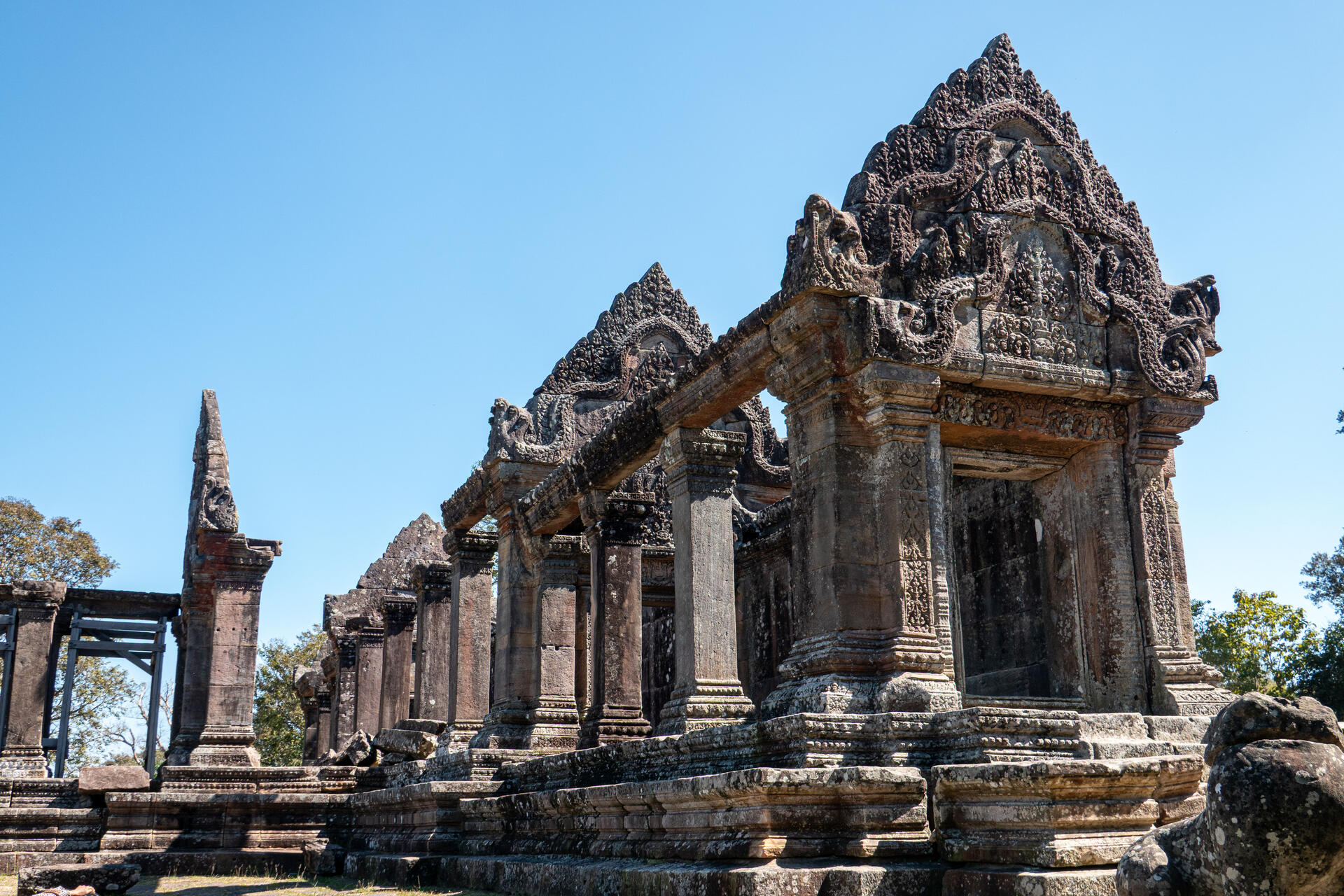
© PsamatheM, CC BY-SA 4.0 Resized from original. (This derivative is under the same CC BY-SA license.)

World Heritage Research
Discover scientific research and academic studies that deepen our understanding of Temple of Preah Vihear from its history and significance to its conservation, management, and contemporary challenges.
-
The 2013 Judgment of the ICJ in theTemple of Preah VihearCase and the Protection of World Cultural Heritage Sites in Wartime
A critical analysis of the International Court of Justice's (ICJ) 2013 judgment in the Temple of Preah Vihear case reveals its narrow interpretation of states' obligations under the World Heritage Convention, particularly concerning the protection of cultural heritage during wartime. While the ICJ emphasized cooperation between Cambodia and Thailand for safeguarding the temple—a site of 'outstanding universal value'—it overlooked the applicability of wartime heritage protection regimes. This study dissects the Court's jurisprudence, highlighting its implications for international cultural heritage law and broader legal frameworks. By contextualizing the judgment within evolving global standards, it underscores gaps in the ICJ's approach that could compromise the preservation of vulnerable sites during conflicts.
CHECHI, A. (2015). The 2013 Judgment of the ICJ in theTemple of Preah VihearCase and the Protection of World Cultural Heritage Sites in Wartime. Asian Journal of International Law, 6(2), 353–378. https://doi.org/10.1017/s2044251315000156
View Publication Record | Read Publication -
Institutional Design and Its Constraints: Explaining ASEAN's Role in the Temple of Preah Vihear Dispute
ASEAN played a crucial but limited role in managing the Temple of Preah Vihear dispute, successfully preventing escalation through negotiation while facing institutional constraints that hindered deeper conflict resolution. The study highlights ASEAN's effectiveness in crisis mediation, particularly during its renewed efforts to address the conflict, yet underscores structural weaknesses in its institutional design that restrict its ability to settle disputes and maintain long-term peace. By analyzing ASEAN's responses—from initial inaction to later intervention—the research identifies key challenges, including institutional rigidities, and proposes reforms to enhance regional security governance.
PHAN, H. D. (2014). Institutional Design and Its Constraints: Explaining ASEAN’s Role in the Temple of Preah Vihear Dispute. Asian Journal of International Law, 5(1), 7–15. https://doi.org/10.1017/s2044251314000113
View Publication Record | Read Publication -
Request for Interpretation of the Judgment of 15 June 1962 in the Case Concerning the Temple of Preah Vihear (Cambodia v. Thailand)
A legal analysis clarifies the implications of the 1962 International Court of Justice (ICJ) judgment on sovereignty over the Temple of Preah Vihear, a UNESCO World Heritage Site straddling the Cambodia-Thailand border. The study argues that the ICJ's ruling, which awarded the temple to Cambodia, remains legally binding and should guide current disputes over its administration. It examines the judgment's historical context, legal reasoning, and subsequent diplomatic efforts, emphasizing the need for compliance with international law to resolve territorial conflicts at heritage sites. This contribution is significant in advancing the understanding of how legal precedents can address contemporary geopolitical tensions involving cultural heritage.
Ciorciari, J. D. (2014). Request for Interpretation of the Judgment of 15 June 1962 in the Case Concerning the Temple of Preah Vihear (Cambodia v. Thailand). American Journal of International Law, 108(2), 288–295. https://doi.org/10.5305/amerjintelaw.108.2.0288
View Publication Record | Read Publication -
The Ghosts of the Temple of Preah Vihear/Phra Viharn in the 2013 Judgment
A re-examination of the International Court of Justice's (ICJ) 2013 Decision on the Temple of Preah Vihear reveals that it stands in stark contrast to its controversial 1962 predecessor. Unlike the unanimous 2013 ruling, which affirmed Cambodia's sovereignty over the temple, the 1962 Judgment was marred by evidential weaknesses—reliance on an inaccurate sketch map and a single photograph of a meeting between deceased Thai and French officials to deduce Thai acquiescence. This analysis underscores how the ICJ's 2013 Decision consciously reinforced a judgment that, upon closer inspection, lacked robust evidence, thereby addressing historical controversies surrounding the temple's territorial dispute.
KATTAN, V. (2014). The Ghosts of the Temple of Preah Vihear/Phra Viharn in the 2013 Judgment. Asian Journal of International Law, 5(1), 16–25. https://doi.org/10.1017/s2044251314000149
View Publication Record | Read Publication -
The International Court of Justice in Asia: Interpreting the Temple of Preah Vihear Case
A 2013 International Court of Justice (ICJ) decision on the Temple of Preah Vihear case between Cambodia and Thailand reveals that Asian states prefer bilateral dispute resolution, particularly for smaller conflicts involving indivisible assets like temples or islands. This preference underscores a modest but significant role for judicial institutions in Asia, where only eight states have accepted the ICJ's compulsory jurisdiction, and nine have appeared before it. The narrowness of the decision highlights both the limited scope of judicial intervention in regional disputes and the potential for the ICJ to mediate intractable issues that cannot be resolved through bilateral means.
CHESTERMAN, S. (2014). The International Court of Justice in Asia: Interpreting the Temple of Preah Vihear Case. Asian Journal of International Law, 5(1), 1–6. https://doi.org/10.1017/s204425131400006x
View Publication Record | Read Publication -
Interpreting Reasons: The Interpretation of the 1962 Temple of Preah Vihear Judgment
A landmark 2013 interpretation by the International Court of Justice (ICJ) on its 1962 judgment regarding the Temple of Preah Vihear revealed a shift toward greater flexibility in revisiting judicial reasoning under Article 60 of the ICJ Statute. While the Court reaffirmed its strict approach to interpreting previous judgments, it also disavowed a narrow definition of 'inseparable' reasons from operative clauses and acknowledged that 'essential' elements could be subject to reinterpretation. This suggests potential future flexibility in how the Court handles such requests, balancing stability in international relations with adaptability. The study argues that intermediate conclusions from prior judgments should remain open to interpretation under Article 60, challenging traditional legal boundaries.
Peat, D. (2013). Interpreting Reasons: The Interpretation of the 1962 Temple of Preah Vihear Judgment. Hague Yearbook of International Law / Annuaire de La Haye de Droit International, Vol. 26 (2013), 201–215. https://doi.org/10.1163/9789004287365_009
View Publication Record | Read Publication -
State and Uncivil Society in Thailand at the Temple of Preah Vihear
The dispute over the Temple of Preah Vihear, which began in 2008, initially fostered cooperation between Thailand and Cambodia, transforming a territorial conflict into a symbol of regional friendship. However, ultra-nationalist movements, supported by civic groups and institutions, derailed this progress, turning the temple into a source of animosity between the two nations. This study reveals how Thailand's strategic shift toward cultural diplomacy was undermined by domestic political forces, highlighting the complex interplay between state policy and civil society in shaping international relations.
R. Pawakapan, P. (2013). State and Uncivil Society in Thailand at the Temple of Preah Vihear. https://doi.org/10.1355/9789814459914
View Publication Record | Read Publication -
A New Phase of the Temple of Preah Vihear Dispute before the International Court of Justice: Reflections on the Indication of Provisional Measures of 18 July 2011
A significant legal milestone was reached on 18 July 2011, when the International Court of Justice (ICJ) issued provisional measures regarding the Temple of Preah Vihear dispute between Cambodia and Thailand. This decision introduced a demilitarized zone around the temple, aiming to prevent further aggravation of tensions. The study examines the validity and implications of these measures, particularly their role in cases involving the use of force and the plausibility test as a distinct condition for provisional measures. It also explores the Court's power to enforce non-aggravation measures and the legitimacy of the demilitarized zone created by the ICJ.
Tanaka, Y. (2012). A New Phase of the Temple of Preah Vihear Dispute before the International Court of Justice: Reflections on the Indication of Provisional Measures of 18 July 2011. Chinese Journal of International Law, 11(1), 191–226. https://doi.org/10.1093/chinesejil/jmr051
View Publication Record | Read Publication -
The International Court of Justice: Order on the Request for the Indication of Provisional Measures, Request for Interpretation of the Judgment of 15 June 1962 in the Case Concerning the Temple of Preah Vihear (Cambodia v. Thai.)
A landmark legal case involving the UNESCO World Heritage Site, Temple of Preah Vihear, reached a significant milestone with the International Court of Justice's (ICJ) Order on Provisional Measures and Interpretation of its 1962 Judgment. The ICJ addressed Cambodia's request for provisional measures to prevent any actions that might aggravate or extend the dispute over the temple's sovereignty between Cambodia and Thailand. This case, rooted in historical claims and border disputes, underscores the role of international law in preserving cultural heritage sites. The ICJ's decision provides a framework for resolving territorial disputes while safeguarding significant archaeological and cultural landmarks.
Giorgetti, C. (2011). The International Court of Justice: Order on the Request for the Indication of Provisional Measures, Request for Interpretation of the Judgment of 15 June 1962 in the Case Concerning the Temple of Preah Vihear (Cambodia v. Thai.). International Legal Materials, 50(6), 1131–1147. https://doi.org/10.5305/intelegamate.50.6.1131
View Publication Record | Read Publication