World Heritage Identification Number: 590
World Heritage since: 2005
Category: Natural Heritage
WHE Type: Protected Areas & National Parks
Transboundary Heritage: No
Endangered Heritage: No
Country: 🇹🇭 Thailand
Continent: Asia
UNESCO World Region: Asia and the Pacific
Map
A Biodiverse Haven: The Dong Phayayen-Khao Yai Forest Complex
The Dong Phayayen-Khao Yai Forest Complex, a designated UNESCO World Heritage Site since 2005, is a testament to Thailand's commitment to preserving its rich biodiversity. This expansive forest complex stretches over 230 kilometers, encompassing five protected areas within the Dong Phaya Yen Mountains and Sankamphaeng Range. These protected areas include Khao Yai, Thap Lan, Pang Sida, Ta Phraya National Parks, and Dong Yai Wildlife Sanctuary.
More to come…UNESCO Description of the World Heritage Site
The Dong Phayayen-Khao Yai Forest Complex spans 230 km between Ta Phraya National Park on the Cambodian border in the east, and Khao Yai National Park in the west. The site is home to more than 800 species of fauna, including 112 mammal species (among them two species of gibbon), 392 bird species and 200 reptile and amphibian species. It is internationally important for the conservation of globally threatened and endangered mammal, bird and reptile species, among them 19 that are vulnerable, four that are endangered, and one that is critically endangered. The area contains substantial and important tropical forest ecosystems, which can provide a viable habitat for the long-term survival of these species.
UNESCO Justification of the World Heritage Site
Criterion (x): The Dong Phayayen-Khao Yai Forest Complex (DPKY-FC) contains more than 800 fauna species, including 112 species of mammals, 392 species of birds and 200 reptiles and amphibians. The property is internationally important for the conservation of globally threatened and endangered mammal, bird and reptile species that are recognised as being of outstanding universal value. This includes 1 critically endangered, 4 endangered and 19 vulnerable species. The property contains the last substantial area of globally important tropical forest ecosystems of the Thailandian Monsoon Forest biogeographic province in northeast Thailand, which in turn can provide a viable area for long-term survival of endangered, globally important species, including tiger, elephant, leopard cat and banteng. The unique overlap of the range of two species of gibbon, including the vulnerable pileated gibbon, further adds to the global value of the complex. In addition to the resident species the complex plays an important role for the conservation of migratory species, including the endangered Spot-billed Pelican and critically endangered Greater Adjutant.
Encyclopedia Record: Dong Phayayen–Khao Yai Forest Complex
Dong Phayayen–Khao Yai Forest Complex is a UNESCO World Heritage Site in Thailand. It covers the areas of five protected areas in the Dong Phaya Yen Mountains and Sankamphaeng Range, namely Khao Yai, Thap Lan, Pang Sida and Ta Phraya National Parks, and Dong Yai Wildlife Sanctuary. The property was inscribed on the World Heritage list in 2005.Additional Site Details
Area: 615,500 hectares
Number of Components: 5
Coordinates: 14.33 , 102.05
IUCN World Heritage Outlook
The 2025 Conservation Outlook on Dong Phayayen-Khao Yai Forest Complex reports the following assessment:
Source: International Union for Conservation of Nature (IUCN) · View assessment
Image
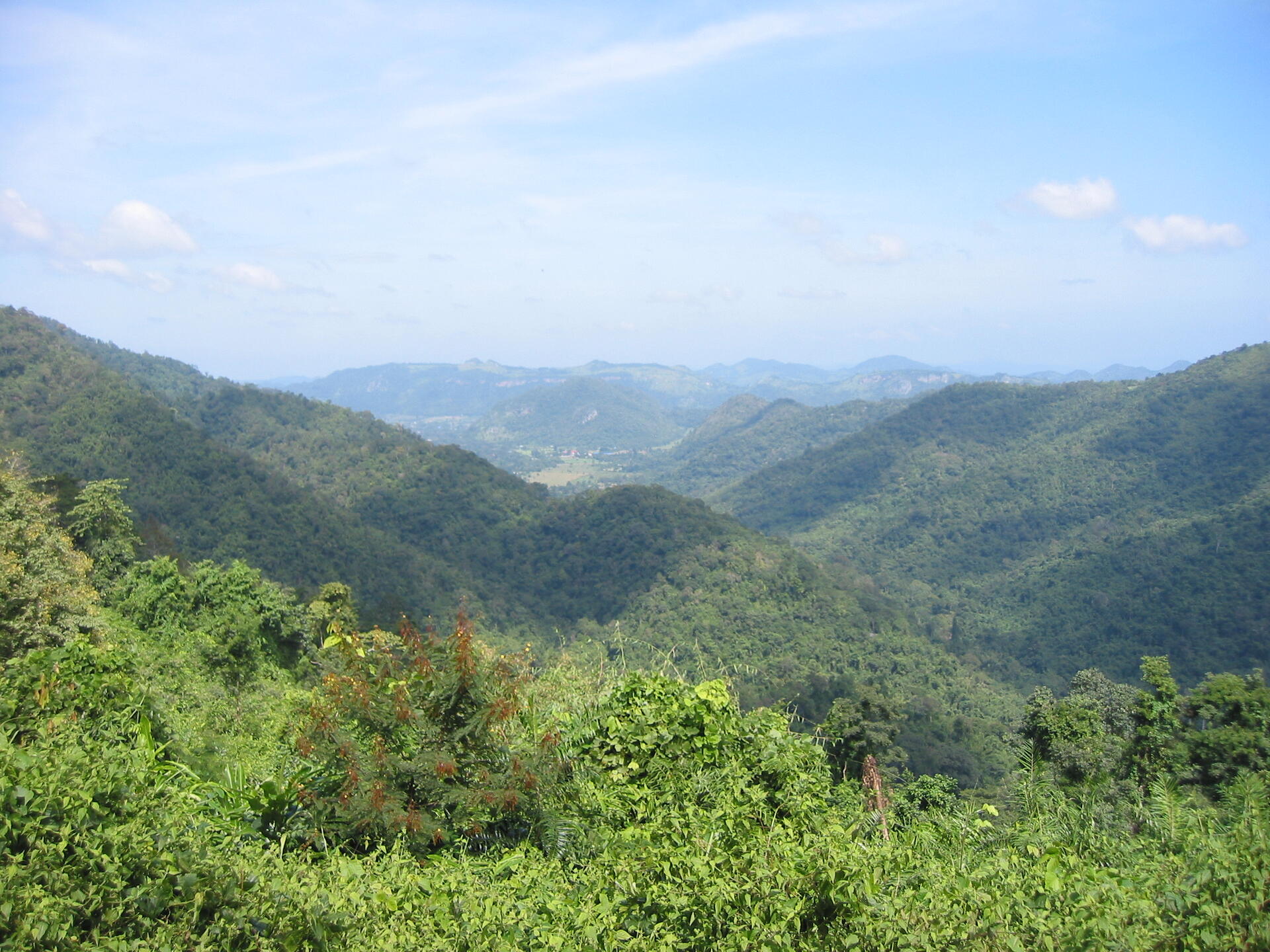
© Jtri at Dutch Wikipedia, CC BY-SA 3.0 Resized from original. (This derivative is under the same CC BY-SA license.)
World Heritage Research
Discover scientific research and academic studies that deepen our understanding of Dong Phayayen-Khao Yai Forest Complex from its history and significance to its conservation, management, and contemporary challenges.
-
Can Southeast Asia's Tigers Break Free? The Connectivity, Constraints, and Recovery of the Region's Remaining Tiger Populations
Southeast Asia's tiger populations face critical challenges but show signs of recovery, particularly through habitat connectivity. A study using spatially-synoptic modeling identified only four contiguous core habitat patches across three landscapes—Dawna-Tenasserim (DTL), Upper Chindwin (UCL), and Dong Phayayen-Khao Yai (DPKY)—as having broad-scale connectivity potential. The DTL landscape emerged as a key site for population spread, while UCL's expansive habitat offers unparalleled potential for expansion, though its status remains uncertain. Conversely, DPKY's isolated configuration poses significant constraints to movement, highlighting the need for targeted conservation efforts. This research provides actionable insights for tiger recovery strategies in a rapidly changing region.
Ash, E., Cushman, S. A., Kaszta, Ż., Redford, T., & Macdonald, D. W. (2025). Can Southeast Asia’s Tigers Break Free? The Connectivity, Constraints, and Recovery of the Region’s Remaining Tiger Populations. Animal Conservation, 29(1), 71–85. Portico. https://doi.org/10.1111/acv.70021
View Publication Record | Read Publication -
Environmental influence on the spatial abundance of tiger prey monitored using camera traps in Thap Lan and Pang Sida National Parks, Thailand
A study in Thailand's Dong Phayayen-Khao Yai Forest Complex reveals critical environmental factors influencing the spatial abundance of five key tiger prey species: gaur, banteng, sambar deer, muntjac, and wild boar. Using advanced camera-trap data analysis models (REST and Royle-Nichols), researchers found that vegetation cover, proximity to human settlements, elevation, and salt licks significantly impact prey densities. Muntjac and wild boar consistently showed higher densities, with estimates ranging from 1.05 to 3.06 individuals per km² depending on the model used. These findings provide a novel framework for predicting animal density, offering crucial insights for conservation strategies aimed at sustaining tiger populations in this UNESCO World Heritage Site.
MEEAMNART, B., PAKPIAN, S., KHONGMUEANG, J., KAMSUDSANG, P., PAANSRI, P., DUENGKAE, P., & SUKSAVATE, W. (2025). Environmental influence on the spatial abundance of tiger prey monitored using camera traps in Thap Lan and Pang Sida National Parks, Thailand. Biodiversitas Journal of Biological Diversity, 26(3). https://doi.org/10.13057/biodiv/d260350
View Publication Record | Read Publication -
Home range and habitat utilization of gaur (Bos gaurus) in transition zone between protected forest and human-dominated landscape, Eastern Thailand
Gaur (Bos gaurus), a vulnerable species, exhibits distinct home range and habitat utilization patterns in the Dong Phayayen-Khao Yai Forest Complex, a UNESCO Natural World Heritage site. This study reveals that gaurs, while primarily dwelling within protected areas like Khao Phaeng Ma Non-hunting Area (KPM-NHA), frequently move between protected forests and surrounding agricultural landscapes. Male gaurs have an average home range of 9.33 km², traveling approximately 6.38 km/day, whereas females cover a smaller range (4.09 km²) with daily movements of about 6.19 km. Gaurs show a preference for habitats with lower canopy density, including dry evergreen forests, grasslands, field crops, rangelands, urban areas, and water bodies. These findings provide critical data for mitigating human-gaur conflicts and enhancing conservation strategies, particularly in managing grasslands within protected areas. The research utilized GPS-collar data collected from 11 adult gaurs over a two-year period, employing autocorrelated kernel density estimation (AKDE) and step-selection functions (SSFs) to analyze their spatial ecology.
Prayoon, U., Suksavate, W., Chaiyes, A., Paansri, P., Siriaroonrat, B., Utara, Y., Tipkantha, W., Baicharoen, S., Jairak, W., Kaewkhunjob, E., Chaisonkhram, C., Maikaew, U., Ieamsaard, G., Sripiboon, S., Winitpornsawan, S., Thunhikorn, S., Wanna, N., Sriracha, S., Sornsa, T., et al. (2024). Home range and habitat utilization of gaur (Bos gaurus) in transition zone between protected forest and human-dominated landscape, Eastern Thailand. Global Ecology and Conservation, 50, e02811. https://doi.org/10.1016/j.gecco.2024.e02811
View Publication Record | Read Publication -
Identifying wildlife corridors to restore population connectivity: An integration approach involving multiple data sources
A novel framework integrating multiple data sources identifies critical wildlife corridors for the Asiatic black bear in the Dong Phayayen-Khao Yai Forest Complex, revealing that 22% of the assessed area is highly suitable under current conditions. The study highlights that improving human attitudes toward corridor construction could expand suitability to 29%, while increased threats like hunting and vehicle collisions could reduce it to just 4%. This approach combines ecological data with landscape characteristics and human dimensions using a Bayesian Belief Network, offering a practical tool for conservation decision-making that can be adapted globally.
Tantipisanuh, N., Phakpian, S., Tangtorwongsakul, P., Vinitpornsawan, S., & Ngoprasert, D. (2024). Identifying wildlife corridors to restore population connectivity: An integration approach involving multiple data sources. Global Ecology and Conservation, 53, e03015. https://doi.org/10.1016/j.gecco.2024.e03015
View Publication Record | Read Publication -
Female-biased introductions produce higher predicted population size and genetic diversity in simulations of a small, isolated tiger (Panthera tigris) population
Female-biased introductions significantly enhance population size and genetic diversity in small, isolated tiger populations. A study simulating the genetic trajectory of tigers in Thailand's Dong Phayayen-Khao Yai Forest Complex found that translocating females consistently improved allelic richness and heterozygosity compared to equal numbers of males. Without intervention, simulations predicted stark declines in genetic diversity—46.5% for allelic richness and 53.5% for heterozygosity. Frequent translocations (four females every generation or every other generation) were necessary to mitigate long-term losses. The research underscores the critical role of sex-biased introductions and frequent gene flow in preserving genetic diversity, offering actionable insights for tiger conservation efforts.
Ash, E., Cushman, S., Kaszta, Ż., Landguth, E., Redford, T., & Macdonald, D. W. (2023). Female-biased introductions produce higher predicted population size and genetic diversity in simulations of a small, isolated tiger (Panthera tigris) population. Scientific Reports, 13(1). https://doi.org/10.1038/s41598-023-36849-z
View Publication Record | Read Publication -
Tigers on the edge: mortality and landscape change dominate individual-based spatially-explicit simulations of a small tiger population
A small tiger population in Thailand's Dong Phayayen-Khao Yai Forest Complex (DPKY) faces high extinction risk due to landscape changes and mortality patterns, according to individual-based spatially-explicit simulations. The study found that even moderate mortality risks could lead to population declines or extinction, with rates shifting dramatically based on spatial patterns—from 46% to 85% under slightly convex and concave forms, respectively. Road expansion and dam construction significantly worsened outcomes, with combined development leading to 96% extinction risk even when habitat restoration was applied. Adjustments in landscape resistance and population density had minimal impact. These findings highlight the critical need for incorporating spatially-explicit mortality risks into conservation models to accurately assess extinction threats.
Ash, E., Cushman, S. A., Redford, T., Macdonald, D. W., & Kaszta, Ż. (2022). Tigers on the edge: mortality and landscape change dominate individual-based spatially-explicit simulations of a small tiger population. Landscape Ecology, 37(12), 3079–3102. https://doi.org/10.1007/s10980-022-01494-w
View Publication Record | Read Publication -
Spatial Modeling of Forage Crops for Tiger Prey Species in the Area Surrounding Highway 304 in the Dong Phayayen-Khao Yai Forest Complex
Spatial modeling reveals critical insights into the habitat preferences of tiger prey species, sambar deer and gaur, in the Dong Phayayen-Khao Yai Forest Complex (DPKY-FC). The study found that sambar deer occurrence is positively linked to grass biomass and distance from disturbances or streams, while gaur presence correlates with higher normalized difference vegetation index (NDVI) but declines with slope, road proximity, and stream distance. These patterns highlight the nuanced relationship between prey behavior and environmental factors, offering a data-driven approach for wildlife habitat management in areas impacted by infrastructure like Highway 304. The research leverages generalized linear models and field data from 318 plots to simulate real-world conditions, demonstrating the potential of spatial modeling as a tool for conservation planning.
Paansri, P., Sangprom, N., Suksavate, W., Chaiyes, A., Duengkae, P.,. (2021). Spatial Modeling of Forage Crops for Tiger Prey Species in the Area Surrounding Highway 304 in the Dong Phayayen-Khao Yai Forest Complex. Environment and Natural Resources Journal, 19(3), 220–229. https://doi.org/10.32526/ennrj/19/2020234
View Publication Record | Read Publication -
Effects of a highway on the genetic diversity of Asiatic black bears
A highway separating two parts of the Dong Phayayen-Khao Yai Forest Complex in Thailand acts as a significant dispersal barrier for Asiatic black bears (Ursus thibetanus), with a current migration rate of just 1% between the populations. Despite similar genetic diversity levels, the study found notable differentiation (FST = 0.035) and no strong evidence of inbreeding, suggesting long-term effects of habitat fragmentation. The effective population size (Ne = 178 bears) is below recommended thresholds, raising conservation concerns. Simulations predict a strong negative impact on genetic diversity within the next decade if isolation persists. Noninvasive hair sampling and microsatellite analysis of 95 individuals revealed these patterns, highlighting the potential for assisted migration via habitat corridors to mitigate road impacts.
Vaeokhaw, S., Ngoprasert, D., Swatdipong, A., Gale, G. A., Klinsawat, W., & Vichitsoonthonkul, T. (2020). Effects of a highway on the genetic diversity of Asiatic black bears. Ursus, 2020(31e3), 1. https://doi.org/10.2192/ursus-d-18-00013.2
View Publication Record | Read Publication -
Environmental factors, human presence and prey interact to explain patterns of tiger presence in Eastern Thailand
A complex interplay of prey availability, human presence, and environmental conditions significantly shapes tiger distribution in the Dong Phayayen-Khao Yai Forest Complex (DPKY), a critical habitat for Panthera tigris in Thailand. The study reveals that tiger presence is strongly positively associated with wild boar abundance and overall prey richness, while negatively influenced by human settlement density, road networks, and poaching activity. Environmental factors alone explained nearly 20% of the variance in tiger occurrence, surpassing the influence of prey variables (3.1%), but were often confounded with anthropogenic pressures (31.1%). These findings suggest that environmental data, when integrated with human impact metrics, can effectively model tiger habitats even where direct survey data is limited. The research provides actionable insights for prioritizing conservation efforts, mitigating human-wildlife conflict, and identifying key prey species essential for tiger recovery in this UNESCO-recognized landscape.
Ash, E., Kaszta, Ż., Noochdumrong, A., Redford, T., & Macdonald, D. W. (2020). Environmental factors, human presence and prey interact to explain patterns of tiger presence in Eastern Thailand. Animal Conservation, 24(2), 268–279. Portico. https://doi.org/10.1111/acv.12631
View Publication Record | Read Publication -
High roadkill rates in the Dong Phayayen‐Khao Yai World Heritage Site: conservation implications of a rising threat to wildlife
A study conducted between 2015 and 2017 in the Dong Phayayen-Khao Yai Forest Complex, a UNESCO World Heritage Site in Thailand, revealed alarmingly high roadkill rates among vertebrates. Researchers estimated an annual average of 9688 mortalities per year from 124 species on a 47.8-km highway transect, which is currently being expanded as part of the Belt and Road Initiative. The study identified spatial and temporal patterns, with mortality peaking during the dry season due to high bird and bat casualties. Spatial analyses highlighted hotspots and landscape factors contributing to these mortalities, suggesting that protected areas near forests showed lower mortality rates and species diversity, possibly indicating fewer crossing events or an already depleted environment. This research provides a critical baseline for understanding the direct impacts of road expansion on tropical biodiversity, emphasizing the need for further studies to mitigate threats to threatened species in Southeast Asia.
Silva, I., Crane, M., & Savini, T. (2020). High roadkill rates in the Dong Phayayen‐Khao Yai World Heritage Site: conservation implications of a rising threat to wildlife. Animal Conservation, 23(4), 466–478. Portico. https://doi.org/10.1111/acv.12560
View Publication Record | Read Publication -
Opportunity for Thailand's forgotten tigers: assessment of the Indochinese tiger Panthera tigris corbetti and its prey with camera-trap surveys
Thailand's Dong Phayayen-Khao Yai Forest Complex is identified as one of the few remaining breeding locations for the Endangered Indochinese tiger (Panthera tigris corbetti), with camera-trap surveys revealing at least 16 adult tigers and six cubs/juveniles from four breeding females over a decade-long study. The research, spanning five protected areas, found significant variation in tiger and prey detection rates, suggesting that tiger distribution may be influenced by the availability of key prey species. This study highlights the critical role of this landscape in tiger conservation, providing urgent insights for South-east Asian tiger recovery efforts.
Ash, E., Kaszta, Ż., Noochdumrong, A., Redford, T., Chanteap, P., Hallam, C., Jaroensuk, B., Raksat, S., Srinoppawan, K., & Macdonald, D. W. (2020). Opportunity for Thailand’s forgotten tigers: assessment of the Indochinese tiger Panthera tigris corbetti and its prey with camera-trap surveys. Oryx, 55(2), 204–211. https://doi.org/10.1017/s0030605319000589
View Publication Record | Read Publication -
Bait Selection of Butterflies at Dong Phayayen-Khao Yai Forest Complex World Heritage, Thailand
A study at the Dong Phayayen-Khao Yai Forest Complex, a UNESCO World Heritage Site in Thailand, identified fermented fish mixed with fermented pineapple as the most effective bait for attracting tropical butterflies. This combination, rich in sodium and amino acids, drew 69 butterfly species, surpassing other baits like fish sauce or fruit-based options. The research, conducted from May to October 2010, deployed bait traps in dry evergreen and secondary forests, capturing a total of 3,038 individuals across 79 species. Significant differences were observed in species diversity and abundance based on bait type, month, and forest type (p<0.01). The most prevalent species included Euploea core, Euploea radamanthus, and Caleta roxus, among others. These findings highlight the potential of fermented fish-pineapple mixtures for butterfly monitoring in tropical ecosystems.
Lapkratok, S., & Suwanwaree, P. (2014). Bait Selection of Butterflies at Dong Phayayen-Khao Yai Forest Complex World Heritage, Thailand. Advanced Materials Research, 1030-1032, 683–686. https://doi.org/10.4028/www.scientific.net/amr.1030-1032.683
View Publication Record | Read Publication -
Corinne SAMINADAYAR-PERRIN [dir.], L’invention littéraire de la Méditerranée dans la France du XIXe siècle. Paris/Montpellier, Geuthner/MSH-M, 2012, 258 p. ISBN : 978-2-7053-3856-5. 33 euros.
A small, isolated tiger population in Thailand's Dong Phayayen-Khao Yai Forest Complex faces significant genetic decline without intervention. Research using individual-based, spatially-explicit population modeling reveals that frequent translocations of four females every generation or every other generation are necessary to prevent substantial loss of heterozygosity and allelic richness. Female-biased introductions consistently produce higher population size and genetic diversity compared to equal numbers of males. Despite potential population increases through translocations, long-term genetic diversity may not be preserved unless applied frequently, underscoring the importance of incorporating realistic genetic processes in conservation strategies for small populations.
Ash, E., Cushman, S., Kaszta, Ż., Landguth, E., Redford, T., & Macdonald, D. W. (2023). Female-biased introductions produce higher predicted population size and genetic diversity in simulations of a small, isolated tiger (Panthera tigris) population. Scientific Reports, 13(1). https://doi.org/10.1038/s41598-023-36849-z
View Publication Record | Read Publication