World Heritage Identification Number: 576
World Heritage since: 1991
Category: Cultural Heritage
WHE Type: Historic Cities & Urban Areas
Transboundary Heritage: No
Endangered Heritage: No
Country: 🇹🇭 Thailand
Continent: Asia
UNESCO World Region: Asia and the Pacific
Map
Ayutthaya: A Glimpse into Ancient Splendor
The Historic City of Ayutthaya, inscribed as a UNESCO World Heritage Site in 1991, offers a captivating glimpse into the rich historical tapestry of Thailand. Founded in 1350 CE, Ayutthaya became a major center of power in mainland Southeast Asia. It is widely regarded as the second capital of the Siamese kingdom, following Sukhothai, though the transition between the two was a gradual integration rather than an abrupt shift.
Ayutthaya's origins can be traced back to the influence of the Khmer Empire and the Mon Dvaravati period, with settlements in the area potentially existing as early as the 8th or 9th centuries. Known as Ayodhya during this period, it was named after one of the most sacred cities in Hindu mythology. This name, which translates to "Invincible," reflects the deep cultural and religious influences—specifically the Ramayana—that helped shape the kingdom’s identity.
King Ramathibodi I, traditionally considered the founder of Ayutthaya, consolidated power in the region in the mid-14th century. Under his rule, Ayutthaya emerged as a significant political and cultural center, attracting scholars, artists, and merchants from across Southeast Asia and beyond. The city flourished for over four centuries, reaching its zenith under the reign of King Narai (1656-1688), whose court maintained active diplomatic relations with major global powers, including France and Persia.
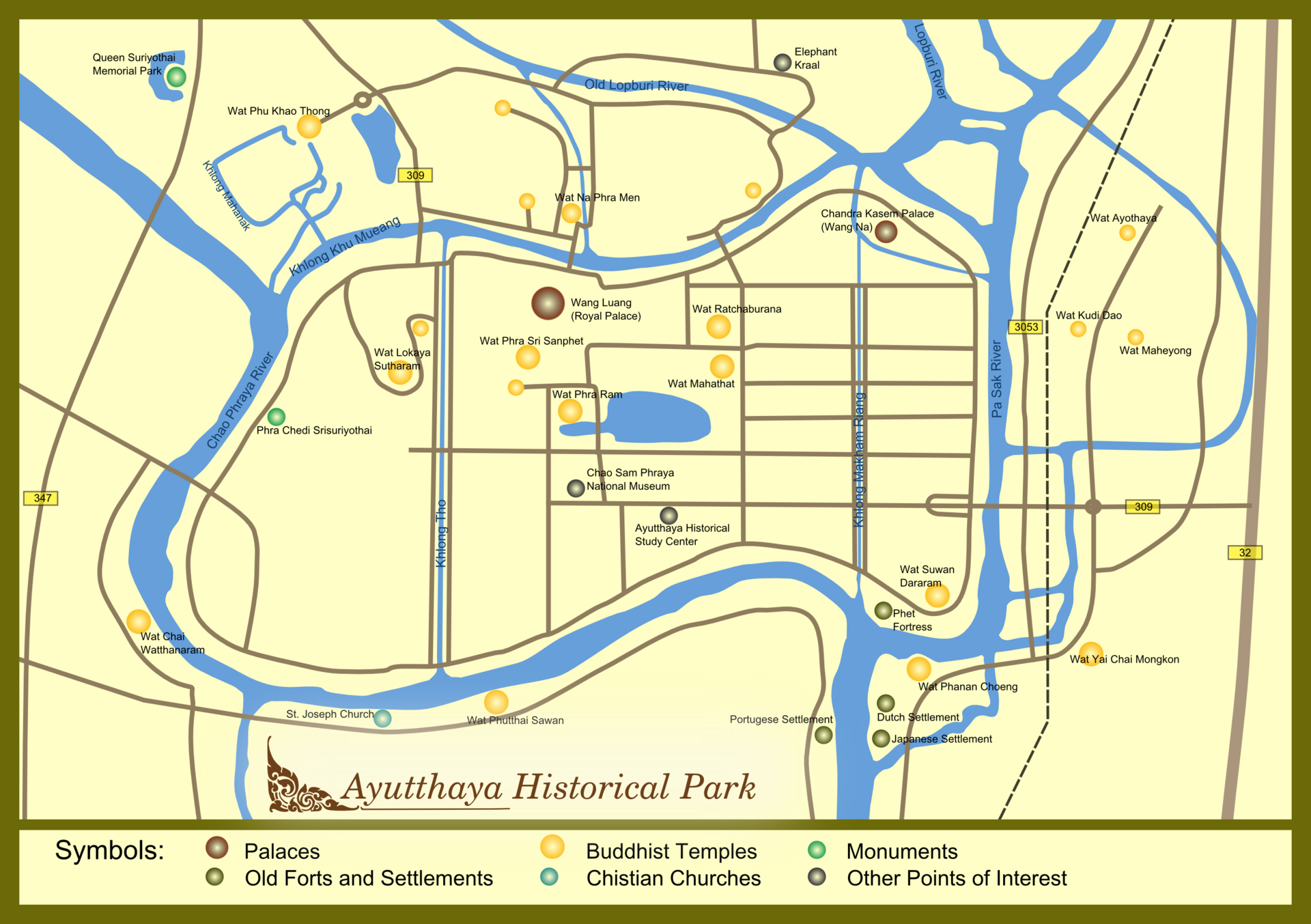
The city was founded on an island at the confluence of three rivers: the Chao Phraya, Lopburi, and Pa Sak rivers. This natural moat-like formation made it easily defensible against invasions, while also creating fertile land ideal for agriculture. The surrounding rivers provided a reliable water source, supporting rice cultivation and sustaining a growing population.
As a result, Ayutthaya became one of the most populous and cosmopolitan cities in the world. Positioned along major riverine trade routes, its waterways allowed goods, people, and ideas to move efficiently between the Gulf of Thailand and the interior of Asia. Its strategic location attracted merchants, diplomats, and missionaries from across Asia, the Middle East, and Europe, creating a diverse global hub.
Ayutthaya's architectural legacy is perhaps its most enduring contribution to Thai history. The city's unique blend of Khmer, Sukothai, Chinese, and European influences can be seen in its numerous temples, palaces, and public buildings. Prang, or tower-like structures inspired by Khmer design, are a distinctive feature of Ayutthaya's architecture, blending Buddhist and Hindu elements. These towering structures, often adorned with intricate carvings, stand as testaments to the city's former grandeur.
One of the most iconic sites within the Ayutthaya Historical Park is Wat Yai Chai Mongkhon, a massive monastery founded in the 14th century and expanded in the late Ayutthaya period. The temple's impressive prang, measuring over 60 meters tall, dominates the Ayutthaya skyline. Another notable site is Wat Mahathat, home to the famous Buddha head entwined in the roots of a tree, symbolizing the intertwining of religion and nature in Ayutthaya's culture.
Ayutthaya’s prosperity came to a tragic end in 1767, when the city was destroyed by invading Burmese forces. The fall of Ayutthaya marked a turning point in Thai history, leading to the eventual establishment of a new capital elsewhere. The city was left in ruins, marking the end of the city's golden age, but its remnants continue to fascinate visitors today. The Ayutthaya Historical Park, established in 1976, preserves these ruins, providing a tangible link to Thailand's distant past.
Today, the Historic City of Ayutthaya stands as a poignant reminder of Thailand's rich historical heritage. Its architectural wonders, steeped in the cultures of various civilizations, offer a unique insight into the country's past, and into a once-thriving global center of commerce, religion, and art. As a UNESCO World Heritage Site, Ayutthaya serves not only as a national treasure but also as a global ambassador for Thai history and culture.
UNESCO Description of the World Heritage Site
Founded c. 1350, Ayutthaya became the second Siamese capital after Sukhothai. It was destroyed by the Burmese in the 18th century. Its remains, characterized by the prang (reliquary towers) and gigantic monasteries, give an idea of its past splendour.
UNESCO Justification of the World Heritage Site
Criterion (iii): The Historic City of Ayutthaya bears excellent witness to the period of development of a true national Thai art.
Encyclopedia Record: Ayutthaya Historical Park
Ayutthaya Historical Park covers the ruins of the old city of Ayutthaya, Phra Nakhon Si Ayutthaya province, Thailand. The city of Ayutthaya was founded by King Ramathibodi I in 1351,[a] though it is likely to be significantly older, based on evidence showing that the area was already populated during the Mon Dvaravati period. Sources further mention that around 850 AD, the Khmers occupied the area and established a stronghold there, naming it Ayodhya, after one of the holiest Hindu cities in India of the same name. The early history of Ayutthaya is connected to this Khmer settlement. Additionally, Prince Damrong has also attested to the existence of a city named Ayodhya, founded by the Khmers ruling from Lopburi at the point where the three rivers meet. An excavation map shows traces of an ancient baray close to the southwestern tip of Wat Yai Chai Mongkhon, which could have been built on a former important Khmer temple complex.Additional Site Details
Area: 289 hectares
Number of Components: 1
Coordinates: 14.34778 , 100.56056
World Heritage Research
Discover scientific research and academic studies that deepen our understanding of Historic City of Ayutthaya from its history and significance to its conservation, management, and contemporary challenges.
-
Assessment of Traffic - Induced Ground Vibrations and Effects on Masonry Monuments in Ayutthaya Historical Park, Thailand
Traffic-induced ground vibrations in Ayutthaya Historical Park were found to attenuate based on subsoil properties, specifically the average shear wave velocity (Vs). The study derived attenuation curves from regression analysis, providing practical tools for risk management of masonry monuments. Additionally, traffic vibrations were within recommended limits, and finite element analysis showed that induced stresses were lower than the structural strength of ancient bricks and mortar, suggesting minimal risk to historic structures.
Poovarodom, N., Choopthong, W., Bhadrakom, B., Chaiyasarn, K., Limsamphancharoen, N., & Hussain, Q. (2023). Assessment of Traffic - Induced Ground Vibrations and Effects on Masonry Monuments in Ayutthaya Historical Park, Thailand. Studies in Conservation, 69(4), 230–242. https://doi.org/10.1080/00393630.2023.2213922
View Publication Record | Read Publication -
Lost and found: the water-based settlement of the historic city of Ayutthaya
A study on the historic city of Ayutthaya reveals that despite its reputation for advanced water management, the connection between historical monuments and water features is diminishing. Research found that areas outside the World Heritage Site remain linked to this system, showcasing the resilience of traditional designs in flood-prone regions. The ancient Chao Phraya River settlements also highlight living practices adapted to water-based environments, demonstrating the enduring legacy of Ayutthaya's water management strategies.
Yodsurang, P. (2023). Lost and found: the water-based settlement of the historic city of Ayutthaya. Restauro Archeologico, 30(1). https://doi.org/10.36253/rar-14356
View Publication Record | Read Publication -
Application of 3D laser scanning technology for preservation and monitoring of Thai pagoda: A case study of Wat Krachee Ayutthaya
3D laser scanning technology has been demonstrated as highly effective for the preservation and monitoring of heritage structures, offering precise and rapid digital documentation. A case study at Wat Krachee, a Thai pagoda in Ayutthaya, revealed significant dimensions and deformations over multiple scans conducted between 2018 and 2019. The technology's ability to generate high-density point cloud data enabled accurate structural assessment and conservation planning, addressing unique challenges such as intertwined trees integrated into the pagoda structure. This approach supports sustainable preservation efforts led by UNESCO and Thai authorities.
Sairuamyat, P., Mahasuwanchai, P., Athisakul, C., Leelataviwat, S., & Chucheepsakul, S. (2020). Application of 3D laser scanning technology for preservation and monitoring of Thai pagoda: A case study of Wat Krachee Ayutthaya. IOP Conference Series: Earth and Environmental Science, 463(1), 12082. https://doi.org/10.1088/1755-1315/463/1/012082
View Publication Record | Read Publication -
The study of water management system in ancient towns: a case study of Ayutthaya
Ancient Ayutthaya thrived for 417 years without significant flood damage despite its location in Thailand's flood-prone lower central plain. A study reveals that the city's resilience was rooted in an advanced water management system, offering insights applicable to modern urban planning. The research employs a landscape integration approach, combining multidisciplinary perspectives to analyze Ayutthaya's water development cycle and its evolution within riverine and deltaic areas. This methodology not only clarifies Ayutthaya's water management but also provides a model for other towns facing similar environmental challenges.
Siriphatthanakun, H. The study of water management system in ancient towns: a case study of Ayutthaya. https://doi.org/10.58837/chula.the.2020.19
View Publication Record | Read Publication -
Appropriate participatory food waste management in the World Heritage Site, the Historic City of Ayutthaya
A participatory food waste management strategy for the UNESCO World Heritage Site, Historic City of Ayutthaya, demonstrated that converting domestic food waste into bio-extract or bio-fertilizer is an effective approach to improve waste separation and urban environment. The study, employing quantitative methods and Participatory Action Research (PAR), found that while 87.2% of participants separated recyclable garbage, only 72.2% separated food waste due to attitudes toward waste management. PAR revealed that producing bio-fertilizer from food waste could enhance community engagement in waste separation, offering a sustainable solution for preserving Ayutthaya's heritage status by addressing waste-related image concerns.
Srijuntrapun, P. (2018). Appropriate participatory food waste management in the World Heritage Site, the Historic City of Ayutthaya. Kasetsart Journal of Social Sciences, 39(3), 381–386. https://doi.org/10.1016/j.kjss.2017.07.005
View Publication Record | Read Publication -
Assessing the sustainability of tourism-related livelihoods in an urban World Heritage Site
Research on the Historic City of Ayutthaya reveals that tourism-related livelihoods in urban areas are inherently unsustainable when measured by self-reliance, as residents heavily depend on external sources. The study, using DFID’s Sustainable Livelihood Framework, highlights conflicts between the urban poor and both the Thai government and neighboring industrial zones due to tourism and development pressures. These tensions raise concerns about the potential loss of World Heritage status. The findings challenge traditional sustainability metrics by emphasizing that urban livelihoods cannot be evaluated solely on self-reliance, given their reliance on external inputs.
Srijuntrapun, P., Fisher, D., & Rennie, H. G. (2017). Assessing the sustainability of tourism-related livelihoods in an urban World Heritage Site. Journal of Heritage Tourism, 13(5), 395–410. https://doi.org/10.1080/1743873x.2017.1373779
View Publication Record | Read Publication -
Tourism Object Benchmarking : Borobudur Temple And Historic City of Ayyuthaya
Benchmarking analysis between Borobudur Temple (Indonesia) and the Historic City of Ayutthaya (Thailand) reveals key performance gaps that could enhance tourism outcomes. The study, based on surveys of 100 Indonesian tourists familiar with both sites, identifies disparities in economic, satisfaction, sustainability, and organizational indicators. Findings suggest that leveraging Ayutthaya's strengths—such as its reputation for large-scale Hindu temples and ASEAN prominence—could improve Borobudur Temple's visitor experience and economic benefits for local communities. The research employs accidental sampling via online questionnaires to assess performance against predefined standards, offering actionable insights for local authorities to refine services and attract more tourists.
Hendratono, T.,., S. (2015). Tourism Object Benchmarking : Borobudur Temple And Historic City of Ayyuthaya. Journal of Business on Hospitality and Tourism, 1(1), 12. https://doi.org/10.22334/jbhost.v1i1.18
View Publication Record | Read Publication -
The Valuation of Heritage Interpretation for Conservation and Sustainable Tourism: A Case Study of the Historic City of Ayutthaya
A groundbreaking contingent valuation study of the UNESCO-listed Historic City of Ayutthaya reveals that visitors are willing to pay up to 422.44 Baht per day for heritage interpretation programs aimed at restoring and improving fifteen historic sites, with significant value also attributed to smaller-scale restoration efforts (137.44 Baht). Contrary to expectations, the study found no evidence of distance decay—a phenomenon where willingness to pay decreases with travel distance—challenging long-held assumptions in tourism economics. It also validated the scope test and ruled out anchoring bias statistically, underscoring the robustness of its methodology. The research highlights heritage interpretation as a critical tool for sustainable conservation and tourism, using one-day package entrance fees to align incentives effectively.
Wiroj Lakkhanaadisorn. (2014). The Valuation of Heritage Interpretation for Conservation and Sustainable Tourism: A Case Study of the Historic City of Ayutthaya. 2, 54, NIDA Development Journal. https://doi.org/10.14456/NDJ.2014.20
View Publication Record | Read Publication -
Assessing the Flood Impacts and the Cultural Properties Vulnerabilities in Ayutthaya, Thailand
Flood risk to Ayutthaya’s UNESCO World Heritage monuments is primarily determined by elevation above mean sea level and proximity to rivers or canals. A 2013 study analyzed flood-induced damage—categorized as high, medium, or low risk—and monument value (high, medium, or low) to prioritize conservation efforts. The research found that sites closer to water bodies faced the greatest vulnerability, particularly during the severe 2011 floods, which overwhelmed traditional canal-based flood defenses. By integrating environmental damage assessments with cultural significance rankings, the study highlighted critical areas for stakeholder-driven conservation planning to mitigate future risks.
Daungthima, W., & Kazunori, H. (2013). Assessing the Flood Impacts and the Cultural Properties Vulnerabilities in Ayutthaya, Thailand. Procedia Environmental Sciences, 17, 739–748. https://doi.org/10.1016/j.proenv.2013.02.091
View Publication Record | Read Publication -
Role-Play Gaming Simulation For Flood Management On Cultural Heritage: A Case Study Of Ayutthaya Historic City
Role-play gaming simulations effectively enhance public awareness and collaboration for flood management on cultural heritage, as demonstrated by a case study of Ayutthaya Historic City. The methodology, developed from existing data and role-playing techniques, improves understanding of flood impacts and fosters cooperation among government, private, and public sectors. This approach serves as a tool to deepen knowledge about participatory flood management, offering a practical solution for preserving cultural heritage in flood-prone areas.
Pongpisit Huyakorn, Chaweewan Denpaiboon, & Kanegae, H. (2012). Role-Play Gaming Simulation For Flood Management On Cultural Heritage: A Case Study Of Ayutthaya Historic City. Zenodo. https://doi.org/10.5281/ZENODO.1328723
View Publication Record | Read Publication -
World Heritage Sites and Domestic Tourism in Thailand
Rapidly growing domestic tourism, particularly from Thailand's urban middle class, is redefining the use and value of UNESCO World Heritage Sites while also exerting significant pressure on their conservation. This study highlights how metropolitan-driven development and shifting lifestyles are reshaping attitudes toward cultural and natural heritage, with Ayutthaya, Sukhothai, and the Dong Phayayen-Khao Yai Forest Complex serving as case studies. By analyzing these tensions, researchers reveal a complex dynamic where tourism growth both benefits and threatens heritage preservation, offering critical insights for sustainable management in Thailand.
King, V. T., & Parnwell, M. J. G. (2011). World Heritage Sites and Domestic Tourism in Thailand. South East Asia Research, 19(3), 381–420. https://doi.org/10.5367/sear.2011.0055
View Publication Record | Read Publication