World Heritage Identification Number: 793
World Heritage since: 1996
Category: Cultural Heritage
WHE Type: Historic Cities & Urban Areas
Transboundary Heritage: No
Endangered Heritage: No
Country: 🇲🇦 Morocco
Continent: Africa
UNESCO World Region: Arab States
Map
The Historic City of Meknes: A Blend of Islamic and European Architectural Styles
The Historic City of Meknes, situated in northern central Morocco, is one of the four Imperial cities of the kingdom and the sixth largest city by population. This ancient city, founded in the 11th century by the Almoravids as a military settlement, has a rich history that spans over a millennium. Its most significant period began during the reign of Sultan Ismail Ibn Sharif (1672–1727), who transformed Meknes into a grand city in Spanish-Moorish style.
More to come…UNESCO Description of the World Heritage Site
Founded in the 11th century by the Almoravids as a military settlement, Meknes became a capital under Sultan Moulay Ismaïl (1672–1727), the founder of the Alawite dynasty. The sultan turned it into a impressive city in Spanish-Moorish style, surrounded by high walls with great doors, where the harmonious blending of the Islamic and European styles of the 17th century Maghreb are still evident today.
UNESCO Justification of the World Heritage Site
Criterion (iv): Meknès is distinctive by the monumental and voluminous aspect of its ramparts reaching 15 metres in height. It is considered as an exemplary testimony of the fortified towns of the Maghreb. It is a property representing a remarkably complete urban and architectural structure of a North African capital of the 17th century, harmoniously combining Islamic and European conceptual and planning elements. Endowed with a princely urbanism, the Historic City of Meknes also illustrates the specificities of earthen architecture (cobwork) of sub-Saharan towns of the Maghreb.
Encyclopedia Record: Meknes
Meknes is one of the four Imperial cities of Morocco, located in northern central Morocco and the sixth largest city by population in the kingdom. Founded in the 11th century by the Almoravids as a military settlement, Meknes became the capital of Morocco during the reign of Sultan Ismail Ibn Sharif (1672–1727), son of the founder of the Alaouite dynasty. Sultan Ismail created a massive imperial palace complex and endowed the city with extensive fortifications and monumental gates. The city recorded a population of 551,503 in the 2024 Moroccan census. It is the seat of Meknès Prefecture and an important economic hub in the region of Fès-Meknès.Additional Site Details
Area: Not available
Number of Components: 1
Coordinates: 33.88333 , -5.55833
Image
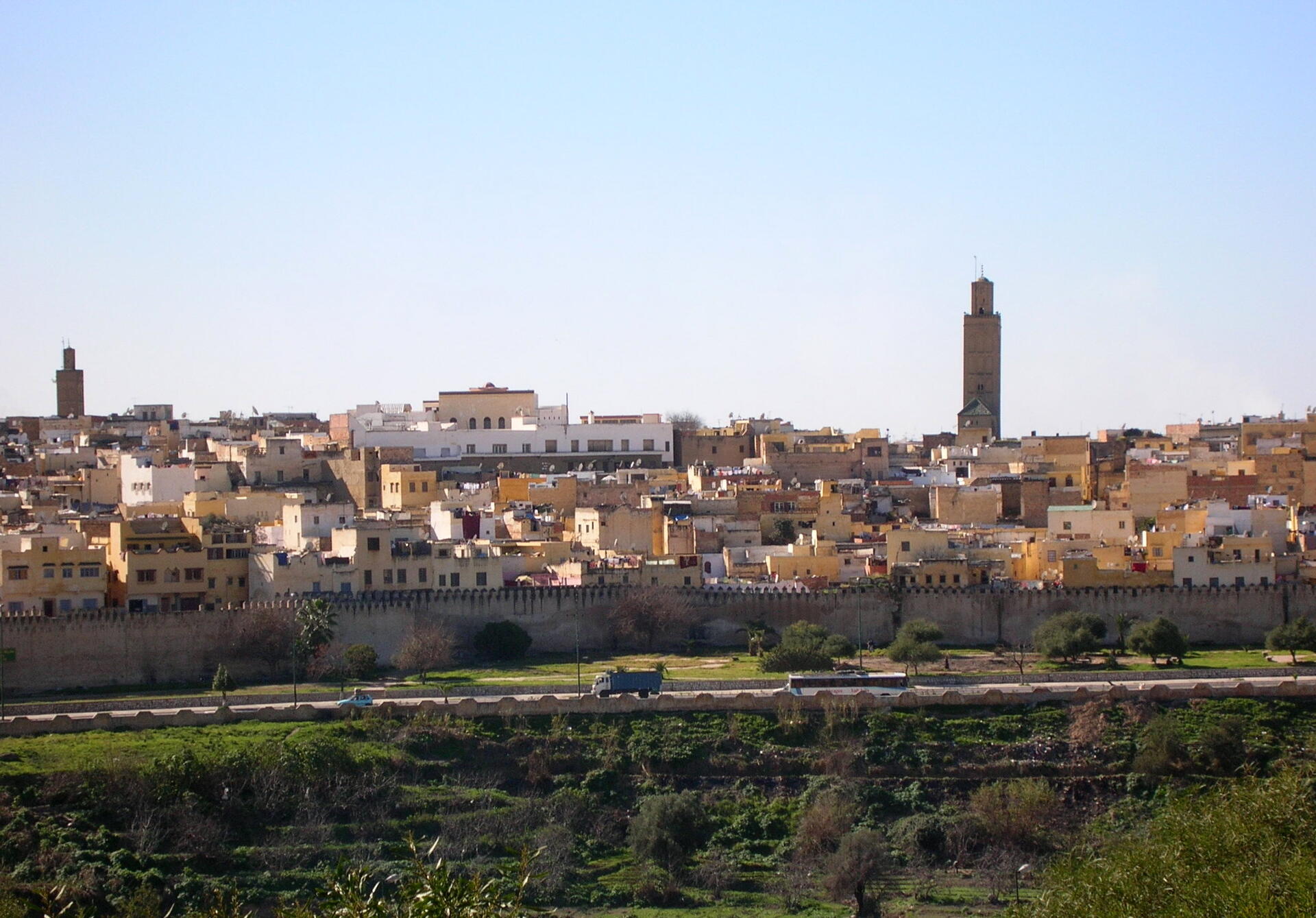
© Bernard Gagnon, CC BY-SA 3.0 Resized from original. (This derivative is under the same CC BY-SA license.)
World Heritage Research
Discover scientific research and academic studies that deepen our understanding of Historic City of Meknes from its history and significance to its conservation, management, and contemporary challenges.
-
Vernacular architecture, between the sovereignty of the environment and the restoration requirements: The case of Ksar of Igoulmimen and the medina of Meknes
Vernacular architecture in Morocco exemplifies the harmonious integration of human ingenuity with environmental determinants, reflecting a dynamic interplay between nature and cultural adaptation. This study reveals that restoration efforts in UNESCO World Heritage Sites like the Ksar of Igoulmimen and the Medina of Meknes often prioritize aesthetic preservation over functional resilience, leading to passive rehabilitation rather than adaptive revitalization. By analyzing these cases through field research and established literature, the study highlights the tension between traditional craftsmanship and modern restoration requirements, questioning whether current approaches foster 'intelligent contextualization' that balances heritage aesthetics with socio-economic sustainability.
SEDREDDINE, M. (2025). Vernacular architecture, between the sovereignty of the environment and the restoration requirements: The case of Ksar of Igoulmimen and the medina of Meknes. Vernacular Architecture, 47, 147–155. https://doi.org/10.21741/9781644903391-17
View Publication Record | Read Publication -
Digital Transformation in African Heritage Preservation: A Digital Twin Framework for a Sustainable Bab Al-Mansour in Meknes City, Morocco
A groundbreaking framework leveraging Digital Twin technology offers a sustainable approach to heritage preservation, demonstrated through the Bab Al-Mansour Gate in Meknes, Morocco. This innovative model enables real-time monitoring of structural health, damage detection over time, and predictive maintenance, significantly reducing invasive inspections while optimizing resource use. By integrating advanced data collection, processing, and analysis methods, the framework creates a dynamic Digital Twin Heritage Building (DTHB) platform that enhances conservation planning and mitigates environmental risks. This study provides a replicable solution for preserving cultural landmarks, addressing critical gaps in heritage management through data-driven solutions.
Serbouti, I., Chenal, J., Tazi, S. A., Baik, A., & Hakdaoui, M. (2025). Digital Transformation in African Heritage Preservation: A Digital Twin Framework for a Sustainable Bab Al-Mansour in Meknes City, Morocco. Smart Cities, 8(1), 29. https://doi.org/10.3390/smartcities8010029
View Publication Record | Read Publication -
Exposure to Air Pollution from Road Traffic and Incidence of Respiratory Diseases in the City of Meknes, Morocco
Residents of Meknes, Morocco, particularly those living near heavy road traffic, are at higher risk of respiratory diseases compared to those near industrial areas. A study using passive diffusive samplers and GIS-based health indicators found that nitrogen dioxide (NO2) concentrations peak in the city center, correlating with increased incidence of acute respiratory illnesses and asthma attacks, especially among women aged 15–49 years and over 50, respectively. The research also revealed seasonal trends, with higher disease prevalence in winter and fall, and identified young children under 11 months as particularly vulnerable to pneumonia. This integrative approach highlights the significant impact of traffic-related pollution on public health, particularly in densely populated districts like the old Medina.
El Ghazi, I., Berni, I., Menouni, A., Amane, M., Kestemont, M.-P., & El Jaafari, S. (2022). Exposure to Air Pollution from Road Traffic and Incidence of Respiratory Diseases in the City of Meknes, Morocco. Pollutants, 2(3), 306–327. https://doi.org/10.3390/pollutants2030020
View Publication Record | Read Publication -
Double Trauma and Manifold Narratives: Jews’ and Muslims’ Representations of the Departure of Moroccan Jews in the 1950s and 1960s
A shared trauma persists in Morocco regarding the departure of Jews in the 1950s and 1960s, with narratives from both Jewish and Muslim communities revealing fragmented memories. The study, based on oral histories from Meknes, highlights a shift in perception during the Six-Day War (1967), where Jews were reimagined as 'courageous' rather than 'fearful,' disrupting prevailing Muslim stereotypes. This transition challenged societal norms around virility and loyalty, leaving an unresolved emotional wound. Despite differing social class perspectives, the issue remains sensitive, with Muslims suppressing recollections of a 1967 incident involving Jewish victims. Jewish memories oscillate between fear and nostalgia, underscoring the complex, multifaceted legacy of this historical upheaval.
Semi, E. T. (2018). Double Trauma and Manifold Narratives: Jews’ and Muslims’ Representations of the Departure of Moroccan Jews in the 1950s and 1960s. Sites of Jewish Memory, 45–63. https://doi.org/10.4324/9781315796796-3
View Publication Record | Read Publication -
Reptiles traded in markets for medicinal purposes in contemporary Morocco
In contemporary Morocco, reptiles are extensively traded for medicinal purposes despite legal protections, with an estimated annual turnover of 1,520 Mediterranean chameleons and 775 Bell's Dabb lizards. A survey conducted in 49 wildlife markets across 20 Moroccan towns and two Spanish exclaves between 2013-2014 identified at least nine reptile species, including the Mediterranean chameleon (Chamaeleo chamaeleon) and Bell's Dabb lizard (Uromastyx acanthinura), with a combined value of approximately US $100,000. The study found that markets in Marrakesh, Meknes, Casablanca, and Fez were the most prominent, with significant trade in both dried and live specimens. Notably, over 200 African rock python (Python sebae) skins were identified, suggesting potential illicit imports from other parts of Africa. Despite regulations under CITES, traders often do not disclose the legal status or restrictions on these species, highlighting the need for increased enforcement to prevent further exploitation and its impact on imperiled species.
Nijman, V., & Bergin, D. (2017). Reptiles traded in markets for medicinal purposes in contemporary Morocco. Contributions to Zoology, 86(1), 39–50. https://doi.org/10.1163/18759866-08601003
View Publication Record | Read Publication -
Double Trauma and Manifold Narratives: Jews' and Muslims' Representations of the Departure of Moroccan Jews in the 1950s and 1960s
A study of the departure of Moroccan Jews in the 1950s and 1960s reveals that both Jewish and Muslim narratives reflect deep, unresolved trauma. While Muslims often depicted Jews as 'fearful' or 'weak,' this perception shifted dramatically during the Six-Day War, when Jews were seen as 'courageous' and 'strong.' This transformation disrupted Muslim societal norms, which associated emigration with a lack of virility. The research, based on oral histories from both communities, shows that the memory of these events remains fragmented and sensitive, with Muslims suppressing recollections of two young Jews murdered in 1967 in Meknes. The study argues that the departure of a historic component of Moroccan society has left an enduring emotional wound, with Jewish narratives oscillating between fear and nostalgia.
Semi, E. T. (2010). DOUBLE TRAUMA AND MANIFOLD NARRATIVES: JEWS’ AND MUSLIMS’ REPRESENTATIONS OF THE DEPARTURE OF MOROCCAN JEWS IN THE 1950s AND 1960s. Journal of Modern Jewish Studies, 9(1), 107–125. https://doi.org/10.1080/14725880903549319
View Publication Record | Read Publication