
World Heritage Identification Number: 170
World Heritage since: 1981
Category: Cultural Heritage
WHE Type: Historic Cities & Urban Areas
Transboundary Heritage: No
Endangered Heritage: No
Country: 🇲🇦 Morocco
Continent: Africa
UNESCO World Region: Arab States
Map
The Medina of Fez: A Cultural and Spiritual Center of Morocco
The Medina of Fez, located in the heart of the ancient city of Fez, Morocco, stands as a testament to the rich history and cultural heritage of the region. Inscribed as a UNESCO World Heritage Site in 1981, the Medina of Fez is a living example of medieval Islamic architecture and urban planning that dates back to the 9th century.
More to come…UNESCO Description of the World Heritage Site
Founded in the 9th century, Fez reached its height in the 13th–14th centuries under the Marinids, when it replaced Marrakesh as the capital of the kingdom. The urban fabric and the principal monuments in the medina – madrasas, fondouks, palaces, residences, mosques and fountains - date from this period. Although the political capital of Morocco was transferred to Rabat in 1912, Fez has retained its status as the country's cultural and spiritual centre.
UNESCO Justification of the World Heritage Site
Criterion (ii): The Medina of Fez bears a living witness to a flourishing city of the eastern Mediterranean having exercised considerable influence mainly from the 12th to the 15th centuries, on the development of architecture, monumental arts and town-planning, notably in North Africa, Andalousia and in Sub-Saharan Africa. Fez Jedid (the new town), was inspired from the earlier town-planning model of Marrakesh.
Criterion (v): The Medina of Fez constitutes an outstanding example of a medieval town created during the very first centuries of Islamisation of Morocco and presenting an original type of human settlement and traditional occupation of the land representative of Moroccan urban culture over a long historical period (from the 9th to the beginning of the 20th centuries). The ancient fragmented district of the medina with its high density of monuments of religious, civil and military character, are outstanding examples of this culture and the resulting interaction with the diverse stratas of the population that have influenced the wide variety of architectural forms and urban landscapes.
Encyclopedia Record: Fes el Bali
Fes el Bali is the oldest part of Fez, Morocco. It is one of the three main districts of Fez, along with Fes Jdid and the French-created Ville Nouvelle. Together with Fes Jdid, it forms the medina of Fez, significant for the preservation of its pre-modern urban layout and numerous historic monuments, which have earned it UNESCO World Heritage Site status.Additional Site Details
Area: 280 hectares
Number of Components: 2
(v) — Outstanding example of traditional human settlement
Coordinates: 34.06111 , -4.97778
Image
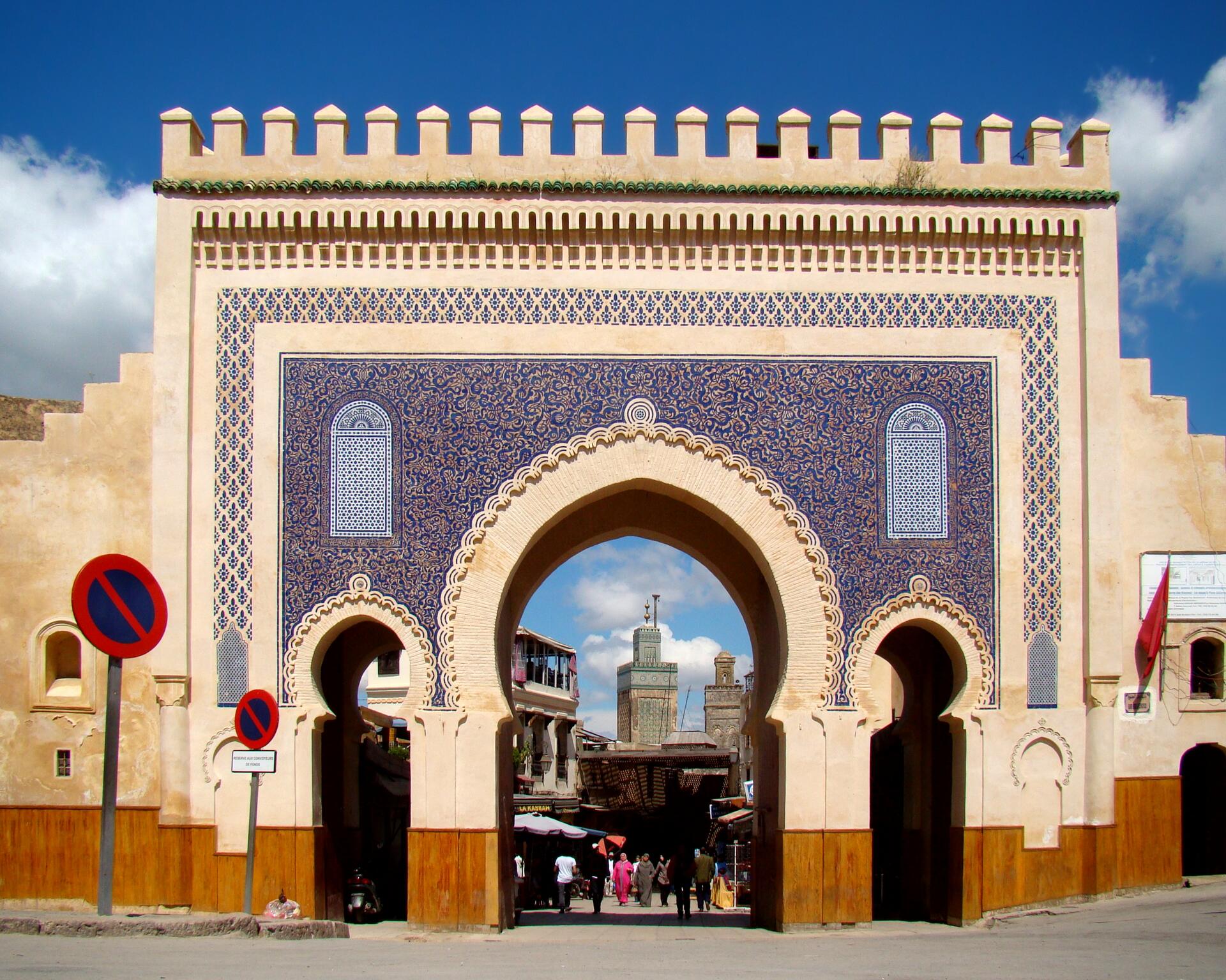
© Bjørn Christian Tørrissen, CC BY-SA 3.0 Resized from original. (This derivative is under the same CC BY-SA license.)

World Heritage Research
Discover scientific research and academic studies that deepen our understanding of Medina of Fez from its history and significance to its conservation, management, and contemporary challenges.
-
Building an Ontology for the Tangible Cultural Heritage of the Medina of Fez
A groundbreaking ontology, MedinaOnto, has been developed to model the tangible cultural heritage of the Medina of Fez. This semantic framework integrates social, geospatial, and historical dimensions, enabling robust semantic reasoning and effective data querying. Built upon established standards like CIDOC-CRM, FOAF, and GEOSPARQL, MedinaOnto leverages structured data from open sources such as Wikidata and DBpedia to represent a wide range of heritage entities, including monuments and culturally significant spaces. The ontology was rigorously evaluated through logical consistency tests, scenario-based validation, and SPARQL queries, confirming its scalability and reusability for both public and heritage professionals. This innovative approach offers new avenues for the valorization, mediation, and research of cultural heritage.
Daoudi, H., Chaker, I., & Zahi, A. (2025). Building an Ontology for the Tangible Cultural Heritage of the Medina of Fez. Heritage, 8(9), 391. https://doi.org/10.3390/heritage8090391
View Publication Record | Read Publication -
Hydrography as a guide to reading the urban form of the Medina of Fez
Hydrography has been a pivotal factor in shaping the urban form and evolution of Fez’s Medina, demonstrating its profound influence on spatial organization, socio-economic structures, and cultural practices from the Idrisid period to contemporary times. This study reveals that water management systems have not only facilitated but also constrained urban development, illustrating a dynamic interplay between environmental adaptation and resilience. By analyzing hydrological transformations over centuries, the research underscores how Fez’s urban landscape has responded to environmental and sociopolitical changes, offering insights into the adaptability of historic cities.
MOUJOUD, L. (2025). Hydrography as a guide to reading the urban form of the Medina of Fez. Vernacular Architecture, 47, 188–196. https://doi.org/10.21741/9781644903391-22
View Publication Record | Read Publication -
Cultural heritage tourism and urban regeneration: The case of Fez Medina in Morocco
Urban regeneration in historic cities, such as Fez Medina in Morocco, can achieve economic and social sustainability without displacing local communities. The 'Ziyarates Fez' project demonstrates an innovative approach to rehabilitating traditional houses for tourism while preserving their original occupants. This study highlights how previous strategies, focused on physical development and riad hotels, exacerbated gentrification and socioeconomic stratification. By employing a mixed-method approach—including desk research, content analysis, fieldwork, observations, and qualitative interviews—the research identifies holistic regeneration strategies that balance conservation with modern needs. These findings contribute to global efforts in sustainable urban regeneration, offering actionable insights for policymakers and researchers.
Boussaa, D., & Madandola, M. (2024). Cultural heritage tourism and urban regeneration: The case of Fez Medina in Morocco. Frontiers of Architectural Research, 13(6), 1228–1248. https://doi.org/10.1016/j.foar.2024.04.008
View Publication Record | Read Publication -
“Soukinage” Practices in The Medina of Fez in The Light of Consumer Culture Theory
Moroccan consumers' attachment to traditional trade in the Medina of Fez is driven by five key dimensions: seller trust, religiosity, nostalgia, orality, and mutual knowledge. Despite the rise of modern distribution systems, these factors continue to influence shopping behaviors, as revealed through an ethnographic study. The research highlights how cultural values and social relationships sustain traditional commerce in historic urban settings like Fez's medina.
NASSIM, S., & TOUATE, S. (2023). “Soukinage” Practices in The Medina of Fez in The Light of Consumer Culture Theory. Communications of International Proceedings. https://doi.org/10.5171/2023.4235823
View Publication Record | Read Publication -
The Craft Production System in Morocco, Especially in the Medina of Fez.
Morocco's craft sector, particularly within the historic Medina of Fez, faces significant challenges in production and management. This study identifies critical strengths and weaknesses in local craft enterprises, aiming to enhance their performance through systematic analysis. By examining current operational practices, researchers seek to provide actionable insights for sustainable development. The approach involves a detailed assessment of craft units' conduct and management, offering a roadmap for improvement in both traditional and modern production systems.
Nada, N., Anas, C., & Salaheddine, K. A. (2022). The Craft Production System in Morocco, Especially in the Medina of Fez. Proceedings of the International Conference on Industrial Engineering and Operations Management, 1587–1588. https://doi.org/10.46254/eu05.20220304
View Publication Record | Read Publication -
Experimentation of visual augmented reality for visiting the historical monuments of the medina of Fez
A prototype Android mobile application leveraging visual augmented reality (AR) was successfully developed to enhance the tourist experience at the Medina of Fez. The application serves as an interactive pocket guide, overlaying digital information onto the physical environment to provide richer historical context for visitors. By integrating multiple software and hardware technologies, AR transforms the way users perceive and engage with historical monuments. The prototype's adaptability—achieved by simply replacing its database—demonstrates potential for broader application across other cities, making it a scalable solution for heritage tourism. This study highlights the transformative impact of AR in cultural preservation and visitor engagement.
Zaifri, M., Azough, A., & El Alaoui, S. O. (2018). Experimentation of visual augmented reality for visiting the historical monuments of the medina of Fez. 2018 International Conference on Intelligent Systems and Computer Vision (ISCV), 1–4. https://doi.org/10.1109/isacv.2018.8354051
View Publication Record | Read Publication -
Determination of endoglucanase activity of paper decaying fungi from an old library at the ancient Medina of Fez
Research on paper decaying fungi from the ancient library of Fez, Morocco, reveals that all tested isolates exhibit cellulase, amylase, pectinase, and ligninase activities. Notably, Mucor racemosus PF15, Aspergillus niger, and Aspergillus oryzae demonstrated the highest endoglucanase activity (0.256, 0.236, and 0.216 UI/mL, respectively) after six days in liquid medium at 25°C. Optimal enzyme production occurred at pH 5–6 and temperatures of 25–30°C, providing critical insights into the biodeterioration mechanisms affecting historical paper in UNESCO World Heritage Sites like Fez's Medina.
El Bergadi, F., Laachari, F., Sadiki, M., Elabed, S., Iraqui, M. H., & Ibnsouda, S. K. (2016). Determination of endoglucanase activity of paper decaying fungi from an old library at the ancient Medina of Fez. Microbiology, 85(1), 47–55. https://doi.org/10.1134/s0026261716010021
View Publication Record | Read Publication -
Cellulolytic potential and filter paper activity of fungi isolated from ancients manuscripts from the Medina of Fez
Fungi isolated from ancient manuscripts in the Medina of Fez exhibit significant cellulolytic activity, posing a threat to historical paper. Nine out of 31 filamentous fungi demonstrated the ability to degrade carboxymethylcellulose (CMC) and produce filter paper activity (FPUase), with varying effectiveness depending on temperature and pH. The most prevalent species included Penicillium chrysogenum, Aspergillus niger, Aspergillus oryzae, and Mucor racemosus, while others like Hypocrea lixii, Aspergillus melleus, and Schizophyllum commune were less common. Long-term experiments showed these fungi could degrade filter paper at 25°C, highlighting their destructive potential on cultural heritage materials.
El Bergadi, F., Laachari, F., Elabed, S., Mohammed, I. H., & Ibnsouda, S. K. (2013). Cellulolytic potential and filter paper activity of fungi isolated from ancients manuscripts from the Medina of Fez. Annals of Microbiology, 64(2), 815–822. https://doi.org/10.1007/s13213-013-0718-6
View Publication Record | Read Publication