World Heritage Identification Number: 836
World Heritage since: 1997
Category: Cultural Heritage
WHE Type: Archaeological Sites
Transboundary Heritage: No
Endangered Heritage: No
Country: 🇲🇦 Morocco
Continent: Africa
UNESCO World Region: Arab States
Map
Archaeological Site of Volubilis: A Blend of Berber and Roman Cultures
The Archaeological Site of Volubilis, nestled in the fertile agricultural region of Morocco, offers a unique blend of Berber and Roman cultures that has earned it a place on the prestigious UNESCO World Heritage List since 1997. This ancient city, which may have served as the capital of the Kingdom of Mauretania, provides a captivating glimpse into the rich history of North Africa.
More to come…UNESCO Description of the World Heritage Site
The Mauritanian capital, founded in the 3rd century B.C., became an important outpost of the Roman Empire and was graced with many fine buildings. Extensive remains of these survive in the archaeological site, located in a fertile agricultural area. Volubilis was later briefly to become the capital of Idris I, founder of the Idrisid dynasty, who is buried at nearby Moulay Idris.
UNESCO Justification of the World Heritage Site
Criterion (ii): The archaeological site of Volubilis is an outstanding example of a town bearing witness to an exchange of influences since High Antiquity until Islamic times. These interchanges took place in a town environment corresponding to the boundary of the site, and in a rural area extending between the prerif ridges from Zerhoun and the Gharb Plain. These influences testify to Mediterranean, Libyan and Moor, Punic, Roman and Arab-Islamic cultures as well as African and Christian cultures. They are evident in the urban evolution of the town, the construction styles and architectural decorations and landscape creation.
Criterion (iii): This site is an outstanding example of an archaeological and architectural complex and of a cultural landscape bearing witness to many cultures (Libyco-Berber and Mauritanian, Roman, Christian and Arabo-Islamic) of which several have disappeared.
Criterion (iv): The archaeological site of Volubilis is an outstanding example of a focus for the different kinds of immigration, cultural traditions and lost cultures (Libyco-Berber and Mauritanian, Roman, Christian and Arabo-Islamic) since High Antiquity until the Islamic period.
Criterion (vi): The archaeological site of Volubilis is rich in history, events, ideas, beliefs and artistic works of universal significance, notably as a place that, for a brief period, became the capital of the Muslim dynasty of the Idrissids. The town of Moulay Idriss Zerhoun adjacent to the site houses the tomb of this founder and is the subject of an annual pilgrimage.
Encyclopedia Record: Volubilis
Volubilis is a partly excavated Berber-Roman city in Morocco, situated near the city of Meknes, that may have been the capital of the Kingdom of Mauretania, at least from the time of King Juba II. Before Volubilis, the capital of the kingdom may have been at Gilda.Additional Site Details
Area: 42 hectares
Number of Components: 1
(iii) — Unique or exceptional testimony to a cultural tradition
(iv) — Outstanding example of a type of building or landscape
(vi) — Directly associated with events or living traditions
Coordinates: 34.07389 , -5.55694
Image
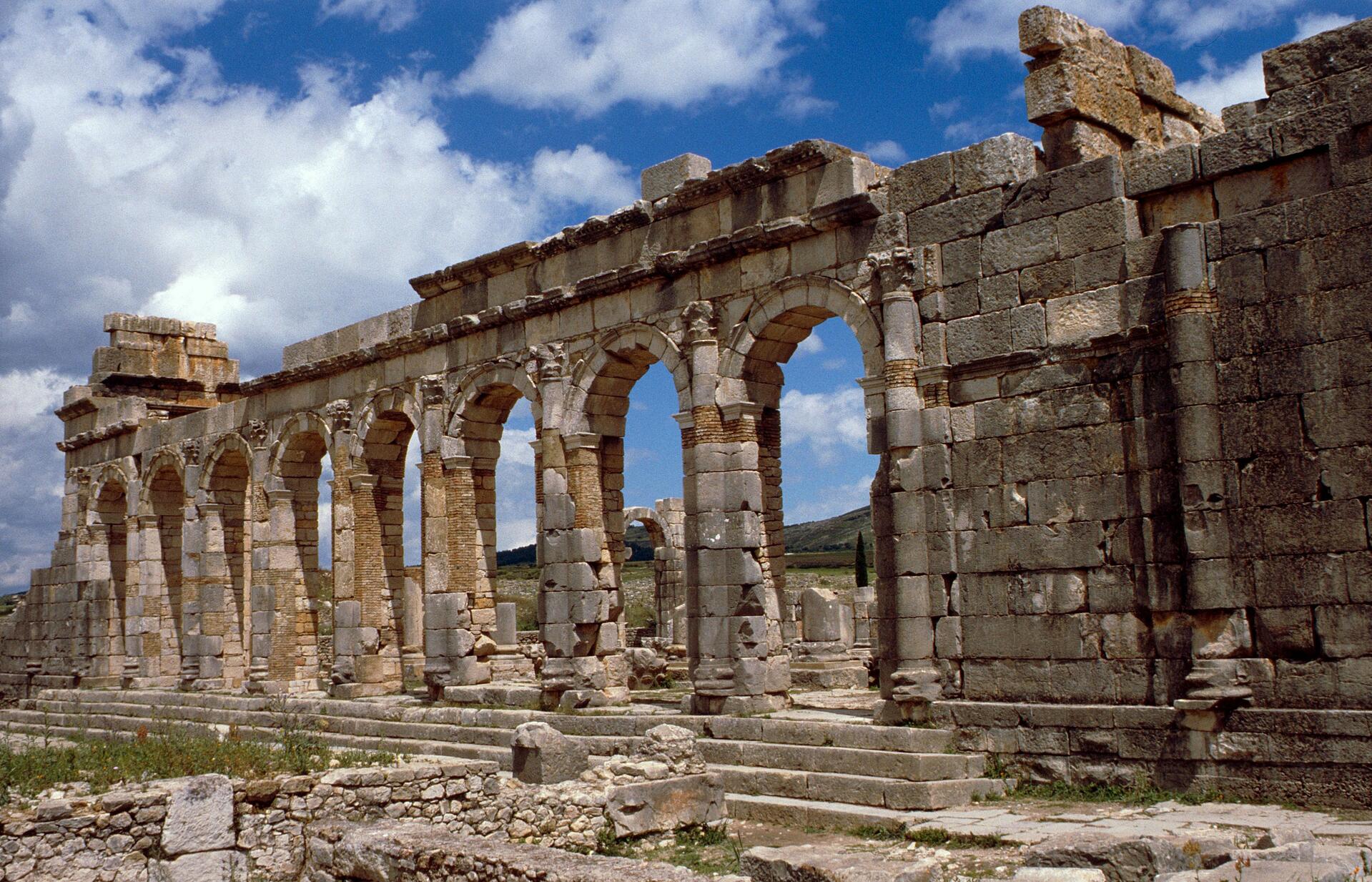
© Chrisi1964, CC BY-SA 4.0 Resized from original. (This derivative is under the same CC BY-SA license.)
World Heritage Research
Discover scientific research and academic studies that deepen our understanding of Archaeological Site of Volubilis from its history and significance to its conservation, management, and contemporary challenges.
-
Bryological Flora and Its Biodeteriogenic Effect on the Stones of the Archaeological Site of Volubilis in Morocco
Research at the UNESCO World Heritage Site of Volubilis, Morocco, reveals that 16 bryophyte species—all acrocarp mosses—significantly contribute to stone biodeterioration. These taxa, belonging to five orders, seven families (with Pottiaceae dominating), and 13 genera, thrive in the site's humid conditions, particularly in material joints, leading to aesthetic changes and structural damage over time. The study employed systematic sampling along walls and cobblestones to identify these species, highlighting their destructive potential on historical substrates.
Dabghi, A., Achoual, K., El Khaddari, A., Bouhssini, A., Belahbib, N., Benharbit, M., & Dahmani, J. (2025). Bryological Flora and Its Biodeteriogenic Effect on the Stones of the Archaeological Site of Volubilis in Morocco. Technical Innovation and Modeling in the Biological Sciences, 81–92. https://doi.org/10.4018/979-8-3693-9450-2.ch004
View Publication Record | Read Publication -
The tourism attractiveness of the Moroccan archaeological site of Volubilis: An analysis of the determinants through analytic hierarchy process (AHP)
Unique historic remains, museums, maintained trails, and archaeological amenities are the key factors driving tourism attractiveness at Morocco's UNESCO World Heritage Site of Volubilis. This insight emerged from an analytic hierarchy process (AHP) analysis involving 32 experts, who identified these attributes as the most significant among 34 criteria influencing visitor appeal. The study highlights how well-preserved infrastructure and interpretive resources enhance rural archaeological sites' tourism potential, offering practical guidance for heritage managers and policymakers. By focusing on tangible and intangible assets, researchers provide a framework to optimize development strategies while balancing conservation with visitor experience.
Ksissou, K., El Kadri, A., El-Khodary, M., & Trid, S. (2024). The tourism attractiveness of the Moroccan archaeological site of Volubilis: An analysis of the determinants through analytic hierarchy process (AHP). International Journal of Geoheritage and Parks, 12(4), 606–620. https://doi.org/10.1016/j.ijgeop.2024.11.007
View Publication Record | Read Publication -
Digital Survey and Structural Investigation on the Triumphal Arch of Caracalla in the Archaeological Site of Volubilis in Morocco: Retracing the Timeline of Collapses Occurred during the 18th Century Earthquake
A low seismic acceleration of just 0.168 g was sufficient to cause the collapse of the Triumphal Arch of Caracalla at Volubilis, Morocco, during the 1755 Lisbon earthquake—a finding that aligns with current Moroccan seismic codes estimating a demand of 0.16 g for the region. This discovery underscores the arch's vulnerability, as its capacity matches the expected seismic demand, leaving it inadequately protected against unexpected events. The study retraced the timeline of collapses using digital surveys and structural analyses, including rigid-block and continuous finite element (FE) models, based on historical investigations and data collected in 2017. These methods revealed that the visible arch today is a reconstruction from 1930, masking its original state after the 18th-century earthquake.
Galassi, S., Bigongiari, M., Tempesta, G., Rovero, L., Fazzi, E., Azil, C., Di Pasquale, L., & Pancani, G. (2022). Digital Survey and Structural Investigation on the Triumphal Arch of Caracalla in the Archaeological Site of Volubilis in Morocco: Retracing the Timeline of Collapses Occurred during the 18th Century Earthquake. International Journal of Architectural Heritage, 16(6), 940–955. https://doi.org/10.1080/15583058.2022.2045387
View Publication Record | Read Publication -
Islamizing Berber Lifestyles
Islamization of Berber lifestyles in the Western Maghreb occurred gradually, with new archaeological evidence from sites like Rirha and Volubilis revealing shifts in settlement patterns, diet, pottery, and coinage use. Unlike the rapid Romanization of urban centers, Islamization was a slower process, driven by emulation among elites and a gradual change in general habits. While earlier evidence is scarce, excavations at these sites provide insights into the transition from pre-Islamic to fully Islamized communities by the 10th century, highlighting regional variations between Berber and Arabic communities.
Fentress, E. (2022). Islamizing Berber Lifestyles. Medieval Worlds, medieval worlds(Volume 16. 2022), 67–92. https://doi.org/10.1553/medievalworlds_no16_2022s67
View Publication Record | Read Publication -
Seismic Vulnerability Assessment of the Triumphal Arch of Caracalla in Volubilis (Morocco): Past Events and Provisions for the Future
A seismic vulnerability assessment of the Triumphal Arch of Caracalla in Volubilis, Morocco, reveals significant structural weaknesses despite its 1930s restoration. The arch, dating back to 216 AD, suffered severe damage during the 1755 Lisbon earthquake, which nearly destroyed it entirely. By analyzing historical drawings and archaeological evidence, researchers reconstructed the arch's original configuration and traced its seismic history. Using a rigid-block structural model, they assessed its current vulnerability to future earthquakes, providing critical insights for conservation efforts. This study highlights the long-term impact of seismic events on ancient structures and underscores the need for proactive measures to safeguard such heritage sites.
Pancani, G., Galassi, S., Rovero, L., Dipasquale, L., Fazzi, E., & Tempesta, G. (2020). SEISMIC VULNERABILITY ASSESSMENT OF THE TRIUMPHAL ARCH OF CARACALLA IN VOLUBILIS (MOROCCO): PAST EVENTS AND PROVISIONS FOR THE FUTURE. The International Archives of the Photogrammetry, Remote Sensing and Spatial Information Sciences, XLIV-M-1-2020, 435–442. https://doi.org/10.5194/isprs-archives-xliv-m-1-2020-435-2020
View Publication Record | Read Publication -
Touring ‘our’ past
Tourism significantly impacts Morocco's economy, contributing 11% to its GDP and employing 5% of the workforce. The Archaeological Site of Volubilis serves as a case study to analyze how these sites are used as international representations of national identity, often influenced by colonial and Orientalist perspectives. The study reveals that French tourists, the largest group visiting Morocco, play a crucial role in shaping heritage tourism narratives. By examining the complexities of heritage planning and the selection of World Heritage Sites, this research sheds light on the intersection of tourism, identity, and historical representation.
Adie, B. A. (2020). Touring ‘our’ past. Cultural and Heritage Tourism in the Middle East and North Africa, 102–114. https://doi.org/10.4324/9780429279065-6
View Publication Record | Read Publication -
Microstructural Characterization and Mechanical Properties of Roman Mortars for their Restoration Case of the Historic site of Volubilis (Morocco)
Roman mortars from the archaeological site of Volubilis, Morocco, were found to consist primarily of quartz and calcite, with trace amounts of feldspar, mica, and dolomite. These findings enabled the reformulation of spare mortars for restoration purposes, using a precise blend of lime (63.6%) and sand (36.4%), including varying grain sizes. Mechanical testing confirmed the performance of these reformulated mortars, providing a basis for restoring damaged Roman mosaics. The study utilized X-ray diffraction to analyze mortar samples from broken tiles and pavements, offering insights into the mineralogical and chemical composition that can guide conservation efforts at historic sites.
Ammari, A., Dekayir, A., & Mohamed Amine, B. (2019). Microstructural Characterization and Mechanical Properties of Roman Mortars for their Restoration Case of the Historic site of Volubilis (Morocco). https://doi.org/10.20944/preprints201912.0169.v1
View Publication Record | Read Publication -
Volubilis après Rome
Volubilis, Morocco’s most-visited archaeological site, reveals a dynamic post-Roman history through new excavations. Contrary to assumptions of decline after the third century, elite houses continued commissioning sophisticated mosaics into the fifth century before a catastrophic earthquake ended Roman occupation. The site then revived in the sixth century under Berber Awraba rule and became pivotal in the eighth century as the headquarters of Idris I, who unified much of Morocco. This study sheds light on Volubilis' resilience and cultural transitions across three eras—Roman, Berber, and early Islamic—challenging narratives of post-Roman collapse.
Fentress, E., & Limane, H. (2019). Volubilis après Rome. https://doi.org/10.1163/9789004371583
View Publication Record | Read Publication -
Mineralogy and chemical compositions of ancient slags from Volubilis archaeological site and Awam ancient mine (Morocco)
Ancient slags from the Roman-period archaeological site of Volubilis and the Awam mine in Morocco reveal evidence of sophisticated pyrometallurgical techniques. Analysis of six slag samples using optical microscopy, XRD, ICP-AES, and XRF identified iron oxi-hydroxide, quartz, pyroxene, and calcite, with bulk chemical compositions suggesting the refining of a homogeneous polymetallic ore, likely similar to that of Awam (rich in lead and silver). The minimal metal content in the slags indicates advanced metallurgical mastery during the 2nd–3rd centuries AD. This study provides insights into Roman-era mining and smelting practices, linking Volubilis to the Awam mine's mineralogical profile.
Hourri, F., Dekayir, A., & Makdoun, M. (2017). Mineralogy and chemical compositions of ancient slags from Volubilis archaeological site and Awam ancient mine (Morocco). STAR: Science & Technology of Archaeological Research, 3(2), 238–244. https://doi.org/10.1080/20548923.2018.1433269
View Publication Record | Read Publication -
Restoration mortars for the Volubilis calcarenite stone
A compatible mortar formulation for the restoration of Volubilis' calcarenite stone, a key material at Morocco's UNESCO World Heritage Site, has been identified. The study found that incorporating brick dust as a lime substitute in aerial lime-based mortars significantly enhances compressive strength while reducing porosity and capillary absorption—critical properties for preservation. Conversely, using brick dust as an aggregate increases these undesirable traits. Regional materials like washed dolomitic sand were also integrated into nine mortar mixes, which underwent physical and mechanical testing after one month of maturation. The research confirms the pozzolanicity of brick dust, offering a promising approach to balancing durability with material compatibility for future conservation efforts at Volubilis.
Issam, A., Kevin, B., Xavier, B., Dalal, B., Khalid, C., Ali, C., & Muzahim, A.-M. (2017). Restoration mortars for the Volubilis calcarenite stone. Procedia Structural Integrity, 5, 1123–1128. https://doi.org/10.1016/j.prostr.2017.07.106
View Publication Record | Read Publication -
From Africa to Ifrīqiya: Settlement and Society in Early Medieval North Africa (650–800)
Contrary to the long-held assumption that the Arab conquests (7th–8th centuries) were catastrophic for North African society, archaeological evidence reveals a more nuanced picture. Most Byzantine urban centers, including Volubilis, persisted as significant hubs rather than being abandoned. Rural landscapes remained active, with estates, farms, and fortified villages indicating sustained economic activity. Case studies of Tocra, Sbeïtla, and Volubilis—analyzing fortifications, religious structures (churches and mosques), housing, and production—challenge the notion of abrupt societal collapse. The study suggests that Arab rule in North Africa was more complex than previously thought, with urban continuity and rural resilience shaping early medieval Ifrīqiya.
Fenwick, C. (2013). From Africa to Ifrīqiya: Settlement and Society in Early Medieval North Africa (650–800). Al-Masāq, 25(1), 9–33. https://doi.org/10.1080/09503110.2013.767008
View Publication Record | Read Publication -
Dilation behaviour of lime mortars for restoration work: application to the compatibility of cracked stone reassembling
Research reveals that dilation, particularly thermal and hygric dilation, is a critical factor in the degradation of stones in semi-arid environments, such as those found at UNESCO World Heritage Sites like Volubilis (Morocco) and Djemila (Algeria). This study introduces a novel method to measure these dilations, highlighting their significance in assessing stone-mortar compatibility. Unlike traditional criteria for mortar selection—such as chemical composition, porosity, or mechanical strength—dilation behaviour provides deeper insight into how stones respond to environmental stresses, offering a more reliable basis for restoration techniques. The findings challenge conventional approaches, suggesting that mortars and grouts must be carefully matched to the dilation properties of cracked limestones to ensure long-term durability in harsh climates.
Mertz, J.-D., Guiavarc’h, M., & Pagnin, P. (2012). Dilation behaviour of lime mortars for restoration work: application to the compatibility of cracked stone reassembling. European Journal of Environmental and Civil Engineering, 16(5), 527–542. https://doi.org/10.1080/19648189.2012.668018
View Publication Record | Read Publication