World Heritage Identification Number: 191
World Heritage since: 1982
Category: Cultural Heritage
WHE Type: Archaeological Sites
Transboundary Heritage: No
Endangered Heritage: No
Country: 🇩🇿 Algeria
Continent: Africa
UNESCO World Region: Arab States
Map
Exploring the Ancient Roman Town of Djémila, Algeria
The ancient Roman town of Djémila, located in modern-day Algeria, offers a captivating glimpse into the rich history of the Roman Empire. Inscribed as a UNESCO World Heritage Site in 1982, this well-preserved settlement provides valuable insights into the architectural, cultural, and social aspects of Roman civilization.
More to come…UNESCO Description of the World Heritage Site
Situated 900 m above sea-level, Djémila, or Cuicul, with its forum, temples, basilicas, triumphal arches and houses, is an interesting example of Roman town planning adapted to a mountain location.
UNESCO Justification of the World Heritage Site
Criterion (iii): Djémila bears exceptional testimony to a civilization which has disappeared. It is one of the world's most beautiful Roman ruins. The archaeological vestiges, the well integrated Roman urban planning and the surrounding environment comprise the elements that represent the values attributed to this site. Criteron (iv): Djémila is an outstanding example of a type of architectural ensemble illustrating a significant stage in Roman history of North Africa, from the 2nd to the 6th centuries. In this instance, the classic formula of Roman urban planning has been adapted to the geophysical constraints of the site. The site comprises a very diversified typological and architectural repertoire with a defensive system and Arch of Triumph, public convenience and theatre buildings, facilities for crafts and commerce, including the market of the Cosinus brothers that constitutes remarkable evidence of economic prosperity of the city.
Encyclopedia Record: Djémila
Djémila, formerly Cuicul, is a small mountain village in Algeria, near the northern coast east of Algiers, where some of the best preserved Roman ruins in North Africa are found. It is situated in the region bordering the Constantinois and Petite Kabylie.Additional Site Details
Area: 30.6 hectares
Number of Components: 1
(iv) — Outstanding example of a type of building or landscape
Coordinates: 36.32056 , 5.73667
Image
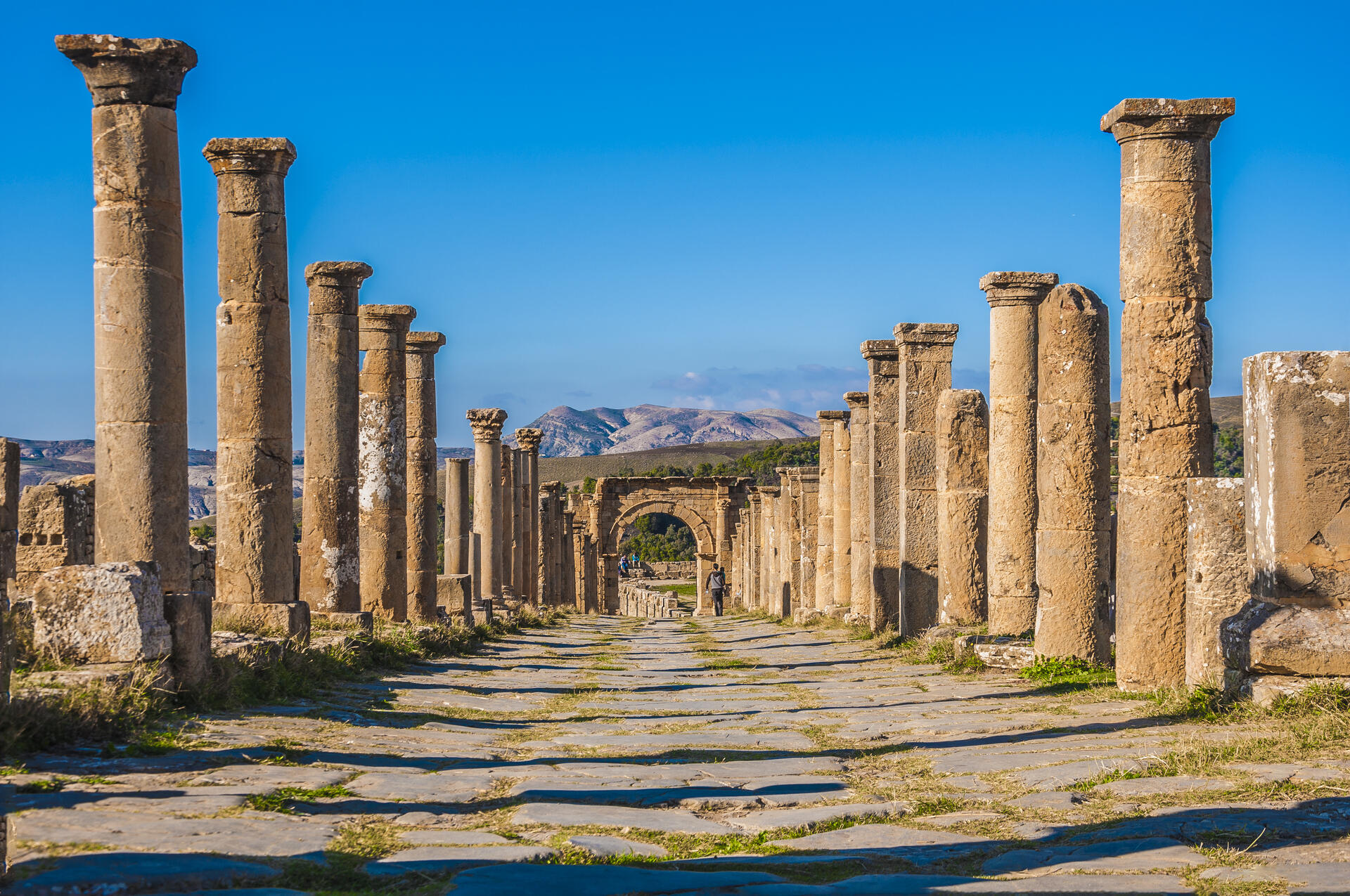
© Alioueche Mokhtar, CC BY-SA 4.0 Resized from original. (This derivative is under the same CC BY-SA license.)
World Heritage Research
Discover scientific research and academic studies that deepen our understanding of Djémila from its history and significance to its conservation, management, and contemporary challenges.
-
Le Vent à Djémila
A deep connection between archaeologist Yvonne Allais and the UNESCO World Heritage Site of Djémila is revealed, illustrating how her prolonged engagement with the site led to a profound identification with its Roman-era past. This study highlights the significance of personal immersion in archaeological research, showcasing Allais' contributions through her extensive work at Cuicul (Djémila) from 1925 onwards. Her life and career exemplify the symbiotic relationship between researchers and historical sites, offering insights into the emotional and intellectual dimensions of archaeological exploration.
Viccei, R. (2026). Le Vent à Djémila. Whims of the Wind, 179–192. https://doi.org/10.65272/978-88-6977-569-7_15
View Publication Record | Read Publication -
The Absence of Christian Iconography and the Presence of Roman Cult and Culture in the Baptismal Complex of Cuicul, Numidia
A study of the baptismal complex in Cuicul (Djémila, Algeria) reveals that the late Roman Christian community integrated Roman cultural and religious elements to strengthen its Nicene-Catholic identity during the Donatist conflict. The research finds that architectural features, such as a double church and baptistery, along with the use of Roman imagery and honorary titles, reflect a deliberate fusion of Roman tradition with Christian practice. This approach challenged theological strife by reinforcing communal unity through cultural continuity. The study also critiques allegorical interpretations, advocating for a nuanced understanding that incorporates literal, cultural, and socio-political dimensions.
(Ed.). (2025). The Absence of Christian Iconography and the Presence of Roman Cult and Culture in the Baptismal Complex of Cuicul, Numidia. Roman Identity and Lived Religion, 25–78. https://doi.org/10.1017/9781009408677.003
View Publication Record | Read Publication -
Documenting Ancient Materials for a Digital Materials Library Project. The Case of Three World Heritage Sites in Algeria
A comprehensive analysis of three Roman-era World Heritage Sites in Algeria—Timgad, Djémila, and Tipaza—reveals the prevalence of clay-based materials, natural mineral stones, and wood as primary construction components. The study identifies these materials' diverse applications and origins, including both local sourcing and imported trade networks, providing critical insights for restoration efforts. This research contributes to a Digital Materials Library (DML) project aimed at supporting stakeholders in heritage conservation by documenting ancient materials systematically. The findings highlight the importance of understanding material provenance and availability for future reconstruction, addressing key challenges in preserving Algeria's built and archaeological heritage.
Allaouchiche, S., Kacher, S., & Sanz-Arauz, D. (2025). Documenting Ancient Materials for a Digital Materials Library Project. The Case of Three World Heritage Sites in Algeria. International Journal of Architectural Heritage, 19(12), 3335–3358. https://doi.org/10.1080/15583058.2025.2495960
View Publication Record | Read Publication -
“Le monde finit toujours par vaincre l’histoire’’: recepção da antiguidade em Le vent à djemila (1938), de Albert Camus
Albert Camus's essay 'Le vent à Djémila' (1938) from his collection 'Noces' presents the antiquity of Djémila as a symbol of enduring beauty and permanence, contrasting with the transient nature of human history. The study reveals that Camus uses the ancient Roman ruins to evoke a profound philosophical reflection on mortality, suggesting that the only viable response to death is its courageous acceptance. This interpretation emerges from an analysis of key passages where antiquity serves as a lens to examine the tension between material existence and historical narrative. By framing Djémila's ruins as a representation of human desire for permanence, Camus challenges readers to confront the inevitability of time and change.
de Miranda, R. (2024). “Le monde finit toujours par vaincre l’histoire’’: recepção da antiguidade em Le vent à djemila (1938), de Albert Camus. Revista Canoa Do Tempo, 16(FC), 1–27. https://doi.org/10.38047/rct.v16.fc.2024.da9.p.1.27
View Publication Record | Read Publication -
Study of Repairs and Various Post-Seismic Interventions Carried Out in Ancient Sites in Algeria
Ancient Roman construction techniques in Algeria, particularly at sites like Djemila, Timgad, and Lambèse, reveal sophisticated post-seismic interventions that mirror those found in European counterparts such as Pompeii and Ostia. The study identifies a correlation between historical renovations and seismic activity, suggesting that Roman builders in North Africa adapted their methods to mitigate earthquake damage. This insight underscores the advanced engineering expertise of Roman civilizations, which extended across their vast territories. The research employed visual examinations and comparative analyses, drawing parallels between Algerian and Italian sites to reconstruct past repair strategies.
Benmehidi, S., & Bordjiba, A. (2024). Study of Repairs and Various Post-Seismic Interventions Carried Out in Ancient Sites in Algeria. Selected Scientific Papers - Journal of Civil Engineering, 19(1). https://doi.org/10.2478/sspjce-2024-0006
View Publication Record | Read Publication -
L'héritage paléochrétien en Afrique du Nord : cas des monuments de la région Est de l'Algérie
A groundbreaking study on the paleochristian heritage of eastern Algeria reveals the region's architectural richness, dating back to the 1st century AD and peaking in the 4th century. Focusing on emblematic sites like Theveste (Tébessa), Hippone (Annaba), Cuicul (Djémila), and Thamugadi (Timgad), the research employs advanced virtual restitution technologies to document, analyze, and preserve these monuments. This methodology offers a dynamic approach to heritage conservation, creating an evolving database that integrates new discoveries and interventions. The study also highlights the urgent need for legal protection and modernization of preservation strategies in Algeria, aiming to safeguard this invaluable cultural legacy for future generations.
Boughanem, F. Z. L’héritage paléochrétien en Afrique du Nord : cas des monuments de la région Est de l’Algérie. https://doi.org/10.70675/210af5baz9e5fz4209zb11cz6b41360763d7
View Publication Record | Read Publication -
Exergue
A new analysis of the exergue at Djémila reveals that urban Christian basilicas in Roman North Africa were part of larger 'episcopal groups,' suggesting a hierarchical structure within early Christian communities. These complexes, previously documented in major sites like Hippone and Timgad, likely extended to smaller cities as well, hinting at a more widespread architectural pattern. The study, based on archaeological findings from Djémila, proposes that further excavations could uncover more modest variants of these structures, offering deeper insights into the organization of early Christian churches across Africa.
Ben Abed-ben Kheder, A., Fixot, M., & Helfer-Lebert, L. (2023). Exergue. Sidi Jdidi III, ix–ix. https://doi.org/10.4000/books.efr.48269
View Publication Record | Read Publication