World Heritage Identification Number: 481
World Heritage since: 2001
Category: Cultural Heritage
WHE Type: Archaeological Sites
Transboundary Heritage: No
Endangered Heritage: No
Country: 🇱🇦 Lao People's Democratic Republic
Continent: Asia
UNESCO World Region: Asia and the Pacific
Map
Exploring the Ancient Khmer Civilization: Vat Phou and Associated Ancient Settlements within the Champasak Cultural Landscape
The Champasak Cultural Landscape, inscribed as a UNESCO World Heritage Site in 2001, offers a unique glimpse into the ancient Khmer civilization that thrived in Southeast Asia between the 5th and 15th centuries. This extensive cultural landscape, spanning approximately 10 kilometers, is centered around the Vat Phou Temple complex, located at the foot of Mount Phou Khao in southern Laos.
More to come…UNESCO Description of the World Heritage Site
The Champasak cultural landscape, including the Vat Phou Temple complex, is a remarkably well-preserved planned landscape more than 1,000 years old. It was shaped to express the Hindu vision of the relationship between nature and humanity, using an axis from mountain top to river bank to lay out a geometric pattern of temples, shrines and waterworks extending over some 10 km. Two planned cities on the banks of the Mekong River are also part of the site, as well as Phou Kao mountain. The whole represents a development ranging from the 5th to 15th centuries, mainly associated with the Khmer Empire.
UNESCO Justification of the World Heritage Site
Criterion (iii): The Temple Complex of Vat Phou bears exceptional testimony to the cultures of Southeast Asia, and in particular to the Khmer Empire, which dominated the region in the 9th–14th centuries.
Criterion (iv): The Vat Phou complex is an outstanding example of the integration of a symbolic landscape of great spiritual significance to its natural surroundings.
Criterion (vi): Contrived to express the Hindu version of the relationship between nature and humanity, Vat Phou exhibits a remarkable complex of monuments and other structures over an extensive area between river and mountain, some of outstanding architecture, many containing great works of art, and all expressing intense religious conviction and commitment.
Encyclopedia Record: Vat Phou
Vat Phou is a ruined Khmer-Hindu temple complex in southern Laos. There was a sanctuary on the site, centred on a spring and an offering place for a tutelary sprit dating back to pre-historic times. The first megalithic stone structures had been built probably as early as the second century BCE, consisting of two stone cells, a carving of a crocodile, serpent stairs, and offering platforms. One of the pre-Angkor brick buildings onsite was erected in the 7th century and became the focus of consequent building activities.Additional Site Details
Area: 39,000 hectares
Number of Components: 1
(iv) — Outstanding example of a type of building or landscape
(vi) — Directly associated with events or living traditions
Coordinates: 14.8483333333 , 105.8222222222
Image
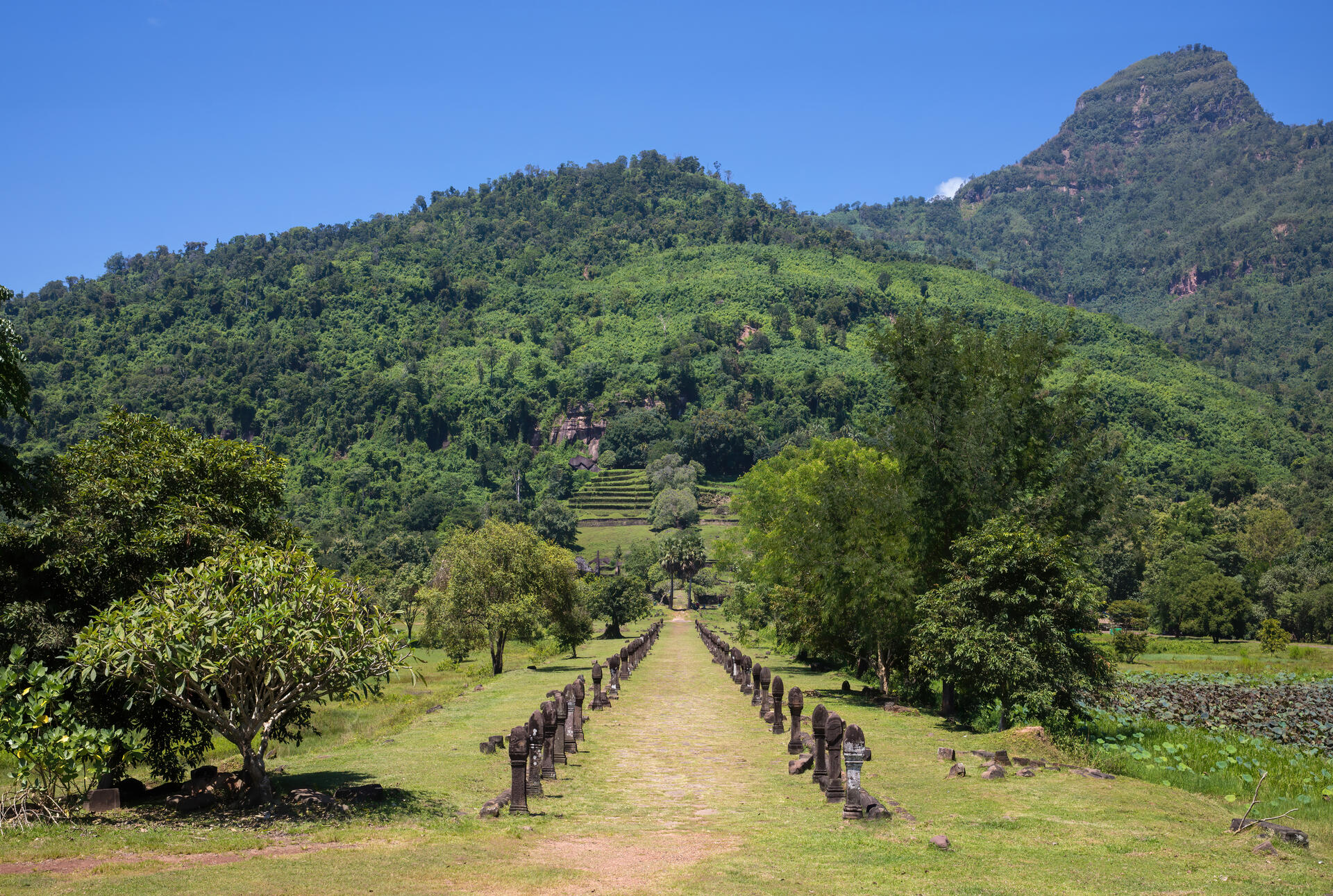
© Basile Morin, CC BY-SA 4.0 Resized from original. (This derivative is under the same CC BY-SA license.)
World Heritage Research
Discover scientific research and academic studies that deepen our understanding of Vat Phou and Associated Ancient Settlements within the Champasak Cultural Landscape from its history and significance to its conservation, management, and contemporary challenges.
-
Planning for the Development and Rehabilitation of the Sustainable Degraded Khmer Stone Sanctuary Site in Lao PDR Case Study: Archaeological Site “Tomo” Pathoumphone District, Champasak Province
A sustainable development model for the Oup Moung (Wat Tomo) archaeological site, a degraded Khmer stone sanctuary in Lao PDR, reveals that elevating it into a local museum with Anastylosis restoration can preserve its historical and cultural value while promoting heritage awareness. The study, employing mixed-methods surveys of local communities and stakeholders, identifies the site's unique 'Hin Nam Nor' architecture and Pre-Angkorian artifacts as key assets. It proposes a balanced approach to conservation and cultural tourism, controlling facility construction to maintain environmental harmony and prioritizing education to foster community income without compromising original cultural values. This research provides critical guidelines for government agencies in formulating management policies and strategic budget allocations.
VANIVONG, K. (2026). Planning for the Development and Rehabilitation of the Sustainable Degraded Khmer Stone Sanctuary Site in Lao PDR Case Study: Archaeological Site “Tomo” Pathoumphone District, Champasak Province. Souphanouvong University Journal Multidisciplinary Research and Development, 12(1), 34–39. https://doi.org/10.69692/sujmrd1234
View Publication Record | Read Publication -
Transnational Khmer cultural landscapes: A comparative analysis of symbols, belief systems, and communal structures in Vietnam, Cambodia, Thailand, and Laos
A comparative analysis of Khmer cultural symbols across Vietnam, Cambodia, Thailand, and Laos reveals distinct patterns of symbolization and identity formation. While Cambodia has nationalized the Khmer symbolic system as a cornerstone of its national identity, Vietnam's Khmer community acts as a soft agent of indigenization, preserving symbolic forms through rituals, temples, language, and performative practices. In contrast, Thailand and Laos have largely assimilated or excluded these symbols from public representation. The study proposes a three-tiered model of symbolic analysis—encompassing visual, functional, and mnemonic dimensions—and introduces a new approach to minority identity studies in regional contexts, highlighting the unique intermediary role of the Vietnamese Khmer within Southeast Asia's cultural architecture.
Ca, N. M., Diem, N. T., & Pham, H. T. (2025). Transnational Khmer cultural landscapes: A comparative analysis of symbols, belief systems, and communal structures in Vietnam, Cambodia, Thailand, and Laos. Edelweiss Applied Science and Technology, 9(6), 760–775. https://doi.org/10.55214/25768484.v9i6.7874
View Publication Record | Read Publication -
Cultural landscapes in Southeast Asia
Five UNESCO World Heritage Sites in Southeast Asia are recognized for their cultural landscape significance, highlighting the interplay between human ingenuity and ecological sustainability. These sites—Bali's Subak system, Vat Phou and its ancient settlements, the Philippines' rice terraces, Singapore Botanic Gardens, and Trang An landscape complex—demonstrate how traditional knowledge, ecosystem protection, and livelihood opportunities are crucial for their preservation. Unlike Borobudur, which relies on expert-led conservation, sites like the rice terraces depend on continuous community maintenance to survive. This underscores a broader need for integrating local practices with scientific conservation strategies to safeguard cultural landscapes, ensuring their enduring value.
Lin, R. C.-H., Unakul, M. H., & Chiba, M. (2023). Cultural landscapes in Southeast Asia. Routledge Handbook of Cultural Landscape Practice, 150–157. https://doi.org/10.4324/9781315203119-16
View Publication Record | Read Publication -
Characterization of Historic Bricks and Binder at Vat Phou World Heritage Site in Lao PDR and Selection of Compatible Replacement Units for Restoration
A groundbreaking study at Vat Phou, a UNESCO World Heritage Site in Lao PDR, reveals that natural wood resin, not lime, was used as the binder in historic brick masonry. This challenges traditional assumptions about mortar composition in Southeast Asia and provides empirical evidence for an alternative binding method. The research employed micro-analytical techniques, including X-ray diffraction and scanning electron microscopy, to characterize both the bricks and their binder. Additionally, physicomechanical tests ensured compatibility between historic and newly manufactured replacement bricks, guiding restoration practices. These findings offer critical insights for preserving similar sites across the Mekong River Basin region.
Manohar, S., Shukla, S., Menon, A., & Santhanam, M. (2020). Characterization of Historic Bricks and Binder at Vat Phou World Heritage Site in Lao PDR and Selection of Compatible Replacement Units for Restoration. Current Science, 119(8), 1300. https://doi.org/10.18520/cs/v119/i8/1300-1307
View Publication Record | Read Publication -
Institutional dynamics and adaptive capacity in world heritage management: case studies from Southeast Asia
World Heritage site management institutions face increasing complexity due to evolving heritage concepts and global threats, yet many struggle to adapt. A refined framework for adaptive capacity is proposed, identifying six key factors—cognitive frame, learning capacity, formal governance structures, organizational relations, agency, and resources—that shape institutional dynamics. This study, focusing on three Southeast Asian sites (Vat Phou in Lao PDR, Ayutthaya in Thailand, and George Town in Malaysia), demonstrates that while adaptive change concepts are useful beyond climate contexts, existing frameworks fall short of capturing dynamic processes. The research suggests restructuring World Heritage policy to address the growing complexity of heritage conservation.
Unakul, M. Institutional dynamics and adaptive capacity in world heritage management: case studies from Southeast Asia. https://doi.org/10.58837/chula.the.2019.528
View Publication Record | Read Publication