World Heritage Identification Number: 1441
World Heritage since: 2014
Category: Cultural Heritage
WHE Type: Infrastructure & Industry
Transboundary Heritage: No
Endangered Heritage: No
Country: 🇳🇱 Netherlands (Kingdom of the)
Continent: Europe
UNESCO World Region: Europe and North America
Map
A Landmark of Modern Industrial Architecture: Van Nellefabriek
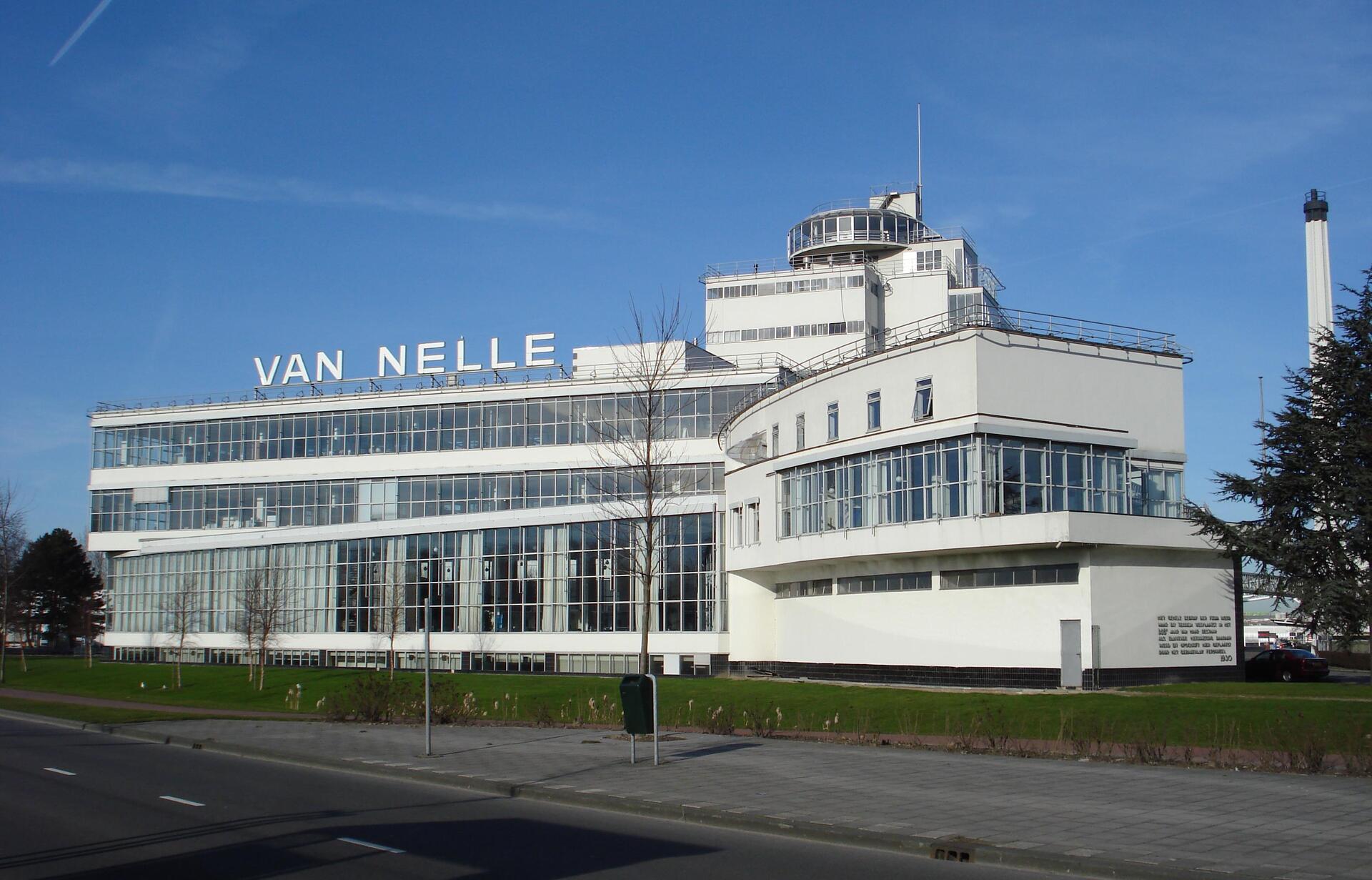
The Van Nellefabriek, located in the Spaanse Polder industrial zone north-west of Rotterdam, stands as a testament to the evolution of industrial architecture in the 20th century. This iconic site, inscribed as a UNESCO World Heritage Site in 2014, exemplifies the modernist and functionalist ethos that characterized the inter-war period.
More to come…UNESCO Description of the World Heritage Site
Van Nellefabriek was designed and built in the 1920s on the banks of a canal in the Spaanse Polder industrial zone north-west of Rotterdam. The site is one of the icons of 20th-century industrial architecture, comprising a complex of factories, with façades consisting essentially of steel and glass, making large-scale use of the curtain wall principle. It was conceived as an ‘ideal factory’, open to the outside world, whose interior working spaces evolved according to need, and in which daylight was used to provide pleasant working conditions. It embodies the new kind of factory that became a symbol of the modernist and functionalist culture of the inter-war period and bears witness to the long commercial and industrial history of the Netherlands in the field of importation and processing of food products from tropical countries, and their industrial processing for marketing in Europe.
UNESCO Justification of the World Heritage Site
Criterion (ii): The Van Nellefabriek brings together and makes use of technical and architectural ideas originating from various parts of Europe and North America in the early 20th century. It is exceptionally successful both in terms of its industrial setup and its degree of architectural and aesthetic accomplishment. It represents an exemplary contribution by the Netherlands to the Modernism of the inter-war years, and has since its construction become an emblematic example and an influential reference throughout the world.
Criterion (iv): In the context of industrial architecture in the first half of the 20th century, the Van Nellefabriek is an outstanding illustration of the values of relationships with the environment, the rational organisation of production flows, and dispatch via the nearby communication network, maximum admission of daylight to the internal spaces via the widespread use of a glass curtain wall with metal frames, and open interior spaces. It expresses the values of clarity, fluidity and the opening up of industry to the outside world.
Encyclopedia Record: Van Nelle Factory
The former Van Nelle Factory on the Schie in Rotterdam, is considered a prime example of the modernist and functionalist architecture. It has been a designated UNESCO World Heritage Site since 2014. Soon after it was built, prominent architects described the factory as "the most beautiful spectacle of the modern age" and "a poem in steel and glass".Additional Site Details
Area: 6.94 hectares
Number of Components: 1
(iv) — Outstanding example of a type of building or landscape
Coordinates: 51.9244444444 , 4.4325
World Heritage Research
Discover scientific research and academic studies that deepen our understanding of Van Nellefabriek from its history and significance to its conservation, management, and contemporary challenges.
-
Post-industrial transformation under the pressure of heritage, water, and gentrification: a comparative study of Gdańsk, Rome, and Rotterdam
Successful adaptive reuse of post-industrial waterfront areas hinges on integrated governance, long-term planning, and active public-sector involvement—not just location alone. A comparative study of Gdańsk Shipyard (Poland), Rome's Ostiense district (Italy), and Rotterdam's Van Nelle Factory (Netherlands) reveals that fragmented ownership and market-driven development often intensify gentrification, limiting social accessibility. The research highlights the need for institutional continuity, heritage protection regimes, and cultural industries to balance regeneration with inclusivity. Findings offer actionable recommendations for policymakers aiming to achieve sustainable waterfront revitalization amid climate change pressures.
Rubczak, A. (2026). Transformacja obszarów poprzemysłowych pod presją dziedzictwa, wody i gentryfikacji: studium porównawcze Gdańska, Rzymu i Rotterdamu. Rozwój Regionalny I Polityka Regionalna, (79), 127–144. https://doi.org/10.14746/rrpr.2026.79.08
View Publication Record | Read Publication -
Archival Challenges for the Van Nelle Factory
A landmark achievement in heritage preservation, the transfer of the Van Nelle Factory's redevelopment archive to Rotterdam City Archive ensures long-term conservation and public accessibility. This case study highlights the critical role of archives in safeguarding modern World Heritage Sites (WHS), offering a model for other protected sites facing similar challenges. The research examines the documentation process, emphasizing its importance in preserving historical integrity while addressing practical archival hurdles. By analyzing the Van Nelle Factory's redevelopment, the study underscores the need for systematic archival practices to support heritage conservation efforts globally.
Van Hevele, E., & De Jonge, W. (2024). Archival Challenges for the Van Nelle Factory. Docomomo Journal, (70), 96–101. https://doi.org/10.52200/docomomo.70.12
View Publication Record | Read Publication