World Heritage Identification Number: 1548
World Heritage since: 2017
Category: Cultural Heritage
WHE Type: Archaeological Sites
Transboundary Heritage: No
Endangered Heritage: No
Country: 🇧🇷 Brazil
Continent: Americas
UNESCO World Region: Latin America and the Caribbean
Map
Tracing the Legacy of the Valongo Wharf Archaeological Site: A Testimony to the Transatlantic Slave Trade
The Valongo Wharf Archaeological Site, inscribed as a UNESCO World Heritage Site in 2017, offers a poignant glimpse into one of the darkest chapters in human history – the transatlantic slave trade. Located in central Rio de Janeiro, this significant historical landmark stands as a testament to the resilience, endurance, and cultural richness that African descendants have brought to the Americas.
More to come…UNESCO Description of the World Heritage Site
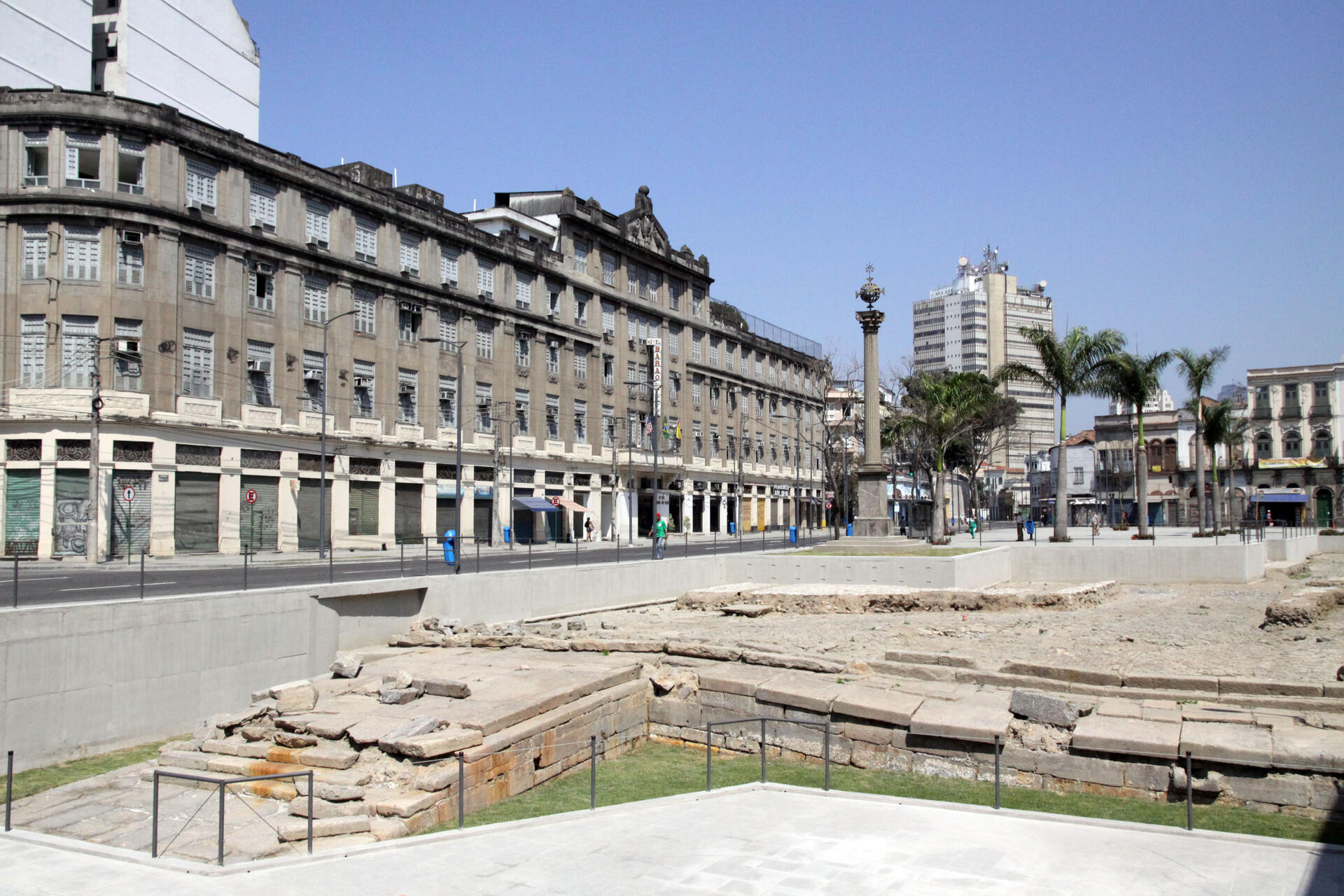
Valongo Wharf Archaeological Site is located in central Rio de Janeiro and encompasses the entirety of Jornal do Comércio Square. It is in the former harbour area of Rio de Janeiro in which the old stone wharf was built for the landing of enslaved Africans reaching the South American continent from 1811 onwards. An estimated 900,000 Africans arrived in South America via Valongo. The site is composed of several archaeological layers, the lowest of which consists of floor pavings in pé de moleque style, attributed to the original Valongo Wharf. It is the most important physical trace of the arrival of African slaves on the American continent.
UNESCO Justification of the World Heritage Site
Criterion (vi): Valongo Wharf is the most important physical evidence associated with the historic arrival of enslaved Africans on the American continent. It is a site of conscience, which illustrates strong and tangible associations to one of the most terrible crimes of humanity, the enslavement of hundreds of thousands of people creating the largest forced migration movement in history. As the very location the African stepped onto American soil and with it into their new lives as enslaved labour, the site evokes painful memories, which many African Brazilians can strongly relate to. Preserving these memories, the vicinity of Valongo Wharf has become an arena for various manifestations celebrating African heritage on an ongoing basis.
Encyclopedia Record: Valongo Wharf
The Valongo Wharf (Portuguese: Cais do Valongo) is an old dock located in the port area of Rio de Janeiro, between the current Coelho e Castro and Sacadura Cabral streets. Built in 1811, it was the site of landing and trading of enslaved Africans until 1831, with the blockade of Africa banning the Atlantic slave trade to Brazil.Additional Site Details
Area: 0.3895 hectares
Number of Components: 1
Coordinates: -22.8971111111 , -43.1873944444
Image
© Halley Pacheco de Oliveira, CC BY-SA 3.0 Resized from original. (This derivative is under the same CC BY-SA license.)
World Heritage Research
Discover scientific research and academic studies that deepen our understanding of Valongo Wharf Archaeological Site from its history and significance to its conservation, management, and contemporary challenges.
-
Caminhos e descaminhos do patrimônio arqueológico do Cais do Valongo (Rio de Janeiro)
Valongo Wharf, recognized as the most significant physical evidence of enslaved Africans' arrival in the Americas by UNESCO, faces critical challenges in preservation and public recognition despite its 2017 World Heritage designation. Research reveals that coordination gaps between government levels, insufficient funding, and policy implementation delays hinder the site's potential as a memory site for African diaspora history. The absence of an interpretation center further limits educational opportunities on slavery and contemporary race issues. This analysis, based on judicial and administrative proceedings, underscores the need for stronger governance to fully realize Valongo Wharf's heritage value.
Gardenghi Suiama, S. (2025). Caminos y desvíos del patrimonio arqueológico del Muelle de Valongo (Río de Janeiro). Vestígios - Revista Latino-Americana de Arqueologia Histórica, 19(2), 91–112. https://doi.org/10.31239/rap61667
View Publication Record | Read Publication -
Some Thoughts on the Human Valuing of Amber, Past and Present
Recent archaeological findings from the Valongo Wharf site in Rio de Janeiro and an historic cemetery in New York reveal significant insights into the human valuation of amber, spanning millennia. These discoveries highlight amber's role in artisanal practices, trade, and cultural exchange, particularly within African and diasporic communities. The study integrates sourcing, manufacture, usage, and display methods, offering a nuanced understanding of how amber has been cherished and shared across different societies. By analyzing these elements, the research sheds light on the enduring significance of amber in both private and public contexts, from Neolithic times to the present.
Causey, F. (2024). Kilka uwag o wartości bursztynu dla ludzkości dawniej i dziś. Porta Aurea, (23), 226–239. https://doi.org/10.26881/porta.2024.23.12
View Publication Record | Read Publication -
Lugar de Memória, Lugar de Consciência: O Cais do Valongo e o debate sobre a escravidão no espaço público
The Valongo Wharf Archaeological Site has emerged as a significant 'site of memory' and 'site of consciousness,' offering profound reflections on slavery's legacy. Since its excavation in 2011, the site has sparked ongoing debates about slavery in public spaces, emphasizing its role in historical awareness. The study analyzes the site's candidacy for UNESCO World Heritage status, focusing on three objectives that aim to enhance its visibility and understanding. These objectives are evaluated based on their development since the site's discovery, highlighting the wharf's importance as a reference point for confronting sensitive pasts. The research employs a critical approach, drawing from PhD-level investigations to explore problematic issues arising from the site's historical significance.
Rios, D. (2023). Site of memory, site of consciousness: the Valongo Wharf and the debate about slavery in public space. Revista Do Arquivo Geral Da Cidade Do Rio de Janeiro, (25), 74–105. https://doi.org/10.65625/3077qb29
View Publication Record | Read Publication -
Sensitive memories at a World Heritage Site
A study reveals that individual narratives about the Valongo Wharf Archaeological Site, recognized as a UNESCO World Heritage Site, expose decolonial perspectives and forms of resistance against structural racism. The research analyzes how the heritagization process shapes life stories, highlighting the emergence of identifications with black collectivities and the silencing of discriminatory practices rooted in coloniality. By examining the constructed narrative of value for Valongo Wharf's inclusion on the UNESCO list and its relation to the nearby New African Cemetery, the study adopted a listening approach to uncover complex pasts and changing attitudes. This work underscores the significance of personal narratives in displacing centralities and illuminating structural inequalities.
Chuva, M., Aguiar, L. B., & Fonseca, B. C. (2021). Sensitive memories at a World Heritage Site. Decolonizing Colonial Heritage, 175–192. https://doi.org/10.4324/9781003100102-12
View Publication Record | Read Publication -
Heritage Sites: How Afro-Brazilian and Indigenous Communities Leverage Archaeology and Architecture to Protect Their Histories and Challenge the Hegemonic Heritage Discourse
During the construction for the 2016 Rio de Janeiro Olympics, the Valongo Wharf Archaeological Site reemerged as a significant historical landmark, representing the main port of entry for enslaved Africans in the Americas. This study highlights how Afro-Brazilian and Indigenous communities are leveraging archaeology and architecture to protect their histories and challenge dominant heritage narratives. The research focuses on the resurfacing of the Valongo Wharf in 2011 and the state government's attempt to demolish the Museu do Índio, a site crucial for discussing and promoting Brazilian Indigenous cultures. By analyzing these events, the study underscores the communities' agency in preserving their heritage against hegemonic discourses, offering insights into the intersection of archaeology, architecture, and cultural resistance.
Querin, C. (2020). Heritage Sites: How Afro-Brazilian and Indigenous Communities Leverage Archaeology and Architecture to Protect Their Histories and Challenge the Hegemonic Heritage Discourse. Latin American and Latinx Visual Culture, 2(1), 82–91. https://doi.org/10.1525/lavc.2020.210007
View Publication Record | Read Publication -
Valongo
Valongo Wharf serves as a powerful symbol of Brazil's complex relationship with its history of slavery and racial inequality. The site, which has been the focus of archaeological and sociopolitical action, reveals uncomfortable truths about the subjugation of Black people by Whites that persist in collective memory. This study highlights the challenges and limitations faced by White archaeologists in investigating such sensitive sites, emphasizing the need for Afro-descendants to take a more active role in the recovery and interpretation of their own past. By examining Valongo Wharf's significance, the research sheds light on contemporary issues of racial recognition, social justice, and the ongoing struggle for fundamental rights for Brazil's Black population.
Lima, T. A. (2020). Valongo. Current Anthropology, 61(S22), S317–S327. https://doi.org/10.1086/709820
View Publication Record | Read Publication