World Heritage Identification Number: 124
World Heritage since: 1980
Category: Cultural Heritage
WHE Type: Historic Cities & Urban Areas
Transboundary Heritage: No
Endangered Heritage: No
Country: 🇧🇷 Brazil
Continent: Americas
UNESCO World Region: Latin America and the Caribbean
Map
A Glimpse into the Rich History of the Historic Town of Ouro Preto, Brazil
The Historic Town of Ouro Preto, nestled within the Serra do Espinhaço mountain range in the state of Minas Gerais, Brazil, stands as a testament to the country's rich historical and cultural heritage. Established at the end of the 17th century during the height of the Brazilian gold rush, this once bustling mining town has since evolved into a UNESCO World Heritage Site, renowned for its exceptional Baroque architecture.
More to come…UNESCO Description of the World Heritage Site
Founded at the end of the 17th century, Ouro Preto (Black Gold) was the focal point of the gold rush and Brazil’s golden age in the 18th century. With the exhaustion of the gold mines in the 19th century, the city’s influence declined but many churches, bridges and fountains remain as a testimony to its past prosperity and the exceptional talent of the Baroque sculptor Aleijadinho.
UNESCO Justification of the World Heritage Site
Criterion (i): Set in a remote and rugged landscape, the aesthetic quality of the vernacular and erudite architecture and irregular urban pattern of Ouro Preto makes the town a treasure of human genius. The most notable of the city’s architectural works are represented by the religious monuments and administrative buildings, including the Palácio dos Governadores (Governors’ Palace), today the School of Mines, and the former Casa de Câmara e Cadeia (Administrative and Prison House), home to the Inconfidência Museum. The Baroque churches carry sculptures by Antônio Francisco Lisboa, Aleijadinho, colonial Brazil’s greatest artist, and the ceiling paintings of Manuel da Costa Athaide among others. These were the representatives of the initial expressions of an artistic form deemed genuinely national and developed in a region marked by difficult access and a scarcity of materials and labor in the 18th century.
Criterion (iii): The built heritage of the Historic City of Ouro Preto bears exceptional testimony to the creative talents of a society built on pioneering mining wealth under Portuguese colonial rule. Although the architecture, paintings, and sculptures are based on underlying models introduced by Portuguese immigrants, the works vary significantly from the contemporary European art, not only with respect to their spatial conception, but in their decorative treatment, in particular the stone sculptures carved on the facades, distinctive for their originality and design and in the combined use of two materials, gneiss and soapstone. The absence of formal convents or monasteries, due to the edict of the Portuguese Crown which prohibited the establishment of religious orders in Minas Gerais, led to the construction of churches and chapels displaying the full splendor, quality, and originality of the syncretized artistic traditions of two cultures.
Encyclopedia Record: Ouro Preto
Ouro Preto, formerly Vila Rica, is a municipality in the state of Minas Gerais, Brazil. The city, a former colonial mining town located in the Serra do Espinhaço mountains, was designated a World Heritage Site by UNESCO due to its Baroque colonial architecture. Ouro Preto used to be the capital of Minas Gerais from 1720 until the foundation of Belo Horizonte in 1897.Additional Site Details
Area: 167.8 hectares
Number of Components: 1
(iii) — Unique or exceptional testimony to a cultural tradition
Coordinates: -20.38888889 , -43.50555556
Image
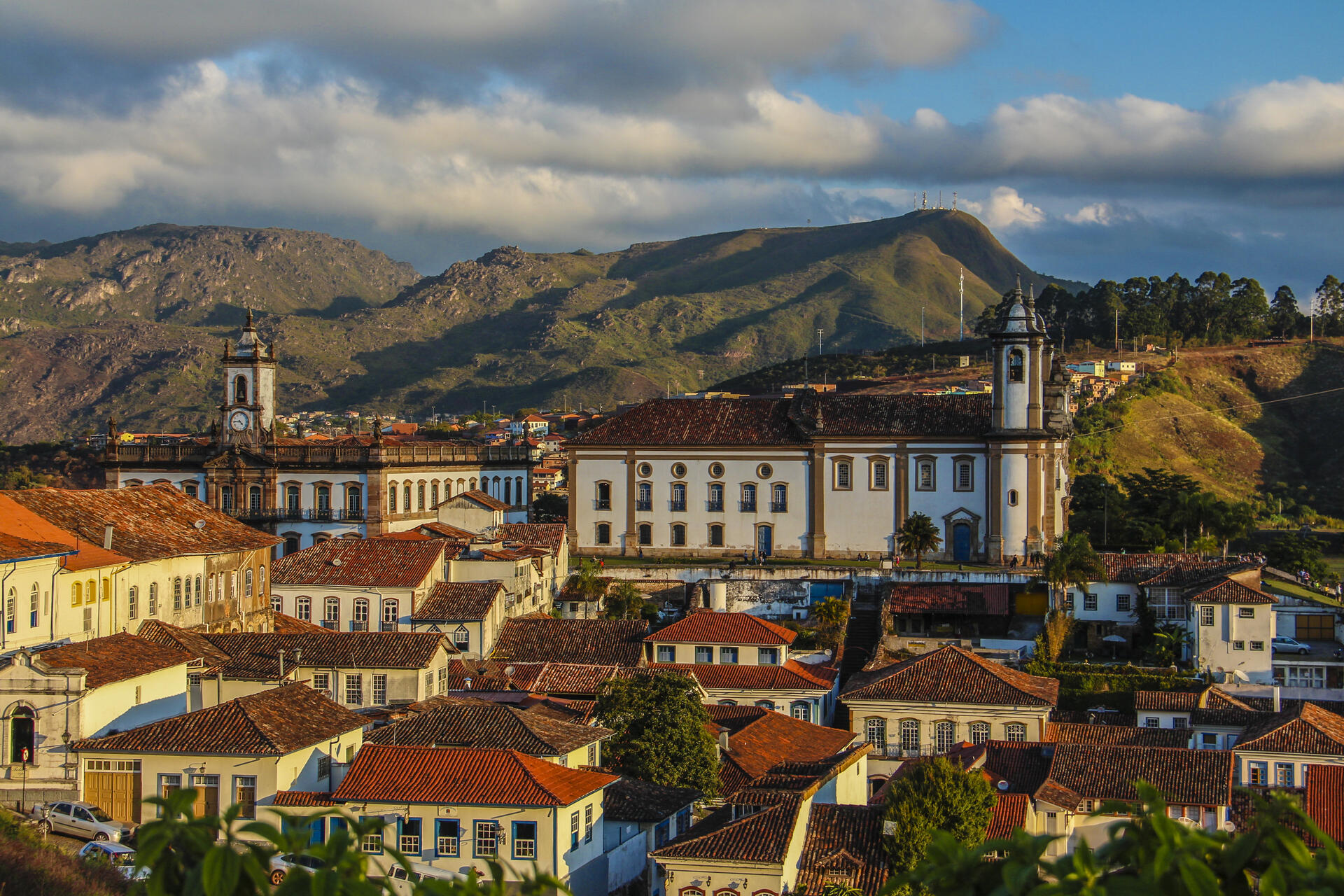
© Raquel Mendes Silva, CC BY-SA 4.0 Resized from original. (This derivative is under the same CC BY-SA license.)
World Heritage Research
Discover scientific research and academic studies that deepen our understanding of Historic Town of Ouro Preto from its history and significance to its conservation, management, and contemporary challenges.
-
Slavery and Sociability in a House on the Direita Street in Ouro Preto, Minas Gerais/Brazil, XVIII-XIX Centuries
Parietal drawings discovered in the basement of a house on Direita Street in Ouro Preto, Minas Gerais, Brazil, are interpreted as representing episodes from the life of an enslaved African woman from the Mina Coast (presently Togo, Benin, and Nigeria). These inscriptions likely formed part of a mortuary panel dedicated to her memory, offering a rare glimpse into the experiences of Africans in the region during the 18th and 19th centuries. The study connects the dwelling houses on Direita Street to broader urban sociability, examining the social and economic dynamics of Vila Rica within the Captaincy of Minas. Through extensive documentation—including registry office records, city council documents, parish records, and tribute records—the research reconstructs the woman's life trajectory, shedding light on her agency and interrelationships within a context of subjugation, neighborhood, friendship, and kinship.
ANDRADE, F. E. D., & SOARES, M. D. C. (2026). Slavery and Sociability in a House on the Direita Street in Ouro Preto, Minas Gerais/Brazil, XVIII-XIX Centuries. Varia Historia, 42. https://doi.org/10.1590/0104-87752026v42e26026
View Publication Record | Read Publication -
AltarData: A novel annotated dataset for object detection in the Brazilian heritage altars using deep learning
A novel annotated dataset, AltarData, achieves high accuracy in object detection within Brazilian heritage altars using deep learning, with validation accuracies reaching up to 97.3% for tabernacles and an F1-score of 79% in test experiments. This breakthrough addresses a critical gap in available datasets for cultural heritage research, enabling advancements in automatic digital documentation and technological inspections of historical churches. The dataset comprises 1278 high-quality images from 33 churches across Brazil, including three UNESCO World Heritage Sites, with annotations covering six key altar components: altar table, column, crucifix, saint sculpture, tabernacle, and throne. A deep learning approach with hyperparameter tuning was employed to optimize object recognition, demonstrating the potential for multi-object detection in interior environments of historical religious buildings.
Ottoni, A. L. C., & Ottoni, L. T. C. (2026). AltarData: A novel annotated dataset for object detection in the Brazilian heritage altars using deep learning. Journal of Cultural Heritage, 81, 248–259. https://doi.org/10.1016/j.culher.2026.07.024
View Publication Record | Read Publication -
Between the Square and the Pentagram: Some Reflections on the Music and Architecture of the Old Ouro Preto
Ouro Preto's cultural heritage emerges from the interplay between its architecture and music, creating a unique legacy that reflects both national history and artistic evolution. The study reveals how the town's architectural transformations, marked by colonial Baroque and Rococo styles, paralleled the development of local musical practices during the 18th century. While the stylistic directions diverged, their complementary relationship fostered a distinct cultural identity preserved today. This interplay highlights the significance of Ouro Preto as a site where architecture and music coalesced to shape national society and history.
Fonseca, М. Flávio Chagas. (2024). Between the Square and the Pentagram: Some Reflections on the Music and Architecture of the Old Ouro Preto. Cuadernos Iberoamericanos, 12(1), 35–46. https://doi.org/10.46272/2409-3416-2024-12-1-35-46
View Publication Record | Read Publication -
ImageOP: The Image Dataset with Religious Buildings in the World Heritage Town of Ouro Preto for Deep Learning Classification
A new image dataset, ImageOP, comprising 1613 images of religious buildings from Ouro Preto, the first Brazilian UNESCO World Heritage Site, achieves high accuracy in deep learning classification. Using EfficientNet B0 and MobileNet V2 architectures, the dataset demonstrated exceptional performance with an accuracy of 94.5%, precision, recall, and F-score of 96.0% in simulations. Real-time mobile device testing confirmed its effectiveness, achieving 88.0% average accuracy across nine monuments. This advancement addresses a critical gap in datasets for Brazilian religious building classification, offering potential for heritage digitization and conservation applications.
Ottoni, A. L. C., & Ottoni, L. T. C. (2024). ImageOP: The Image Dataset with Religious Buildings in the World Heritage Town of Ouro Preto for Deep Learning Classification. Heritage, 7(11), 6499–6525. https://doi.org/10.3390/heritage7110302
View Publication Record | Read Publication -
Deciphering the footprint of Emil Grosse from Germany to Brazil: a brief review
A previously overlooked chapter of German-Brazilian geoscientific collaboration comes to light through documentation of Emil Grosse's work at the Fábrica mine (later Ferteco) in Ouro Preto, Brazil. This study reveals that Grosse, a German geologist, conducted significant fieldwork on banded iron formations (BIFs) in the Quadrilátero Ferrífero between 1936 and 1949, including during World War II, yet his contributions remained largely unknown until now. The research reconstructs his trajectory from Colombia to Brazil, highlighting his role in validating iron deposits for a German-owned subsidiary while living between Peine (Germany) and Belo Horizonte (Brazil). Key findings include the first recorded evidence of Grosse's work in Brazil, his 1946 publication on the Fábrica mine, and his eventual permanent residency in Germany. The study bridges historical gaps using archival records, offering new insights into transatlantic geoscientific exchanges during a pivotal period.
Velásquez Ruiz, F., Weber Scharff, M., & Cuadros Jimenez, F. (2023). Deciphering the footprint of Emil Grosse from Germany to Brazil: a brief review. Revista de La Academia Colombiana de Ciencias Exactas, Físicas Y Naturales. https://doi.org/10.18257/raccefyn.1908
View Publication Record | Read Publication -
An Assessment of Fire Hazard in the Historic Town of Ouro Preto based on Four Established Analysis Methodologies
A high fire risk has been identified in the historic center of Ouro Preto, Brazil, with most buildings in the studied block demonstrating insufficient fire safety measures. This assessment was conducted using four established methodologies—Ebrafire, Chichorro, Gretener, and Multi-criteria—which revealed discrepancies in their fire hazard evaluations but collectively underscored the urgent need for mitigation actions to reduce fire risk in this UNESCO World Heritage Site. The study, though preliminary, highlights critical vulnerabilities that could threaten the preservation of this culturally significant area.
Gustavo Von, K. P., José, S. F., Esteves, L. E., Tomich Magalhães, F. A. R., Ana Carolina, C., Crisley Nayanne, O., & Luana Oliveira, G. (2022). An Assessment of Fire Hazard in the Historic Town of Ouro Preto based on Four Established Analysis Methodologies. Global Journal of Human-Social Science, 1–8. DWT. https://doi.org/10.34257/gjhssbvol21is4pg1
View Publication Record | Read Publication -
The Challenge of Accessibility in Historic Towns: The Case of Tiradentes Square in Ouro Preto - Brazil
Efforts to improve accessibility in Tiradentes Square, the heart of Ouro Preto—a UNESCO World Heritage Site renowned for its Portuguese colonial architecture—have fallen short. Despite interventions in 2008 aimed at leveling the square's terrain, the study found that these changes were insufficient to fully address accessibility challenges. The research employed a literature review and case study analysis, examining historical contexts of disability rights from colonization through the mid-18th century alongside Ouro Preto’s urban development. Findings underscore the need for more comprehensive accessibility solutions in historic towns, balancing preservation with inclusive design.
Carla do Nascimento Dias, M., Pereira Quinelato, P., Alberto Barroso Castañon, J., & Teresa Gomes Barbosa, M. (2022). The Challenge of Accessibility in Historic Towns: The Case of Tiradentes Square in Ouro Preto - Brazil. Advances in Ergonomics in Design, Usability & Special Populations: Part III. https://doi.org/10.54941/ahfe1001324
View Publication Record | Read Publication