
World Heritage Identification Number: 1532
World Heritage since: 2017
Category: Cultural Heritage
WHE Type: Archaeological Sites
Transboundary Heritage: No
Endangered Heritage: No
Country: 🇰🇭 Cambodia
Continent: Asia
UNESCO World Region: Asia and the Pacific
Map
Exploring the Temple Zone of Sambor Prei Kuk: A Glimpse into Ancient Ishanapura
The Temple Zone of Sambor Prei Kuk, officially recognized as the Archaeological Site of Ancient Ishanapura, offers a captivating window into the rich history of the Chenla Empire, which thrived during the late 6th and early 7th centuries AD. Located in Kampong Thom Province, approximately 30 kilometers north of Kampong Thom and 176 kilometers east of Angkor, this remarkable site was designated a UNESCO World Heritage Site in 2017.
More to come…UNESCO Description of the World Heritage Site
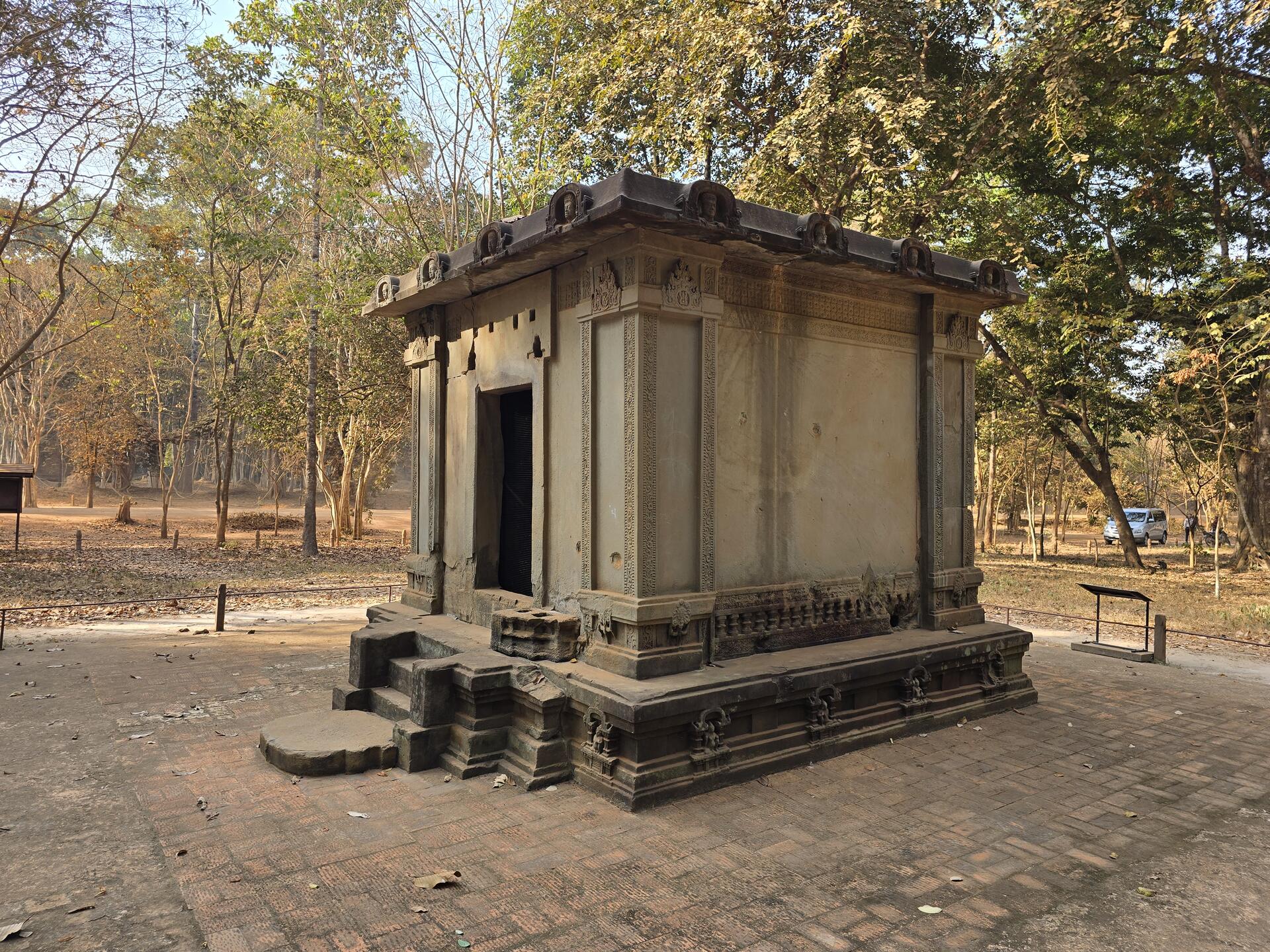
The archaeological site of Sambor Prei Kuk, “the temple in the richness of the forest” in the Khmer language, has been identified as Ishanapura, the capital of the Chenla Empire that flourished in the late 6th and early 7th centuries AD. The property comprises more than a hundred temples, ten of which are octagonal, unique specimens of their genre in South-East Asia. Decorated sandstone elements in the site are characteristic of the pre-Angkor decorative idiom, known as the Sambor Prei Kuk Style. Some of these elements, including lintels, pediments and colonnades, are true masterpieces. The art and architecture developed here became models for other parts of the region and lay the ground for the unique Khmer style of the Angkor period.
UNESCO Justification of the World Heritage Site
Criterion (ii): The Sambor Prei Kuk architectural and artistic style of the Temple Zone of Ishanapura, as exemplified in the layout, architectural forms and sculptured reflects on 186 fired bricks temples with sandstone detailing, presents a vivid convergence of spiritual and technical influences between Hindu cults predominantly from India and Persia and elements of animism and Buddhism, which became a model that spread to other parts of the region and eventually led to the crystallization of the unique Khmer style of the Angkorian period.
Criterion (iii): The Temple Zone of Sambor Prei Kuk of Ancient Ishanapura, in terms of the scale and scope of its surviving buildings and watercourses, is an outstanding testimony to the cultural traditions of the Chenla Kingdom, which flourished over much of Southeast Asia in the late 6th and early 7th centuries AD, and whose architectural achievements laid the foundations for those of the later Khmer civilization in the Angkorian period.
Criterion (vi): The temple inscriptions in the Khmer language of the Temple Zone of Sambor Prei Kuk reflect the concept of the God-King, which according to legends originated in Vat Phou, was further developed during the Angkor period, and then much later influenced Thailand’s four pillared administrative system in Ayutthaya. It remained a concept that was fundamental to the political and governance systems of Cambodia and Thailand until the beginning of the 20th century.
Encyclopedia Record: Sambor Prei Kuk
Sambor Prei Kuk (Isanapura) is an archaeological site in Cambodia located in Kampong Thom Province, 30 km (19 mi) north of Kampong Thom, the provincial capital, 176 km (109 mi) east of Angkor and 206 km (128 mi) north of Phnom Penh. The now ruined complex dates back to the Pre-Angkorian Chenla Kingdom, established by king Isanavarman I as central royal sanctuary and capital, known then as "Isanapura". In 2017, Sambor Prei Kuk was declared a UNESCO World Heritage Site.Additional Site Details
Area: 840.03 hectares
Number of Components: 1
(iii) — Unique or exceptional testimony to a cultural tradition
(vi) — Directly associated with events or living traditions
Coordinates: 12.8725 , 105.0430555556
World Heritage Research
Discover scientific research and academic studies that deepen our understanding of Temple Zone of Sambor Prei Kuk, Archaeological Site of Ancient Ishanapura from its history and significance to its conservation, management, and contemporary challenges.
-
Large Terrace Structure Unearthed in the Heart of the City Zone of Īśānapura: Could It Be the ‘Great Hall’ Described in the Book of Sui?
Recent archaeological excavations at the UNESCO World Heritage Site of Sambor Prei Kuk, identified as the ancient capital Īśānapura of the Chenla Kingdom, have uncovered a large terrace structure that may correspond to the 'Great Hall' described in the 7th-century Book of Sui. Radiocarbon dating places its construction between the mid-6th and mid-7th centuries, aligning with the period when Īśānapura flourished as a political hub before the rise of the Angkor Empire. The structure's unique configuration, situated within the city zone rather than the eastern temple area, suggests it served an administrative function. LiDAR analysis further revealed linear features extending eastward, indicating a possible larger administrative compound. These findings challenge previous assumptions about the site's urban layout and provide new insights into the political architecture of early Khmer civilization.
Ichita, S., Vitharong, C., & Menghong, C. (2025). Large Terrace Structure Unearthed in the Heart of the City Zone of Īśānapura: Could It Be the ‘Great Hall’ Described in the Book of Sui? Heritage, 8(7), 258. https://doi.org/10.3390/heritage8070258
View Publication Record | Read Publication -
Prasat Sambor as a Prototype of the Pyramidal State-Temple in Khmer Temple Construction
Recent comprehensive field research at the UNESCO World Heritage Site of Sambor Prei Kuk has uncovered three distinct temple complexes—Prasat Sambor, Prasat Yeai Poeun, and Prasat Tao—that represent a pivotal prototype in Khmer temple architecture. These square enclosures with central shrines and adjacent precincts laid the foundation for the complex temple designs that later flourished during the Angkorian period, culminating in iconic structures like Angkor Wat. Analysis of Prasat Sambor's dimensional layout revealed its role as an early pyramidal state-temple, serving as a central religious facility while also elucidating the planning techniques and construction units used in its design. This study sheds light on the architectural evolution from pre-Angkorian single-brick shrines to the sophisticated temple complexes that defined Khmer civilization.
Ichita, S. (2021). Prasat Sambor as a Prototype of the Pyramidal State-Temple in Khmer Temple Construction. Archaeological Discovery, 09(01), 52–83. https://doi.org/10.4236/ad.2021.91003
View Publication Record | Read Publication -
Damage Assessment and Guidelines for Restoration Methods of Ancient Brick Structures at Sambor Prei Kuk, Cambodia
A comprehensive damage assessment of the 286 ancient brick structures at Sambor Prei Kuk, Cambodia, identified critical threats to their stability: outward deformation of foundations, structural stress from corbel arches, weakness around door openings, vegetation-induced fragmentation, and impacts from fallen trees. These findings, derived from a detailed risk mapping and diagnostic survey by the Sambor Prei Kuk Conservation Project, highlight the urgent need for targeted restoration methods that balance stabilization with preservation of authenticity. The study provides actionable guidelines to mitigate deterioration while safeguarding the integrity of this UNESCO World Heritage Site, which was inscribed in 2017.
Shimoda, I., So, S., & Chan, V. (2021). Damage Assessment and Guidelines for Restoration Methods of Ancient Brick Structures at Sambor Prei Kuk, Cambodia. International Journal of Architectural Heritage, 16(9), 1366–1381. https://doi.org/10.1080/15583058.2021.1884319
View Publication Record | Read Publication -
World Heritage and Human Rights: Lessons from the Asia-Pacific and Global Arena ed. by Peter Bille Larsen
A critical examination of the intersection between UNESCO World Heritage designation and human rights reveals that while the program aims for universal recognition, it often clashes with local cultural values and economic interests. The study highlights the 'original sin' of excluding people from heritage narratives, leading to contradictions in legal frameworks and practices across Asia-Pacific and globally. It emphasizes the need for localized, context-specific approaches over abstract universalism, citing cases like Sambor Prei Kuk, Cambodia, where fragile religious practices face erasure under official cultural reabsorption. The research advocates for ethnographic methods and cross-referencing between local groups and international bodies to address power imbalances and ensure dignity in heritage conservation.
Herzfeld, M. (2020). World Heritage and Human Rights: Lessons from the Asia-Pacific and Global Arena ed. by Peter Bille Larsen. Asian Perspectives, 59(2), 487–488. https://doi.org/10.1353/asi.2020.0025
View Publication Record | Read Publication -
On the Dimensional Plan in Prasat Sambor Monuments in Sambor Prei Kuk Monuments
A novel method for planning brick structures in the Sambor Prei Kuk Monuments, part of the UNESCO World Heritage Site, has been revealed. This study builds on recent advancements in understanding the dimensional planning of Khmer temple complexes, particularly focusing on the Prasat Sambor monuments from the Pre-Angkor and Angkor periods. The research sheds light on the architectural techniques used in these significant historical sites, which were previously understudied despite their registration as a World Heritage Site in 2015 for their historical importance. By analyzing the planning methods of brick structures, this study contributes to the ongoing restoration efforts and deepens our understanding of ancient Khmer urban planning.
NARUI, I., NAKAGAWA, T., & KOIWA, M. (2019). サンボー・プレイ・クック遺跡群北寺院群における祠堂平面計画. Journal of Architecture and Planning (Transactions of AIJ), 84(760), 1463–1472. https://doi.org/10.3130/aija.84.1463
View Publication Record | Read Publication -
Estimated Construction Order of the Major Shrines of Sambor Prei Kuk Based on an Analysis of Bricks
Analysis of brick composition and size at the Temple Zone of Sambor Prei Kuk reveals a more complex construction timeline for its major shrines than previously assumed. The study, which examined 59 well-preserved brick structures in the archaeological site of ancient Ishanapura (capital of the Chenla Dynasty), identified distinct groups corresponding to different construction stages. This challenges earlier dating based on epigraphy and decorative styles, suggesting that individual shrines within temple complexes were built through a nuanced, multi-phase process rather than as simple, sequential additions.
Shimoda, I., Uchida, E., & Tsuda, K. (2019). Estimated Construction Order of the Major Shrines of Sambor Prei Kuk Based on an Analysis of Bricks. Heritage, 2(3), 1941–1959. https://doi.org/10.3390/heritage2030118
View Publication Record | Read Publication -
Sambor Prei Kuk
Sambor Prei Kuk, a potential UNESCO World Heritage Site in Cambodia, faces risks of marginalizing local farming communities and religious practices, mirroring issues seen at Angkor Wat. The study proposes an equitable rights-based framework to protect religious heritage, contrasting it with hierarchical approaches. It highlights the need for balanced policies that integrate human rights with cultural preservation, ensuring sustainable protection for both communities and traditions.
Liljeblad, J. (2017). Sambor Prei Kuk. World Heritage and Human Rights, 70–86. https://doi.org/10.4324/9781315402789-4
View Publication Record | Read Publication
