World Heritage Identification Number: 704
World Heritage since: 1994
Category: Cultural Heritage
WHE Type: Religious Sites & Sacred Architecture
Transboundary Heritage: No
Endangered Heritage: No
Country: 🇨🇳 China
Continent: Asia
UNESCO World Region: Asia and the Pacific
Map
Temple and Cemetery of Confucius and the Kong Family Mansion in Qufu: A Cultural Legacy of Ancient China
The Temple and Cemetery of Confucius and the Kong Family Mansion in Qufu, Shandong Province, China, is a significant UNESCO World Heritage Site that offers a unique glimpse into the rich cultural heritage of ancient China. This complex of monuments, built to honor the renowned philosopher, politician, and educator Confucius (551–479 BC), has been revered for over two millennia by successive Chinese emperors.
More to come…UNESCO Description of the World Heritage Site
The temple, cemetery and family mansion of Confucius, the great philosopher, politician and educator of the 6th–5th centuries B.C., are located at Qufu, in Shandong Province. Built to commemorate him in 478 B.C., the temple has been destroyed and reconstructed over the centuries; today it comprises more than 100 buildings. The cemetery contains Confucius' tomb and the remains of more than 100,000 of his descendants. The small house of the Kong family developed into a gigantic aristocratic residence, of which 152 buildings remain. The Qufu complex of monuments has retained its outstanding artistic and historic character due to the devotion of successive Chinese emperors over more than 2,000 years.
UNESCO Justification of the World Heritage Site
Criterion (i): The group of monumental ensembles at Qufu is of outstanding artistic value because of the support given to them by Chinese Emperors over two millennia, ensuring that the finest artists and craftsmen were involved in the creation and reconstruction of the buildings and the landscape dedicated to Confucius.
Criterion (iv): The Qufu ensemble represents an outstanding architectural complex which demonstrates the evolution of Chinese material culture over a considerable period of time.
Criterion (vi): The contribution of Confucius to philosophical and political doctrine in the countries of the East for two thousand years, and also in Europe and the west in the 18th and 19th centuries, has been one of the most profound factors in the evolution of modem thought and government.
Encyclopedia Record: Temple and Cemetery of Confucius and the Kong Family Mansion in Qufu
Temple and Cemetery of Confucius and the Kong Family Mansion in Qufu, Shandong Province of China, include Temple of Confucius, Cemetery of Confucius and the Kong Family Mansion.Additional Site Details
Area: 183 hectares
Number of Components: 1
(iv) — Outstanding example of a type of building or landscape
(vi) — Directly associated with events or living traditions
Coordinates: 35.613215 , 116.994561
Image
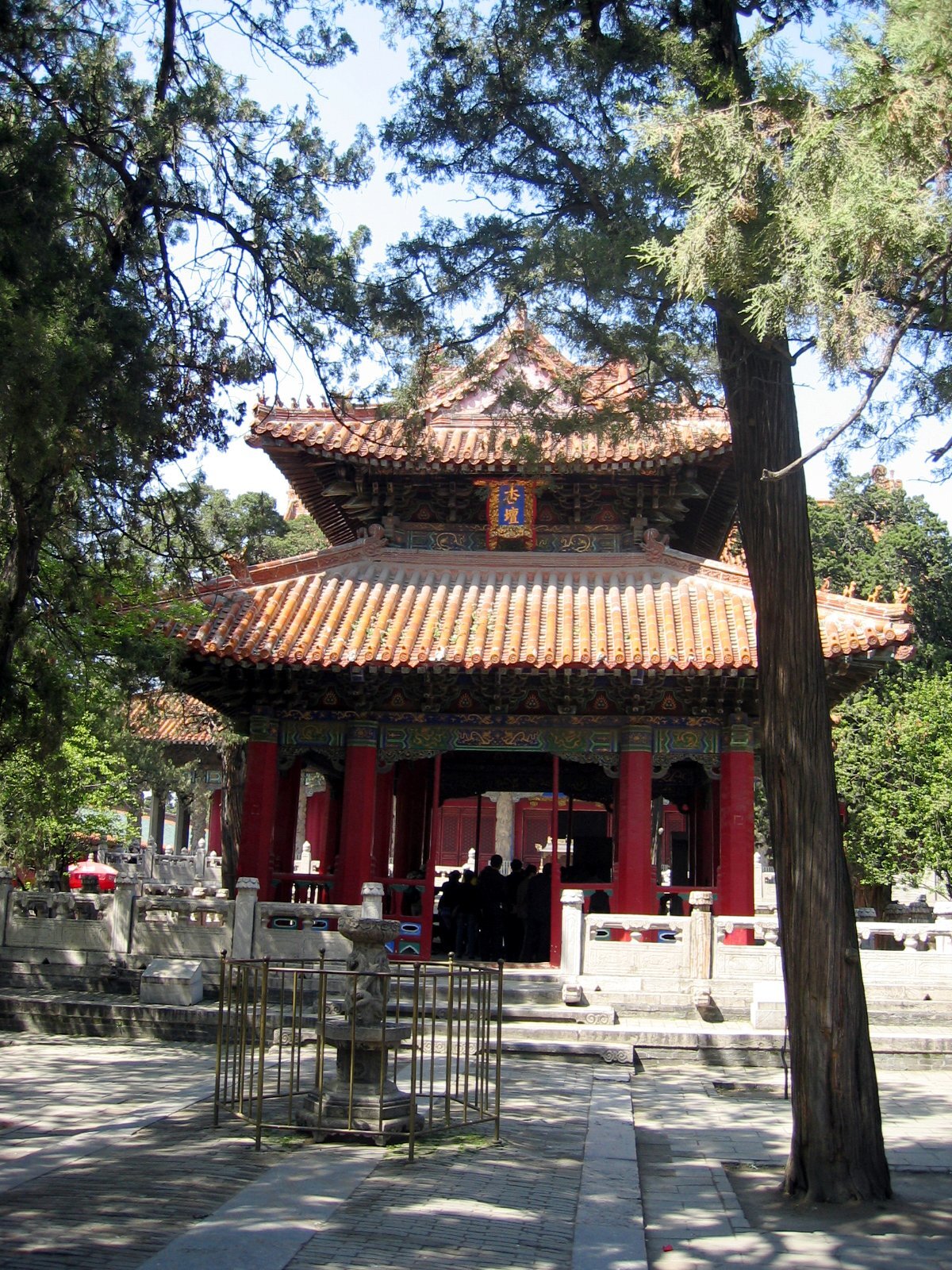
© Unknown, CC BY-SA 3.0 Resized from original. (This derivative is under the same CC BY-SA license.)
World Heritage Research
Discover scientific research and academic studies that deepen our understanding of Temple and Cemetery of Confucius and the Kong Family Mansion in Qufu from its history and significance to its conservation, management, and contemporary challenges.
-
Qufu City and Confucian Architecture
Confucian architecture in Qufu, China, reflects the philosophical principle of Yin Yang balance and harmony, guiding its planning and design. The study examines Qufu, once the capital of the Lu state (1042–249 BCE), as a key example predating the Warring States period (475–221 BCE) that adheres to ancient Chinese city planning ideals outlined in the Record of Rites. The Temple of Confucius, along with the Kong Family Mansion and Cemetery—mostly dating from the Ming (1368–1644) and Qing (1644–1911) dynasties—serves as a UNESCO World Heritage Site since 1994. This research explores how these sites embody Confucian philosophy, particularly through architectural harmony, while also analyzing four modern Confucius-related structures: the Confucius Research Institute, Cultural Park, Six Arts City, and Museum.
Zhang, D. (2025). Qufu City and Confucian Architecture. Athens Journal of Architecture, 12(1), 69–112. https://doi.org/10.30958/aja.12-1-4
View Publication Record | Read Publication -
The Cultural Significance of Construction and International Communication Reflection of San Kong in Qufu, Confucius’ Hometown
Confucius, ranked as the top global cultural figure by UNESCO in 1956, remains a pivotal symbol of Chinese thought and philosophy. The Temple and Cemetery of Confucius and the Kong Family Mansion in Qufu, his hometown, serve as critical material carriers of these traditions. Despite notable achievements in international communication, there is an urgent need for enhanced efforts to promote global understanding of 'San Kong'—the three key Confucian sites—in Qufu. This study highlights the far-reaching cultural significance of these sites and advocates for strategic measures to strengthen their global recognition amid ongoing globalization.
(Ed.). (2021). The Cultural Significance of Construction and International Communication Reflection of San Kong in Qufu, Confucius’ Hometown. Journal of Social Science and Humanities, 4(1), 6–11. https://doi.org/10.26666/rmp.jssh.2021.1.2
View Publication Record | Read Publication -
Conversations with Confucius (551–479 BCE)
A UNESCO World Heritage Site since 1994, the Temple and Cemetery of Confucius and the Kong Family Mansion in Qufu, Shandong Province, China, stands as a testament to the enduring legacy of Confucian thought. This study revisits the historic site, contrasting its serene present with its tumultuous past, particularly during the Cultural Revolution when efforts were made to desecrate Confucius' memory. The research delves into the significance of this site, not only as a cultural and historical landmark but also as a repository of political thought that has influenced Chinese society for millennia. By exploring the architectural and spiritual dimensions of the temple complex, the study sheds light on its role in preserving and disseminating Confucian values.
Yeophantong, P. (2016). Conversations with Confucius (551–479 BCE). The Return of the Theorists, 13–21. https://doi.org/10.1057/9781137516459_3
View Publication Record | Read Publication